

Question 1. Two godowns A and B have gain capacity of 100 quintals and 50 quintals respectively. They supply to 3 ration shops D, E and F whose requirements are 60, 50 and 40 quintals respectively. The cost of transportation per quintal from the godowns to the shops are given in the following table:
| Transportation cost per quintal (in Rs) | ||
|---|---|---|
From/ To | A | B |
D | 6 | 4 |
E | 3 | 2 |
F | 2.50 | 3 |
How should the supplies be transported in order that the transportation cost is minimum? what is the minimum cost?
Solution:
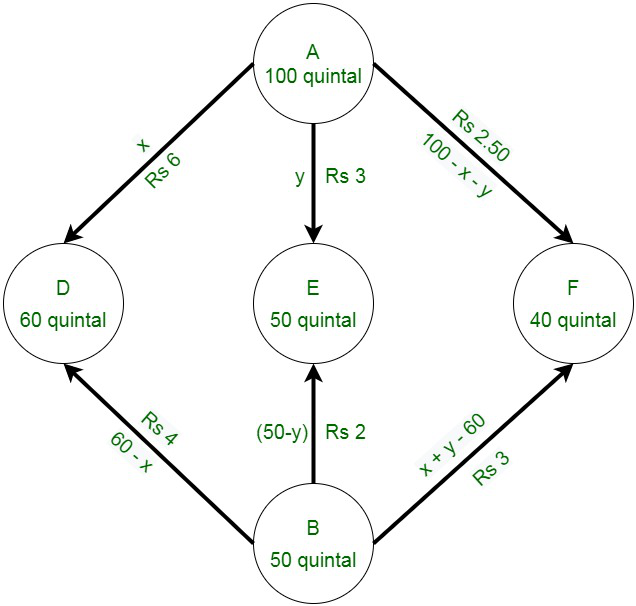
Let us assume godown A supply x and y quintals of grain to the shops D and E.
Afterwards, (100 – x – y) will be supplied to shop F.
The requirement at shop D is 60 quintals
Since, x quintals are transported from godown A.
Therefore, the remaining (60 − x) quintals will be transported from godown B.
Similarly,
(50 − y) quintals and 40 − (100 − x − y) i.e. (x + y − 60) quintals will be transported from godown B to shop E and F respectively.
The diagrammatic representation of the given problem:
x ≥ 0 , y ≥ 0 and 100 – x – y ≥ 0
⇒ x ≥ 0 , y ≥ 0 , and x + y ≤ 100
60 – x ≥ 0 , 50 – y ≥ 0 , and x + y – 60 ≥ 0
⇒ x ≤ 60 , y ≤ 50 , and x + y ≥ 60
Total transportation cost Z is given by,
Z = 6x + 3y + 2.5(100 – x – y) + 4(60 – x) + 2(50 – y) + 3( x + y – 60)
= 6x + 3y + 250 – 2.5x – 2.5y + 240 – 4x + 100 – 2y + 3x + 3y – 180
= 2.5x + 1.5y + 410
Thus, the required mathematical formulation of linear programming is:
Minimize Z = 2.5x + 1.5y + 410
subject to the constraints,
x + y ≤ 100
x ≤ 60
y ≤ 50
x + y ≥ 60
x, y ≥ 0
The feasible region obtained by the system of constraints is:
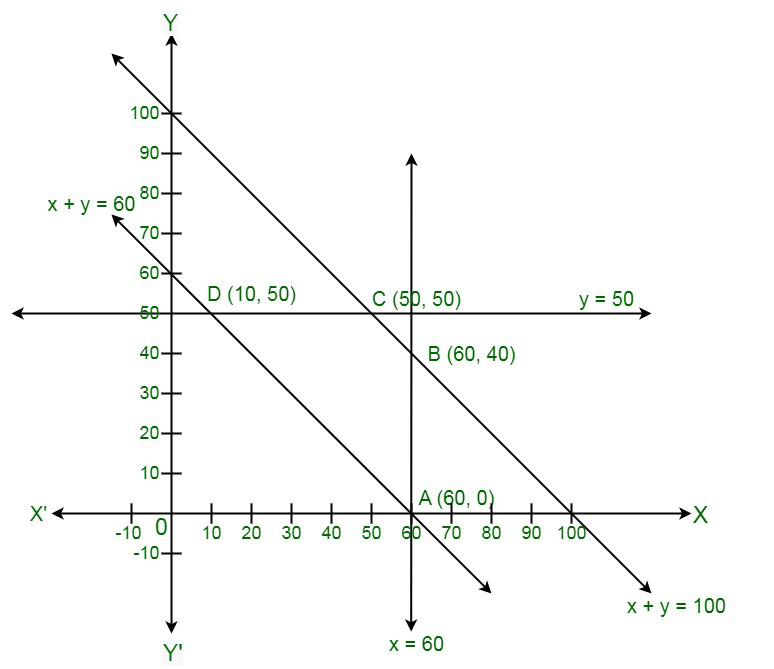
The corner points are A(60, 0), B(60, 40), C(50, 50), and D(10, 50).
The values of Z at these corner points are given below.
Corner point Z = 2.5x + 1.5y + 410 A (60, 0) 560 B (60, 40) 620 C (50, 50) 610 D (10, 50) 510 -> minimum Therefore,
The minimum value of Z is 510 at D (10, 50).
Hence, the amount of grain transported from A to D, E, and F is 10 quintals, 50 quintals, and 40 quintals respectively.
From B to D, E, and F is 50 quintals, 0 quintals, and 0 quintals respectively.
The minimum cost is Rs 510.
Question 2. A medical company has factories at two places, A and B. From these places, supply is made to each of its three agencies situated at P, Q and R. The monthly requirements of the agencies are respectively 40, 40 and 50 packets of the medicines, while the production capacity of the factories, A and B are 60 and 70 packets respectively. The transportation cost per packet from the factories to the agencies are given below:
| Transportation cost per packet (in Rs) | ||
To\From | A | B |
P | 5 | 4 |
Q | 4 | 2 |
R | 3 | 5 |
How many packets from each factory be transported to each agency so that the cost of transportation is minimum? Also, find the minimum cost?
Solution:
The diagrammatic representation of the given problem:
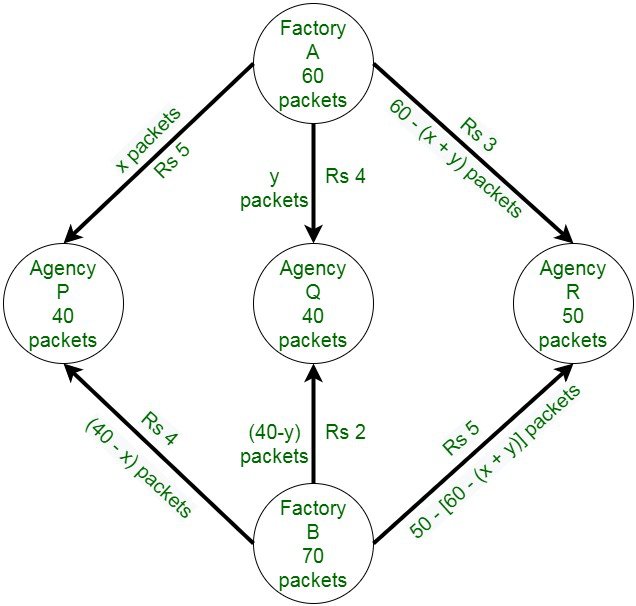
Assume x and y packets be transported from factory A to the agencies P and Q respectively.
After that,
[60 − (x + y)] packets be transported to the agency R.
First constraint ⇢ x, y ≥ 0 and
Second constraint ⇢ 60 − (x + y) ≥ 0
(x + y) ≤ 60
The requirement at agency P is 40 packets.
Since, x packets are transported from factory A,
Therefore, the remaining (40 − x) packets are transported from factory B.
Similarly,
(40 − y) packets are transported by B to Q and 50− [60 − (x + y)]
i.e. (x + y − 10) packets will be transported from factory B to agency R respectively.
Number of packets cannot be negative.
Hence,
Third constraint ⇢ 40 – x ≥ 0
=> x ≤ 40
Fourth constraint ⇢ 40 – y ≥ 0
=> y ≤ 40
Fifth constraint ⇢ x + y – 10 ≥ 0
=> x + y ≥ 10
Thus,
Costs of transportation of each packet from factory A to agency P, Q, R are Rs 5, 4, 3.
Costs of transportation of each packet from factory B to agency P, Q, R are Rs 4, 2, 5.
Let total cost of transportation be Z.
Z = 5x + 4y + 3[60 – x + y] + 4(40 – x) + 2(40 – y) + 5(x + y – 10]
= 3x + 4y + 10
Hence,
The required mathematical formulation of linear programming is:
Minimize Z = 3x + 4y + 370
subject to constraints,
x + y ≤ 60
x ≤ 40
y ≤ 40
x + y ≥ 10
where, x, y ≥ 0
Let us convert inequations into equations as follows:
x + y = 60, x = 40, y = 40, x + y = 10, x = 0 and y = 0
Region represented by x + y ≤ 60:
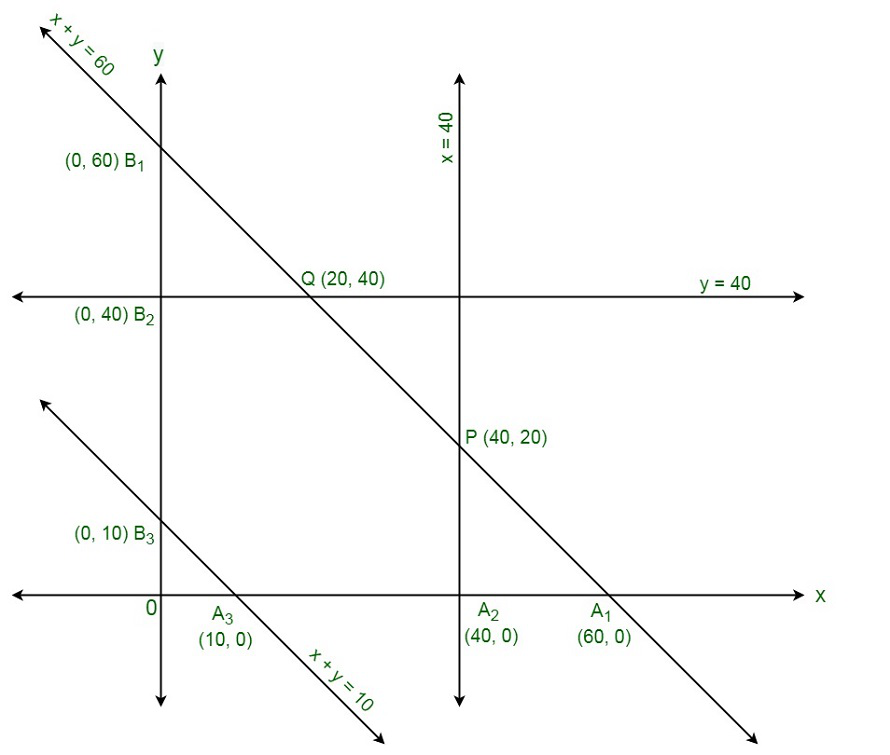
The line x + y = 60 meets the coordinate axes at A1 (60, 0) and B1 (0, 60) respectively.
Region containing origin represents x + y ≤ 60 as (0, 0) satisfies x + y ≤ 60.
Region represented by x ≤ 40:
The line x = 40 is parallel to y-axis, meets x-axis at A2 (40, 0). Region containing origin represents x ≤ 40 as (0, 0) satisfies x ≤ 40.
Region represented by y ≤ 40:
The line y = 40 is parallel to x-axis, meets y-axis at B2 (0, 40).
Region containing origin represents y ≤ 40 as (0, 0) satisfies y ≤ 40.
Region represented by x + y ≥ 10:
The line x + y = 10 meets the coordinate axes at A2 (10, 0) and B3 (0, 10) respectively.
Region not containing origin represents x + y ≥ 10 as (0, 0) does not satisfy x + y ≥ 10.
Shaded region A3 A2 P Q B2 B3 represents feasible region.
Point P(40, 20) is obtained by solving x = 40 and x + y = 60
Point Q(20, 40) is obtained by solving y = 40 and x + y = 60
The value of Z = 3x + 4y + 370 at
A3(10, 0) = 3(10) + 4(0) + 370 = 400
A2(40, 0) = 3(40) + 4(0) + 370 = 490
P(40, 20) = 3(40) + 4(20) + 370 = 570
Q(20, 40) = 3(20) + 4(40) + 370 = 590
B2(0, 40) = 3(0) + 4(40) + 370 = 530
B3(0, 10) = 3(0) + 4(10) + 370 = 410
Hence, minimum value of Z = 400 at x = 10, y = 0
So,
From A -> P = 10 packets
From A -> Q = 0 packets
From A -> R = 50 packets
From B -> P = 30 packets
From B -> Q = 40 packets
From B -> R = 0 packets
Therefore, minimum cost = Rs 400
