

Consecutive interior angles are two angles that lie between two lines and on the same side of a transversal. When the two lines are parallel, the sum of each pair of consecutive interior angles is 180°.
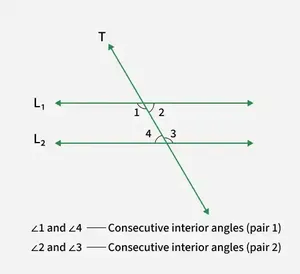
In the figure given above, L₁ and L₂ are parallel lines, and T is the transversal. The pairs of consecutive interior angles are:
- ∠1 and ∠4
- ∠2 and ∠3
Angles Formed by a Transversal
When a transversal intersects two parallel lines, several pairs of angles are formed, including corresponding angles, alternate interior angles, alternate exterior angles, and consecutive interior angles.
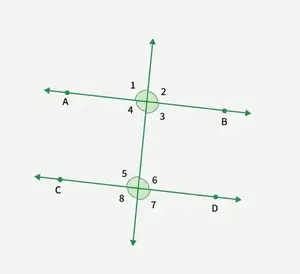
The figure shows the different pairs of angles and their properties.
| Type of Angles | Property | Angle Pairs in the Figure |
|---|---|---|
| Corresponding Angles | Corresponding angles lie in the same relative position at each intersection. When the lines are parallel, they are equal. | ∠1 and ∠5, ∠2 and ∠6, ∠3 and ∠7, ∠4 and ∠8 |
| Alternate Interior Angles | These angles lie between the two lines and on opposite sides of the transversal. When the lines are parallel, they are equal. | ∠4 and ∠6, ∠3 and ∠5 |
| Alternate Exterior Angles | These angles lie outside the two lines and on opposite sides of the transversal. When the lines are parallel, they are equal. | ∠1 and ∠7, ∠2 and ∠8 |
| Consecutive Interior Angles | These angles lie between the two lines and on the same side of the transversal. When the lines are parallel, their sum is 180°. | ∠4 and ∠5, ∠3 and ∠6 |
Consecutive Interior Angle Theorem
The Consecutive Interior Angle Theorem states that when a transversal intersects two parallel lines, each pair of consecutive interior angles is supplementary. Therefore, the sum of each pair of consecutive interior angles is 180°.
Proof
To understand the Consecutive Interior Angle Theorem, look at the illustration below.
It is assumed that n and m are parallel, and o is the transversal.
∠2 = ∠6 (corresponding angles) . . . (i)
∠2 + ∠4 = 180° (Supplementary linear pair of angles) . . . (ii)
Substituting ∠2 for ∠6 in Equation (ii) yields
∠6 + ∠4 = 180°
Similarly, we may demonstrate that ∠3 + ∠5 = 180°.
∠1 = ∠5 (corresponding angles) . . . (iii)
∠1 + ∠3 = 180° (Supplementary linear pair of angles) . . . (iv)
When we substitute ∠1 for ∠5 in Equation (iv), we obtain
∠5 + ∠3 = 180°
As may be seen, ∠4 + ∠6 = 180°, and ∠3 + ∠5 = 180°
As a result, it is demonstrated that consecutive interior angles are supplementary.

Converse of Consecutive Interior Angle Theorem
The converse of the consecutive interior angle theorem states that if a transversal intersects two lines and a pair of consecutive interior angles is supplementary, then the two lines are parallel.
Proof
Using the same illustration:
∠6 + ∠4 = 180° (Consecutive Interior Angles) . . . (i)
Because ∠2 and ∠4 make a straight line,
∠2 + ∠4 = 180° (Supplementary linear pair of angles) . . . (ii)
Because the right sides of Equations (i) and (ii) are identical, we may equate the left sides of equations (i) and (ii) and express it as:
∠2 + ∠4 = ∠6 + ∠4
Subtracting ∠4 from both sides: ∠2 = ∠6
Since ∠2 and ∠6 are corresponding angles and are equal, the two lines are parallel.
Thus, if a pair of consecutive interior angles is supplementary, the two lines intersected by the transversal are parallel.
Consecutive Interior Angles of a Parallelogram
The opposite sides of a parallelogram are parallel. Therefore, each pair of consecutive interior angles is supplementary, meaning their sum is 180°.
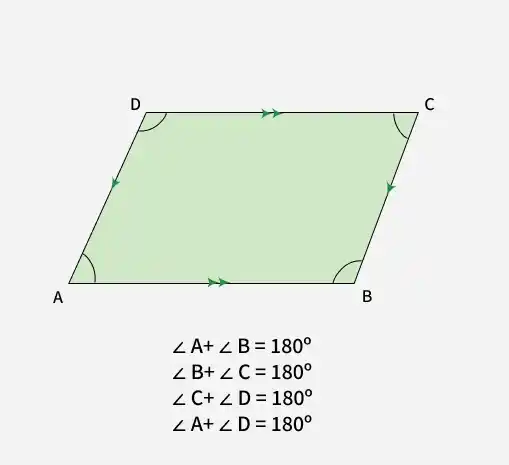
In the parallelogram shown above, the consecutive interior angle pairs are ∠A and ∠B, ∠B and ∠C, ∠C and ∠D, and ∠D and ∠A.
Therefore:
- ∠A + ∠B = 180°
- ∠B + ∠C = 180°
- ∠C + ∠D = 180°
- ∠D + ∠A = 180°
➢Practice: Solved Examples
