

Direct and inverse proportions describe how two quantities change in relation to each other.
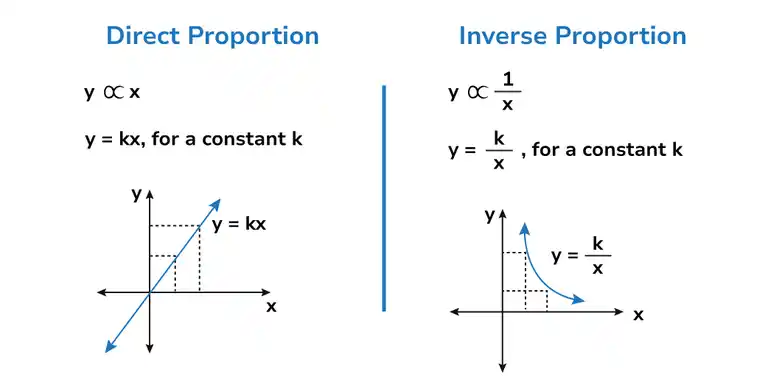
Direct Proportion
If x and y are any two quantities such that both of them increase or decrease together
- As one quantity increases, the other also increases.
- As one quantity decreases, the other also decreases.
- The ratio of the two quantities remains constant.
Formula:
x ∝ y
(x/y) = k ⇒ x = kyWhere, k is constant of proportion.
Similarly, if y1 and y2 are the values of y corresponding to the values of x1 and x2 of x respectively, then
\bold{\frac{x_1}{y_1} = \frac{x_2}{y_2} = k}
OR\bold{x_1y_2 = x_2 y_1 = \text{Constant}}
Example: On the occasion of the School Anniversary, the Head Master of the school decided to take up a plantation of saplings. The number of students in each class is given below in the form of a table. Each student has to plant two saplings.
Class | VI | VII | VIII | IX | X |
|---|---|---|---|---|---|
Number of Students | 7 | 10 | 11 | 14 | 17 |
Number of Saplings required | 14 | 20 | 22 | 28 | 34 |
What can you say regarding the number of saplings required?
Here you clearly observe that the number of saplings is directly proportional to the number of students.
Inverse Proportion
Two quantities are in inverse proportion if one increases while the other decreases in such a way that their product remains constant.
- As one quantity increases, the other decreases.
- As one quantity decreases, the other increases.
Formula:
If x and y are in inverse proportion, then x ∝ (1 / y)
x = k/y ⇒ xy = k
Where, k is the constant of proportionality.
For two cases of each variable, let's consider y1 and y2 are the values of y corresponding to the values of x1 and x2 of x respectively then
\bold{x_1y_1 = k = x_2 y_2}
OR\bold{\frac{x_1}{x_2} = \frac{y_1}{y_2}}
Example: A Parcel company has a certain number of parcels to deliver. If the company engages 36 persons, it takes 12 days. If there are only 18 people, it will take 24 days to finish the task. You see as the number of persons is the halved time taken is doubled if the company engages 72 people, will the time taken be half?
Number of Persons | 36 | 18 | 9 | 72 | 108 |
|---|---|---|---|---|---|
Time Taken | 12 | 24 | 48 | 6 | 4 |
How many persons shall a company engage if it wants to deliver the parcels within a day?
\bold{\text{ Number of days required } \propto \frac{1}{\text{Numbers of persons engaged}} }
The key difference between direct and Inverse Proportions is as follows:
Property | Direct Proportion | Inverse Proportion |
|---|---|---|
| Relationship | When two variables change in the same direction | When two variables change in opposite directions |
| Formula | y = kx (where k is a constant) | y = k/x (where k is a constant) |
| Graph | A straight line passes through the origin (0,0) | A hyperbola |
| Example | The more hours you work, the more money you earn | The more people sharing a pizza, the smaller the slice each person gets |
| Symbol | ∝ (proportional to) E.g. a ∝ b | ∝ (inversely proportional to) E.g. a ∝ 1/b |
| Equation | y = kx | xy = k |
Note: In direct proportion, as one variable increases, the other variable increases proportionally. In inverse proportion, as one variable increases, the other variable decreases proportionally.
➢Practice: Solved Examples
