

A quadratic inequality is an inequality that contains a quadratic expression. Unlike quadratic equations, which use an equals sign (=), quadratic inequalities use inequality symbols such as: >,<,≥,≤
A quadratic inequality has the general form:
- ax2 + bx + c > 0
- ax2 + bx + c < 0
- ax2 + bx + c ≥ 0
- ax2 + bx + c ≤ 0
where a, b, and c are constants with a ≠ 0.
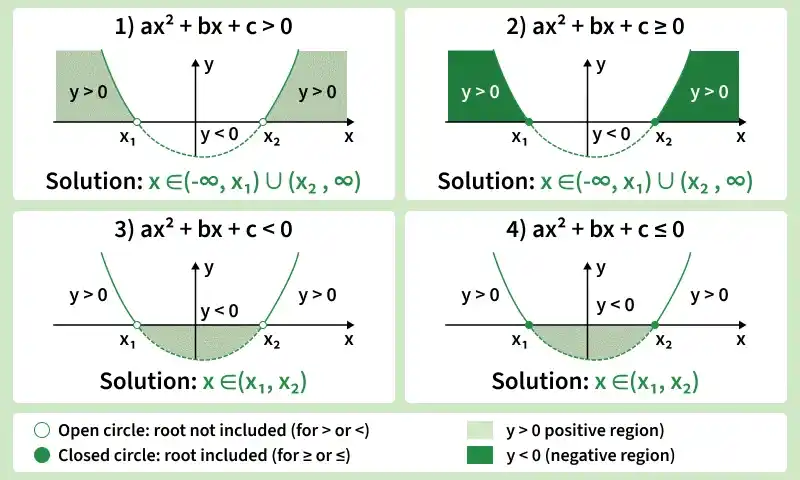
Solving Quadratic Inequalities
Steps to solve a quadratic inequality include:
Step 1: Rewrite Inequality
Rewrite the inequality in standard form so that one side is zero.
ax2 + bx + c (inequality sign) 0
Step 2: Solve Corresponding Quadratic Equation
Solve the equation ax2 + bx + c = 0 to find the roots. The roots (or solutions) can be found using the quadratic formula:
These roots divide the number line into intervals that you will test to determine the sign of the quadratic expression in each interval.
Step 3: Determine Intervals
Use the roots to divide the number line into intervals. These intervals will help determine where the quadratic expression is positive or negative.
- (−∞ , x1)
- (x1 , x2)
- (x2 , ∞)
Step 4: Test Intervals
Pick a test point from each interval and substitute it into the quadratic expression to see if it satisfies the inequality.
Step 5: Write Solution
Based on the results of the test points, write the solution in interval notation (i.e., ≥ or ≤).
Sign of a Quadratic Expression(Trick)
For a quadratic expression with two distinct roots:
- If a>0, the expression is positive outside the roots and negative between them.
- If a<0, the expression is negative outside the roots and positive between them.
This shortcut often avoids testing multiple points.
Solved Examples
Example 1: Solve the quadratic inequality x2 - 5x + 6 > 0.
Step 1: Rewrite the Inequality
Inequality is already in standard form: x2 - 5x + 6 > 0
Step 2: Solve the Corresponding Quadratic equation
x2 - 5x + 6 = 0
(x - 2)(x - 3) = 0
Roots are x = 2 and x = 3.
Step 3: Determine Intervals
Roots divide the number line into three intervals: (-∞, 2) , (2, 3) and (3, ∞)
Step 4: Test Intervals
For (-∞, 2), pick a test point x = 0
02 -5(0) + 6 = 6 > 0 (True)
For (-∞, 2), pick a test point x = 2.5
(2.5)2 -5(2.5) + 6 = -0.25 < 0 (False)
For (-∞,2), pick a test point x = 4
42 -5(4) + 6 = 2 > 0 (True)
Step 5: Write the Solution
Quadratic expression x2 - 5x + 6 is greater than zero in the interval (-∞, 2) and (3, ∞)
Therefore the solution is x ∈ (-∞,2) ∪ (3,∞)
Example 2: Solve the quadratic inequality x2 - 7x + 6 ≥ 0.
Step 1: Rewrite the Inequality
Inequality is already in standard form: x2 - 7x + 6 ≥ 0
Step 2: Solve the Corresponding Quadratic equation
x2 - 7x + 6 = 0
(x - 2)(x - 5) = 0
Roots are x = 2 and x = 5.
Step 3: Determine Intervals
Roots divide the number line into three intervals: (-∞, 2) , (2, 5) and (5, ∞)
Step 4: Test the Intervals
For (-∞,2), pick a test point x = 0
02 -7(0) + 10 = 10 > 0 (True)
For (2,5), pick a test point x = 3
32 -7(3) + 10 = -2 < 0 (False)
For (5,∞), pick a test point x = 6
62 -7(6) + 10 = 2 > 0 (True)
Step 5: Write the Solution
Quadratic expression x2 - 7x + 6 = 0. is greater than zero in the interval (-∞, 2] and [5, ∞)
Therefore the solution is x ∈ (-∞, 2] ∪ [5, ∞)
Practice Questions
Questions 1. Solve the quadratic inequality x2 - 4x + 3 > 0.
Questions 2. Solve the quadratic inequality x2 + 2x - 8 < 0.
Questions 3. Solve the quadratic inequality x2 - 3x + 2 ≤ 0.
Questions 4. Solve the quadratic inequality x2 - x -12 ≥ 0.
Questions 5. Solve the quadratic inequality 2x2 - 8x + 6 < 0.
