

A quadratic equation is a polynomial equation of degree 2 in one variable.
- It can have two real roots, one repeated real root, or two complex roots.
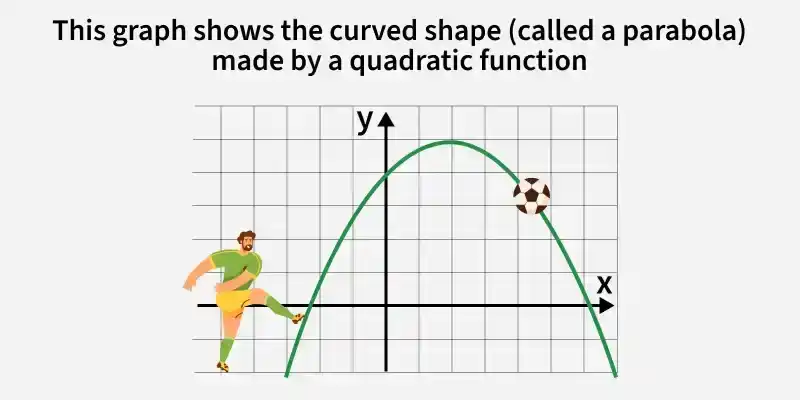
- Its graph is a parabola, which opens upward if a>0 and downward if a<0.
5x2 + x + 2 = 0, x2 = 2x + 3 and 2x2 = 0 are all examples of quadratic equations.
The following is a real-life example:
Standard Form
The standard form of a quadratic equation is:
ax2 + bx + c = 0
Where a, b, and c are constants, x is the variable, and a ≠ 0.
The values of x that satisfy the equation are called the roots (or solutions) of the quadratic equation
Example: For the equation: 2x2 + 5x − 3 = 0
- Coefficient of x2: a = 2
- Coefficient of x: b = 5
- Constant term: c = −3
Discriminant
Before solving, you can predict what kind of roots an equation has just by looking at b2 − 4ac, called the discriminant:
| Discriminant (b2−4ac) | Roots |
|---|---|
| Positive, perfect square | Two distinct rational real roots |
| Positive, not a perfect square | Two distinct irrational real roots |
| Zero | One repeated real root |
| Negative | Two complex (non-real) roots |
Quadratic Formula
A method used to find the roots of a quadratic equation, especially when the equation cannot be easily factored. For a quadratic equation of the form ax² + bx + c = 0, the roots are given by:
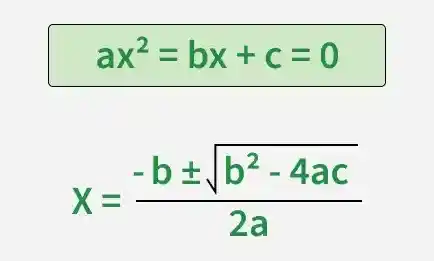
The ± sign gives the two possible roots of the equation. This formula is also known as the Sridharacharya formula.
Example: Find the roots of the quadratic equation x² − 3x − 4 = 0 using the quadratic formula.
Solution:
Here, a = 1 ,b = −3 and c = −4
Using the quadratic formula:
x = \frac{-b \pm \sqrt{b^2 - 4ac}}{2a} Substitute the values:
x = \frac{-(-3) \pm \sqrt{(-3)^2 - 4(1)(-4)}}{2(1)}
x = \frac{3 \pm \sqrt{9 + 16}}{2}
x = \frac{3 \pm \sqrt{25}}{2} = (3 + 5) / 2 or (3 − 5) / 2
= 8/2 or −2/2
x = 4 or x = −1
Therefore, the roots of the equation are 4 and −1.
Methods to Solve Quadratic Equations
Quadratic equations can be solved using several other methods:
- Factorization: Expresses the equation as a product of two linear factors, each set to zero to find the roots. Quick, but only works when the equation factors easily.
- Completing the square: Rearrange the equation into the form (x−h)2 = k to find the roots. Used to derive the quadratic formula and to find a parabola's vertex.
➢Practice: Solved Examples
