

A derivative measures the rate at which a function changes with respect to a variable. It represents the slope of the tangent to the curve at a given point. In some cases, the behavior of a function may differ on either side of a point. To study such situations, we use the concepts of Left Hand Derivative (LHD) and Right Hand Derivative (RHD).
For a function f(x), the derivative is denoted by
{f'(x)=\frac{d}{dx}[f(x)]=\lim\limits_{h\rightarrow 0}\frac{f(x+h)-f(x)}{h}}
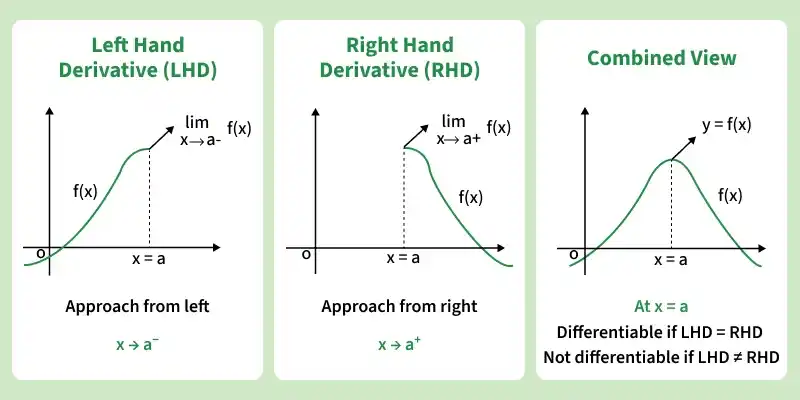
One-Sided Derivative
One-sided derivatives are derivatives calculated by approaching a point from only one side.
- The derivative obtained by approaching from the left side is called the Left Hand Derivative (LHD).
- The derivative obtained by approaching from the right side is called the Right Hand Derivative (RHD).
If both derivatives exist and are equal, the function is differentiable at that point.
Left Hand Derivative (LHD)
The Left Hand Derivative of a function f(x) at x=a is defined as:
LHD = \lim\limits_{h \to 0^-}\frac{f(a+h)-f(a)}{h}
Here, h approaches zero through negative values.
The Left Hand Derivative represents the slope of the tangent line obtained by approaching the point from the left side of the graph.
Right-Hand Derivative(RHD)
The Right Hand Derivative of a function f(x) at x=a is defined as:
RHD = \lim\limits_{h \to 0^+}\frac{f(a+h)-f(a)}{h}
Here, h approaches zero through positive values.
The Right Hand Derivative represents the slope of the tangent line obtained by approaching the point from the right side of the graph.
Condition for Differentiability
A function f(x) is differentiable at x=a if:
\lim\limits_{h \to 0^-}\frac{f(a+h)-f(a)}{h} = \lim\limits_{h \to 0^+}\frac{f(a+h)-f(a)}{h}
That is, LHD = RHD
If these limits are unequal, the function is not differentiable at that point.
Solved Examples
Example 1: Verify whether f(x) = ∣x−2∣ is differentiable at x = 2 :
The given function can be written as:
f(x)= \begin{cases} -x+2 & x\le 2\\ x-2 & x>2 \end{cases} Left Hand Derivative: For x ≤ 2
f(x) = −x+2
At x = 2 , f(2) = 0 and f(2+h)= −(2+h)+2 = −h
Therefore,
\begin{aligned} f'(2^-) &=\lim_{h\to0^-}\frac{f(2+h)-f(2)}{h}\\ &=\lim_{h\to0^-}\frac{-h-0}{h}\\ &=\lim_{h\to0^-}(-1)\\ &=-1 \end{aligned} Right Hand Derivative: For x > 2, f(x) = x−2
At x=2, f(2)=0 and f(2+h) = 2+h−2 = h
Therefore,
\begin{aligned} f'(2^+) &=\lim_{h\to0^+}\frac{f(2+h)-f(2)}{h}\\ &=\lim_{h\to0^+}\frac{h-0}{h}\\ &=\lim_{h\to0^+}(1)\\ &=1 \end{aligned} Since f′(2−) ≠ f′(2+), the derivative does not exist at x=2.
Hence, f(x)=∣x−2∣ is not differentiable at x=2.
Example 2: Show that f'(-3) does not exists if, f(x)= |x+3|+1.
Write the given f(x) into piece wise function,
y=\begin{cases} -(x+3)+1=-x-3+1=-x-2\ , & x\leq -3\\ (x+3)+1=x+3+1=x+4 , & x > -3 \end {cases} For Left hand derivative,
y = f(x) = -x-2
At x=-3, f(-3) = -(-3) - 2 = 1, and f(-3+h) = -(-3)-h-2 = 3-h-2 = 1-h
Left hand derivative is,
\begin{aligned}f'(-3^-)=& \lim_{h \rightarrow 0^-}\frac{f(-3+h)-f(-3)}{h}\\\Rightarrow f'(-3^-)& =\lim_{h \rightarrow 0^-}\frac{1-h-1}{h}=\lim_{h \rightarrow 0^-}\frac{-h}{h}\\\Rightarrow f'(-3^-)& =\lim_{h \rightarrow 0^-}(-1)=-1\end{aligned} For Right hand derivative,
y = f(x) = x+4
At x = -3, f(-3) = -3+4 = 1, and
f(-3+h) = h+1
Right hand derivative is,
\begin{aligned}f'(-3^+)& =\lim_{h \rightarrow 0^+}\frac{f(-3+h)-f(-3)}{h}\\\Rightarrow f'(-3^+)& =\lim_{h \rightarrow 0^+}\frac{h+1-1}{h}=\lim_{h \rightarrow 0^+}\frac{h}{h}\\\Rightarrow f'(-3^+)& =\lim_{h \rightarrow 0^+}(1)=1\end{aligned} As Left hand derivative is not equal to right hand derivative,
So, the derivative of y at x=-3 Does not exist (or) y is not differentiable at x=-3.
Practice Problems
Problem 1: Verify the differentiability of f(x) = x2 at x = 1.
Problem 2: Show that f'(-1) does not exist, for,
Problem 3: Determine whether f(x) = ∣x∣ is differentiable at x=0.
Problem 4: Find LHD and RHD of f(x) = ∣2x+1∣ at x= -1/2.
