

Prime factorization is the process of expressing a number as a product of its prime factors.
Example: The prime factorization of 12 is 2 × 2 × 3.
Solved Examples
Example 1: What is the prime factorization of 80?
Solution:
To find the prime factorization of 80, we can start by dividing it by the smallest prime number, which is 2.
- 80 divided by 2 equals 40.
- 40 divided by 2 equals 20.
- 20 divided by 2 equals 10.
- 10 divided by 2 equals 5.
Now, since 5 is a prime number, we can stop dividing. Therefore, the prime factorization of 80 is: 2 × 2 × 2 × 2 × 5.
Example 2: Prime factorization of 120.
Solution:
Starting with the smallest prime number, which is 2.
- 120 divided by 2 equals 60.
- 60 divided by 2 equals 30.
- 30 divided by 2 equals 15.
- Now, since 15 is not divisible by 2, we move on to the next prime number (i.e, 3)
- 15 divided by 3 equals 5.
Now, since 5 is a prime number, we can stop dividing. Therefore, the prime factorization of 120 is: 2 × 2 × 2 × 3 × 5
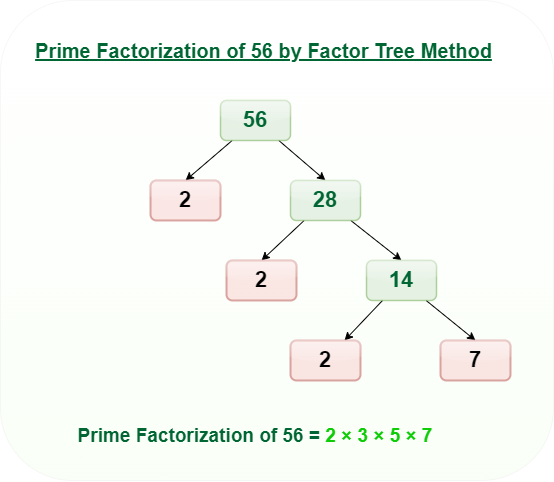
Example 3: What is the Factor Tree of 56?
Practice Questions
Question 1. Find the prime factorization of 36.
Question 2. Determine the prime factorization of 90.
Question 3. What is the prime factorization of 48?
Question 4. Find the prime factorization of 105.
Question 5. What is the prime factorization of 84?
Question 6. Determine the prime factorization of 100.
Question 7. Find the prime factorization of 2310.
Question 8. What is the prime factorization of 56?
Question 9. Determine the prime factorization of 150.
Question 10. What is the prime factorization of 1250?
