

A prime number is a natural number greater than 1 that has exactly two positive divisors: 1 and itself. Numbers that have more than two divisors are called composite numbers.
Prime numbers can be classified into different types based on their properties
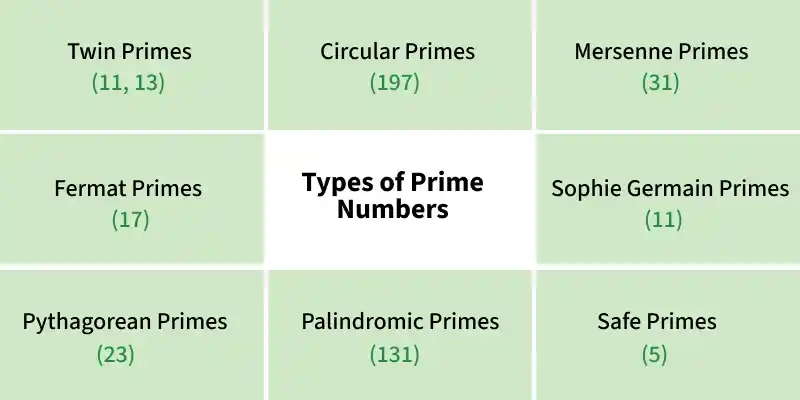
Not all primes are the same kind of "special." Mathematicians classify primes into several named categories based on patterns in how they're formed or how they relate to other numbers.
1. Twin Primes
Two primes that differ by exactly 2.
Examples: (3, 5), (5, 7), (11, 13), (17, 19), (29, 31), (41, 43)
Twin primes get rarer as numbers grow, but it's unknown whether infinitely many twin prime pairs exist; the Twin Prime Conjecture is one of the most famous unsolved problems in mathematics.
2. Mersenne Primes
Primes of the form 2ⁿ − 1, where n itself must be prime (though not every prime n gives a Mersenne prime).
Examples:
- 2² − 1 = 3
- 2³ − 1 = 7
- 2⁵ − 1 = 31
- 2⁷ − 1 = 127
Mersenne primes are the easiest type of very large prime to test using specialized algorithms (the Lucas–Lehmer test), which is why nearly every record-holding "largest known prime" — including the current record, (2136,279,841 − 1) is a Mersenne prime, found through the distributed computing project GIMPS.
3. Fermat Primes
Primes of the form 2(2ⁿ) + 1.
Examples:
- n = 0: 2¹ + 1 = 3
- n = 1: 2² + 1 = 5
- n = 2: 2⁴ + 1 = 17
- n = 3: 2⁸ + 1 = 257
- n = 4: 2¹⁶ + 1 = 65,537
Only five Fermat primes are known (3, 5, 17, 257, 65,537), and it's suspected, though unproven that no more exist.
4. Sophie Germain Primes
A prime p where 2p + 1 is also prime.
Examples:
- p = 2 → 2(2) + 1 = 5 (prime)
- p = 3 → 2(3) + 1 = 7 (prime)
- p = 5 → 2(5) + 1 = 11 (prime)
- p = 11 → 2(11) + 1 = 23 (prime)
Named after French mathematician Sophie Germain, these primes are used in cryptography and in tests related to Fermat's Last Theorem.
5. Safe Primes
A prime q of the form q = 2p + 1, where p is also prime. (This is the flip side of a Sophie Germain prime — if p is a Sophie Germain prime, then q = 2p + 1 is a safe prime.)
Example: p = 11 is a Sophie Germain prime, so q = 23 is a safe prime.
Safe primes are widely used in cryptographic systems (like Diffie–Hellman key exchange) because they help avoid certain algorithmic attacks.
6. Palindromic Primes
A prime number that reads the same forwards and backwards.
Examples: 2, 3, 5, 7, 11, 101, 131, 151, 181, 191, 313, 353
Except for 11, all palindromic primes with an even number of digits are automatically ruled out, any palindrome with an even digit count is divisible by 11, so it can't be prime.
7. Circular Primes
A prime number where every rotation of its digits is also prime.
Examples:
- 197 → rotations are 197, 971, 719 — all prime
- 1193 → rotations are 1193, 1931, 9311, 3119 — all prime
Single-digit primes (2, 3, 5, 7) are trivially circular primes since they have only one "rotation."
8. Pythagorean Primes
A prime of the form 4n + 1, which means it can always be written as the sum of two perfect squares is an Pythagorean Prime.
Examples:
- 5 = 4(1) + 1 = 1² + 2²
- 13 = 4(3) + 1 = 2² + 3²
- 17 = 4(4) + 1 = 1² + 4²
