

Machine Translation (MT) is the use of Artificial Intelligence (AI) and Natural Language Processing (NLP) to automatically translate text or speech from one language to another. It enables fast and scalable translation across different languages without requiring manual translation for every sentence.
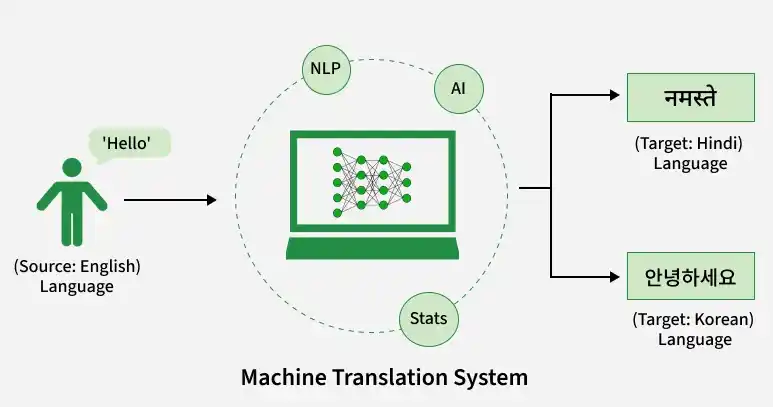
Modern systems primarily use Neural Machine Translation (NMT), which learns linguistic patterns and context from large amounts of multilingual data.
Working
- Input: The system receives text or speech in the source language.
- Preprocessing: The input is cleaned and divided into smaller units such as tokens.
- Encoding: A neural model represents the source sentence in a form that captures its meaning and context.
- Translation: The model generates the corresponding text in the target language.
- Decoding: The system selects the most suitable sequence of target-language tokens.
- Output: The generated translation is presented to the user.
In modern Transformer-based systems, attention mechanisms help the model focus on relevant parts of the source sentence while generating each part of the translation.
Methods
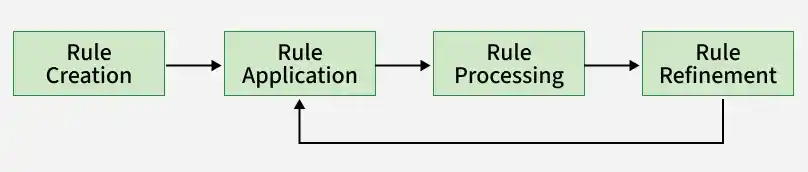
1. Rule-Based Machine Translation
Rule-Based Machine Translation (RBMT) uses manually created grammar rules, bilingual dictionaries and linguistic information to translate text. The system analyzes the structure of the source sentence and applies predefined rules to generate the target-language sentence.
Common techniques: Grammar rules, bilingual dictionaries, morphological analysis and transfer rules.
2. Statistical Machine Translation
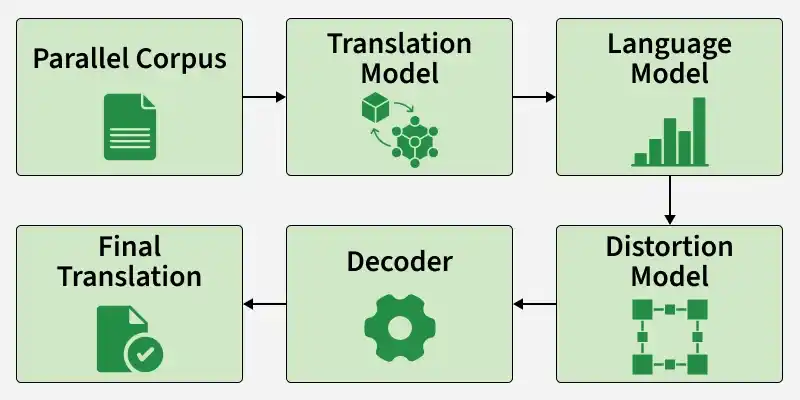
Statistical Machine Translation (SMT) uses statistical models trained on large collections of translated text, called parallel corpora. Instead of relying mainly on manually written rules, the system estimates the probability of different translations and selects the most likely output.
Common models and techniques: IBM translation models, language models and phrase-based translation models.
3. Neural Machine Translation (NMT)
Neural Machine Translation (NMT) uses deep neural networks to learn translation patterns from multilingual data and generate translations based on the context of the source sentence. Unlike traditional approaches that rely heavily on explicit rules or statistical probabilities, NMT learns translation representations directly from training data.
Common models and architectures include:
- RNN: Processes the input sequence step by step and was used in early neural translation systems.
- LSTM: An RNN variant designed to better handle long-range dependencies in sentences.
- GRU: A simpler recurrent architecture that can also model sequential dependencies.
- Encoder-Decoder: Uses one neural network to encode the source sentence and another to generate the target sentence.
- Attention: Allows the decoder to focus on relevant parts of the source sentence during translation.
- Transformer: Uses self-attention to model relationships between tokens and is the dominant architecture in many modern NMT systems.
Modern NMT systems commonly use Transformer-based architectures because they can capture long-range relationships efficiently and process sequences in parallel during training.
4. Transformer-Based Machine Translation
Transformer-based machine translation uses the Transformer architecture, which relies on self-attention to understand relationships between words and generate translations based on context.
- Self-Attention: Captures relationships between words across the sentence.
- Parallel Processing: Processes input sequences efficiently during training.
- Context-Aware Translation: Uses broader sentence context to generate more accurate translations
Evaluation
Machine translation systems can be evaluated using both automatic metrics and human evaluation. Common evaluation methods include:
- BLEU: Measures the similarity between a machine-generated translation and reference translations.
- ROUGE: Compares generated and reference text based on overlapping sequences.
- METEOR: Considers word matches and linguistic variations such as stemming and synonyms.
- Human Evaluation: Human reviewers assess factors such as fluency, accuracy and meaning.
No single metric completely captures translation quality, so multiple evaluation methods may be used.
Application
- Website and App Localization: Translating websites, applications and digital content for users in different regions.
- Business Communication: Translating emails, documents, product information and other business content.
- Travel and Communication: Supporting communication between people who speak different languages.
- Education: Translating learning materials and helping students understand content in other languages.
- Customer Support: Providing multilingual chatbots and support services.
- Media and Entertainment: Translating subtitles, captions and other digital content.
Advantages
- Fast: Can translate large amounts of content within a short time.
- Scalable: Can handle large volumes of content across multiple languages.
- Consistent: Applies the same translation patterns across repeated content.
- Available 24/7: Can provide translation whenever needed.
- Cost-effective: Reduces the cost of translating large volumes of routine content.
Limitations
- Context errors: A word or phrase may have different meanings depending on its context.
- Cultural differences: Idioms, humor and cultural references may not translate correctly.
- Limited data for some languages: Systems may perform poorly when sufficient training data is unavailable.
- Domain-specific errors: Medical, legal and technical content may require specialized knowledge and human review.
- Lack of human judgment: Machines may not fully understand tone, intention or cultural nuances.
Can Human Translators Be Replaced by AI?
AI can automate routine and large-scale translation, but human review remains important for content requiring high accuracy, cultural understanding, specialized knowledge or nuanced tone. AI-assisted translation combines machine-generated translations with human review to improve efficiency and quality.
