Python is a great language for doing data analysis, primarily because of the fantastic ecosystem of data-centric python packages. Pandas is one of those packages and makes importing and analyzing data much easier.
Pandas
Python3
Output :
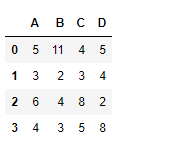 Now find the cumulative maximum value over the index axis
Python3 1==
Output :
 Example #2: Use
Python3
Output :
 Example #3: Use
Python3
dataframe.cummax() is used to find the cumulative maximum value over any axis. Each cell is populated with the maximum value seen so far.
Syntax: DataFrame.cummax(axis=None, skipna=True, *args, **kwargs) Parameters: axis : {index (0), columns (1)} skipna : Exclude NA/null values. If an entire row/column is NA, the result will be NA Returns: cummax : SeriesExample #1: Use
cummax() function to find the cumulative maximum value along the index axis.
# importing pandas as pd
import pandas as pd

# Creating the dataframe
df = pd.DataFrame({"A":[5, 3, 6, 4],
                   "B":[11, 2, 4, 3],
                   "C":[4, 3, 8, 5],
                   "D":[5, 4, 2, 8]})

# Print the dataframe
df
# To find the cumulative max
df.cummax(axis = 0)
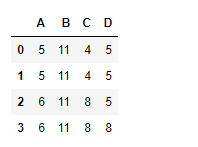
cummax() function to find the cumulative maximum value along the column axis.
# importing pandas as pd
import pandas as pd

# Creating the dataframe
df = pd.DataFrame({"A":[5, 3, 6, 4],
                   "B":[11, 2, 4, 3],
                   "C":[4, 3, 8, 5],
                   "D":[5, 4, 2, 8]})

# To find the cumulative max along column axis
df.cummax(axis = 1)
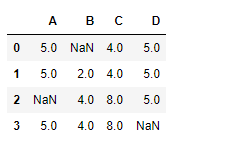
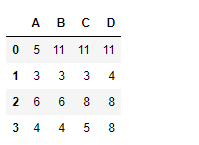
cummax() function to find the cumulative maximum value along the index axis in a data frame with NaN value.
# importing pandas as pd
import pandas as pd

# Creating the dataframe
df = pd.DataFrame({"A":[5, 3, None, 4],
                   "B":[None, 2, 4, 3],
                   "C":[4, 3, 8, 5],
                   "D":[5, 4, 2, None]})

# To find the cumulative max
df.cummax(axis = 0, skipna = True)
Output :