

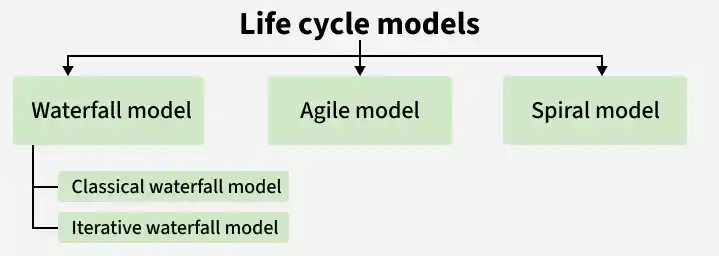
Software development existence cycle models are frameworks that manual the development of software program tasks from start to completion. This section compares some of the most popular Software Development Life Cycle (SDLC) models, including the Waterfall model, the Agile model, and the Spiral model.
Waterfall Model
The Waterfall model is a linear and sequential model that follows a strict series of steps in the software development process. Each phase must be completed before moving to the next. The Waterfall model is suitable when requirements are clearly defined.
Types of waterfall models:
1. Classical Waterfall Model is a linear and structured software development. It follows a sequential process where each phase must be completed before moving to the next. This model is suitable for projects with clearly defined and stable requirements.
- Requirements are collected from clients or stakeholders and analysed for scope, scalability, and risks.
- Coding is carried out according to the design, and software modules are developed.
- The software is tested for defects using unit testing, integration testing, and system testing.
- After successful testing, the software is released to the production environment.
2. Iterative Waterfall Model is a modified version of the Classical Waterfall Model. It follows a sequential development process but allows feedback and revisions between phases. Unlike the traditional model, it supports iterations so that improvements and changes can be made during development.
- Requirements are collected from stakeholders and analysed for scope, scalability, and risks.
- Coding is carried out according to the design, and software modules are developed.
- Necessary changes are made to requirements, design, or code based on feedback.
- The process repeats to allow continuous improvement and refinement.
Classical vs Iterative Waterfall Model
| Classical Waterfall Model | Iterative Waterfall Model |
|---|---|
| Strict linear sequence of phases | Phases allow feedback to previous stages |
| No backtracking once a phase is completed | Backtracking to earlier phases is allowed |
| Errors found mostly in testing stage | Errors can be corrected earlier |
| Suitable for fixed and stable requirements | Suitable for moderately changing requirements |
Agile Model
The Waterfall model is a simple and structured software development approach. It follows a linear and sequential process where each phase is completed before moving to the next. Agile model works best when project requirements are clearly defined and unlikely to change.
- It includes five stages: Requirements, Design, Implementation, Testing, and Maintenance.
- Each phase must be fully completed before the next phase begins.
- It is suitable for projects with stable and fixed requirements.
- Problems are often identified late, making changes difficult and costly.
Spiral Model
The Spiral model is a risk-driven software development approach that combines elements of both Waterfall and Agile models. It focuses on continuous risk analysis and mitigation throughout the development process. This model is suitable for large and complex projects where requirements are not clearly defined.
- It consists of four phases: Planning, Risk Analysis, Engineering, and Evaluation.
- Each cycle includes planning, design, implementation, and testing activities.
- It is useful for projects with high risk and changing requirements.
- It can be time-consuming, and deciding when to move to the next phase may be difficult.
Agile vs Waterfall vs Spiral Models
| Agile Model | Waterfall Model | Spiral Model |
|---|---|---|
| Iterative and incremental process | Linear and sequential process | Iterative process with risk-driven cycles |
| Very high flexibility | Very low flexibility | High flexibility |
| Changes can be made anytime | Changes are difficult after phase completion | Changes allowed after each spiral |
| Continuous customer involvement | Limited customer involvement | Regular customer involvement in each cycle |
| Risks handled during iterations | Limited risk analysis | Strong focus on risk analysis |
| Frequent delivery of working software | Final product delivered at the end | Product delivered in phases |
| Suitable for dynamic and evolving projects | Suitable for small projects with fixed requirements | Suitable for large, complex, high-risk projects |
| Continuous testing | Testing after development phase | Testing in every spiral cycle |
