

Analytical reasoning is the ability to examine information, identify patterns, evaluate evidence, and solve problems logically. It involves breaking complex problems into smaller parts and using facts to reach a well-supported conclusion.
The following is the syllabus for the Analytical Reasoning:
| Topic | Subtopics |
|---|---|
| Introduction to Analytical Reasoning | Definition, Importance |
| Deductive Reasoning | Principles, Examples |
| Inductive Reasoning | Principles, Examples |
| Abductive Reasoning | Principles, Examples |
| Critical Thinking | Elements, Application |
| Pattern Recognition | Data, Sequences, Structures |
| Logical Reasoning | Formal Logic, Rules |
| Spatial Reasoning | Visual Manipulation, Shapes |
| Causal Reasoning | Cause-and-Effect Relationships |
| Decision-Making | Evaluation, Informed Choices |
| Scientific Method | Steps, Experimental Design |
| Integration and Practical Applications | Real-world Problem-Solving |
| Review and Assessment | Practice Problems, Discussions |
| Final Exam | Comprehensive Assessment |
Solved Examples
Q1. Find the number of maximum possible triangles in the below figure.
-05.webp)
Options: A. 10 B. 19 C. 23 D. 21
Solution:
-02.webp)
Number of direct/ simple triangles = 10
Number of triangles composed of two points each = 7
Number of triangles composed of four points each = 4
Total number of triangles = 10+ 7 + 4 = 21
Q2. Determine how many straight lines are necessary to create the given figure.
-06.webp)
Options: A. 9 B. 11 C. 15 D. 16
Solution:
Required horizontal lines are DE, FH, IL and BC i.e. 4
Required slanting lines are AC, DO, FN, IM, AB, EM and HN i.e. 7.
Total number of required lines = 11
Q3. Count the number of rectangles in the below figure.
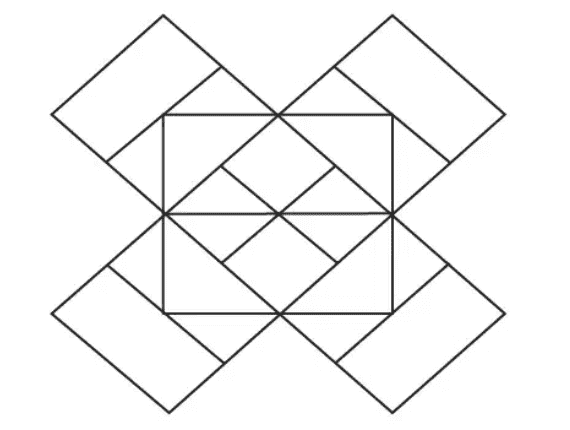
Options: A. 19 B. 16 C. 30 D. 34
Solution:
-03.webp)
Simple rectangles = 8 (VWON, OBAN,XYQP,PQCB, CRSD, RZA1S,DTUA,B1C1UT)
Rectangles combining 2 Components = 8 (ABJL,BCKI,JCDL,KDAI,EFCA,BFGD,CGHA,DHEB)
Squares combining 2 components = 4 (BJMI, CKMJ , DLMK and AIML).
Squares combining 3 components = 4( EBMA, BFCM, MCGD and AMDH).
Squares combining 4 components = 4( VWBA, XYCB, ZA1DC and B1C1AD ).
Squares combining 7 components = 4( NOJL, PQKI, RSLJ and TULK).
Squares combining 8 components = 1 (ABCD).
Squares combining 12 components = 1 (EFGH).
Hence, total number of rectangles = 4 + 4 + 4 + 4 + 1 + 1 +8+8 = 34
Q4. Count the number of squares and triangles in the given figure.
-04.webp)
Options:
A. 28 triangles, 10 squares
B. 28 triangles, 8 squares
C. 32 triangles, 10 squares
D. 32 triangles, 8 squares
Solution:
-08.webp)
Triangle :
The eight most basic triangles are IJQ, JKQ, KLQ, LMQ, MNQ, NOQ, OPQ, and PIQ.
There are 12 triangles who has 2 components = ABQ, BCQ, CDQ, DEQ, EFQ, FGQ, GHQ, HAQ, IKQ, KMQ, MOQ, and OIQ.
There are 12 triangles who has 4 components = ACQ, CEQ, EGQ, GAQ, IKM, KMO, MOI and OIK.
There are 8 triangles who has 8 components = ACE, CEG, EGA and GAC
∴ Total number of triangles in the figure : 8 + 12 + 8 + 4 = 32.
Squares :
Four squares consist of two components each, which are IJQP, JKLQ, QLMN, and PQNO.
Similarly, there are four squares composed of four components each, which are ABQH, BCDQ, QDEF, and HQFG.
There is only one square consisting of eight components, which is IKMO.
Moreover, there is only one square made up of sixteen components, which is ACEG.
The figure contains a total of 10 squares.
Hence, option C is correct.
Q5. Calculate a number of triangles.
-09.webp)
Options: A. 8 B. 7 C. 6 D. 5
Solution:
-10.webp)
Q6. Calculate the number of quadrilaterals in the below figure.

Options: (A) 15 (B) 18 (C) 19 (D) 21
-13.webp)
Solution:
-01.webp)
Quadrilateral: Any closed shape which has 4 sides is called as quadrilateral. Now, we have to count 4 sided closed shape.
No. of square=5
No. of rectangle=4
Shape with 4 sides= 9
Total =18
Q7. Calculate a number of rhombus in the below figure.
-15.webp)
Options: (A) 1 (B) 4 (C) 5 (D) 6
Solution:
Look carefully at the figure. Count only the closed shapes that have four equal sides, which are called rhombuses.
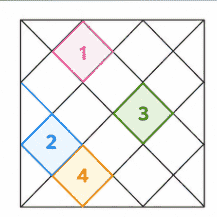
There are 4 rhombuses, in total.
Q8. Count number of squares.

Options: A. 10 B. 17 C.11 D.16
Solution:
Simple squares: 10
Combined squares: 6 (Note: Don't count the center Square twice)
Total : 16.
Q9. Count sum of triangles and square.

Option: A. 23 B. 9 C. 32 D. 19
Solution:
Triangle = 12+7+4 = 23

Square = 6+3 = 9

Answer is 32
Q10: Count parallelogram in the below figure.

Options: A. 26 B. 21 C. 38 D. 47
Solution:
Remember parallelogram is trapezium, but vice versa is not true.

Practice Questions:
Q1. Find the missing number: 5, 11, 19, 29, 41, ?
A) 53
B) 54
C) 55
D) 57
Q2. Find the missing number: 4, 9, 19, 39, 79, ?
A) 149
B )159
C) 169
D) 179
Q3. Find the next term: AB, DE, GH, JK, ?
A) LM
B) MN
C) NO
D) OP
Q4. If APPLE is coded as BQQMF, how is GRAPE coded?
A) HSBQF
B) HSBPF
C) HRBQF
D) HSCQF
Q5. Rahul walks 5 m north, turns right and walks 4 m, then turns right and walks 5 m.
Where is Rahul now from his starting point?
A) 4 m East
B) 4 m West
C) 5 m East
D) 5 m South
Q6. Pointing to a girl, Neha says: She is the daughter of my mother's only son.
How is the girl related to Neha?
A) Sister
B) Daughter
C) Niece
D) Cousin
Q7. Four people P, Q, R and S are sitting in a row.
- P sits to the left of Q.
- R sits to the right of Q.
- S sits between P and Q.
Who sits second from the left?
A) P
B) Q
C) R
D) S
Q8. Statements:
- All books are papers.
- Some papers are files.
- No file is a notebook.
Conclusions:
I. Some papers are not notebooks.
II. All books are files.
III. Some files are papers.
Which conclusions follow?
A) Only I
B) Only II
C) I and III
D) II and III
