Have you ever looked at a system design document and winced at the rigid demand for strict consistency? We have all been there. Engineers love neat little rules. For years, the CAP theorem has served as the ultimate shorthand for distributed systems architecture, locking us into the mental trap of “pick two” out of Consistency, Availability, and Partition Tolerance. But what if that framing is too blunt for the messy reality of modern cloud engineering?
Long before Eric Brewer formalized CAP on a conference stage, a foundational 1999 paper by Armando Fox and Eric Brewer, titled “Harvest, Yield, and Scalable Tolerant Systems,” introduced a far more powerful lens: graceful degradation. Instead of treating a system as completely broken or fully operational, Fox and Brewer proposed continuous metrics. Understanding this shift changes how you think about fault tolerance forever. You can dive deeper into these foundational distributed concepts via resources like the ACM Digital Library.
Redefining System Health: Harvest vs. Yield
Think about how traditional relational databases handle network strain. Under severe lock contention or a partial partition, they often throw up their hands, abort transactions, and return errors to preserve strict consistency. In the Fox-Brewer vocabulary, your yield—the probability that a request is successfully processed—drops straight to zero. Meanwhile, your harvest—the completeness of the data returned—remains at a pristine 100% until the entire node goes dark.
Internet-scale applications usually need the exact opposite priority. Imagine browsing an e-commerce catalog during a regional network glitch. Would you rather stare at a terrifying HTTP 500 error page, or see your product recommendations load with a small note saying some real-time inventory counts are temporarily unavailable?
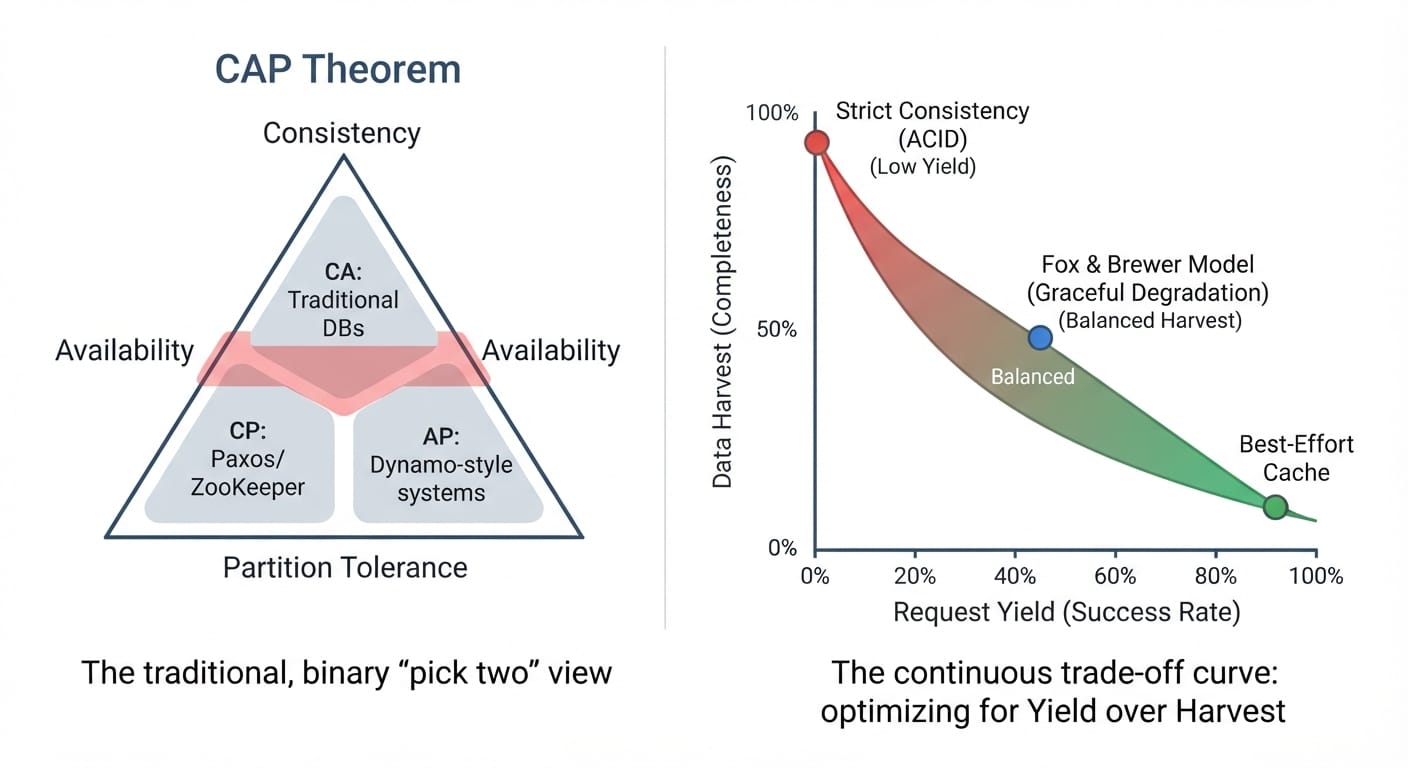
By decoupling data completeness from request success, engineers can build systems that bend instead of breaking. You can explore how modern cloud providers handle these design patterns through Google Cloud architecture guides.
Embracing Partial Failures in Modern Microservices
Real-world network partitions are rarely clean or symmetrical. A cross-region fiber link might suffer high latency, a single database replica might fall behind, or an upstream caching layer might time out. When you design under the Harvest and Yield model, you stop chasing the impossible dream of absolute perfection. Instead, you design for graceful degradation at every layer of your stack.
- Progressive Payload Shrinking: If a secondary analytics or recommendation service fails to respond within 50 milliseconds, drop it from the payload and render the core page anyway.
- Stale-Valued Fallbacks: Serve cached profile data with a subtle staleness warning rather than failing a user login flow entirely.
- Asynchronous Reconciliation: Accept writes locally during a partition, keeping write yield high, and resolve state conflicts in the background once network links stabilize.
What We Have Learned
We started by challenging the rigid limitations of the traditional CAP theorem mindset. Through exploring the 1999 Fox and Brewer paper, we discovered that availability is not a binary switch; it is a continuous curve defined by harvest (data completeness) and yield (request success rate). By prioritizing high yield through graceful degradation, fallback caches, and partial payloads, you can keep your applications resilient when infrastructure inevitably falters.