GraphQL’s Schema Language vs. REST’s Implicit Contract: What It Means to Type an API’s Shape

Every REST API has a contract. The problem is that contract usually lives in three different places at once, a Swagger page nobody’s updated since Q2, a Confluence doc that mentions a field that was renamed months ago, and the actual running code, which is the only one of the three that’s ever fully honest. GraphQL took a different bet entirely: instead of describing the API’s shape somewhere adjacent to the code, make the shape itself an executable artifact the server enforces on every single request. That’s not a stylistic preference. It’s a structurally different answer to a problem REST never really solved.
What does it mean for an API’s schema to be a first-class artifact?
A first-class schema is a formally typed definition of an API’s data shape that the server itself executes and validates against, rather than a separate document maintained alongside the code. In GraphQL, the Schema Definition Language, or SDL, defines every type, field, and relationship the API exposes, and because the running server enforces this schema on every query, the schema can never silently diverge from actual behavior the way external documentation can.
That last clause is the whole argument. Documentation describes a system. A schema, in GraphQL’s model, is the system, or at least is executed as part of it.
REST’s implicit contract, and why it drifts
REST never mandated a formal type system for its resources. That was arguably intentional, Roy Fielding’s original REST dissertation prioritized uniform interfaces and hypermedia-driven discovery over rigid schemas, and for a lot of use cases that flexibility was genuinely valuable. But in practice, most REST APIs ended up needing something schema-like anyway, so the ecosystem built OpenAPI, formerly Swagger, as a bolt-on solution. You write a YAML or JSON file describing your endpoints, request bodies, and response shapes, separately from the code that actually implements them.
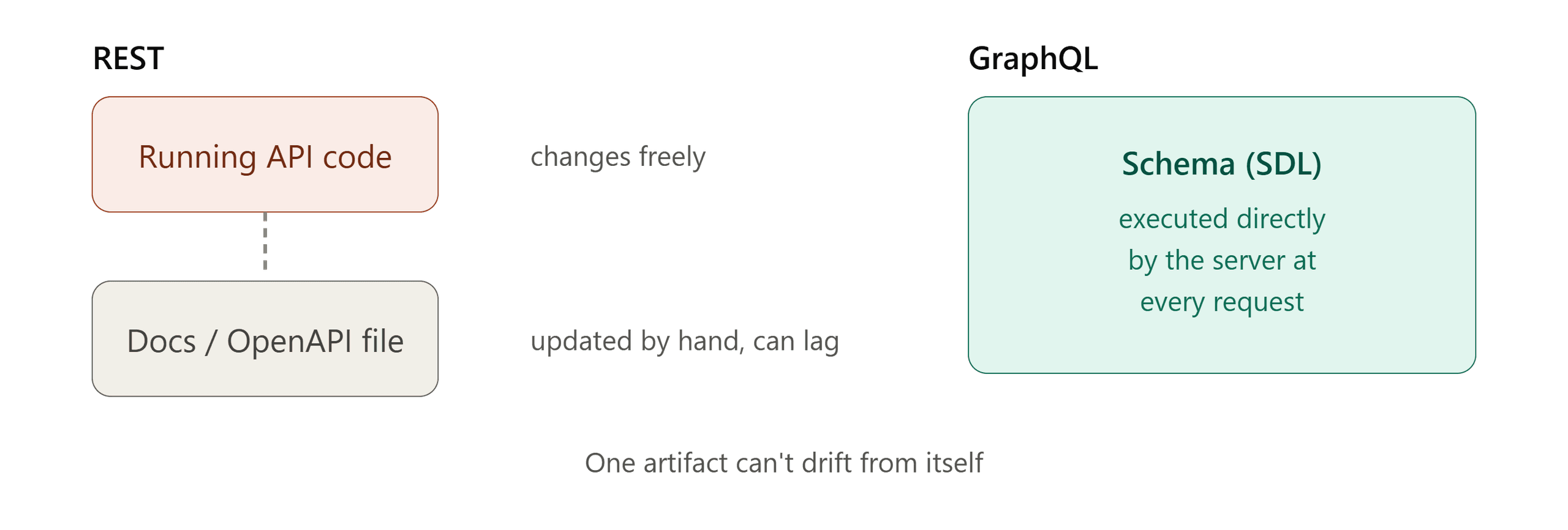
Here’s where things go sideways. Nothing structurally ties that OpenAPI file to the behavior of the running server. A developer can rename a field, drop a parameter, or change a response shape, and unless someone remembers to update the spec file and someone else remembers to review that update against the real implementation, the documentation just quietly becomes fiction. The diagram above draws this out directly, running API code on one side, a docs or OpenAPI file on the other, connected only by a dashed line representing manual, easy-to-skip synchronization. Tools like Spectral for OpenAPI linting help catch malformed specs, but linting a spec’s internal consistency is a different problem from verifying the spec actually matches what the server does at runtime.
This is the “implicit contract” problem in a nutshell. The real contract lives in the server’s actual behavior, which client developers can only observe indirectly, through documentation that might be current or might be embarrassingly stale.
How GraphQL’s SDL closes that gap structurally
GraphQL, originally built inside Facebook in the spring of 2012 by Nick Schrock, Dan Schafer, and Lee Byron to power the News Feed API for a rebuilt iOS app, and open-sourced in the summer of 2015, took the opposite approach from day one. The schema isn’t a description of the API written after the fact. It’s the thing the GraphQL server actually parses, validates queries against, and executes.
type Order {
  id: ID!
  status: OrderStatus!
  items: [OrderItem!]!
  customer: Customer!
  createdAt: DateTime!
}

type Query {
  order(id: ID!): Order
  orders(status: OrderStatus, limit: Int = 20): [Order!]!
}
Send a query asking for a field that doesn’t exist in this schema, and the server rejects it before execution even begins, not because someone wrote validation logic by hand, but because schema conformance is baked into how GraphQL processes every request. Client tooling can also call GraphQL’s built-in introspection query, effectively asking the API “what do you actually support right now,” and get back an answer generated live from the exact same schema the server enforces. There’s no separate document to fall out of sync, because there’s no separate document in the first place, just one artifact serving as both the contract and the enforcement mechanism.
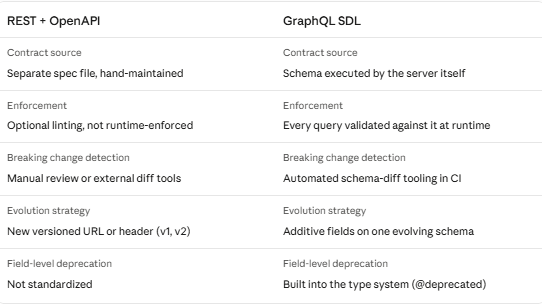
The comparison table above lays out how far this reaches beyond documentation accuracy. Every attribute in that GraphQL column, runtime-enforced validation, automated schema-diff tooling, and built-in field deprecation, exists specifically because the schema is executable rather than descriptive.
Breaking changes: the part REST genuinely struggles with
Versioning is where this difference gets practical fast. A REST API that needs to change a resource’s shape typically reaches for a new URL path or a version header, /v1/orders becomes /v2/orders, and now you’re maintaining two implementations, or worse, one implementation with conditional branches scattered through it based on version. Clients pinned to /v1 keep working, but the API surface itself fragments over time, and nothing in REST’s architecture forces you to communicate exactly which fields changed between versions beyond whatever changelog discipline your team maintains.
GraphQL’s evolution model leans on additive change plus explicit deprecation instead. You add new fields without removing old ones, and when a field genuinely needs retiring, you mark it directly in the schema itself:
type Order {
  id: ID!
  status: OrderStatus!
  legacyStatusCode: Int @deprecated(reason: "Use status instead")
}
That @deprecated directive isn’t a comment somebody has to remember to write in a wiki, it’s part of the schema itself, visible to every client through introspection, and tools like the GraphQL Inspector CI integration can automatically flag when a proposed schema change would break existing client queries, catching the problem in a pull request rather than in production. REST has nothing structurally equivalent baked into the protocol itself, teams build their own conventions for this, with wildly varying rigor.
The tradeoffs nobody should gloss over
None of this means GraphQL is simply “better,” and a good API strategist earns that title by being honest about the costs, not just the wins. REST’s simplicity is a real feature, particularly for resource-oriented APIs where HTTP’s own caching semantics, ETags, Cache-Control headers, CDN-level caching of GET requests, work out of the box in a way GraphQL’s single-endpoint, POST-heavy model generally doesn’t replicate without additional tooling like persisted queries or field-level caching layers.
GraphQL also introduces its own operational sharp edges. The N+1 query problem, where a naive resolver implementation fires a separate database query per item in a list, is a genuinely common production pitfall that REST’s typically flatter, pre-shaped responses don’t create in the same way. Solving it properly usually means adopting batching patterns like DataLoader, which is one more piece of infrastructure a REST API wouldn’t necessarily need.
Companies that have adopted GraphQL in production at scale, a list that includes Airbnb, GitHub, Netflix, and Shopify among others, generally didn’t do it because REST was fundamentally broken for their use case. They did it because the typed-contract guarantee mattered enough, usually in situations with many client teams consuming the same backend independently, to justify taking on GraphQL’s own operational complexity in exchange.
Frequently Asked Questions (FAQ)
Can REST APIs get similar contract guarantees without switching to GraphQL entirely?
To a meaningful degree, yes, through disciplined OpenAPI-first development where the spec generates both server stubs and client SDKs from a single source, closing much of the drift gap. It requires more process discipline than GraphQL’s model, though, since nothing forces the generated code and the actual server behavior to stay synchronized the way GraphQL’s runtime enforcement does automatically.
Does GraphQL’s schema eliminate the need for API documentation entirely?
Not entirely, since the schema tells you what’s available but not necessarily why a field exists or when to use it over a similar one. Good GraphQL teams still write prose documentation, often generated partly from schema descriptions via tools like GraphiQL’s built-in docs explorer, but the risk of that documentation contradicting actual behavior drops sharply because the schema itself anchors the ground truth.
Is GraphQL’s schema enforcement actually a runtime performance cost worth worrying about?
The validation overhead itself is generally negligible compared to the cost of the underlying data-fetching resolvers, so it’s rarely the bottleneck teams need to optimize around. The N+1 resolver problem mentioned above is a far more common and more expensive performance issue in practice than schema validation itself.
Which approach handles a rapidly evolving API better, REST or GraphQL?
GraphQL generally has the edge here specifically because additive schema evolution combined with automated breaking-change detection in CI lets teams ship changes with more confidence than manually coordinated REST versioning typically allows. That said, a REST API built with strict OpenAPI-first discipline and strong contract-testing culture can close much of this gap without a full migration.