


Quake
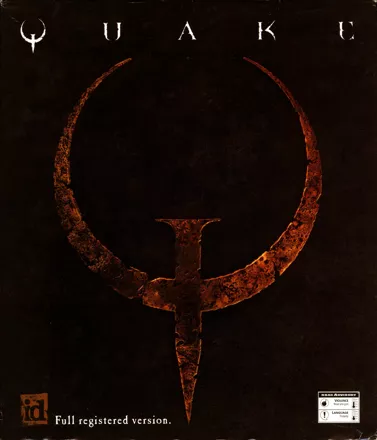
-
 Quake Mission Pack No. 2: Dissolution of Eternity
(1997)
-
 Quake Mission Pack No. I: Scourge of Armagon
(1997)
-
 Quake: Episode 5 - Dimension of the Past
(2016)
-
 Abyss of Pandemonium
(1998)
-
 Aftershock for Quake
(1996)
-
 Aftershock Toolbox for Quake
(1996)
-
 Dark Hour for Quake
(1996)
-
 Deathmatch Maker
(1997)
-
 Earth-Quake
(1996)
-
 Eternal Darkness: 100 new levels for Quake
(1996)
-
 Level Master V
(1997)
-
 Malice: 23rd Century Ultraconversion for Quake
(1997)
-
 Phenomenon
(1996)
-
 Q!Zone
(1996)
-
 Q2
(1996)
-
 Qu.......ke
(1996)
- Quad Damage (1998)
-
 Quake'em
(1996)
-
 Shrak for Quake
(1997)
- Superdead (1996)
-
 Tremor for Quake
(1997)
-
 Ultra Level Add-On
(1997)
-
 Quake
(2021)
-
 id Anthology
(1996)
-
 id Super Pack
(2007)
-
 Quake and The Ultimate Doom Compilation
(1998)
-
 Quake: The Offering
(1998)
- Resurrection Pack for Quake (1998)
-
 The Quake Collection
(2007)
-
 Ultimate Quake
(2001)
Description official descriptions
An enemy codenamed “Quake,” believed to come from another dimension, is using teleportation gates to invade Earth. The player takes the role of a nameless soldier who arrives at his base only to discover that Quake’s forces have overrun it and killed everyone. Somewhere in the base is a teleporter leading to Quake’s realm. The mission is clear: enter the enemy’s dimension, fight through hordes of monsters, and strike back.
id Software’s follow-up to Doom and Doom II, Quake is a first-person shooter. Its main technological innovation is its use of a true 3D engine: the levels, enemies, and objects are built from polygons rather than sprites and flat level geometry. This allows for more natural level design, smoother character animation, vertical spaces, and more dynamic movement. It also supports gameplay elements such as bouncing grenades, projectiles traveling through three-dimensional space, and enemies attacking from above or below the player. The fully 3D environments make vertical movement more important than in id Software’s earlier shooters, with ledges, lifts, underwater passages, jumping, and enemies positioned at different heights.
The game begins in a start area where the player chooses a difficulty setting and enters gateways leading to the four episodes. In single-player mode, the player progresses through these episodes in search of exits while fighting enemies and collecting weapons, ammunition, health, armor, and keys. Interaction with the game world is minimal: since there is no dedicated use key, buttons and switches are activated by touching or shooting them. As in id Software’s earlier shooters, the levels contain numerous secret areas, including hidden exits that lead to secret levels.
Unlike Doom’s mixture of futuristic technology and demonic imagery, Quake’s setting combines several different styles. Each episode begins in a military base connected to the slipgate network, but later levels shift into environments inspired by medieval fantasy, gothic horror, and dark otherworldly architecture, including castles, dungeons, caverns, crypts, and temples. The visual style is darker and more muted than Doom’s, with many levels dominated by browns, grays, stone, metal, and earth tones. The game’s atmosphere is reinforced by an ambient soundtrack and sound design by Trent Reznor and Nine Inch Nails, emphasizing dread and isolation rather than traditional action music.
The enemy roster reflects this blend of themes. Early levels include human soldiers armed with shotguns or energy weapons, while later areas introduce knights, zombies, ogres with grenade launchers and chainsaws, leaping fiends, floating scrags, and larger supernatural creatures. The player’s weapons are mostly modern or industrial in function but have a rough, brutal feel. The arsenal includes an axe, shotguns, nailguns, grenade and rocket launchers, and the Thunderbolt, which discharges electrical energy.
Quake was one of the early first-person shooters designed with both LAN and Internet play in mind. The single-player levels can be played cooperatively, but the game became especially known for its deathmatch mode. Free-for-all matches, team play, and one-on-one duels are supported, with an emphasis on fast reactions, map knowledge, weapon control, and skillful movement through fully 3D spaces. Single-player maps can be used for multiplayer, and the game also includes maps designed specifically for deathmatch.
Series +
Quake series- Next: Quake II (1997)
Groups +
- 3D Engine: Quake
- 3D Engine: SlaveDriver
- BPjS / BPjM indexed games
- Game feature: In-game screenshot capture
- Gameplay feature: Drowning
- Gameplay feature: Recordable replays
- Games with Dopefish
- Games with officially released source code
- Inspiration: Author - H. P. Lovecraft
- Online Service: Heat.net
- Replay (GT / Infogrames / Atari) releases
- Total Entertainment Network (TEN) multiplay platform
Media
Quake
2 More Videos
Spellings
- 雷神之锤 - Simplified Chinese spelling
Screenshots


Credits (DOS version)
27 People (15 developers, 12 thanks) · View all
| Programming | |
| Tools Programmer | |
| Level / Scenario Design | |
| Music | |
| Sound | |
| Project Manager | |
| Support | |
| Biz | |
| Biz assist | |
| Special Thanks To | |
| [ full credits ] | |
Collaborations
People credited on this game were also credited on:
- Quake, a group of 26 people
- Quake: The Offering, a group of 15 people
- Hexen: Beyond Heretic, a group of 14 people
- And 22 more...
[ Upgrade to MobyPlus to view more! ]
Other Games
In addition to this game, these people were also credited on other games:
- John Romero on 149 other games
- Mike Wilson on 135 other games
- John Carmack on 123 other games
- And 22 more...
[ Upgrade to MobyPlus to view more! ]
Reviews
Critics
Average score: 87% (based on 79 ratings)
Players
Average score: 4.0 out of 5 (based on 516 ratings with 20 reviews)
The Good
Whenever I need to release stress and/or anger I have 2 options: throwing my chair against the wall or playing Quake. Since I've been spending a whole budget in chairs lately :) I guess I'll stick to the second option...Just pump the volume to the max, put on God mode, Quad damage and all weapons to begin blasting away at those monsters and...Voila! a couple of minutes later I'm more relaxed (Although I don't know if this is normal in a person!)
I mean, there's nothing like gibbing a shambler armed only with a two-barrelled shotgun with the excellent soundtrack (courtesy of Trent Reznor) roaring trough the speakers.
Quake's also got a lot of atmosphere, the levels are very well designed and the occasional creepy sounds (which you can't never tell for sure where they're coming from) really help to get you "inside" the game. The truly 3D graphics and monster animations are really stunning (Just look closely at the movements of the zombies, for example)
I can understand why this game is a milestone in the FPS genre and why it became so famous.
The Bad
Absolutely no plot (unless you call the txt file with the "monsters-who-came-from-another-dimension" excuse for story a plot) and...NO CUTSCENES??!? I mean...this is a 1996 game, guys! We gamers had witnessed quite a few amazing things by then as far as animations and cutscenes go! The whole story unfolds through text displaying on your screen (remember DOOM?).
These two topics could have been looked over if this game hadn't been so over-hyped and highly anticipated, though.
The Bottom Line
-"Hey, remind me again why I'm shooting these monsters?"
-"Who cares?...It's fun as hell!"
One of the best things about Quake is that you can either play it for a short while (10-15 min) or became sucked into its universe without realizing that you've been playing for 2 hours and still have lots of fun. It may not be the best FPS, but it's one of the greatest.
DOS · by n-n (50) · 2001
A gritty, mud-hued shooter with terrifying monsters
The Good
In early 1996, Duke Nukem captured gamers' attention with a rivetingly humourous one-up of DOOM, but by summer id had regained their position atop the PC gaming world. Quake boasts the first graphics engine capable of rendering not only the game world in true 3D, but also monsters, items, and players.
Aside from the technical considerations, Quake stands out as a top-to-bottom solid shooter. Weapons are varied and satisfying, from your basic shotgun and automatic nailgun, to a double-barreled shotgun and quad-firing nailgun, to your explosive arsenal of a grenade launcher and rocket launcher. All these weapons lay into enemies with a satisfying feel and sound, but the grenade launcher stands out as a really fun weapon. The simple look of the weapon, the sound of grenades clanking off the floor, the primitive pixelated explosions, and of course the chunked body parts all make it one of the most satisfying weapons of all time.
Monsters are another stand-out feature. Your basic zombies fling wads of rotting flesh at you, werewolves come at you with horrifying speed, samurai knights cut you to ribbons with a devastating broadsword, and the Shambler is a truly horrific Yeti-beast that can zap you with lightning bolts but prefers to deal with you personally with his claws.
The general tone and atmosphere of Quake is a third stand-out feature. Although the world is rendered in drab earthy hues, there are occasional lava pits to brighten things up. Levels are really well done, and when you finish one it's a great relief. Generally the tension will build as you explore a new level, monsters and puzzles become trickier as you progress, and towards the end there will be some terrific showdown with one or more tough enemies. The end bosses of each of the three chapters are memorable, starting with a Shambler and ending with a gigantic Lovecraft-inspired tentacle beast called Shub-Niggurath.
The Bad
There isn't a lot in Quake to criticize. The color scheme is somewhat drab, but varied lighting keeps everything looking interesting.
The Bottom Line
Quake is a landmark game, the first to really bring a 3D world to life in a believable way. All the elements of a good FPS come together, from smooth rendering to escalating challenges to sparse, effective sound effects to excellent weapons and the resulting gore that they produce. A fine title from id, and in my mind the best of the series.
DOS · by Chris Wright (85) · 2010
A completely underrated yet revolutionary game.
The Good
My God, John Carmack - what more is there to say? While completely underrated (for some reason), this game was simply revolutionary at the time. Unlike Doom it came with a completely, 100% true 3D engine with gouraud-shaded textures and it ran DAMN FAST on any Pentium and adequately on an old 486.
This game completely revolutionized the genre: it was the first to come out-of-the-box with TCP/IP support for internet play (not through TEN or other such services) -- if you had the bandwidth to spare you could simply set up a Quake server and get it on! It was also the first to use the now-common server/client architecture (push the Tilde key and you'll see what I mean) and the first one which doesn't require a seperate module (COMMIT) for multiplayer play.
And most importantly, this game is damn challenging and fun in single player and multiplayer alike!
The Bad
It looks a bit on the brownish side, but we'll let that one pass. The sound effects are a bit annoying too.
The Bottom Line
A wonderful, underrated classic which didn't get the attention it deserved.
DOS · by Tomer Gabel (4534) · 2000
Discussion
| Subject | By | Date |
|---|---|---|
| Paul Steed credit | leilei (343) | Aug 13, 2012 |
| What music? | null-geodesic (103) | Jun 12, 2008 |
Trivia
1001 Video Games
The PC version of Quake appears in the book 1001 Video Games You Must Play Before You Die by General Editor Tony Mott.
3D cards support
The original game had software rendering mode only. You could download glquake to use your 3d accelerated card. A special version was made for the intergraph rendition cards called vquake.
Anaconda level
Bizarre product tie-ins: for the release of the movie Anaconda, Sony Pictures released through their website an add-on level for Quake titled Temple of the Mist were the player made their way through an ancient temple searching for the altar that holds the key to escape. Obviously, before escaping, the player has to go mano a mano with the Anaconda itself.
Development
The original Quake was supposed to have a medieval environment, but a few months before its release, most of the medieval-role playing aspects of the game were removed (i.e. one of the weapons was going to be a sword and there was a dragon to fight with) and the result was a game with guns but such enemies like the fiend or the death knight (these were included in the original project). Many original design elements were scrapped -- the kernel idea behind Quake was this massive Thor-like warhammer that you could slam down on the ground to make shockwaves ripple through the game world. This "ultimate weapon" idea followed John Romero to his game Daikatana.
The original concept was inspired by a character named Quake in id's long D&D campaign (which actually ended with demons destroying the universe due to John Romero's greed), DM'd by John Carmack. Because of the switch to sci-fi, Romero was angry enough to leave id after Quake, even though Carmack fired him first. He later used another inspiration from the D&D campaign to make Daikatana.
Deathmatch
Kornelia, a famous female Quake player, won the "TEN GibFest Contest" at the computer game developers conference at Santa Clara. As a result, she was afforded the opportunity to play John Romero in a 1v1 deathmatch. She beat him 22 to 1 and also took home a P200 MMX system.
Dopefish
Quake is yet another of id Software's games that contains the infamous Dopefish. The level where he is located in is E2M3, The Well of Wishes, in a secret location. Incidentally, "The Well of Wishes" is the same title as a Commander Keen 4: Secret of the Oracle level where the Dopefish first appears.
Engine
The engine that iD Software started to make Quake with was called Six Degrees of Freedom
German index
On 31 August 1996, Quake was put on the infamous German index by the BPjS. For more information about what this means and to see a list of games sharing the same fate, take a look here: BPjS / BPjM indexed games.
Guinness World Record
- 1999 - Biggest computer game cult
IFQuake
Taking John Romero's work on the Apple II bootloader for Infocom's Zork Zero: The Revenge of Megaboz as a point of departure, in 2004 Jason Bergman released IFQuake -- the difficulty-selection stage and first level of the shareware version of Quake implemented as a text adventure game, downloadable at http://mirror.ifarchive.org/if-archive/games/zcode/ifquake.zip
Innovations
Almost incidentally, Quake introduced the now-standard concept of a FPS 'console', and popularised 'mouselook' as *the* absolute standard control interface. Although the specifications required a Pentium, Quake ran acceptably well on a 486 DX4/100 and, at a push, the faster 486es. Along with Magic Carpet it was however the game that most established the Pentium as a must-have processor. It was also the first game which offered the opportunity for both Amiga and PC gamers to play online together.
Machinima
Machinima, an animated film using the 3D environment of a game, started with the Quake engine. Doom already had a recording feature, but it wasn't until Quake when people added narrative and called it "movies" that the genre was born. The first known machinima is Diary of a Camper, by a group of players called The Rangers, released on 26 October 1996.
Qtest1
Quake was preceded by Qtest1, a tech demo which was released in February 1996. It consisted of three small, monster-free levels which illustrated the game's engine. Of particular note was Test3, which became the basis for the second level of Quake's first episode (of the other levels, Test2 seemed to be a very, very early incarnation of 'Ziggurat Vertigo', the infamous low-gravity secret level). The engine was almost fully complete, although wall-mounted torches were still sprite-based.
Although the test had no game - rather like the original Doom 'alpha releases' - multiplayer support was, fortunately, included. The infamous 'rocket jump' was discovered quite quickly, as Qtest included both rocket and grenade launchers.
"Chris ([email protected])" eventually discovered that monsters were included in the game's source code, and a patch released in June 1996 allowed players to experience early versions of Quake's beasties.
References
All of the sounds and music for Quake were produced by Trent Reznor, the man behind the industrial/alternative group Nine Inch Nails. The ammo boxes for the nailgun ("nails") have the band's logo (NIN) on the side.
References to the game
One of the songs on Karl Sander's album Saurian Meditation, "Elder God Shrine", was named after the Quake level E4M3 which has the same name.
Saturn version
The Saturn version of Quake is the only version with colored lighting.
Scrapped versions
The Game Boy Advance version of Quake was in development by AGB Games. There were also plans for port to Sony PlayStation by Lobotomy Studios, which was able to work, under some circumstances, in 60 FPS. First one was cancelled for unknown reasons, while second cancellation was caused by fact, that developer failed to find a publisher.
Source code release
In 1999, id Software made the complete source code for Quake freely available to the public. You can download it here.
Speedruns
Quake inspired the art of speedruns: trying to beat a game as fast as possible. The initial release was Quake Done Quick, completed in 19:49 and released on 1997. As of 2012, players still work on breaking the latest records.
Xbox version
In 2003 (to a small audience) and later on 11 December 2012 (publicly), Jayeson Lee-Steere of Titanium Studios showed screenshots from an experimental build of an Xbox port of Quake that was never finished.
Zeebo version
On 15 June 2010, both Quake and Quake II were removed from Zeebo's wireless network, the Brazilian Zeebonet. Both games were offered for 10 Z-credits and each Brazilian Zeebo came with 35 Z-credits, so the games were sold virtually for free. They were replaced for Zeebo Extreme Rolimã and Zeebo Extreme Jetboard as free downloads.
Awards
- Computer Gaming World
- November 1996 (15th anniversary issue) - #36 in the “150 Best Games of All Time” list
- November 1996 (15th anniversary issue) – The Best Way To Die In Computer Gaming (being telefragged)
- November 1996 (15th anniversary issue) –Worst Back Story of All Time
- November 1996 (15th anniversary issue) – #5 Least Rewarding Ending of All Time
- May 1997 (Issue #154) – Action Game of the Year
- May 1997 (Issue #154) – Action Game of the Year (Readers' Choice)
- May 1997 (Issue #154) – Special Award for Technological Achievement (for its engine)
- April 1999 (Issue #177) - Introduced into the Hall of Fame
- March 2001 (Issue #200) - #8 Best Game of All Time
- GameSpy
- 2001 – #5 Top Game of All Time
- GameStar (Germany)
- Issue 12/1999 - #7 in the "100 Most Important PC Games of the Nineties" ranking
- PC Gamer
- April 2000 - #14 in the "All-Time Top 50 Games" poll
- April 2005 - #26 in the "50 Best Games of All Time" list
- Power Play
- Issue 02/1997 – Best Multiplayer Game in 1996 (together with Jagged Alliance: Deadly Games)
- Świat Gier Komputerowych
- February 1997 (Issue #50) – readers' award Hitek'96 for the best foreign game of 1996
Information also contributed by Adam Baratz, Ashley Pomerov, chirinea, Darksaviour69, D Michael, Erkan O; keth, Maw, n-n, PCGamer77, Pseudo_Intellectual; Sciere, Scott Monster, Xoleras, Zack Green and Zovni
Analytics
Related Games

Released 1997 on Windows, Linux, 1999 on Macintosh...

Released 1999 on Windows, Macintosh, Linux...

Released 1999 on Linux, 2022 on Windows

Released 2023 on Windows, PlayStation 4, Xbox One...

Released 2010 on Browser, Windows
Released 2001 on Windows
Released 2016 on DOS, Windows

Released 1985 on Commodore 64

Released 2009 on Linux, Windows
Related Sites +
-
FitzQuake
The most faithful custom engine available. -
Func_Msgboard
An ever-active forum dedicated to custom mapping, primarily focusing on the original game but also covering the following games in the series from time to time. -
GitHub
official source code repository -
GitHub (tools)
official source code repository -
Matt Chat 54
Video interview with John Romero about the development of Quake -
Planet Quake
An exhaustive quake site visit it for news, mods, levels, tips and all you want related to Quake -
Quaddicted
The most comprehensive site for custom singleplayer maps. -
Quake cheat codes
Detailed information on Quake 1 cheat codes for N64, PC and Sega Saturn -
Tenebrae
Tenebrae is a modification of the quake source that adds stencil shadows and per pixel lights to quake. Stencil shadows allow for realistic shadow effects on every object in the game world. Per pixel lighting allows you to have fine surface details correctly lit. These are essentially the same algorithms as used by the new Doom game.
Identifiers +
Contribute
Are you familiar with this game? Help document and preserve this entry in video game history! If your contribution is approved, you will earn points and be credited as a contributor.
Contributors to this Entry
Game added by robotriot.
Zeebo added by chirinea. Nintendo 64 added by Kartanym. Windows Mobile, Acorn 32-bit, Amiga added by Kabushi. Windows added by The cranky hermit. Macintosh added by Ace of Sevens. SEGA Saturn added by quizzley7.
Additional contributors: JubalHarshaw, Andrew Hartnett, Ledmeister, Roedie, Unicorn Lynx, Atomic Punch!, erc, Kabushi, Patrick, Titan10, Karsa Orlong, Plok, MrFlibble, FatherJack, R3dn3ck3r, coltrain5041.
Game added November 3, 1999. Last modified October 24, 2026.
