Get instant access to a live TrueFoundry environment. Deploy models, route LLM traffic, and explore the full platform — your sandbox is ready in seconds, no credit card required.
9.9
AI Security Platforms & Gateways: Safeguarding LLMs and Agentic AI
AI security platforms help organizations protect AI models, applications, data, and agents from threats such as prompt injection, data leakage, and unauthorized access. The right solution depends on your security needs, deployment model, and governance requirements.
Key takeaways:
TrueFoundry: Centralizes AI traffic management, access controls, guardrails, and governance through an AI Gateway.
Lakera: Focuses on real-time protection against prompt injection, jailbreaks, and data leakage.
Protect AI: Secures machine learning pipelines, models, and dependencies.
HiddenLayer: Helps protect AI assets through model scanning, threat detection, and runtime security.
Robust Intelligence: Focuses on AI model validation and runtime protection.
Why AI security matters: Organizations should adopt AI security controls to reduce risks, protect sensitive data, enforce consistent policies, and maintain visibility as AI usage scales.
As generative AI and LLMs rapidly enter the enterprise, protecting these powerful new tools has become critical. Traditional security tools can’t see inside an AI model or enforce data-use policies on prompts and outputs, leaving organizations blind to AI-specific risks like prompt injection, data leakage, and rogue “agentic” behavior. In fact, a recent Gartner survey found 81% of organizations are on a GenAI journey, but many are already facing project failures, compliance problems, and misuse incidents due to inadequate AI governance. This visibility gap means that until now there was effectively no AI firewall to inspect or block malicious AI traffic.
Industry analysts now say AI-specific security solutions are urgently needed. Gartner predicts that by 2028 more than half of enterprises will deploy an AI security platform to enforce consistent guardrails across all third-party and custom AI applications. AI security is no longer optional – it’s a foundation for trust. Cited by Gartner as a “Vanguard” technology trend, AI security platforms bring visibility and control over LLMs and multiagent systems in the same way traditional firewalls and gateways protect networks. Without these controls, even well-intentioned AI projects can leak sensitive information or spin out of control. Embedding proactive safety checks and governance in the AI stack is now essential for enterprises scaling LLMs or deploying autonomous AI assistants. In the sections below we’ll explain what “AI Security Platforms” are, why AI security matters more than ever, and why an AI gateway is the practical enforcement layer for AI security. We’ll also show how TrueFoundry’s AI Gateway implements all these requirements in one unified solution – effectively becoming your organization’s AI firewall.
Secure Your AI Stack With TrueFoundry
Manage AI traffic, enforce security policies, and govern models, agents, and MCP tools through a unified AI Gateway.
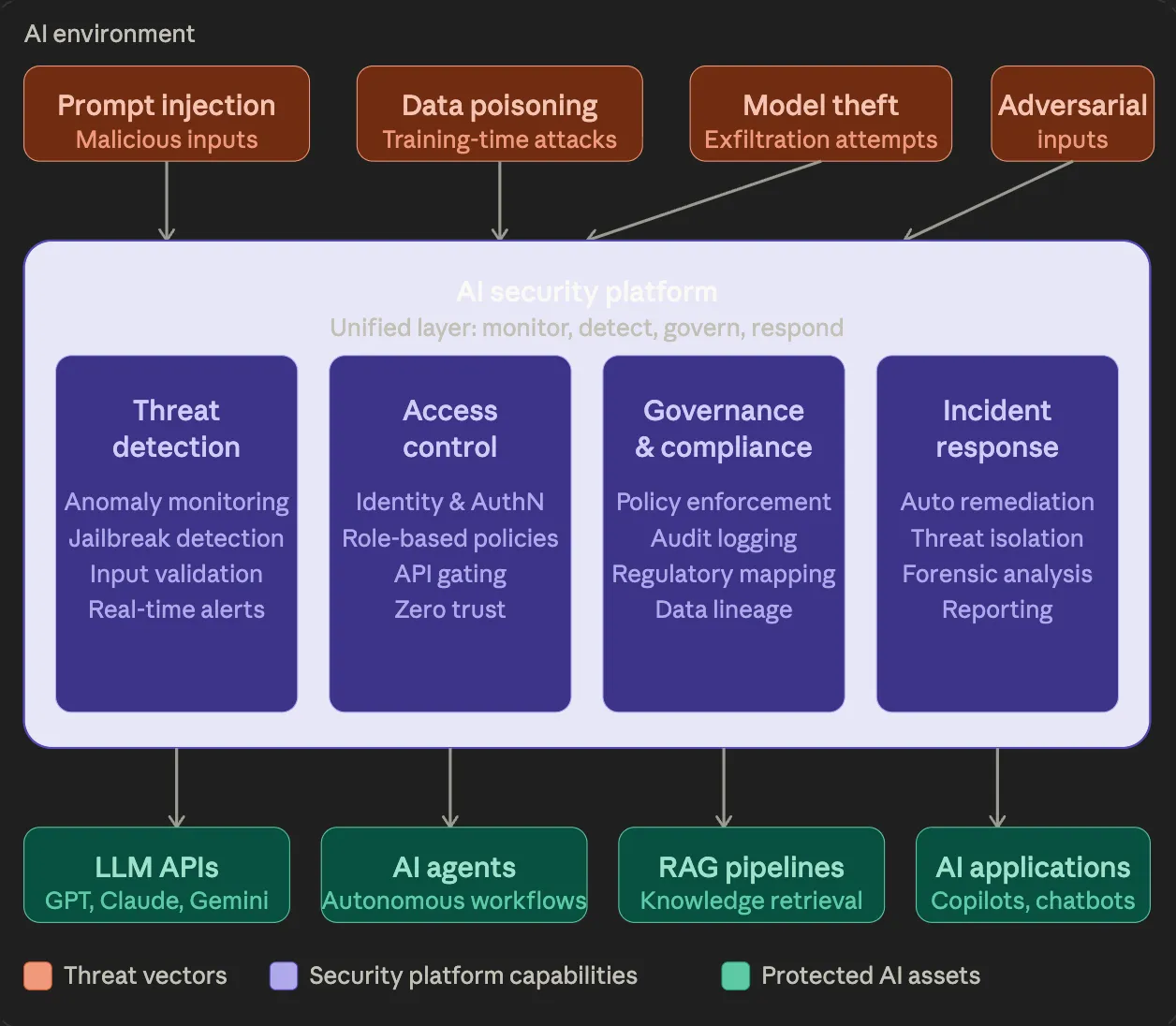
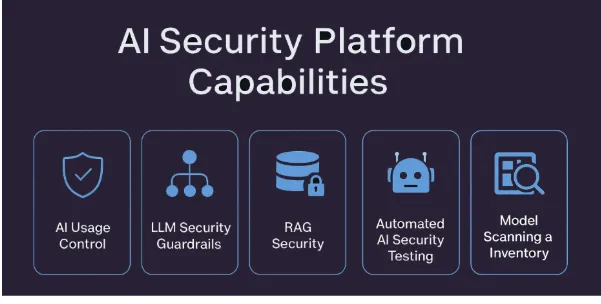
Gartner defines an AI Security Platform (AISP) as a unified security layer for all AI usage – third-party services and in-house models alike. In practice, an AISP combines two pillars: AI Usage Control (AIUC) and AI Application Cybersecurity (AIAC).
AI Usage Control (AIUC): Governs how users and apps interact with external AI services (e.g. ChatGPT, cloud AI APIs). AIUC enforces acceptable-use policies on generative AI, discovers and inventories “shadow AI” usage, prevents sensitive data from being sent to unauthorized models, and monitors risky interactions. For example, an AIUC feature might block an employee from querying ChatGPT with proprietary documents, or automatically redact PII from prompts. It also continuously scans prompts and responses for signs of leaks or malicious content (prompt injection testing is now an expected capability). In short, AIUC is like an intelligent gatekeeper for all 3rd-party LLM usage in the organization.
AI Application Cybersecurity (AIAC): Protects custom-built AI models and agents inside the enterprise – from development through deployment. This pillar addresses novel AI threats that conventional AppSec tools can’t catch: scanning downloaded model artifacts for backdoors, detecting prompt-injection or model-poisoning attacks, and tracking the behavior of autonomous AI agents for “rogue” actions. AIAC also applies safety guardrails in real time: validating every input request before it hits your custom model, and filtering or mutating outputs to prevent harmful or non-compliant data from reaching end users. Gartner emphasizes that AIAC delivers end-to-end protection across the AI lifecycle – something no legacy vulnerability scanner or WAF can do.
By combining AIUC and AIAC, a mature AI Security Platform provides a single pane of glass for AI governance. It centralizes visibility of all model calls, enforces consistent policies (data residency rules, content policies, access controls) across every AI workload, and continuously monitors for AI-specific risks like prompt injections or unauthorized agent activities. Gartner predicts that unified AISPs (offering both AIUC and AIAC) will dominate the market, providing a consolidated solution rather than piecemeal tools. Essentially, an AISP is the AI-era equivalent of an enterprise firewall and SIEM combined – tailored for large language models (LLMs) and AI agents.
Why AI Security Is Essential Now
The rapid adoption of LLMs and “agentic AI” (multi-step AI assistants) has vastly expanded the enterprise attack surface. Here are key reasons AI security is now mission-critical for any organization deploying generative AI:
New Vulnerabilities (Prompt Injection, Data Leakage): Traditional security tools were not built to understand AI. Attackers can now “inject” malicious instructions or data into prompts to manipulate models or extract sensitive data. For example, a cleverly crafted user prompt might trick a model into revealing confidential information it was exposed to during fine-tuning. Without AI-aware guards, enterprises are blind to such malicious inputs and outputs.
Unpredictable “Agentic” Risk:Agentic AI security introduces fresh challenges as autonomous AI agents expand enterprise attack surfaces. These AI services can carry out tasks or make decisions without human approval. Since agent actions are probabilistic and less predictable, they can inadvertently bypass controls or take harmful actions. Gartner warns that custom AI agents create “new attack surfaces” and uncertainty, requiring secure dev and runtime practices. In practice, this means every API call made by an AI agent must be logged, monitored and potentially restricted – something only a purpose-built gateway can enforce.
Lack of Visibility and Enforcement: Most organizations lack visibility into how employees use AI tools or what data flows through them. The PointGuard survey noted that enterprise security stacks have no visibility into AI prompts or model training workflows. There is no native way to “block” an AI prompt or audit a model’s output. As a result, compliance mandates (from GDPR/CCPA to the EU AI Act) and internal data policies become impossible to enforce without an AI control layer.
Regulatory and Compliance Pressure: New regulations like the EU’s AI Act and Digital Services Act explicitly demand risk management, documentation, and governance for AI systems. This means companies will need to prove they have safety checks and logging for their AI apps. An AI Security Platform provides the necessary tooling (audit trails, policy enforcement, content moderation) to meet these requirements out of the box.
Growing Adoption = Growing Risk: Gartner found that as of 2025, 81% of enterprises are deploying GenAI, yet many report compliance issues and project failures due to poor governance. Without change, more scale only means more incidents. In response, analysts say treating AI security as an afterthought will leave organizations dangerously exposed. They advise embracing a dedicated AI security architecture – namely the AI Security Platform model.
In short, LLM security and AI governance can no longer be ignored. Data scientists and developers are already experimenting with public AI services; the question now is how to do so safely. Enterprises need an “AI firewall” – a control point that understands the semantics of AI traffic and can apply policies dynamically. Enter the AI Gateway: the practical enforcement point where security, compliance, and observability come together at runtime.
What are the key capabilities of an AI Security Platform?
An effective AI security platform goes beyond traditional security tools to address the unique business risks introduced by AI systems. Here, have a look at the capabilities of an AI security gateway:
Real-time monitoring and observability: Continuously tracks model inputs, outputs, and system behavior to detect anomalies, suspicious patterns, or misuse as it happens. This helps teams quickly identify and respond to potential threats in production environments.
Prompt injection and adversarial attack detection: Identifies malicious or manipulative inputs designed to override system instructions, extract sensitive data, or alter model behavior. Advanced platforms use pattern detection and policy rules to block or sanitize such inputs.
Data protection and privacy controls: Ensures sensitive data (PII, financial, healthcare, etc.) is protected through techniques like redaction, masking, tokenization, and encryption. It also helps enforce compliance with regulations such as GDPR or HIPAA.
Access control and authentication: Implements role-based access control (RBAC) and authentication mechanisms to ensure only authorized users and services can interact with models, APIs, and data.
Audit logging and governance: Maintains detailed logs of all interactions, including prompts, responses, and user actions. This supports compliance, forensic analysis, and accountability across teams.
Policy enforcement and guardrails: Allows teams to define custom security and usage policies (e.g., restricted topics, output constraints) and enforce them consistently across all AI applications and endpoints.
Integration with existing security and AI stack: Seamlessly connects with existing tools such as identity providers, SIEM systems, data pipelines, and model deployment platforms, enabling a unified security posture.
Threat intelligence and continuous updates: Leverages evolving threat intelligence to stay ahead of new attack vectors, ensuring the platform adapts to emerging risks in the AI landscape.
5 Best AI Security Platforms
Choosing the best AI security platform depends on where you need protection: AI infrastructure, live LLM interactions, machine learning pipelines, or model deployment. Some platforms focus on blocking prompt injection and data leaks, while others help secure model files, test vulnerabilities, and enforce policies across AI applications.
The following platforms address different layers of AI security, from centralized gateway controls to model validation and runtime protection.
1. TrueFoundry
Primary security layer: Infrastructure and AI Gateway
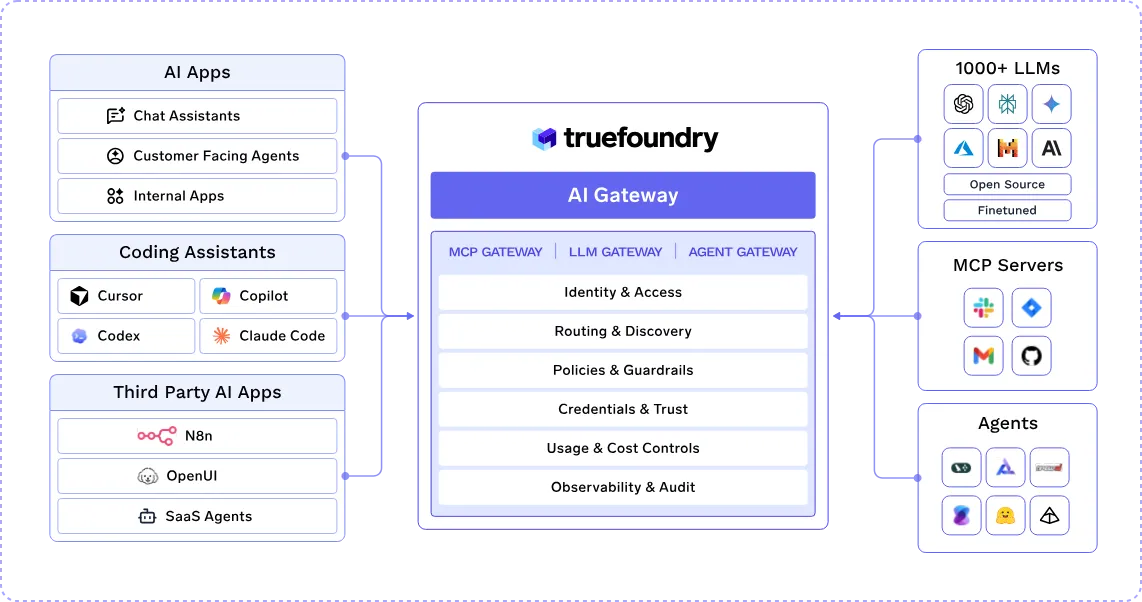
TrueFoundry provides an enterprise AI Gateway that helps organizations secure and manage access to LLMs, MCP servers, and AI agents through a centralized control plane. Instead of implementing separate security controls for each application, teams can enforce policies across AI traffic at the infrastructure layer.
The platform supports private-cloud deployment and integrates security tools into the request path. This allows organizations to inspect, block, or modify AI requests before they reach a model or tool, while keeping sensitive data within their own cloud environment.
Key Features
Centralized AI Gateway and Routing: Provides a unified access layer for AI models, MCP servers, and AI agents, with centralized usage policies and traffic management.
Private-Cloud Deployment: Runs inside your AWS, Google Cloud, Azure, or AWS GovCloud environment, helping you maintain control over data residency and network boundaries.
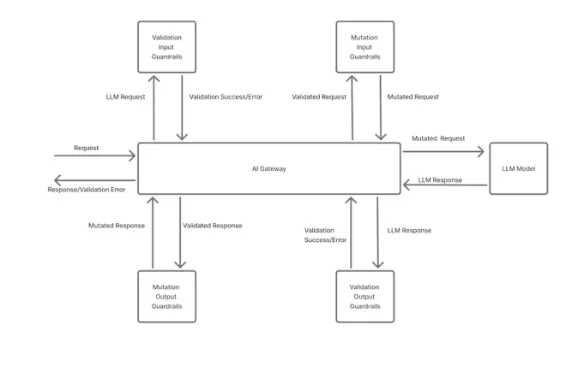
Modular Security Guardrails: Integrates external security tools, including HiddenLayer, into the AI request path. Validate guardrails inspect requests and can block them, while Mutate guardrails modify or redact content before it proceeds.
Centralized Policy Enforcement: Helps platform teams apply consistent security controls across AI applications rather than relying on each application to implement its own safeguards.
AI Traffic Visibility: Supports monitoring and governance across model calls and tool interactions, helping teams investigate activity and maintain audit records.
Flexible Infrastructure Controls: Combines AI traffic management with security integrations, allowing organizations to build a security layer that fits their existing infrastructure.
Pricing
TrueFoundry offers a free Developer plan, a Pro plan at $25 per user/month, and a custom-priced Enterprise plan with advanced security, governance, and private deployment options. Check the pricing page for details
Best For: CTOs, platform engineering teams, and large enterprises that need centralized AI traffic control, private-cloud deployment, low-latency request processing, and data residency controls for regulated workloads.
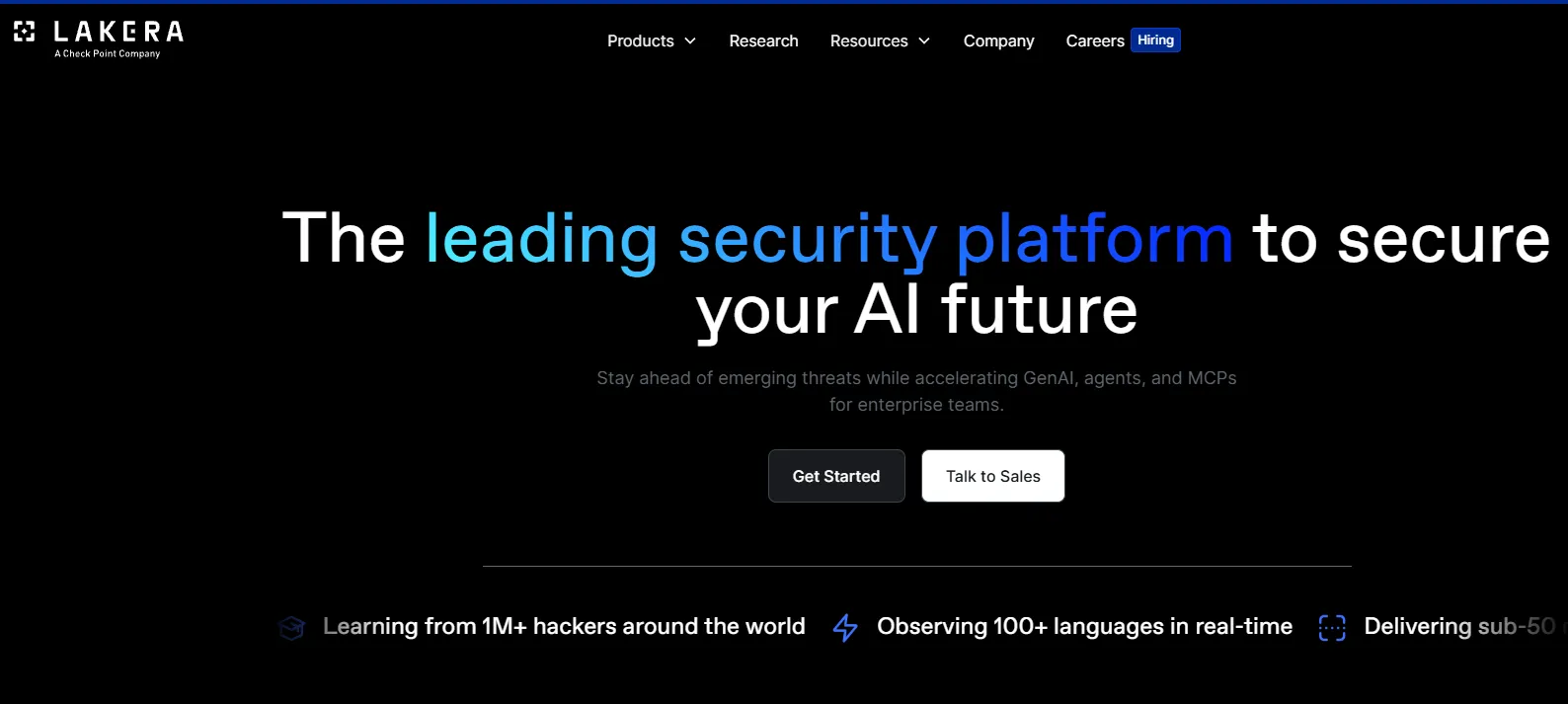
2. Lakera (Check Point)
Primary security layer: Runtime guardrails
Lakera specializes in runtime security for generative AI applications. It inspects AI interactions to detect and block threats such as prompt injection, jailbreaks, and sensitive data leakage before they compromise an application.
Its context-aware security approach helps organizations apply consistent safeguards across different AI models and conversational applications without relying entirely on the underlying model's built-in protections.
Key Features
Real-Time Threat Prevention: Detects and blocks prompt injection, jailbreak attempts, and data leakage.
Context-Aware Detection: Uses specialized AI security models to assess potentially malicious inputs and reduce incorrect threat classifications.
Centralized Policy Controls: Helps teams apply security policies across chatbots and other conversational AI applications.
Model-Agnostic Protection: Supports protection across different underlying models and AI application configurations.
Pros
Focuses on threats targeting live generative AI applications.
Helps security teams apply consistent runtime safeguards across models.
Cons
Organizations needing private-cloud AI routing and broader infrastructure management may require additional capabilities.
Its runtime focus may not replace dedicated machine learning supply chain security tools.
Best For: Application developers and security teams that need real-time, model-agnostic protection against prompt injection, jailbreaks, and data leakage.
3. Protect AI
Primary security layer: ML development pipelines
Protect AI focuses on machine learning security, vulnerability management, and protection across the AI development lifecycle. It helps organizations identify weaknesses in model files, datasets, code dependencies, and other components used to build and deploy AI systems.
Its approach is particularly relevant to teams developing custom machine learning models that need security checks throughout training, development, and production.
Key Features
MLSecOps Integration: Supports security across machine learning engineering workflows, from model development to deployment.
Vulnerability Tracking: Helps identify vulnerabilities in open-source models, datasets, and code dependencies.
Pipeline Security: Helps teams identify risks in the components and processes used to build AI systems.
Model Risk Assessment: Supports security reviews of AI assets before they are deployed.
Pros
Addresses vulnerabilities across machine learning development pipelines.
Helps organizations identify supply chain and dependency risks early.
Cons
Teams primarily looking for real-time LLM traffic inspection may need a separate AI gateway or runtime security layer.
Implementing pipeline-wide security checks may require integration with existing ML development workflows.
Best For: Organizations building custom machine learning models that need security visibility across training environments, model dependencies, and ML deployment pipelines.
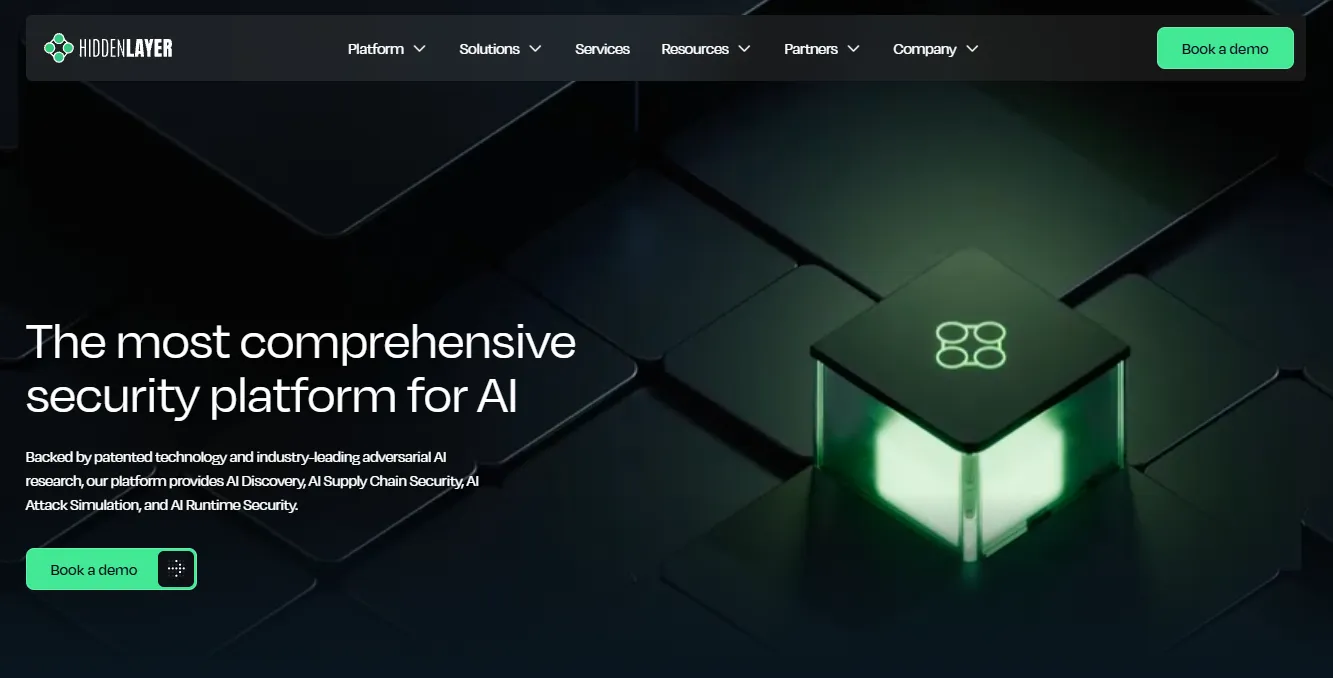
4. HiddenLayer
Primary security layer: AI supply chain and runtime protection
HiddenLayer provides enterprise AI security capabilities covering AI discovery, model supply chain security, attack simulation, and runtime protection. It helps organizations understand which AI assets they use and identify vulnerabilities in models and applications before attackers can exploit them.
Its model-scanning capabilities are particularly useful for enterprises working with third-party models, open-source weights, and different machine learning frameworks.
Key Features
Model Supply Chain Security: Its ModelScanner analyzes model artifacts across multiple formats, including PyTorch, TensorFlow, ONNX, GGUF, and Safetensors.
AI Discovery and Inventory: Helps identify and inventory AI applications, models, and active agents across an organization's environment.
Attack Simulation: Supports security testing to uncover weaknesses in AI systems before they are exploited.
Runtime Protection: Monitors AI interactions and helps detect threats targeting generative AI applications and AI agents.
Pros
Covers multiple stages of AI security, from model artifacts to runtime interactions.
Supports a broad range of model formats, making it useful for diverse AI environments.
Cons
Organizations may need additional infrastructure controls for centralized model routing and usage management.
Integrating security across diverse AI assets can require coordination with existing security and development tools.
Best For: Enterprises using diverse third-party models, open-source model weights, and complex AI agent architectures that need model scanning, asset discovery, and runtime protection.
5. Robust Intelligence (Cisco)
Primary security layer: Model validation and runtime protection
Robust Intelligence focuses on identifying AI vulnerabilities through pre-deployment testing and runtime protection. Its approach helps organizations test how models respond to unexpected inputs and potential attacks before deployment, then monitor live interactions for emerging risks.
Following its acquisition by Cisco, its technology became part of Cisco's broader AI security portfolio, making its capabilities relevant to enterprises evaluating AI security alongside their existing security infrastructure.
Key Features
Pre-Deployment Validation: Stress-tests AI models against edge cases, adversarial inputs, and potential failure scenarios before release.
AI Security Testing: Helps identify weaknesses that could expose models to manipulation or unreliable behavior.
Runtime Protection: Its AI firewall approach monitors model inputs and outputs to detect and block certain attacks during live use.
Continuous Risk Assessment: Helps organizations evaluate model behavior and identify risks that may emerge after deployment.
Pros
Combines pre-deployment testing with runtime security concepts.
Supports a proactive approach to identifying model vulnerabilities before they affect users.
Cons
Enterprises should verify the availability and packaging of specific capabilities within Cisco's current portfolio.
Organizations may still need separate controls for AI gateway routing, tool permissions, and centralized usage governance.
Best For: Enterprises evaluating AI validation and runtime protection as part of a broader Cisco security strategy, particularly for customer-facing AI applications.
How to Choose an AI Security Platform
The right AI security platform depends on how your organization uses AI, the risks you need to address, and the level of control your team requires. Before choosing a solution, evaluate these key factors:
Identify your security needs: Determine whether you need protection against prompt injection and data leakage, model vulnerability scanning, runtime threat detection, or security controls across AI agents and tools.
Check integration with your AI stack: Choose a platform that works with your existing LLMs, AI applications, frameworks, and MCP servers. Model-agnostic support can help you avoid being locked into a single provider.
Evaluate deployment and data privacy: Check whether the platform supports your preferred cloud, private VPC, on-premises, or air-gapped deployment. This matters if sensitive data must remain within your organization's security boundary.
Look for centralized policy enforcement: Ensure you can apply access controls, guardrails, and security policies consistently across AI applications. For enterprise use, consider role-based permissions and controls for AI agent tool calls.
Assess monitoring and audit capabilities: Look for visibility into prompts, model responses, tool calls, and security events. Detailed logs help your team investigate incidents and demonstrate compliance.
Consider performance and scalability: Security checks should not introduce unacceptable latency. Evaluate how the platform performs under your expected traffic volume and whether it can scale with growing AI workloads.
Compare pricing and operational effort: Review subscription costs, usage limits, deployment expenses, and integration requirements. Consider the engineering effort needed to manage the platform alongside its direct cost.
AI Security Platform vs. AI Gateway vs. AI Guardrails
AI security platforms, AI gateways, and AI guardrails serve different purposes, but they work best when used together.
An AI security platform provides broader security management, an AI gateway controls traffic between applications and AI systems, and AI guardrails inspect inputs and outputs to enforce safety policies.
Feature
AI Security Platform
AI Gateway
AI Guardrails
Primary purpose
Manage AI security risks across the organization
Control and secure AI traffic
Enforce safety and security rules on AI interactions
Main focus
Threat detection, risk management, and governance
Routing, access control, monitoring, and policy enforcement
Prompt injection detection, data redaction, and output filtering
Where it operates
Across the AI lifecycle, depending on the solution
Between AI applications, models, and tools
Within the request and response processing flow
Key capabilities
AI asset discovery, vulnerability assessment, security monitoring
Model routing, authentication, rate limits, logging, and access policies
Input validation, PII detection, content filtering, and response validation
Example use case
Identifying security risks across an organization's AI systems
Restricting which models and tools an application can access
Blocking a prompt containing sensitive information
Examples
HiddenLayer, Protect AI
TrueFoundry AI Gateway
Lakera and integrated guardrail tools
How Do They Work Together?
Consider an AI assistant that helps employees retrieve information from internal company systems.
AI security platform: Helps identify risks across the AI environment and monitor security posture.
AI gateway: Controls which models and internal tools the assistant can access, applies permissions, and records requests.
AI guardrails: Inspect prompts and responses to detect threats, sensitive information, or policy violations before the interaction proceeds.
These layers address different risks. A gateway can control access to a tool, for example, but that alone may not detect a malicious instruction hidden in retrieved content. Guardrails can inspect that content, while broader security tools help teams assess risks across their AI environment.
Where TrueFoundry fits: TrueFoundry's AI Gateway acts as an infrastructure-level enforcement layer for AI traffic. It centralizes access policies and supports integrating security tools as guardrails that can inspect, block, redact, or modify requests along the processing path.
This lets enterprises combine traffic management with additional security checks instead of treating every AI application as a separate security boundary.
AI Gateways: The Enforcement Point for AI Security
An AI Gateway is a specialized proxy layer that sits between applications (or agents) and AI model services. Gartner describes it as middleware managing security, observability, routing, and cost for AI APIs. In other words, the AI Gateway is the runtime anchor of your AI security platform. It is here that policies from AIUC and AIAC are actually enforced on live traffic. Let’s break down the key roles an AI Gateway plays in securing AI:
Runtime Protection & Guardrails: Every request to a model passes through the gateway’s security and policy engine. Here, input guardrails can validate or mutate prompts before they hit the LLM. For example, the gateway can automatically mask or redact PII, sanitize inputs to prevent prompt injection, or outright block disallowed queries. Similarly, output guardrails scan and transform model responses: filtering profanity, removing hallucinated private data, or enforcing a consistent answer format. By front-ending each AI call with these checks, the gateway enforces corporate security policies just like an API firewall.
Data Residency & Hybrid Control: Many enterprises require that certain data never leave a specific cloud or region. AI Gateways make this possible by routing traffic based on geolocation or deployment rules. You could send regulated data only to an on-prem model, or use a sovereign-cloud LLM for EU customer data. The gateway’s centralized routing logic ensures requests land where they should, and that none of them slip out to unauthorized cloud endpoints. In effect, the gateway provides data-residency controls for AI.
Model and Provider Governance: An AI Gateway keeps a single inventory of models and AI services. Administrators can register approved LLM endpoints (OpenAI, Anthropic, on-prem Llama, etc.), along with fine-grained access controls. Each application or user can be authorized for only the models it needs. The gateway also handles credential management and key rotation for those services. In practice, this means the gateway acts like an AI-network manager: it can throttle or quota usage per model, deny calls to out-of-policy providers, and perform intelligent load balancing across multiple model deployments. For example, if one model instance is hitting its token limit, the gateway can route overflow to a secondary instance to ensure reliability. These controls address Gartner’s call for “consistent guardrails and content moderation across third-party and in-house AI”.
Agentic AI and MCP Integration: Modern AI agents often interact with external tools and data stores. TrueFoundry’s gateway natively supports the Model Context Protocol (MCP) to connect agents to enterprise systems in a secure way. This allows the gateway to trace every action an agent takes – which tools it calls, what data it retrieves – and enforce governance on those actions as well. In other words, even autonomous multi-step processes remain under centralized audit and control. An AI Gateway can also set policy on agent behavior (“this agent can write emails but cannot execute financial transactions,” for example), effectively managing agentic AI risk.
Logging & AI Observability: Beyond blocking threats, the gateway provides rich telemetry. It logs every prompt sent and every response received, along with metadata like user identity, model choice, and execution time. Dashboards and alerts can then surface anomalies or risky trends (e.g. spikes in rejected prompts, unexpected uses of a particular model, or agents deviating from safe paths). TrueFoundry’s solution, for instance, offers integrated analytics and OpenTelemetry support so that LLM interactions appear in enterprise monitoring tools. This kind of AI observability is essential for forensic auditing and continuous compliance.
In essence, the AI Gateway is the enforcement engine of your AI Security Platform. It turns abstract policies into action at the point of integration with models. Gartner notes that modern gateways are evolving “from simple traffic routers to intelligent governance engines”. Organizations use AI Gateways to handle everything from cost optimization to AI trust/risk management. For example, the tasks: authenticating and authorizing AI calls, balancing load across endpoints, logging interactions, and enforcing token quotas – are listed as exactly the controls needed for secure AI deployment.
Bring AI Security and Governance Under One Roof
Protect AI applications with centralized access controls, configurable guardrails, and visibility across model and agent interactions.
TrueFoundry’s AI Gateway is built precisely to fulfill the role of a comprehensive AI Security Platform. Gartner has even recognized TrueFoundry as a representative vendor in this fast-evolving category. The Gateway acts as a unified control layer for AI – offering observability, governance, cost control, and security for your AI environment. Here’s how it meets the key requirements:
Centralized Ingress & Routing: All AI traffic flows through the gateway’s front end. TrueFoundry provides a single OpenAI-compatible API endpoint, so applications need only code against one URL. Behind the scenes, the gateway routes requests to the optimal model or cloud provider (OpenAI, Anthropic, AWS, Azure, etc.) based on rules you set. This enables use cases like latency-based routing or intent-based routing (sending finance queries to a finance-tuned model, for example). Automatic failover ensures continuity: if one model endpoint goes down, the gateway seamlessly retries on an alternate backend.
Token-Aware Cost Management: Built-in cost controls monitor token usage at a granular level – by user, team, model, or application. Administrators can set quotas and rate limits on token consumption to prevent runaway costs or noisy neighbors. The gateway also supports semantic caching: it detects when a new prompt is highly similar to a recent one and returns the cached response instead of incurring a new model call. In real workloads, this can cut redundant LLM requests by up to 40%, drastically lowering spend while speeding up responses. All usage data is tracked for billing and chargeback.
Security and Guardrail Enforcement: TrueFoundry’s gateway integrates with popular moderation and guardrail services to vet every request and response. It provides built-in hooks so you can apply content filters (via OpenAI Moderation, Azure Safety, Enkrypt AI, etc.) to block or mutate unsafe prompts and outputs.
For example, upon receiving a user prompt, the gateway can run an integrated privacy filter to redact any sensitive PII before calling the model. After the model returns an answer, the gateway can apply another policy (e.g. “no medical advice allowed”) and block any responses that violate enterprise policy. The gateway also handles credential rotation and RBAC for AI keys: individual developers or services get only the permissions they need. By default it enforces OAuth2/OIDC, so your standard identity controls govern who can query which model. In short, it acts as an AI firewall and content filter on every interaction – a central enforcement point for AI governance.
Example Use Case: Consider a financial firm building an AI-powered assistant for customer service. Using TrueFoundry AI Gateway, the company can set a policy that any prompt to the assistant first passes through a compliance filter (blocking any request containing account numbers or instructions to execute trades). The assistant’s responses are similarly filtered for inappropriate financial advice.
All interactions are logged for auditing. Moreover, the gateway can route regulatory-sensitive queries to an internally-hosted LLM (ensuring data never goes to an external cloud), while other traffic uses a public model for general knowledge. Meanwhile, token usage by the assistant is tracked and capped, preventing surprises in the cloud bill. In this way, the gateway operationalizes the firm’s AI governance rules end-to-end.
Conclusion
In summary, AI gateways are central to any modern AI security strategy. They serve as the operational enforcement point for the Gartner-defined AI Security Platform, applying centralized policies and guardrails at the point of inference. By inspecting every prompt and output, controlling model access, and providing full observability, AI gateways transform the distributed chaos of AI usage into a governable, secure system.
TrueFoundry’s AI Gateway embodies this vision as a unified AI firewall and control plane. It delivers AI security platform capabilities, from prompt injection protection and data loss prevention to agentic AI risk management, all in one technical stack. Gartner even recognizes TrueFoundry’s offering as a leader in this space. For CTOs and AI platform teams, deploying an AI Gateway from a solution like TrueFoundry is the fastest way to operationalize AI security: it enforces usage policies, performs continuous risk testing, and ensures enterprise-grade compliance across your LLM and agent use cases.
With generative AI adoption surging, the time to act is now. An AI gateway turns AI security policies from hope into practice, blocking threats in real time and providing a single pane of glass for AI governance. By unifying third-party and custom AI under one roof, TrueFoundry AI Gateway helps enterprises “secure the path to AI adoption,” enabling innovation without compromising trust.
See how TrueFoundry’s AI Gateway can protect your LLMs, enforce policies, and provide full visibility across your AI stack, book a demo today.
TrueFoundry AI Gateway delivers ~3–4 ms latency, handles 350+ RPS on 1 vCPU, scales horizontally with ease, and is production-ready, while LiteLLM suffers from high latency, struggles beyond moderate RPS, lacks built-in scaling, and is best for light or prototype workloads.
AI security tools are solutions designed to protect AI systems, models, and data from threats like prompt injection, data leakage, and adversarial attacks. They provide monitoring, access control, content filtering, and policy enforcement to ensure safe, compliant, and reliable AI usage.
Do I need an AI security gateway?
If you’re deploying AI in production, an AI security gateway helps centralize control, enforce policies, and monitor usage. It protects against threats like prompt injection and data leaks while ensuring compliance, making it essential for scaling AI applications securely and reliably.
What are the 5 best AI security platforms?
Some leading AI security platforms include Lakera, Protect AI, HiddenLayer, Robust Intelligence, and TrueFoundry. These tools offer capabilities like threat detection, model monitoring, policy enforcement, and secure deployment, helping organizations protect AI systems across development and production environments.
How do AI security platforms protect against model exploitation?
AI security platforms protect against exploitation by intercepting malicious inputs, such as prompt injections or jailbreaking attempts, before they reach the model. TrueFoundry enhances this defense by integrating real-time guardrails and input sanitization, ensuring that model interactions stay within safe, predefined boundaries while mitigating the risk of unauthorized command execution.
How do AI security platforms handle API key protection?
Modern AI security platforms replace fragmented, hardcoded credentials with centralized secret management. TrueFoundry’s gateway allows developers to access multiple model providers using a single, secure identity via RBAC. By managing provider keys internally and supporting automated rotation, it ensures that sensitive API secrets are never exposed to end users or stored in application code.
Can AI security platforms protect against data leakage?
Yes, AI security platforms are specifically designed to prevent sensitive corporate data from being sent to external model providers. TrueFoundry provides automated PII masking and log scrubbing to redact confidential information in real time. Because the platform deploys within your own VPC, it ensures that proprietary data remains under your direct control, satisfying strict data residency requirements.
How do AI security platforms help secure AI APIs and gateways?
AI security platforms act as a secure proxy layer that enforces consistent policies across all model endpoints. TrueFoundry secures these gateways by providing federated authentication and comprehensive audit trails for every request. This centralized approach allows teams to apply rate limits, cost controls, and security filters across the entire organization through a single control plane.
What’s the difference between AI security platforms and traditional security tools?
While traditional tools focus on network-level threats like IP filtering or firewalls, AI security platforms operate at the semantic level. They are designed to understand prompts, tokens, and model outputs, allowing them to detect AI-specific risks like data poisoning or toxic content. TrueFoundry provides this specialized intelligence, offering a security layer that traditional WAFs cannot provide for complex LLM workloads.
What are the top 3 AI security risks?
The top three AI security risks are prompt injection, sensitive data leakage, and unauthorized AI actions. Prompt injection manipulates AI behavior, data leakage exposes confidential information, and unauthorized actions occur when AI agents access systems or perform tasks without proper permissions.