
Search the Site with

|
Search the Site with
|
 General Characteristics Crew List Memorabilia Cruise Books About the Ship's Coat of Arms Accidents aboard the Ship USS Mobile Bay History Homeports of USS Mobile Bay About the Ship's Name Patch Gallery Image Gallery to end of page
 |  |  |
USS MOBILE BAY was the seventh ship in the TICONDEROGA-class of guided missile cruisers and the second ship in the class equipped with the
| General Characteristics: | Awarded: January 15, 1982 |
| Keel laid: June 6, 1984 | |
| Launched: August 22, 1985 | |
| Commissioned: February 21, 1987 | |
| Decommissioned: August 18, 2023 | |
| Builder: Ingalls Shipbuilding, West Bank, Pascagoula, Miss. | |
| Propulsion system: four General Electric LM 2500 gas turbine engines | |
| Propellers: two | |
| Blades on each Propeller: five | |
| Length: 567 feet (173 meters) | |
| Beam: 55 feet (16.8 meters) | |
| Draft: 34 feet (10.2 meters) | |
| Displacement: approx. 9,600 tons full load | |
| Speed: 30+ knots | |
| Cost: about $1 billion | |
| Aircraft: two | |
| Armament: two | |
| Crew: 33 Officers, 27 Chief Petty Officers and approx. 340 Enlisted |
 back to top go to the end of the pageback to top go to the end of the page
Crew List:
This section contains the names of sailors who served aboard USS MOBILE BAY. It is no official listing but contains the names of sailors who submitted their information.
back to top go to the end of the pageback to top go to the end of the pageUSS MOBILE BAY Cruise Books:
back to top go to the end of the page
About the Ship's Coat of Arms:
USS MOBILE BAY's shield, located in the center of the crest, contains a ship's wheel and crossed cutlass and sword. The wheel represents naval leadership on the oceans of the world. The modern ship, crossed swords, and cutlass signify professional expertise and the spirit of the Surface Warfare community from which the ship's officers and crew are drawn. A naval cannon, typical of armaments used in the Battle of Mobile Bay, supports the shield and symbolizes ancient and modern weaponry.
The ships' crest recalls the Battle of Mobile Bay by the silhouettes of the steam sloop USS Hartford and CSS Tennessee. The former was the flagship of Admiral David Farragut's Federal Fleet and the later a ram of the Confederate Navy. The four stars reflect Admiral Farragut's commission as the Navy's first four-star admiral.
The shield's border is made up of a continuous anchor chain signifies a unity of purpose and teamwork; the elongated octagonal band suggests the unique, primary radar associated with the AEGIS system.
back to top go to the end of the pageAccidents aboard USS MOBILE BAY:
| Date | Where | Events |
|---|---|---|
| September 6, 2002 | Arabian Gulf | While flying in support of maritime interdiction operations one of MOBILE BAY's SH-60 helicopters crashed in the Arabian Gulf. A civilian television cameraman was killed and four US Navy sailors were injured. The cameraman, from KCBS-TV Los Angeles, was filming a news story on the US Navy. The helicopter had been hovering over a Syrian-flagged vessel to observe a maritime health inspection boarding when its rotor blades hit the ship's mast. |
back to top go to the end of the page
History of USS MOBILE BAY:
The construction contract for USS MOBILE BAY was awarded to Ingalls Shipbuilding on January 15, 1982. Her keel was laid in June 1984, and she was launched on August 22, 1985. The ship was sponsored by Jane M. Denton, wife of retired Rear Adm. Jeremiah A. Denton Jr., a former naval aviator and prisoner of war who subsequently represented Alabama in the United States Senate. Following launching, construction and outfitting continued through 1985 and 1986, including installation and integration of the propulsion machinery, AEGIS combat system, missile launchers, communications facilities and electronic warfare equipment. Builder's trials and acceptance evaluations were conducted in the Gulf of Mexico before the ship was delivered to the Navy.
USS MOBILE BAY was commissioned at the Alabama State Docks in Mobile, Alabama, on February 21, 1987, with Capt. F. Richard Whalen as her first commanding officer. Following commissioning, the cruiser proceeded to her first homeport at Naval Station Mayport, Florida, arriving in March. During the remainder of 1987, MOBILE BAY completed initial training, engineering evaluations, combat systems certification and operational readiness inspections. Her exercises included air defense coordination, antisubmarine warfare training, tactical maneuvering and missile system evaluations. The ship's early operating period was intended to establish the readiness of the AEGIS combat system and its integration with other Atlantic Fleet warships and aircraft.
On December 31, 1987, USS MOBILE BAY received the Commander in Chief U.S. Atlantic Fleet Golden Anchor Award for personnel retention. During the opening months of 1988, she continued exercises and readiness inspections in the Atlantic and Caribbean. Her performance in food service was recognized with the Captain Edward Francis Ney Award, while her air warfare readiness resulted in the Commander Naval Surface Force Atlantic Fleet Anti-Air Warfare Award. The cruiser also conducted exercises involving the detection and engagement of simulated airborne threats while preparing for a possible overseas deployment.
A deployment to the Middle East had been scheduled for August 1988, when tensions remained high in the Persian Gulf because of the continuing Iran-Iraq War. American naval forces were conducting Operation Earnest Will to protect Kuwaiti tankers reflagged under the American flag. Following changes in operational requirements associated with the ceasefire between Iran and Iraq, which took effect on August 20, the planned deployment was canceled. MOBILE BAY consequently continued Atlantic Fleet operations.
On August 24, 1988, USS MOBILE BAY departed for NATO Exercise Teamwork 88, a major multinational maritime exercise conducted in the North Atlantic and northern European waters. The exercise involved American and allied naval units conducting coordinated air defense, antisubmarine warfare, surface warfare and tactical communications training. MOBILE BAY participated in operations intended to improve interoperability between NATO navies operating in the difficult weather and sea conditions of the northern Atlantic. She completed the exercise and returned to Mayport on October 12, 1988. On December 15, the cruiser received another Golden Anchor Award for personnel retention.
During the opening months of 1989, USS MOBILE BAY completed further qualifications, certifications and readiness training in preparation for her first extended overseas deployment. On April 1, she received the Secretary of the Navy Energy Conservation Award. Following completion of the necessary training and maintenance, MOBILE BAY departed Mayport on May 11, 1989, for a deployment to the Mediterranean and Indian Ocean.
During the initial phase of the deployment, USS MOBILE BAY participated in exercises with American and allied naval units in the Mediterranean. She maintained air defense surveillance and coordinated tactical information with other surface combatants and supporting aircraft. The deployment also provided opportunities to evaluate the AEGIS combat system during sustained operations in congested maritime areas and to develop the crew's proficiency in carrier escort and independent surveillance duties.
After proceeding through the Mediterranean and Suez Canal, USS MOBILE BAY entered the Indian Ocean and operated in the North Arabian Sea and Gulf of Oman. American naval forces maintained a presence in the region following the August 1988 ceasefire between Iran and Iraq, continuing to monitor maritime traffic and developments near the Strait of Hormuz. MOBILE BAY conducted air defense coordination, maritime surveillance, tactical training and operations with other American naval units. Her service in the Gulf of Oman qualified her for the Armed Forces Expeditionary Medal, while the overseas cruise was recognized with the Sea Service Deployment Ribbon.
During September 1989, USS MOBILE BAY was operating in the Mediterranean at a time of renewed fighting and political instability in Lebanon. The United States ordered the withdrawal of personnel from its embassy in Beirut as security conditions deteriorated. American naval forces in the Mediterranean maintained contingency arrangements to support the withdrawal and provide assistance if required. MOBILE BAY operated with these forces during the crisis, conducting maritime surveillance and maintaining readiness for possible evacuation support.
Following completion of her overseas assignment, USS MOBILE BAY returned to Mayport on September 30, 1989. The deployment had lasted more than four months. During November and December, the cruiser resumed local training, antisubmarine warfare exercises and visits to American ports. The ship also began preparations for a major change in her operational assignment.
During the first half of 1990, USS MOBILE BAY transferred from the Atlantic Fleet to the forward-deployed American naval force in the western Pacific. In June, she shifted her homeport from Mayport, Florida, to Fleet Activities Yokosuka, Japan. The relocation placed the cruiser under the operational control of the Seventh Fleet and enabled her to support American naval operations in Northeast Asia and the western Pacific without returning regularly to the United States between deployments. The transfer to Japan coincided with significant changes in the international security environment. On August 2, 1990, Iraq invaded Kuwait, prompting the United States and its allies to deploy military forces to the Middle East under Operation Desert Shield. The American naval presence in the Persian Gulf and adjoining waters was expanded to enforce United Nations sanctions, deter further Iraqi military advances and prepare for possible combat operations.
During August 1990, USS MOBILE BAY deployed from the western Pacific in support of Operation Desert Shield. The cruise included extensive operations in the Indian Ocean and Persian Gulf region. Her movements between the Atlantic and Pacific Fleets and subsequent deployment to the Middle East also completed the ship's first circumnavigation of the globe. MOBILE BAY's AEGIS combat system made her particularly suitable for air defense coordination in the increasingly large multinational naval force assembled in the region.
During the final months of 1990, USS MOBILE BAY participated in maritime surveillance, air defense training and contingency preparations while American and coalition forces continued to assemble in the Middle East. The cruiser operated with carrier battle groups and other surface combatants assigned to enforce sanctions against Iraq and protect regional maritime routes. Her duties included identifying aircraft, maintaining radar surveillance and coordinating information among participating ships and aircraft.
At the beginning of January 1991, USS MOBILE BAY was operating with Battle Group Alpha in the Indian Ocean in support of Operation Desert Shield. During the opening days of the year, she completed a four-day maintenance period alongside the destroyer tender USS ACADIA (AD 42), which was anchored off the coast of Oman. The availability allowed the crew to complete necessary equipment repairs and preparations before the anticipated commencement of military operations against Iraq.
On January 11, 1991, USS MOBILE BAY transited the Strait of Hormuz into the Persian Gulf in company with the aircraft carrier USS MIDWAY (CV 41). The following morning, the cruiser assumed duties as alternate Anti-Air Warfare Commander for Battle Force Zulu, the American naval formation operating in the Persian Gulf. The assignment required MOBILE BAY to maintain an extensive air surveillance picture and coordinate defensive information between ships and aircraft operating in the region.
On January 15, 1991, USS MOBILE BAY detached from USS MIDWAY and proceeded toward a station in the northern Persian Gulf near Farsi Island. Together with the guided missile cruisers USS BUNKER HILL and USS WORDEN (CG 18), MOBILE BAY formed part of an air defense screen extending across the northern Gulf. The aircraft carrier USS RANGER (CV 61) joined the force during the same period. The participating cruisers maintained air surveillance and coordinated information from their radars to protect the ships operating near the Kuwaiti coast.
Operation Desert Storm began on January 17, 1991, following the expiration of the United Nations deadline for Iraqi withdrawal from Kuwait. American and coalition aircraft and warships launched attacks against Iraqi military facilities, air defense installations, command centers and other targets. During the opening phase of the campaign, surface ships and submarines fired Tomahawk land-attack cruise missiles at targets throughout Iraq. Between January 18 and January 20, 1991, USS MOBILE BAY launched a total of 22 Tomahawk cruise missiles against Iraqi military targets. The launches were conducted in coordination with the wider naval and air campaign, which involved aircraft carriers operating in the Persian Gulf and Red Sea. The strike operations required careful coordination of missile flight paths, airspace control and communications between naval units and supporting command authorities.
During the same period, American naval forces continued to expand their carrier presence in the Persian Gulf. The nuclear-powered aircraft carrier USS THEODORE ROOSEVELT (CVN 71) reinforced the force on January 19, joining USS MIDWAY and USS RANGER. The larger American naval presence provided additional aircraft for operations against Iraq while increasing the requirements for coordinated air defense and airspace management.
Because USS MOBILE BAY operated relatively close to the Kuwaiti coast and possessed extensive surveillance capabilities, she was assigned additional duties as an anti-surface warfare air-control ship. From January 21 through March 11, 1991, the cruiser supported operations intended to locate and attack Iraqi naval units operating in the northern Persian Gulf. During this period, American and coalition aircraft and ships destroyed or disabled numerous Iraqi patrol boats, minelayers and other naval vessels. MOBILE BAY contributed to the detection, identification and targeting of Iraqi surface units during operations in which 38 Iraqi naval vessels were destroyed or disabled.
On January 24, 1991, USS MOBILE BAY was involved in a potentially dangerous air defense incident. Iraqi military aircraft departed an airfield near al-Kut, southeast of Baghdad, and proceeded toward the Kuwaiti coast. Two Iraqi Mirage F1 fighters continued southeast through an area near the boundary between American Air Force and Navy radar coverage. An American E-3 Sentry airborne warning and control aircraft detected the approaching fighters but experienced difficulties in communicating the information to the naval air defense units, including USS MOBILE BAY, USS BUNKER HILL and USS WORDEN.
American F/A-18 Hornet fighters from USS MIDWAY and USS THEODORE ROOSEVELT attempted to intercept the Iraqi aircraft but were unable to complete the engagement. The E-3 subsequently directed Saudi Arabian Air Force F-15 Eagle fighters toward the Iraqi aircraft. Saudi Capt. Ayedh al-Shamrani intercepted and shot down both Mirage F1 fighters using Sidewinder air-to-air missiles. Before being intercepted, the Iraqi aircraft had approached to within approximately 60 nautical miles of USS MOBILE BAY, close enough to represent a potential threat if armed with Exocet antiship missiles. The incident demonstrated the difficulties of coordinating air defense information among different national forces and command systems during large-scale coalition operations.
On February 14, 1991, USS MOBILE BAY relieved USS BUNKER HILL as Anti-Air Warfare Commander for Battle Force Zulu. The following day, the aircraft carrier USS AMERICA (CV 66) entered the Persian Gulf and joined the formation, increasing the number of American aircraft carriers operating with the force to four. MOBILE BAY became responsible for coordinating air defense information among the ships and aircraft of this large naval formation.
The assignment involved extensive control and surveillance responsibilities. During the remaining weeks of Operation Desert Storm, USS MOBILE BAY monitored, identified and coordinated an average of more than 2,500 aircraft movements per day, including strike aircraft, fighters, reconnaissance aircraft and command and control platforms. Her combat information center also coordinated armed reconnaissance aircraft and maintained a continuous radar picture involving large numbers of air contacts. The ship's AEGIS system normally tracked approximately 120 aircraft simultaneously, with higher numbers during periods of intensive operations.
On February 24, 1991, coalition ground forces began the offensive to liberate Kuwait. American carrier aircraft continued attacks against Iraqi forces while the naval formation maintained air defense coverage and maritime security operations in the Persian Gulf. USS MOBILE BAY continued coordinating the air surveillance picture and monitoring possible threats to the participating ships. The coalition ground campaign achieved its principal objectives within several days, and a ceasefire took effect on February 28.
Following the ceasefire, USS MOBILE BAY remained in the Persian Gulf region for continued maritime security, surveillance and operational duties. American naval forces maintained a presence while mine countermeasures operations and other activities associated with the end of the conflict continued. After departing the Middle East, MOBILE BAY crossed the Indian Ocean and made port visits to Pattaya, Thailand, Hong Kong and Subic Bay, Philippines. She returned to Yokosuka on April 15, 1991, completing her principal Operation Desert Shield and Desert Storm deployment.
During the following weeks, USS MOBILE BAY underwent post-deployment maintenance, crew leave and readiness restoration. The ship's participation in the Gulf War was recognized through unit and individual decorations, including the Navy Unit Commendation and Joint Meritorious Unit Commendation. Crew members also received campaign and service medals associated with the operations.
In June 1991, USS MOBILE BAY received new orders following the eruption of Mount Pinatubo on the Philippine island of Luzon. The volcano erupted violently on June 12, sending ash and debris over a wide area. Typhoon Yunya compounded the damage when heavy rainfall and strong winds struck the region shortly afterward. The disaster damaged military facilities and civilian communities, forcing the evacuation of large numbers of American military personnel, dependents and other affected residents. The United States began Operation Fiery Vigil to evacuate personnel from Naval Station Subic Bay, Naval Air Station Cubi Point and Clark Air Base. American naval forces involved in the operation included the aircraft carriers USS ABRAHAM LINCOLN (CVN 72) and USS MIDWAY, together with amphibious forces centered on USS PELELIU (LHA 5).
USS MOBILE BAY proceeded at high speed toward the Philippines and arrived at Subic Bay on June 21, 1991. She was assigned to support the evacuation of personnel from the affected area. After USS MIDWAY embarked the final evacuees assigned to the carrier, MOBILE BAY escorted the ship to Cebu, where American Air Force transport aircraft provided onward transportation. After completing her assignment in Operation Fiery Vigil, MOBILE BAY returned toward Japan and arrived at Yokosuka on July 1, 1991. The arrival marked the conclusion of a second major operation during the same year, following the Gulf War deployment.

 During the remainder of 1991, USS MOBILE BAY entered a period of inspections and maintenance, including a dry-docking availability from September through November. In December, she resumed training and preparations for another deployment to the Middle East. American naval forces continued to maintain a substantial presence in the Persian Gulf, where their assignments included enforcing United Nations restrictions against Iraq, monitoring regional military activity and maintaining the security of international shipping routes.
On April 15, 1992, USS MOBILE BAY departed Yokosuka for another deployment to the Persian Gulf. During the westbound passage, the cruiser visited Sydney, Australia, to participate in events commemorating the fiftieth anniversary of the Battle of the Coral Sea. The commemorations recalled the May 1942 naval battle in which American and Australian forces helped prevent a Japanese advance toward Port Moresby. The visit included official ceremonies and professional exchanges between American and Australian naval personnel. After leaving Australia, USS MOBILE BAY continued across the Indian Ocean and entered the Persian Gulf through the Strait of Hormuz in late May 1992. She assumed duties as Anti-Air Warfare Commander for American naval forces operating in the region. These responsibilities included maintaining air surveillance, monitoring regional military aircraft and coordinating defensive procedures with participating ships and supporting aircraft.
During the deployment, USS MOBILE BAY participated in maritime security operations associated with the continuing sanctions imposed on Iraq after the 1991 Gulf War. American and coalition forces monitored merchant shipping and maintained readiness to respond to Iraqi military activity. MOBILE BAY's radar and communications equipment allowed the cruiser to provide air defense coordination over a large maritime operating area.
In August 1992, the United States, United Kingdom and France established Operation Southern Watch to enforce restrictions on Iraqi military aviation over southern Iraq. USS MOBILE BAY supported the initial implementation of the operation while American and coalition aircraft began patrols south of the 32nd parallel. The cruiser maintained air surveillance, coordinated tactical information and provided defensive support for naval forces operating in the Persian Gulf.
Following completion of the Middle East operating period, USS MOBILE BAY returned to Yokosuka in October 1992. She subsequently participated in ANNUALEX 92, a large combined exercise involving the U.S. Navy and Japan Maritime Self-Defense Force. During the exercise, MOBILE BAY served as Anti-Air Warfare Commander for a combined American-Japanese naval formation. The training involved tactical maneuvering, simulated air and missile attacks, antisubmarine warfare and communications procedures intended to improve interoperability between the participating forces.
On January 15, 1993, USS MOBILE BAY visited Nagasaki, Japan, marking one of the first visits by an American naval vessel to the city in several years. The visit included official engagements with Japanese authorities and opportunities for contact between the crew and the local community. Following the visit, MOBILE BAY resumed training and operations from Yokosuka.
In May 1993, USS MOBILE BAY proceeded to Western Australia for Exercise Spring Training 93. The multinational exercise involved American, Australian and Singaporean naval forces and included air defense, surface warfare, antisubmarine warfare and tactical communications training. The participating ships and aircraft practiced combined operations designed to improve coordination among regional naval forces. Following Spring Training 93, USS MOBILE BAY returned to Japan and continued combat systems training and maintenance. During July 1993, the cruiser received modifications allowing her to employ the Block III Tomahawk cruise missile, becoming one of the first ships in the fleet to receive the upgraded capability. From July 19 to July 23, she completed an inspection conducted by the Board of Inspection and Survey, which evaluated the material condition and operational readiness of the ship's equipment and systems.
 In September 1993, USS MOBILE BAY participated in a diplomatic visit to Vladivostok, Russia, together with the guided missile cruiser USS BUNKER HILL. The two American ships arrived on September 18 and remained until September 20. The visit followed the end of the Cold War and formed part of efforts to improve relations between the United States and Russia, including professional contact between their naval forces. During the visit, American and Russian naval personnel participated in ship tours, official receptions and professional exchanges.
Following the visit to Russia, USS MOBILE BAY returned to Seventh Fleet operations and prepared for another deployment to the Middle East. On November 17, 1993, she departed Yokosuka for her next Persian Gulf assignment. The deployment took place during continuing international efforts to enforce sanctions and restrictions on Iraqi military operations. After arriving in the Persian Gulf in December 1993, USS MOBILE BAY assumed duties as Anti-Air Warfare Commander for American naval forces in the region. She also remained available as a Tomahawk land-attack platform in the event that military operations against Iraq became necessary. Her duties included air defense surveillance, maritime security operations, exercises and coordination with other American and coalition surface combatants. MOBILE BAY remained on station until February 1994 before beginning the return passage to Japan.
On March 17, 1994, USS MOBILE BAY returned to Yokosuka, completing another deployment to the Middle East. Following a short dry-docking availability in May, the cruiser proceeded to Hawaiian waters for RIMPAC 94. The multinational exercise involved more than fifty warships from five Pacific Rim countries and included air defense, antisubmarine warfare, surface warfare and coordinated maritime operations. MOBILE BAY subsequently returned to Japan and resumed Seventh Fleet duties.
During the autumn of 1994, USS MOBILE BAY conducted several periods of independent operations in the western Pacific. The cruiser visited Hong Kong in early September and subsequently operated in the vicinity of Leyte Gulf during October. Her schedule included additional visits to Southeast Asian ports, tactical exercises and training with regional naval forces.
During 1995, USS MOBILE BAY maintained an extensive operating schedule from Yokosuka. The cruiser participated in readiness exercises and deployments throughout East Asia and the Persian Gulf. These activities included air defense coordination, maritime surveillance, training with other American and allied warships and operations associated with the continued enforcement of restrictions on Iraqi military activity. MOBILE BAY returned to Japan in December after completing her operating commitments.
On January 8, 1996, USS MOBILE BAY entered a major dry-docking maintenance availability at Yokosuka that continued until May 21. The work included inspections and repairs to the hull, propulsion machinery, auxiliary systems and combat equipment. After completing the availability, MOBILE BAY conducted sea trials, equipment evaluations and training intended to restore her operational readiness.
During the second half of 1996, USS MOBILE BAY resumed exercises with Seventh Fleet forces. From October 16 through November 12, the cruiser participated in a series of combined exercises, including Foal Eagle, Keen Sword and ANNUALEX. The activities involved American, Japanese and South Korean naval forces conducting air defense, surface warfare, antisubmarine warfare and tactical communications training. From December 7 to December 13, MOBILE BAY participated in Missile Exercise 1-97, evaluating weapons readiness and the integration of her missile systems with the AEGIS combat system. The cruiser subsequently received the 1996 Battle Efficiency Award.
During the opening months of 1997, USS MOBILE BAY completed additional operational training, including antisubmarine warfare exercises, engineering certification, naval surface fire support evaluations and combat systems inspections. These activities prepared the cruiser for another inspection by the Board of Inspection and Survey in July. Following the inspection, MOBILE BAY resumed fleet operations and continued training with other Seventh Fleet ships.
During the autumn of 1997, USS MOBILE BAY operated with the carrier battle group centered on USS INDEPENDENCE (CV 62). Her activities included Foal Eagle 98, ANNUALEX and antisubmarine warfare exercises with American and Japanese naval units. The cruiser provided air defense surveillance and tactical coordination during the combined operations while maintaining readiness for possible regional contingencies.
During 1998, USS MOBILE BAY continued Seventh Fleet training and operations from Yokosuka. Her operating schedule included exercises with American and allied naval forces, maintenance periods and preparation for further deployments in the western Pacific. The ship maintained her responsibilities as an AEGIS-equipped surface combatant capable of providing air defense coordination for carrier and amphibious forces.
During the spring of 1999, USS MOBILE BAY made three transits of the Taiwan Strait at a time of renewed tension between Taiwan and the People's Republic of China. The transits were conducted as part of the continuing American naval presence in the western Pacific and the U.S. Navy's freedom-of-navigation activities. In early May, MOBILE BAY visited Singapore to participate in the International Maritime Defence Exhibition Asia, where naval vessels and defense representatives from several countries gathered for professional exchanges and equipment demonstrations.
During June 1999, USS MOBILE BAY was ordered to waters near the Korean Peninsula as tensions increased between North and South Korea over fishing rights and disputed maritime boundaries in the Yellow Sea. The confrontation became known as the First Battle of Yeonpyeong and formed part of a wider series of disputes sometimes referred to as the Crab Wars. MOBILE BAY maintained maritime surveillance and readiness while American naval forces monitored the situation.
On August 23, 1999, USS MOBILE BAY departed Japan for an operating period that was originally intended to include visits to Australian ports and participation in Exercise Crocodile 99. The schedule changed following the deterioration of security conditions in East Timor. A United Nations-sponsored referendum on August 30 resulted in a vote for independence from Indonesia, but violence by pro-Indonesian militias and associated security forces forced large numbers of civilians to flee their homes. The United Nations authorized a multinational force, known as INTERFET, to restore security.
USS MOBILE BAY was redirected by Commander Seventh Fleet toward waters off East Timor and began participating in the American naval contribution to the international operation. From approximately September 20 to October 5, 1999, the cruiser operated in support of the Australian-led INTERFET force. MOBILE BAY served as a command and surveillance platform for American naval forces. Her responsibilities included air defense coordination, intelligence gathering, maritime surveillance, escort duties and the provision of a secure operating location for supporting military personnel. The cruiser also managed tactical data links and provided radar information to assist aircraft transporting troops and humanitarian supplies into and out of East Timor.
The operation required extensive cooperation between American, Australian and other multinational forces. MOBILE BAY's air surveillance capabilities were particularly important because the multinational force depended heavily on transport aircraft and helicopters while security and infrastructure conditions ashore remained unstable. The cruiser maintained communications with participating ships and aircraft, coordinated surveillance information and supported operations intended to restore security and facilitate humanitarian assistance.
On October 7, 1999, the amphibious assault ship USS BELLEAU WOOD (LHA 3) assumed responsibility for the principal American naval support functions in the East Timor operating area. Following completion of her assignment, USS MOBILE BAY resumed Seventh Fleet operations and continued her previously planned western Pacific itinerary. The remainder of MOBILE BAY's 1999 deployment included visits to Singapore, Pattaya in Thailand, Kagoshima and Sasebo in Japan. During November, the cruiser participated in ANNUALEX with units of the Japan Maritime Self-Defense Force before returning to normal operations from Yokosuka.
In July 2000, USS MOBILE BAY transferred her homeport from Yokosuka, Japan, to Naval Station San Diego, California, ending approximately ten years of forward-deployed Seventh Fleet service. The move placed her in the normal Pacific Fleet deployment cycle based in the United States. During the remainder of 2000, the cruiser underwent maintenance and continued training in the eastern Pacific. She subsequently received the 2000 Battle Efficiency Award.
During 2001, USS MOBILE BAY became involved in the Navy's Optimal Manning Project, an initiative intended to evaluate whether increased automation and changes in shipboard organization could reduce crew requirements without diminishing operational readiness. The cruiser was one of a small number of ships selected to test concepts associated with automated shipboard control and monitoring systems. The program followed earlier experiments conducted under the Navy's Smart Ship initiative and was intended to provide information relevant to the design and operation of future surface combatants.
The modifications and evaluations conducted aboard USS MOBILE BAY included changes to selected shipboard systems and operating procedures, together with crew training and assessments of workload. The project examined the use of integrated monitoring equipment and improved communications to reduce the number of personnel required for certain routine tasks. The cruiser subsequently resumed Pacific Fleet operations while continuing to evaluate the effects of the changes on readiness and crew workload.
On December 21, 2001, USS MOBILE BAY participated in a major counter-narcotics operation in the eastern Pacific. A Coast Guard Law Enforcement Detachment embarked aboard the cruiser seized approximately 10.5 metric tons of cocaine from a vessel operating about 800 miles southwest of Acapulco, Mexico. The operation involved maritime surveillance and coordination between the ship's crew, embarked law-enforcement personnel and supporting agencies. The seizure was one of the largest recorded during the period.
During the opening months of 2002, USS MOBILE BAY resumed training and preparations for another overseas deployment with the carrier battle group centered on USS ABRAHAM LINCOLN. The preparations included combat systems readiness assessments, missile and ammunition loading, engineering evaluations, force-protection inspections and combined exercises with other battle group units.
On April 10, 2002, Capt. W. James Kear assumed command of USS MOBILE BAY from Capt. Peter B. Opsal during a ceremony at Naval Station San Diego. Later in April, the cruiser proceeded to Naval Weapons Station Seal Beach to load ammunition before participating in a Joint Task Force Exercise with the carrier battle group. The exercise included tactical scenarios intended to prepare the ships for operations in a region affected by terrorism, international sanctions and possible military conflict. From May 14 to May 16, 2002, USS MOBILE BAY completed a Battle Group Force Protection Inspection, evaluating the crew's response to simulated terrorist attacks, chemical and biological threats and other security incidents. On June 14, she completed an inspection by the Board of Inspection and Survey. Following completion of the inspection and associated preparations, MOBILE BAY began the final pre-deployment phase.
On July 24, 2002, USS MOBILE BAY departed San Diego with the USS ABRAHAM LINCOLN Battle Group for operations in the western Pacific, Indian Ocean and Persian Gulf. The deployment took place during the continuing American military campaign against al-Qaeda and the Taliban in Afghanistan, as well as increasing tension over Iraq's compliance with United Nations resolutions. During the deployment, USS MOBILE BAY conducted maritime security and interdiction operations in the Arabian Sea and Persian Gulf. The cruiser supported efforts to prevent the movement of prohibited cargo to and from Iraq while also monitoring vessels that might be associated with terrorist organizations. Her AEGIS radar, communications equipment and embarked helicopter detachment contributed to surveillance and the coordination of boarding operations.
While enforcing sanctions against Iraq, personnel from USS MOBILE BAY boarded or inspected 122 merchant vessels suspected of transporting prohibited Iraqi oil. The operations resulted in the identification and confiscation of more than 12,000 tons of Iraqi crude oil valued at over two million dollars. The patrols required cooperation with American and coalition naval units, Coast Guard personnel and other agencies responsible for maritime sanctions enforcement. During operations in the Gulf of Aden and waters near the Horn of Africa, USS MOBILE BAY also queried approximately 220 vessels in connection with maritime security and counterterrorism activities. These operations were intended to identify suspicious shipping and restrict possible maritime movement by members of al-Qaeda and related organizations. The cruiser maintained a continuous surveillance capability while participating in the multinational naval effort associated with Operation Enduring Freedom.
On September 6, 2002, USS MOBILE BAY was involved in a fatal aviation accident in the Persian Gulf. An SH-60B Seahawk helicopter from Helicopter Antisubmarine Squadron Light 43, Detachment 1, was hovering near a Syrian-flagged merchant vessel approximately 80 nautical miles west of Bushehr, Iran. The helicopter was observing a boarding operation when its rotor blades struck the merchant ship's mast, causing the aircraft to crash into the sea. Larry Greene, a 50-year-old civilian cameraman from KCBS-TV in Los Angeles who was aboard the helicopter while preparing a report about Navy operations, was killed in the crash. Four Navy crew members sustained minor injuries. American and allied naval personnel responded to the accident and assisted the survivors. The Australian frigate HMAS ARUNTA (FFH 151) provided medical support, while one of the injured sailors was transported by helicopter to the aircraft carrier USS GEORGE WASHINGTON (CVN 73) for treatment. The accident was subsequently investigated by the Navy.
Following the September 2002 accident, USS MOBILE BAY continued her scheduled deployment, maintaining maritime surveillance, sanctions enforcement and carrier escort duties. During the latter part of the year, the American naval buildup in the Middle East increased as the United States prepared for possible military operations against Iraq. MOBILE BAY continued operating with American carrier forces in the Arabian Sea and Persian Gulf while maintaining readiness for Tomahawk missile strikes and other combat assignments.
In March 2003, USS MOBILE BAY was assigned to Cruiser-Destroyer Group Five and participated in the opening operations of the campaign against Iraq. During the final preparations for Operation Iraqi Freedom, the cruiser operated with American naval forces including the aircraft carrier USS CONSTELLATION (CV 64). The American naval force was responsible for conducting air and missile strikes against Iraqi military targets while maintaining surveillance and maritime security in the Persian Gulf.
On March 21, 2003, USS MOBILE BAY joined American and British warships and submarines launching Tomahawk land-attack cruise missiles against Iraqi targets. Approximately thirty coalition naval vessels participated in the wider missile strike campaign. MOBILE BAY continued launching missiles during the following days as coalition forces carried out attacks against Iraqi military installations, command facilities and other targets.
During the subsequent stages of Operation Iraqi Freedom, USS MOBILE BAY continued air defense, maritime surveillance and carrier escort duties. Coalition naval forces maintained security around shipping routes and offshore facilities while supporting military operations ashore. The campaign required extensive coordination between aircraft carriers, surface combatants, submarines and coalition command authorities operating across the Persian Gulf region. Following the initial invasion and the fall of Baghdad in April 2003, American and coalition forces continued operations in Iraq. USS MOBILE BAY completed her nine-month overseas deployment and returned to San Diego on April 25, 2003. The cruiser subsequently received the 2003 Battle Efficiency Award.
During the remainder of 2003 and the opening months of 2004, USS MOBILE BAY underwent maintenance, readiness training and preparations for another deployment. The forthcoming assignment would be conducted with an expeditionary strike group rather than a traditional carrier battle group. The Navy was developing the Expeditionary Strike Group concept to combine amphibious ships with guided missile cruisers, destroyers and submarines capable of providing air defense, surface warfare and antisubmarine warfare support.
On June 17, 2004, USS MOBILE BAY departed San Diego for deployment with Expeditionary Strike Group Three, centered on the amphibious assault ship USS BELLEAU WOOD. The principal amphibious ships of the group had departed earlier, on May 27. Other vessels associated with the force included the amphibious transport dock USS DENVER (LPD 9), the dock landing ship USS COMSTOCK (LSD 45), the guided missile destroyers USS HOPPER (DDG 70) and USS PREBLE (DDG 88), and the nuclear-powered attack submarine USS CHARLOTTE (SSN 766).
The deployment was conducted in support of continuing American military operations in Iraq and maritime security missions in the Middle East. USS MOBILE BAY provided air defense surveillance, command and control capabilities and escort protection for the amphibious ships. The expeditionary strike group operated in the western Pacific and Indian Ocean before entering the Fifth Fleet area of responsibility. During the summer of 2004, USS MOBILE BAY conducted maritime security operations in the Persian Gulf and adjoining waters. The mission included protection of coalition shipping and the offshore infrastructure associated with Iraqi oil exports. Following attacks against the Iraqi oil terminals earlier in the year, American and coalition naval forces maintained an increased security presence around the installations to prevent further attacks by small boats carrying explosives.
On August 14, 2004, USS MOBILE BAY received a distress message concerning the Iranian sailing cargo vessel NAJI, which was taking on water in the northern Persian Gulf. Six Iranian sailors were aboard the damaged vessel. MOBILE BAY was operating more than 200 nautical miles from the location and could not reach the vessel quickly enough to provide direct assistance. The cruiser forwarded the distress information to the aircraft carrier USS JOHN F. KENNEDY (CV 67), which was operating in the region. Two Seahawk helicopters from Helicopter Antisubmarine Squadron 15 subsequently departed the carrier and rescued all six Iranian sailors. A P-3C Orion maritime patrol aircraft from Patrol Squadron Nine assisted in coordinating the rescue from the air.
USS MOBILE BAY continued operations with the USS BELLEAU WOOD Expeditionary Strike Group during the remainder of the deployment. Her assignments included air defense coordination, maritime security patrols, tactical exercises and protection of the amphibious force. The cruise concluded in December 2004, with MOBILE BAY returning to San Diego on December 17 after approximately six months overseas. Her service during the deployment was subsequently recognized through campaign and unit awards associated with Operation Iraqi Freedom.
Following the deployment, USS MOBILE BAY underwent post-deployment maintenance and resumed training from San Diego. During October 2005, she participated in San Francisco Fleet Week, including the Parade of Ships held in San Francisco Bay on October 12. The event involved American naval and Coast Guard vessels visiting the Bay Area for public tours, official engagements and community events.
During the opening months of 2006, USS MOBILE BAY completed preparations for another western Pacific deployment with the carrier strike group centered on USS ABRAHAM LINCOLN. The preparations included air defense exercises, tactical communications training, carrier escort procedures and operational readiness inspections.
On March 3, 2006, USS MOBILE BAY departed San Diego with the USS ABRAHAM LINCOLN Carrier Strike Group for operations in the western Pacific. MOBILE BAY served as Air Defense Commander for the strike group, coordinating radar surveillance and air defense information among participating ships and aircraft. The deployment included combined exercises with regional partners and operations intended to maintain the American naval presence in Northeast Asia. During March and April 2006, USS MOBILE BAY participated in Reception, Staging, Onward Movement and Integration training and Exercise Foal Eagle with Republic of Korea forces. The exercises involved combined maritime surveillance, air defense, antisubmarine warfare and tactical coordination. The training was intended to improve interoperability between American and South Korean forces operating near the Korean Peninsula.
On April 10, 2006, USS MOBILE BAY participated in flight operations with the Hong Kong Government Flying Service. The agency provided search and rescue, emergency medical transport and other aviation services in Hong Kong and surrounding coastal waters. The exercise involved coordination between the cruiser's aviation facilities and civilian government helicopters, providing training relevant to maritime emergencies and helicopter operations.
From June 19 to June 23, 2006, USS MOBILE BAY participated in Exercise Valiant Shield near Guam. The exercise involved American carrier strike groups, submarines, aircraft and surface combatants conducting large-scale joint operations. MOBILE BAY contributed air defense coordination and tactical surveillance while the participating forces practiced responses to simulated military threats.
On July 5, 2006, USS MOBILE BAY departed Pearl Harbor, Hawaii, to participate in RIMPAC 2006. The multinational exercise involved naval forces from Australia, Canada, Chile, Peru, Japan, the Republic of Korea, the United Kingdom and the United States. The exercise program included air defense, antisubmarine warfare, surface warfare, maritime interdiction and live-fire weapons training. During RIMPAC 2006, USS MOBILE BAY participated in a sinking exercise involving the decommissioned amphibious assault ship ex-USS BELLEAU WOOD. On July 13 and July 14, American and allied ships and aircraft attacked the former amphibious ship using various weapons. MOBILE BAY fired a Harpoon antiship missile against the target. Despite receiving several missile and other weapons impacts, the former USS BELLEAU WOOD remained afloat. Explosive ordnance disposal personnel subsequently detonated charges placed aboard the target, causing it to sink.
Following RIMPAC, USS MOBILE BAY resumed operations from San Diego and continued maintenance and readiness training. Her performance during 2006 was recognized with another Battle Efficiency Award. During 2007, the cruiser participated in local operations and additional training with the USS ABRAHAM LINCOLN Carrier Strike Group. On June 7, she visited Portland, Oregon, for Fleet Week activities associated with the annual Portland Rose Festival. Later in the year, MOBILE BAY participated in Composite Training Unit Exercise as the carrier strike group prepared for its next deployment.
On March 17, 2008, USS MOBILE BAY departed San Diego for another overseas deployment with the USS ABRAHAM LINCOLN Carrier Strike Group. The cruiser served as Air Defense Commander during operations in the Third, Seventh and Fifth Fleet areas of responsibility. Her mission included maintaining the recognized air picture, coordinating air defense procedures and protecting the carrier and accompanying ships during operations in the western Pacific and Middle East. During the 2008 deployment, USS MOBILE BAY participated in numerous air defense and tactical communications exercises, including eight American air defense exercises, three combined exercises with allied forces and twelve tactical data-link exercises. These activities were intended to maintain the readiness of the carrier strike group and improve coordination between ships and supporting aircraft. The deployment also included maritime security operations and carrier escort duties. USS MOBILE BAY completed the deployment and returned to San Diego on August 4, 2008. Following her return, the cruiser entered a period of maintenance and training. Her operational performance during the year resulted in the award of another Battle Efficiency Award.
In June 2009, USS MOBILE BAY began an extensive modernization under the Navy's Cruiser Modernization Program. The work was carried out at San Diego and continued until April 2010. MOBILE BAY was the second TICONDEROGA-class cruiser to undergo the major modernization program, following USS BUNKER HILL. The modernization was intended to replace aging combat systems equipment, improve the integration of sensors and weapons and extend the operational usefulness of the cruiser. The work included installation of an updated AEGIS combat system based on an open computing architecture, replacement of computer equipment and operator consoles, improvements to the ship's gun and close-in defense systems and upgrades to selected radar and communications equipment. The modernization also included mechanical and electrical improvements intended to sustain the ship's operation during the following years.
Following completion of the modernization in April 2010, USS MOBILE BAY began testing and certification of the upgraded equipment. From June through August, the cruiser participated in Combat System Ship Qualification Trials, evaluating the integration of the updated sensors, computers and weapons. The trials included missile firing exercises intended to demonstrate the capabilities of the modernized AEGIS system. During the 2010 trials, USS MOBILE BAY successfully fired an Evolved Sea Sparrow Missile, becoming the first cruiser to conduct a successful firing of the weapon. The test demonstrated the integration of the Evolved Sea Sparrow Missile with the cruiser's updated combat system. In July, MOBILE BAY also supported educational and professional development activities associated with the Science, Mathematics and Research for Transformation Scholarship for Service Program in Monterey, California.
During the latter part of 2010, USS MOBILE BAY resumed training and preparations for another carrier strike group deployment. The ship continued to operate from San Diego while completing engineering evaluations, combat systems exercises and certification requirements. Her next deployment would be conducted with the carrier strike group centered on USS JOHN C. STENNIS (CVN 74).
On February 4, 2011, USS MOBILE BAY departed San Diego for operations associated with the USS JOHN C. STENNIS Carrier Strike Group. The operating period included training and readiness evaluations intended to prepare the cruiser for another overseas deployment. During March and April, MOBILE BAY completed inspections and assessments, including an evaluation by the Board of Inspection and Survey. The inspection, completed on April 8, 2011, identified significant material deficiencies affecting several shipboard systems. The initial assessment was unsatisfactory, with problems reported in propulsion, communications, aviation facilities and other equipment. The Navy subsequently required corrective maintenance and another evaluation. MOBILE BAY completed the necessary repairs and passed a follow-up inspection in June, allowing the ship to continue preparations for deployment.
On July 27, 2011, USS MOBILE BAY began the final departure sequence for her next overseas deployment. After a stop at Naval Weapons Station Seal Beach for ammunition loading, she departed the continental United States on July 29 with the USS JOHN C. STENNIS Carrier Strike Group. The deployment was conducted in support of American military operations in the western Pacific, Indian Ocean and Middle East. During the deployment, USS MOBILE BAY served as Air Defense Commander for the carrier strike group. Her duties included maintaining the recognized air picture, coordinating defensive procedures and protecting the carrier and accompanying surface combatants. The cruiser also supported maritime security operations in the Arabian Sea and Persian Gulf, where American and coalition naval forces continued to monitor shipping and provide support for military operations ashore.
During the final months of 2011, USS MOBILE BAY operated in support of Operations Enduring Freedom and New Dawn. Operation New Dawn was the designation for the American military mission in Iraq after the end of major combat operations, while Operation Enduring Freedom continued in Afghanistan and other operating areas. MOBILE BAY maintained air defense surveillance and tactical coordination for naval forces supporting these operations.
On December 18, 2011, American combat forces completed their withdrawal from Iraq. USS MOBILE BAY was operating in the Persian Gulf region during the final phase of the withdrawal, maintaining the maritime security and air defense capabilities required for the American naval presence. The cruiser subsequently completed the remaining stages of the deployment and returned to San Diego in 2012.
Following her return, USS MOBILE BAY resumed maintenance, inspections and training. The cruiser subsequently prepared for another deployment with the USS JOHN C. STENNIS Carrier Strike Group. On August 27, 2012, USS MOBILE BAY departed San Diego for another overseas deployment with USS JOHN C. STENNIS. The strike group proceeded toward the western Pacific and Indian Ocean before entering the Fifth Fleet area of responsibility. MOBILE BAY again served as an air defense coordination platform for the carrier strike group while supporting maritime security operations and American military activities associated with Operation Enduring Freedom.
During the deployment, USS MOBILE BAY maintained air surveillance, coordinated tactical information and conducted exercises with American and allied naval forces. The operations included carrier escort duties, maritime security patrols and training designed to improve cooperation between participating ships and aircraft. The deployment required sustained readiness in a region affected by the continuing conflict in Afghanistan and tension surrounding Iran's nuclear program and regional military activities. USS MOBILE BAY completed the deployment and returned to San Diego on May 3, 2013. Following the return, the cruiser underwent post-deployment maintenance and resumed training in the eastern Pacific. During October 2013, she participated in a multinational task group exercise involving combined maritime operations and tactical training with allied naval forces.
During the latter part of 2013 and the opening months of 2014, USS MOBILE BAY underwent a maintenance availability at BAE Systems San Diego Ship Repair. The work included inspections, machinery repairs and maintenance necessary to sustain her operational capabilities. The ship remained at the yard into the spring of 2014 before resuming sea trials and readiness evaluations.
During 2014 and 2015, USS MOBILE BAY continued training and maintenance from San Diego. The cruiser participated in combat systems evaluations, engineering inspections and exercises with other Pacific Fleet units. The operating schedule included the restoration of readiness following the maintenance availability and preparations for another deployment with the USS JOHN C. STENNIS Carrier Strike Group.
On January 19, 2016, USS MOBILE BAY departed San Diego for a seven-month deployment to the Indo-Pacific region with the USS JOHN C. STENNIS Carrier Strike Group. MOBILE BAY served as Air and Missile Defense Commander for the force, coordinating radar surveillance and defensive operations while the strike group conducted exercises and maritime security patrols throughout the Third and Seventh Fleet areas of responsibility. During the deployment, USS MOBILE BAY participated in Exercise Foal Eagle with Republic of Korea forces and Exercise Malabar with Indian and Japanese naval units. These exercises involved combined maritime operations, air defense coordination, antisubmarine warfare and tactical communications. The activities were intended to improve interoperability and maintain the readiness of American and partner naval forces operating in the western Pacific and Indian Ocean.
The 2016 deployment included more than sixty days of operations in the South China Sea, where the United States maintained naval forces amid continuing territorial and maritime disputes involving several regional countries. MOBILE BAY provided air defense coordination and maritime surveillance while the carrier strike group conducted routine flight operations and training. During the return voyage, USS MOBILE BAY participated in RIMPAC 2016 in Hawaiian waters. The multinational exercise involved naval forces from numerous countries conducting air defense, antisubmarine warfare, surface warfare, maritime security and live-fire exercises. Following completion of the exercise, MOBILE BAY proceeded to Southern California and arrived at San Diego on August 11, 2016, completing the deployment.
During the remainder of 2016 and the opening months of 2017, USS MOBILE BAY underwent maintenance and further combat systems modernization. The work included an upgrade from AEGIS Baseline 8 to Baseline 9, incorporating improvements intended to enhance sensor integration, missile control and tactical data processing. The modernization made use of the open computing architecture introduced during the earlier modernization program, allowing major software and systems improvements without complete replacement of all existing equipment.
On October 24, 2017, USS MOBILE BAY conducted a significant missile test off the coast of Southern California to evaluate the updated AEGIS combat system. The cruiser fired two Standard Missile 2 surface-to-air missiles and one Evolved Sea Sparrow Missile from her forward Mk 41 Vertical Launching System. The test evaluated the integration of the updated weapons-control software, sensors and missile systems. During the exercise, USS MOBILE BAY completed an SM-2 engagement using targeting information from the AN/SPQ-9 radar, an achievement described by the Navy as the first of its kind. The successful firing demonstrated the enhanced capabilities of the AEGIS Baseline 9 upgrade and the ability to introduce significant improvements through the open architecture approach. MOBILE BAY was the first cruiser to complete the Baseline 8-to-9 upgrade while retaining substantial existing hardware.
Following the missile test, USS MOBILE BAY resumed training and operational preparations. During the first half of 2018, the cruiser continued workups with the carrier strike group centered on USS JOHN C. STENNIS. The training included carrier escort operations, air defense coordination, tactical communications and integrated exercises with other surface combatants and carrier-based aircraft.
On October 27, 2018, USS MOBILE BAY departed San Diego for an extended deployment with the USS JOHN C. STENNIS Carrier Strike Group. The carrier itself had departed Bremerton on October 15. Other ships associated with the strike group included the guided missile destroyers USS SPRUANCE (DDG 111), USS STOCKDALE (DDG 106) and USS CHUNG-HOON (DDG 93). The deployment was planned to include operations in the western Pacific and Middle East before the carrier continued to the East Coast for a major overhaul.
During the western Pacific phase of the deployment, USS MOBILE BAY served as Air Defense Commander for the strike group. Her responsibilities included coordinating the recognized air picture and maintaining defensive readiness while the carrier conducted flight operations. The force participated in exercises and maritime security activities with American and allied naval units before proceeding toward the Indian Ocean and Fifth Fleet area of responsibility.
During the Middle East operating period, USS MOBILE BAY supported Operations Inherent Resolve and Freedom's Sentinel, together with maritime security activities associated with Operation Intrepid Sentinel. The cruiser maintained air surveillance and tactical coordination while aircraft from USS JOHN C. STENNIS conducted missions in support of American and coalition operations. The deployment also included cooperation with British, French and Australian naval forces.
Following completion of the Fifth Fleet assignment, USS MOBILE BAY proceeded through the Suez Canal with the USS JOHN C. STENNIS Carrier Strike Group and entered the Mediterranean. During the Sixth Fleet operating period, MOBILE BAY participated in dual-carrier operations involving the USS ABRAHAM LINCOLN Carrier Strike Group, together with exercises involving French and Spanish naval forces. These operations included combined air defense, maritime surveillance and tactical coordination.
As the deployment continued westward, USS JOHN C. STENNIS proceeded toward Norfolk, Virginia, in preparation for a scheduled Refueling and Complex Overhaul. USS MOBILE BAY separated from the carrier's route and continued toward the Caribbean and Panama Canal. During the Fourth Fleet phase of the deployment, the cruiser participated in exercises with the Colombian Navy before transiting the Panama Canal into the Pacific Ocean. On May 28, 2019, USS MOBILE BAY returned to San Diego, completing an around-the-world deployment that had taken her through all six geographic U.S. Navy fleet areas of responsibility.
Following the deployment, USS MOBILE BAY entered a period of post-deployment maintenance and readiness restoration. In February 2020, the cruiser began a Selected Restricted Availability at BAE Systems San Diego Ship Repair. The maintenance period continued until October and included machinery repairs, equipment inspections and work required to sustain the ship's operational capabilities. The availability took place during the COVID-19 pandemic, which affected naval operating schedules, maintenance activities and personnel arrangements throughout the fleet.
During the remainder of 2020 and throughout 2021, USS MOBILE BAY conducted training and preparations for another overseas deployment. The operating schedule included sea trials, engineering evaluations, combat systems certification and integrated exercises with the carrier strike group centered on USS ABRAHAM LINCOLN. The ship maintained readiness while the Navy continued reviewing plans for the retirement of older TICONDEROGA-class cruisers.
On January 3, 2022, USS MOBILE BAY departed San Diego for what would become her final operational deployment. The cruiser was assigned to Carrier Strike Group Three, centered on USS ABRAHAM LINCOLN, and proceeded toward the western Pacific for operations in the Seventh Fleet area of responsibility. MOBILE BAY served as Air and Missile Defense Commander for the strike group and as a principal surface escort for the carrier. During the opening months of 2022, USS MOBILE BAY conducted maritime security operations and combined exercises in the Philippine Sea and South China Sea. The carrier strike group operated with allied and partner naval forces while maintaining an American naval presence in the Indo-Pacific region. MOBILE BAY's duties included air surveillance, tactical coordination, carrier protection and the exchange of radar and communications information among participating ships and aircraft.
The deployment included Exercises Jungle Warfare, Noble Fusion and Valiant Shield, which involved American and allied forces conducting maritime and joint-force training. The exercises tested air defense, surface warfare, antisubmarine warfare, tactical communications and the ability of participating forces to conduct coordinated operations in the region. During the deployment, USS MOBILE BAY made logistical and port visits to Pearl Harbor, Hawaii, Sasebo and Yokosuka in Japan, and Manila, Philippines. These visits provided opportunities for replenishment, maintenance and professional exchanges with regional naval authorities. The ship continued operations in the western Pacific between the visits, conducting exercises with the carrier strike group and allied naval forces.
In May 2022, USS MOBILE BAY conducted a change of command ceremony while underway, during which Capt. Brandon Burkett relieved Capt. Jeremy Gray as commanding officer. During the deployment, the ship's embarked detachment from Helicopter Maritime Strike Squadron 71 completed more than 1,000 hours of flight operations. The helicopters provided maritime surveillance, antisubmarine warfare and other support for the cruiser and carrier strike group. During the final phase of the deployment, USS MOBILE BAY returned to the Third Fleet area of responsibility and proceeded toward Hawaii to participate in RIMPAC 2022. The multinational exercise involved naval forces from numerous countries conducting coordinated maritime operations, weapons training and tactical exercises. MOBILE BAY participated in the exercise while continuing to serve as an air defense and surveillance platform for the American naval force.
On August 11, 2022, USS MOBILE BAY returned to San Diego, completing a seven-month deployment. The arrival marked the cruiser's final return from an overseas operational assignment after more than thirty-five years of commissioned service. Following her return, USS MOBILE BAY remained at Naval Base San Diego while the Navy prepared for her retirement. The ship underwent administrative inspections, equipment inventories and preparations for transfer to inactive status. Ammunition and selected equipment were removed, and crew members began transferring to other assignments. The preparations also included arrangements for the formal ceremony marking the end of the cruiser's commissioned service.
On August 10, 2023, USS MOBILE BAY held her decommissioning ceremony at Naval Base San Diego. Vice Adm. Roy Kitchener, Commander Naval Surface Forces, served as the guest speaker. The ship's final commanding officer was Capt. Brandon J. Burkett. The Navy's administrative records identify August 18, 2023, as the formal decommissioning and removal date. Following her decommissioning, the former USS MOBILE BAY was transferred to inactive custody and subsequently laid up at the Naval Inactive Ship Maintenance Facility in Bremerton, Washington. There she remained with other retired American warships while the Navy considered final disposal arrangements. The former cruiser was eventually selected for use as a target during a live-fire sinking exercise associated with RIMPAC 2026.
On June 25, 2026, ex-USS MOBILE BAY was removed from her inactive fleet berth at Bremerton and began her final voyage under tow toward Hawaii. The former cruiser was prepared for use as a target during the multinational RIMPAC exercise. The towing operation brought the ship to Hawaiian waters, where participating military forces were preparing a series of coordinated live-fire exercises involving decommissioned warships.
On July 12, 2026, ex-USS MOBILE BAY was used as a target during a multinational sinking exercise conducted as part of RIMPAC 2026. Ships, submarines and aircraft from Australia, Canada, Japan, Spain and the United States participated in the exercise. The operation was intended to evaluate coordinated weapons employment, target detection and maritime strike procedures during a realistic training event involving several allied military forces. During the exercise, the former cruiser was attacked with a variety of naval, air-launched and land-based weapons. The participating forces included ships, submarines, aircraft and missile units operating from the Hawaiian Islands and surrounding waters.
The final engagement was conducted by the Royal Canadian Navy submarine HMCS CORNER BROOK (SSK 878), which fired a Mk 48 heavyweight torpedo at the former cruiser. The torpedo struck ex-MOBILE BAY and caused the ship to sink. The sinking took place more than 50 nautical miles north of Kauai, Hawaii, in water approximately 15,000 feet deep.
back to top go to the end of the pageHomeports of USS MOBILE BAY:
| Period | Homeport |
|---|---|
| commissioned at Mobile, Al. | |
| 1987 - 1990 | Mayport, Fl. |
| 1990 - 2000 | Yokosuka, Japan |
| 2000 - 2023 | San Diego, Ca. |
back to top go to the end of the pageAbout the Ship's Name, about the Battle of Mobile Bay:
USS MOBILE BAY takes its name from the famous Civil War naval battle between Union forces under the command of Admiral David Farragut, and Confederate forces, under Admiral Franklin Buchanan.
By 1864, Mobile, Alabama, was the last Gulf Coast port of any consequence still remaining in Confederate hands. The only entrance to Mobile Bay was a channel running between Forts Morgan and Gaines, reduced to a width of 150 yards by Confederate mines and obstructions. Such Southern strategy forced Admiral Farragut to place his eighteen-ship force within easy range of Fort Morgan's heavy guns. Embarked in the flagship USS HARTFORD just outside Mobile Bay, Farragut scrutinized the forts and other bay defenses, sending in small boats by night to chart obstructions and mines.
Admiral Buchanan, the ranking officer of the Confederate Navy, was ordered to Mobile from Hampton Roads, Virginia, following his battle with USS MONITOR. He began to frantically work to organize a fleet in hopes of countering the imminent Union attack. The monitor CSS TENNESSEE had been floated down river to receive armor. Along with the monitor came three small, old wooden gunboats: MORGAN, GAINES, and SELMA. The group of four Confederate ships was all that stood between the Union Fleet and the port of Mobile.
On the morning of 5 August 1864, the Federal Fleet, led by the monitor TECUMSEH, entered the channel. Abreast of Fort Morgan, TECUMSEH veered from its course and dashed at TENNESSEE. When just 100 yards from TENNESSEE, TECUMSEH ran into a mine that exploded and ripped out its bottom. The ship sank almost instantly, its stern rising out of the water so that the propeller was seen turning in the air as it slipped beneath the waves. The battle line broke and ships backed up on one another. With fire from Fort Morgan raining upon them, they tangled in the channel. Then Farragut, lashed in the rigging of the HARTFORD, "damned the torpedoes" and moved into the bay at full speed.
TENNESSEE and its three tiny gunboats moved down to meet them, 20 guns against 200, and four ships against seventeen. MORGAN, GAINES, and SELMA were quickly out-of-action, leaving TENNESSEE to stand alone against the entire Union Fleet.
Farragut's ships converged upon the great ironclad, firing broadsides and ramming it at full speed with their prows. After two hours, TENNESSEE was dead in the water, its steering gone and stack shot away, filling the gun-deck with suffocating heat and flames. Only then did the wounded Admiral Buchanan give the order to surrender. TENNESSEE's colors came down, concluding one of the most important battles in the Civil War.
back to top go to the end of the pageUSS MOBILE BAY Patch Gallery:
 |  |
back to top go to the end of the page
USS MOBILE BAY Image Gallery:
 |  | 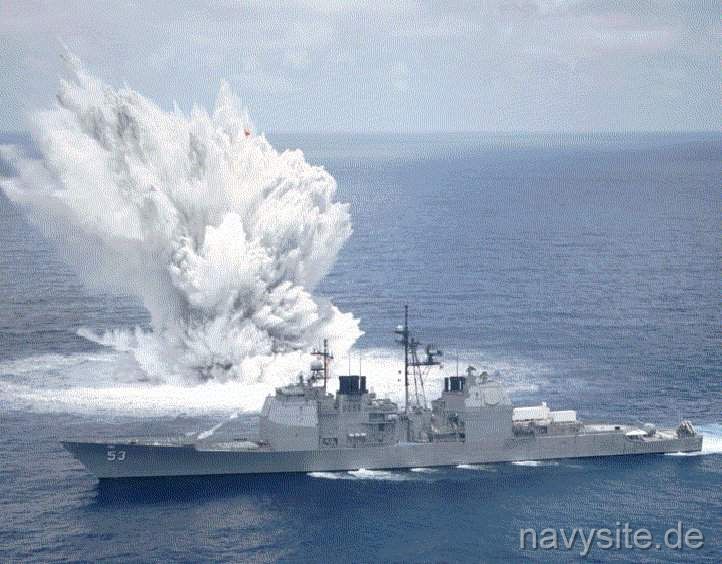 |  |  |
 |  |
The photo below was taken by William Chiu when USS MOBILE BAY visited Hong Kong on April 2, 1991.
 |
The photo below was taken by me on July 27, 2006, and shows the MOBILE BAY berthed at Pearl Harbor, HI., after her participation in RIMPAC 2006.
 |
The photos below were taken by me on March 23, 2010, and show the MOBILE BAY at Naval Base San Diego, Calif.
 |  |  |  |  |
The photos below were taken by me on March 15, 2012, and show the MOBILE BAY at Naval Base San Diego, Calif.
 |  |  |  |
The photos below were taken by me on May 10, 2012, and show the MOBILE BAY at Naval Base San Diego, Calif.
 |  |  |
The photo below was taken by Lydia Perz and shows the MOBILE BAY at BAE Systems San Diego Ship Repair during a six-month Selected Restricted Availability (SRA). The photo was taken on May 3, 2014.
 |
The photos below were taken by Michael Jenning and show the MOBILE BAY at Naval Base San Diego, Calif., on December 27, 2014.
 |  |  |
The photo below was taken by Michael Jenning and shows the MOBILE BAY at Naval Base San Diego, Calif., on October 2, 2015.
 |
The photos below were taken by Michael Jenning and show the MOBILE BAY arriving at San Francisco, Calif., during the Parade of Ships as part of the city's Fleet Week on October 7, 2016.
 |  |  |  |  |
 |  |  |  |
The photos below were taken by Michael Jenning on October 8, 2016, during an open ship aboard USS MOBILE BAY (CG 53) as part of Fleet Week San Francisco, Calif.
 |  |  |  |  |
 |  |  | Click here for more Photos. | |
The photos below were taken by Sebastian Thoma and show the MOBILE BAY at Naval Base San Diego, Calif., on December 20, 2016.
 |  |
The photos below were taken by Michael Jenning and show the MOBILE BAY at Naval Base San Diego, Calif., on October 11, 2017. Note that she is carrying the Golden Battle E on the bridge bulwark meaning that she has been the recipient of the last five Battle E awards of her squadron. The Golden Battle E is a rare sight in the fleet.
 |  |  |
The photos below were taken by Michael Jenning and show the MOBILE BAY at Naval Base San Diego, Calif., on December 29 and 30, 2017.
 |  |  |  |  |
 |
The photos below were taken by Michael Jenning and show the MOBILE BAY at Naval Base San Diego, Calif., on September 28, 2018.
 |  |
The photos below were taken by Michael Jenning and show the MOBILE BAY departing Naval Base San Diego, Calif., for a scheduled WestPac deployment on October 27, 2018. She is deploying as part of the USS JOHN C. STENNIS (CVN 74) Strike Group.
 |  |  |  |  |
 |  |  |  |  |
 |  |
The photos below were taken by Michael Jenning during an open ship event aboard USS MOBILE BAY (CG 53) as part of Seafair Seattle on August 1, 2019.
 |  |  |
 |  |
 |  |  |
 |  |
 |  |  | Click here for more Photos. | |
The photos below were taken by Michael Jenning and show the MOBILE BAY at Naval Base San Diego, Calif., on December 28, 2021.
 |  |  |  |  |
 |
The photo below was taken by Michael Jenning and shows the MOBILE BAY at Naval Base San Diego, Calif., on October 10, 2022.
 |
The photo below was taken by me and shows the decommissioned MOBILE BAY laid up at the Naval Inactive Ship Maintenance Facility, Bremerton, Wash., on July 15, 2024.
 |
The photos below are official US Navy and official Royal Canadian Navy images showing the decommissioned MOBILE BAY being sunk off Kauai, Hi., during RIMPAC 2026 on July 12, 2026.
 |  |  |  |  |
 |  |  |
back to top Back to Cruisers list. Back to ships list. Back to selection page. Back to 1st page.
