
Search the Site with

|
Search the Site with
|
 General Characteristics Crew List Memorabilia Cruise Books About the Ship's Coat of Arms History Homeports of USS Callaghan Patch Gallery Image Gallery to end of page
 |  |
USS CALLAGHAN was the second ship in the KIDD - class of guided missile destroyers and the second ship in the Navy named after Rear Admiral Daniel Judson Callaghan who was killed in action on November 13, 1942, while leading a force of US ships against a far superior Japanese force during the Battle of Guadalcanal. The KIDD - class ships were a modified version of the SPRUANCE - class destroyers. Originally built for Iran, the ship was first named DARYUSH, but after the destroyer's takeover by the U.S. Navy the ship was renamed CALLAGHAN.
CALLAGHAN was homeported in Everett, Wash., and after decommissioning on March 31, 1998, she spent the following years at the Naval Inactive Ship Maintenance Facility (NISMF), Bremerton, Wash. In 2005, she was transferred to Taiwan, where she was recommissioned as SU-AO in December 2005.
| General Characteristics: | Awarded: March 23, 1978 |
| Keel laid: October 23, 1978 | |
| Launched: December 1, 1979 | |
| Commissioned: August 29, 1981 | |
| Decommissioned: March 31, 1998 | |
| Builder: Ingalls Shipbuilding, West Bank, Pascagoula, Miss. | |
| Propulsion system: four General Electric LM 2500 gas turbine engines | |
| Propellers: two | |
| Blades on each Propeller: five | |
| Length: 564,3 feet (172 meters) | |
| Beam: 55,1 feet (16.8 meters) | |
| Draft: 31,5 feet (9.6 meters) | |
| Displacement: approx. 9,500 tons full load | |
| Speed: 30+ knots | |
| Aircraft: two | |
| Armament: two | |
| Crew: 31 officers, 332 enlisted |
 back to top go to the end of the pageback to top go to the end of the page
Crew List:
This section contains the names of sailors who served aboard USS CALLAGHAN. It is no official listing but contains the names of sailors who submitted their information.
back to top go to the end of the pageback to top go to the end of the pageUSS CALLAGHAN Cruise Books:
back to top go to the end of the pageAbout the Ship's Coat of Arms:
USS CALLAGHAN's coast of arms represents the name, birthplace, and distinguished naval career of Rear Admiral Daniel J. Callaghan. It also represents the modern technology of the new CALLAGHAN honored by that name.
The chief simulates the Golden Gate Bridge, symbolizing San Francisco, California, Admiral Callaghan's birth of place. The trident connotes his naval career and the two lightning flashes for his service in World War I and in World War II. The single star represents the medal of honor for his "conspicuous gallantry and intrepidity" in the Naval Battle of Guadalcanal during World War II. The trident with the arcs and the lightning flashes also allude to the mission and capabilities of the CALLAGHAN.
The crest "heraldically speaks" the name Callaghan. The wolf is suggested by the Callaghan coast of arms, and the shamrock symbolizes Ireland. The two stars connote the rank of Rear Admiral Callaghan; they are conjoined to indicate that this is the second ship to bear the name CALLAGHAN.
The ship's motto is the word "Intrepidity", taken from Rear Admiral Callaghan's Medal of Honor citation.
back to top go to the end of the pageUSS CALLAGHAN History:
USS CALLAGHAN was laid down at Ingalls Shipbuilding in Pascagoula, Mississippi, on October 23, 1978, under a contract originally intended for Iran. She slid down the ways on December 1, 1979, and, after the Iranian Revolution halted delivery, the U.S. Navy retained the ship and completed her to American requirements. She was commissioned at Pascagoula on August 29, 1981, the second Navy warship to honor Rear Admiral Daniel J. Callaghan. The next day, she went into dry dock for a sonar-dome groom, and on September 4, 1981, she got underway to join the Pacific Fleet - stopping en route along the Gulf Coast and then transiting via the Panama Canal to her new home on the West Coast. Her early months were filled with shakedown and post-delivery trials, combat-systems calibrations, and work-ups from her Southern California operating areas.
Homeported in San Diego, CALLAGHAN settled into the Pacific Fleet routine of training, inspection cycles, and local task-group exercises through 1982. She integrated her LAMPS I helicopter detachment, practiced anti-air and anti-surface warfare with her twin MK 26 launchers and 5-inch guns, and made the first of many port calls up and down the California littoral, preparing for a Western Pacific (WestPac) deployment.
In 1983, she deployed to the Western Pacific. While visiting Sasebo, Japan, on September 1, 1983, the ship and her crew were recalled to sea after the shootdown of Korean Air Lines Flight 007 over the Sea of Japan. CALLAGHAN joined the multinational search effort under Seventh Fleet control, operating under close observation by Soviet naval forces while sweeping for survivors and debris in a politically fraught Cold War environment. She remained on that task through October 11, 1983, then made a service stop at Yokosuka on October 14 before resuming her schedule. For her role off Sakhalin and in subsequent humanitarian actions that year - including the rescue of two boatloads of people in the South China Sea - she received a Navy Meritorious Unit Commendation and the Humanitarian Service Medal, and she later earned her first Battle Efficiency "E" for the July 1983-December 1984 period.
Through early 1984 and into 1985, CALLAGHAN continued routine Seventh Fleet operations, liberty calls, and exercises. She departed Subic Bay on April 1, 1985, and put into Singapore from April 7-9 before ranging back north for follow-on operations. Over this stretch, the ship refined her air-defense tactics and embarked helicopter procedures in the multi-threat littorals of the Western Pacific.
In 1985-1986, CALLAGHAN repeated the cycle of maintenance, inspections, and advanced training and earned a second consecutive Battle "E" for the grading period January 1985-June 1986. She entered a short ship-repair availability in early 1986 and returned to sea for further work-ups with Pacific Fleet formations as the Navy intensified high-end air-defense training in the latter years of the Cold War.
By mid- to late-1988, geopolitical attention centered on the Iran-Iraq War's endgame and the protection of merchant traffic in the Persian Gulf. CALLAGHAN deployed independently for Operation Earnest Will, getting underway from San Diego on August 11, 1988. She called at Pearl Harbor on August 17-18, Subic Bay on September 2-5, and Singapore on September 9-10, then transited the Strait of Hormuz on September 20 to take station in the Gulf. Operating from Sitrah, Bahrain, she conducted 22 escort and accompaniment evolutions for reflagged and allied merchant shipping amid lingering tensions and mine threats, pausing in Abu Dhabi in mid-October and later shifting to Masirah Anchorage, Oman, for a week-long tender availability alongside PRAIRIE (AD 15) from November 10-17. Her embarked LAMPS detachment, HSL-35 Detachment 3, logged an exceptional flight tempo during the deployment.
With the Gulf patrol complete, CALLAGHAN exited the Strait of Hormuz on December 24, 1988, refueled at Colombo, Sri Lanka, on December 28, and spent January 1-5, 1989, at Phuket, Thailand, before moving on to Singapore (January 6-8), Subic Bay (January 11-14), Hong Kong (January 16-21), and Pearl Harbor (February 2-4). She arrived back in San Diego on February 10, 1989. For her Earnest Will service, the crew received the Armed Forces Expeditionary Medal.
On April 27, 1989, during counter-drug operations off Colombia, CALLAGHAN prosecuted a high-speed contact that jettisoned its cargo while fleeing toward territorial waters. The destroyer and supporting aircraft recovered approximately 3.5 metric tons of cocained - packaged bales later tested as pure - an episode widely covered on the ship's return stateside. Later that year, in September 1989, CALLAGHAN entered Long Beach Naval Shipyard for a regular overhaul that included the New Threat Upgrade (NTU) to her anti-air warfare suite, with completion targeted for - and achieved in - September 1990. Maritime trade press at the time highlighted the award of the overhaul contract, and Navy records note sea trials from October 15-18, 1990, before she returned to the yard for final post-trial work.
Through 1991, she deployed again to the Western Pacific, operating with Seventh Fleet task groups and allies across the Northwest Pacific sea lanes and making customary logistics and liberty stops. Returning to San Diego later that year, she spent 1992-1994 largely in training, inspections, and routine maintenance as the post-Cold War fleet adjusted force levels and homeport distributions on the U.S. West Coast.
In 1995-1996, the Navy finalized plans to populate the new strategic homeport at Naval Station Everett, Washington. CALLAGHAN shifted north, officially arriving at Everett on September 27, 1996, alongside CHANDLER (DDG 996), to form part of the base's initial destroyer contingent supporting the ABRAHAM LINCOLN (CVN 72) Battle Group in the Pacific Northwest. She operated from Everett through 1997, conducting local training and presence patrols while maintaining her systems and crew readiness.
CALLAGHAN was decommissioned on March 31, 1998, after nearly seventeen years in commission, and was placed in reserve at the Naval Inactive Ship Maintenance Facility in Bremerton, Washington. As the Navy consolidated its air-defense destroyer force around AEGIS-equipped classes, the KIDD-class ships were retired in the late 1990s. CALLAGHAN was sold to Taiwan on May 30, 2003, and, following refit and crew training, entered service in the Republic of China Navy as SU AO (DDG 1802) on December 17, 2005.
back to top go to the end of the pageHomeports of USS CALLAGHAN:
| Period | Homeport |
|---|---|
| commissioned at Pascagoula, Miss. | |
| 1981 - 1996 | San Diego, Calif. |
| 1996 - 1998 | Everett, Wash. |
back to top go to the end of the pageUSS CALLAGHAN Patch Gallery:
 |
back to top go to the end of the pageUSS CALLAGHAN Image Gallery:
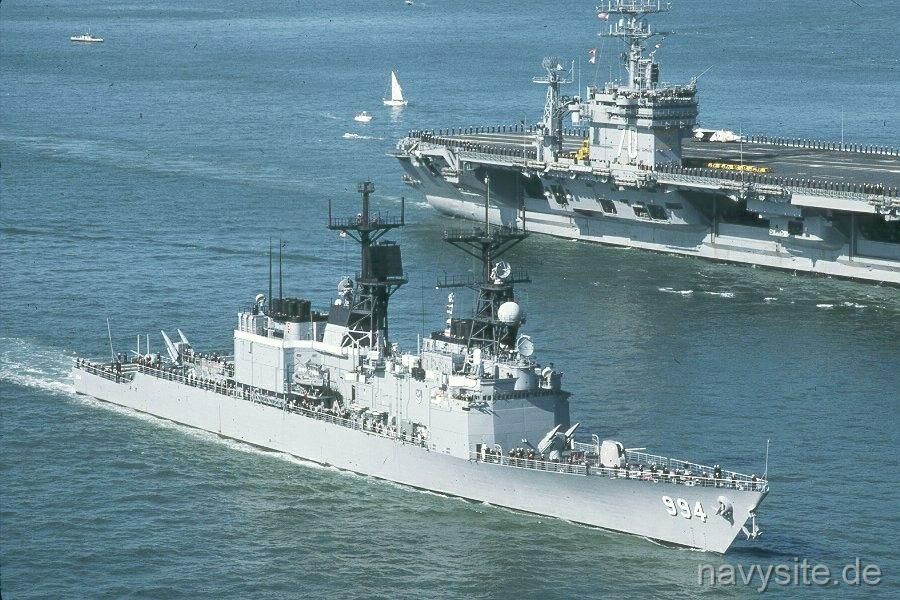 |  |
back to top
 Back to Destroyers list. Back to ships list. Back to selection page. Back to 1st page.
