
Search the Site with

|
Search the Site with
|
 General Characteristics Crew List Memorabilia Accidents aboard the Ship About the Ship's Name History Image Gallery to end of page
 |  |
USS ROARK was the second KNOX - class frigate and the first ship in the Navy to bear the name. Decommissioned on December 14, 1991, and stricken from the Navy list on January 11, 1995, the ROARK spent the following years berthed at the NAVSEA Inactive Ships On-site Maintenance Office in Bremerton, Wash. In 2004, the ROARK was towed to Brownsville, Tx., where she was subsequently scrapped by International Shipbreaking Corp. Scrapping was completed on October 13, 2004.
| General Characteristics: | Awarded: July 22, 1964 |
| Keel laid: February 2, 1966 | |
| Launched: April 24, 1967 | |
| Commissioned: November 22, 1969 | |
| Decommissioned: December 14, 1991 | |
| Builder: Todd Pacific Shipyards Corp., Seattle, Wash. | |
| Propulsion system: 2 - 1200 psi boilers; 1 geared turbine, 1 shaft; 35,000 shaft horsepower | |
| Length: 438 feet (133.5 meters) | |
| Beam: 47 feet (14.4 meters) | |
| Draft: 25 feet (7.6 meters) | |
| Displacement: approx. 4,200 tons full load | |
| Speed: 27 knots | |
| Armament: one Mk-16 missile launcher for ASROC and | |
| Aircraft: one | |
| Crew: 18 officers, 267 enlisted |
 back to top go to the end of the pageback to top go to the end of the page
Crew List:
This section contains the names of sailors who served aboard USS ROARK. It is no official listing but contains the names of sailors who submitted their information.
back to top go to the end of the pageback to top go to the end of the pageAccidents aboard USS ROARK:
| Date | Where | Events |
|---|---|---|
| January 19, 1971 | western Pacific | USS ROARK is badly damaged by an engine room fire which stops the ship dead in the water. The ship is taken in tow by the USS TOWERS (DDG 9) toward Midway Island from where the ROARK was towed to Pearl Harbor, HI., by the USS QUAPAW (ATF 110). |
back to top go to the end of the pageAbout the Ship's Name:
Lieutenant William Marshall Roark was born in Sioux City, Iowa, on October 23, 1938, and grew up in Omaha, Nebraska. He entered the United States Naval Academy in 1956, graduated with the Class of 1960, and was commissioned as an ensign. After completing naval flight training, he became a naval aviator and was eventually assigned to Attack Squadron 153 (VA-153), flying the A-4 Skyhawk from USS CORAL SEA (CVA 43). He was promoted to lieutenant on June 1, 1964.
On April 7, 1965, Roark was leading a two-aircraft armed reconnaissance mission near Dong Hoi, North Vietnam, when his A-4C Skyhawk was hit by anti-aircraft fire during an attack on enemy gun positions. He ejected over coastal waters but was fatally wounded by enemy fire before he could be rescued. He was 26 years old and was posthumously awarded the Distinguished Flying Cross and Purple Heart. His remains were later returned by Vietnam and formally identified on March 31, 1977.
back to top go to the end of the pageUSS ROARK History:
The contract for USS ROARK was awarded to Todd Shipyards Corporation on July 22, 1964. Her keel was laid at Todd-Pacific Shipyards in Seattle, Washington, on February 2, 1966. She was launched and christened on April 24, 1967, sponsored jointly by Mrs. William M. Roark, the lieutenant's widow, and Mrs. Frank F. Roark, his mother. ROARK was conducting precommissioning sea trials in Puget Sound by September 10, 1969, and was commissioned at Puget Sound Naval Shipyard in Bremerton, Washington, on November 22, 1969, with Commander Wayne L. Beech in command. She was assigned to Destroyer Squadron 21 and Destroyer Division 212 and operated from San Diego, California.
Following commissioning, ROARK completed fitting-out, trials, shakedown and qualification work. During the spring of 1970 she completed her shakedown period and thereafter spent much of the remainder of the year conducting training and readiness operations from San Diego. Commander Arthur S. Moreau Jr. relieved Commander Beech in November 1970, shortly before preparations for the ship's first overseas deployment were completed.
ROARK departed San Diego on January 7, 1971, for her first Western Pacific deployment. She sailed as part of a task unit that included USS TOWERS (DDG 9). After crossing to Hawaii, the ships were at Pearl Harbor from January 13 to 14 and continued westward, refueling at Midway on January 18. On January 20, however, a serious fire broke out in ROARK's engine room while she was underway west of Hawaii. The casualty disabled the newly commissioned destroyer escort sufficiently to prevent her from continuing the deployment under her own power. TOWERS went to ROARK's assistance and took the damaged ship in tow after the fire had been brought under control. On January 22, the tow was transferred to the fleet tug USS QUAPAW (ATF 110), which returned ROARK toward Pearl Harbor.
The engine-room fire became the defining event of ROARK's first deployment. Damage extended to numerous valves, motors and other machinery in the affected space, and Pearl Harbor Naval Shipyard undertook an intensive repair effort. The shipyard commander later recalled that work initially expected to require approximately ten to twelve weeks was completed in roughly six weeks. Even with this accelerated effort, ROARK lost a substantial portion of her scheduled deployment.
ROARK resumed her westward voyage in March 1971. During the spring, she was present in Japanese waters and was photographed at Yokosuka in company with USS HEPBURN (DE 1055) and USS GRAY (DE 1054). Her deployment took place while the United States was reducing its ground presence in South Vietnam under the policy of Vietnamization, although the Seventh Fleet continued extensive carrier, reconnaissance, search-and-rescue, escort and surveillance operations throughout East and Southeast Asia. At the same time, American surface ships maintained a substantial presence around Japan and Korea and monitored Soviet naval activity in the western Pacific. ROARK nevertheless remained under Seventh Fleet control through the summer before beginning her return across the Pacific. She arrived back at San Diego on August 10, 1971. The remainder of the year was devoted to maintenance, training and preparation for another Western Pacific deployment.
ROARK began 1972 with intensive predeployment training. She conducted an independent systems-check steaming period on January 6 and was underway again on January 25 for exercises with other units of Destroyer Squadron 31. By this time, she was administratively assigned to Destroyer Squadron 31 under Cruiser-Destroyer Flotilla 9. ROARK departed San Diego on February 8 and reached Subic Bay in the Philippines on February 29.
Her first operational line period began on March 5, 1972. ROARK escorted USS KITTY HAWK (CVA 63) and served as screen commander for the carrier. At that point, American naval forces were still conducting regular combat-support operations off Vietnam, although the scale of activity was about to increase dramatically.
On March 30, North Vietnam began the large conventional offensive later known as the Easter Offensive. North Vietnamese forces attacked across several fronts, including a major thrust across the Demilitarized Zone into Quang Tri Province. The offensive caused a rapid expansion of United States naval and air operations. ROARK began her second line period at 3:00 a.m. on April 2, again initially operating with KITTY HAWK. This line period ultimately lasted 46 days and exposed the ship to a far broader range of combat-related assignments than she had experienced during her first deployment.
ROARK served as escort for USS CHICAGO (CG 11) while the guided missile cruiser operated on Positive Identification Radar Advisory Zone and South Talos stations. These assignments placed long-range radar and missile ships in positions from which they could maintain an air-surveillance picture over the Gulf of Tonkin, support American aircraft and provide air-defense coverage. As the accompanying destroyer escort, ROARK provided close protection and anti-submarine capability while operating relatively close to North Vietnamese waters.
During the same line period ROARK conducted her first naval gunfire-support missions and also performed escort duties for USS HANCOCK (CVA 19) and USS MIDWAY (CVA 41). On April 17, 1972, ROARK herself received hostile fire. April 17 also brought an unusual humanitarian episode. USS FRANCIS HAMMOND (DE 1067), while conducting naval gunfire-support operations off South Vietnam, rescued five South Vietnamese nationals from a sinking sampan and subsequently transferred them to ROARK. The incident occurred during the intensified fleet activity generated by the Easter Offensive.
Commander Robert J. Kerrigan relieved Commander Moreau as commanding officer on May 5, 1972. The change of command took place while ROARK was on a waiting station associated with the gun line.
On May 8 the United States began Operation Pocket Money, mining the approaches to Haiphong and other North Vietnamese ports. Two days later, Operation Linebacker expanded the American air campaign against North Vietnam. Although these larger operations involved many units beyond ROARK, they formed the strategic background to her continuing assignments through the spring and summer. ROARK subsequently returned to Subic Bay. On May 18, she embarked Helicopter Anti-Submarine Squadron Light 31 Detachment 3. The presence of an embarked SH-2 helicopter substantially extended the ship's surveillance and anti-submarine reach beyond the limits of her hull-mounted sensors. When ROARK reentered the Vietnam combat zone on May 29, she became the first destroyer escort documented as carrying a manned helicopter detachment into that combat zone.
During the Subic Bay period, ROARK and FRANCIS HAMMOND were photographed on May 23 alongside the repair ship USS PIEDMONT (AD 17). Subic Bay was the principal Seventh Fleet repair and logistics center in Southeast Asia and repeatedly served as ROARK's support base during the deployment.
ROARK's third line period included service on the northern search-and-rescue station. There, she acted as the close "shotgun" escort for USS BIDDLE (DLG 34) and USS ENGLAND (DLG 22). Ships assigned to these northern stations supported efforts to recover American aircrews forced down during operations over North Vietnam and maintained air-surveillance and defensive functions. The accompanying destroyer escort protected the more specialized radar and missile ships against possible surface and submarine threats.
ROARK also received a sensitive surveillance assignment connected with the American mining campaign. Two Chinese merchant vessels were moving through waters associated with the mined harbor at Vinh, North Vietnam, and ROARK was directed to shadow them. On June 13, FRANCIS HAMMOND was temporarily detached from its own duties to relieve ROARK in following the two merchant ships. The episode illustrated the extent to which Seventh Fleet surface ships combined direct combat-support responsibilities with surveillance of neutral and communist-bloc shipping in waters affected by the mining operations.
At the conclusion of the third line period, ROARK again joined KITTY HAWK as an escort and proceeded toward Hong Kong by way of Subic Bay. She arrived in Hong Kong on June 20 and remained there until July 7, 1972. During the extended visit, ROARK served as Senior Officer Present Afloat, Administrative, for United States Navy ships in the port. ROARK departed Hong Kong on July 7 and returned directly to operational duties. She again proceeded to the Positive Identification Radar Advisory Zone and served as shotgun escort for BIDDLE and USS LONG BEACH (DLGN 9). After LONG BEACH detached her, ROARK moved to the gun line and conducted additional naval gunfire-support missions. She remained engaged in this role through August 6, completing her fourth and final operational line period of the deployment.
The embarked helicopter detachment did not remain aboard for the entire cruise. On July 26 Helicopter Anti-Submarine Squadron Light 31 Detachment 3 was disembarked at Subic Bay to await reassignment to USS TRUXTUN (DLGN 35). ROARK subsequently completed the final portion of her Vietnam operations without the detachment. ROARK departed Subic Bay for the United States on August 15, 1972, and arrived at San Diego on August 31.
A 30-day post-deployment leave and upkeep period followed, together with additional time in port. ROARK returned to sea on October 9 to escort USS RANGER (CVA 61) for five days. After another short port period she got underway again on October 17 for Reconnaissance Exercise 1-72, which tested the concept of employing a destroyer escort in support of a Marine reconnaissance force. ROARK subsequently participated in Exercise Uptide 38 from October 30 through November 8, 1972. The exercise evaluated convergence-zone performance of the AN/SQS-26 sonar and examined developing anti-submarine tactics.
Lieutenant Commander Griffin F. Hamilton relieved Commander Kerrigan as commanding officer at San Diego on November 28. ROARK remained in port through December 31 for upkeep and holiday leave, ending a year dominated by sustained Vietnam combat operations.
The beginning of 1973 found ROARK operating from San Diego. The Paris Peace Accords were signed on January 27, and direct American combat participation in Vietnam was ending. For approximately the first eight months of the year ROARK remained in the San Diego area, carrying out maintenance, qualification and fleet-training work. In August 1973, she departed San Diego for another Western Pacific deployment and arrived at Subic Bay on August 31. The political and military setting had changed considerably since her previous cruise. American offensive combat operations against North Vietnam had ended, but the Seventh Fleet continued to maintain a substantial presence in Asian waters as the United States monitored developments in Indochina and maintained broader Cold War commitments in East Asia.
ROARK spent nearly four months under Seventh Fleet control during the deployment. During the return transit, she was photographed at Midway in December. ROARK reached San Diego on December 21, 1973.
During 1974, ROARK remained an active Pacific Fleet unit operating from San Diego. Lieutenant Commander Paul D. Moses relieved Lieutenant Commander Hamilton as commanding officer in May 1974. Much of the year formed part of the maintenance, qualification and training cycle between ROARK's Vietnam-era deployments and her later peacetime Cold War operations.
On June 30, 1975, the United States Navy implemented a broad reclassification of surface combatants. ROARK was redesignated from destroyer escort DE 1053 to frigate FF 1053. ROARK subsequently undertook another Western Pacific deployment during 1975-76. The cruise returned ROARK to Seventh Fleet service during the period immediately following the end of the Vietnam War. The strategic emphasis of American Pacific operations was changing. Following the fall of Saigon on April 30, 1975, Seventh Fleet surface forces increasingly concentrated on carrier support, anti-submarine warfare, regional presence and surveillance of Soviet naval activity rather than direct combat operations off Indochina. ROARK completed the deployment during the first part of 1976 and returned to the United States. Commander Jack L. Weston relieved Lieutenant Commander Moses as commanding officer in May. A photograph from November 1976 shows ROARK moored at Naval Station San Diego.
ROARK continued Pacific Fleet operations during 1977. In 1978, she became the prototype surface ship for the Navy's application of Reliability-Centered Maintenance. The program sought to replace maintenance performed automatically at fixed intervals with a more analytical system based on the actual relationship between specific maintenance actions, equipment reliability and safety. Hundreds of shipboard systems and subsystems were examined aboard ROARK, and maintenance requirements were revised accordingly. Later assessments found substantial reductions in unnecessary preventive-maintenance work, and the experience contributed to broader adoption of the methodology within the Navy.
ROARK continued normal fleet operations while participating in this maintenance-development work. On July 6, 1978, she conducted a helicopter-related transfer evolution with USS CONSTELLATION (CV 64), illustrating the routine aviation interaction possible between the KNOX-class flight deck and larger Pacific Fleet ships. Commander Thomas E. Ferguson relieved Commander Weston as commanding officer in May 1978.
In early 1979, ROARK deployed into the South Pacific for the cruise and exercise program known as SouthPac 79. Unlike her earlier Vietnam-oriented cruises, this deployment placed substantial emphasis on port visits, allied cooperation and training with forces in the South Pacific and Australia. On January 28, 1979, while crossing the equator at approximately 166 degrees longitude on the way toward Apia, Western Samoa, ROARK conducted the traditional line-crossing ceremony for crewmen making their first equatorial crossing. Apia was among the early destinations of the cruise. During February, ROARK operated in the South Pacific in company with other United States Navy units.
ROARK subsequently reached Sydney, Australia, where she spent an extended period during March. Her own cruise book described the Sydney skyline as a familiar sight during approximately three weeks in the area. The visit was associated with operations and exercises involving American, Australian and New Zealand naval forces. These multinational activities helped preserve interoperability among allied navies during a period when Soviet naval activity in the Pacific and Indian Oceans was increasing. After Sydney, ROARK visited Hobart, Tasmania, for four days. She then returned to sea and crossed the Australian Bight toward Port Hedland on the northwestern coast of Australia. This passage took her from southern Australian waters into the approaches to the Indian Ocean. Port Hedland was followed by a further transit toward Newcastle on Australia's east coast.
On April 9, 1979, as ROARK departed Newcastle, Royal Australian Air Force aircraft conducted a coordinated simulated attack against the frigate as part of the training associated with the deployment. ROARK subsequently returned to Sydney for what her cruise book described as the final sea detail there before continuing the voyage. After completing the cruise, ROARK returned to the United States.
ROARK subsequently entered an extended maintenance period in the Seattle area. By July 1980, she was documented at the Lockheed yard in Seattle while undergoing an overhaul. The availability restored the ship after approximately a decade of sustained Pacific service and prepared her for continued operations in the 1980s. Commander Frederick G. Kleyn III relieved Commander Ferguson on March 17, 1981. ROARK returned to long-range Pacific operations following the overhaul, and a Navy photograph dated May 12, 1981, shows her underway en route to Hawaii.
Later in 1981, ROARK was again operating in Asian waters and became involved in a significant humanitarian rescue. On October 4, while crossing the South China Sea, the frigate encountered a small wooden boat carrying Vietnamese refugees. The craft had reportedly been drifting for approximately five days. Contemporary United States Navy reporting stated that ROARK rescued 63 people, consisting of 24 men, 18 women and 21 children. They were reported to be generally in good condition after being brought aboard. The rescue occurred within the wider postwar refugee crisis in Southeast Asia. Large numbers of Vietnamese had attempted to leave their country by sea after the fall of South Vietnam, frequently using small, overcrowded and poorly equipped boats. Naval and merchant vessels operating in the South China Sea repeatedly encountered such craft in distress.
ROARK subsequently proceeded toward Penang, Malaysia. Contemporary Malaysian press reported that the frigate arrived off Penang at approximately 9:00 a.m. on October 7 and anchored about one mile from Kedah Pier. Malaysian authorities initially placed the ship under quarantine while arrangements concerning the refugees were considered. The same contemporary Malaysian reporting referred to 62 Vietnamese refugees aboard, one fewer than the 63 people listed in the initial United States Navy rescue announcement. The surviving records do not explain the difference.
ROARK's operations during this period also extended toward the Indian Ocean. That region had gained greatly increased strategic importance following the Iranian Revolution of 1979, the seizure of the United States embassy hostages in Tehran, the Soviet intervention in Afghanistan in December 1979 and the outbreak of the Iran-Iraq War in September 1980. American naval deployments increasingly linked western Pacific operating areas with the Indian Ocean and Arabian Sea.
ROARK remained active in Seventh Fleet waters into the following period. On June 15, 1982, she was photographed at the United States Naval Ship Repair Facility at Subic Bay, berthed with USS HAROLD E. HOLT (FF 1074), while USS BROOKE (FFG 1) was moored alongside. The photograph confirms ROARK's continuing use of Subic Bay as a support and repair facility.
Commander Hugh L. Webb relieved Commander Kleyn in October 1982. Under Webb, ROARK prepared for another major deployment. ROARK departed San Diego on March 21, 1983. She crossed to Hawaii and called at Pearl Harbor in late March, remaining there through April 1. She then proceeded into the North Pacific and operated there from April 9 through April 18. The frigate entered Japanese waters and visited Kagoshima from April 19 through April 25. The visit placed ROARK in southern Japan rather than at the principal American naval facilities at Yokosuka or Sasebo. The broader cruise took place during renewed Cold War maritime competition. The Soviet Pacific Fleet maintained substantial submarine and surface forces, while United States Navy training increasingly emphasized operations across the North Pacific and cooperation with Japan.
During this phase of the deployment, ROARK participated in Fleet Exercise 83-1. She was photographed during gunnery activity involving USCGC RUSH (WHEC 723), demonstrating the mix of Navy and Coast Guard units incorporated into major Pacific exercises. ROARK then proceeded south toward the Philippines and entered Subic Bay on May 14. She remained there through May 18 before continuing westward. The frigate reached Singapore on May 27 and remained there through June 8. Singapore occupied a key position at the eastern entrance to the Strait of Malacca and frequently served as a staging point for American ships moving between the western Pacific and the Indian Ocean. ROARK entered the Indian Ocean on June 9.
She remained involved in Indian Ocean operations through June 30. These activities took place while the Iran-Iraq War continued, Soviet forces remained in Afghanistan and both the United States and Soviet Union maintained significant strategic interests in the region. After almost three weeks of Indian Ocean operations, ROARK reached Geraldton, Western Australia, on July 1 and remained there through July 7. ROARK next proceeded northwest and called briefly at Diego Garcia on July 20 and 21. By the early 1980s, Diego Garcia had become one of the most important United States support facilities in the Indian Ocean, providing anchorage, aviation, communications and logistics facilities considerably closer to the Arabian Sea and Persian Gulf than the Navy's major western Pacific bases.
After leaving Diego Garcia, ROARK returned eastward across the Indian Ocean and through Southeast Asian waters. She entered Subic Bay again on July 29 and remained there through July 31. During this phase, ROARK operated with USS KANSAS CITY (AOR 3) and USS INGERSOLL (DD 990), and the ships joined forces associated with the battle group centered on USS NEW JERSEY (BB 62). ROARK then crossed the Pacific and reached Pearl Harbor on August 12, remaining through August 14. Her deployment subsequently included an unusual additional movement to Rodman, Panama, where she arrived on September 6. ROARK finally returned to San Diego on September 17, 1983.
Commander Jeffrey R. Beinbrink assumed command of ROARK in February 1985. Later that year, Continental Maritime of San Diego received a Navy contract valued at approximately $7.47 million for a regular overhaul of the frigate. The work was to be performed at San Diego and was scheduled for completion in March 1986. The contract provides firm documentation for the extended shipyard and maintenance period occupying much of this phase of ROARK's career. The overhaul occurred while the United States Navy was maintaining and modernizing a large surface fleet as part of the Reagan administration's expansion toward a 600-ship Navy. Although newer SPRUANCE-class destroyers and OLIVER HAZARD PERRY-class frigates were increasingly numerous, the KNOX-class frigates remained useful anti-submarine escorts and continued to receive maintenance necessary for further service.
The overhaul was scheduled for completion in March 1986. ROARK subsequently returned to operational duties. The beginning of 1987 marked a major transition in ROARK's career. Her own cruise book records that on January 1 she shifted toward United States Naval Reserve employment and changed homeport from San Diego to San Francisco. She remained at San Diego through January 5 and got underway on January 6 for the transit north. ROARK reached San Francisco on January 10 and remained there through January 12. On January 13 she sailed south again with Task Unit 35.2.4. By January 16, she was in San Diego and served as a visiting ship at Broadway Pier. On January 20 she shifted to Naval Station San Diego.
ROARK conducted local Southern California operations on January 29 and 30. During early February Commander Surface Squadron One embarked for an Operational Propulsion Plant Examination. ROARK was underway in Southern California waters during the examination and returned to San Diego after its completion. The frigate was again underway on February 10. On February 11, she provided services in support of naval gunfire-support spotter training at San Clemente Island. She then began another transit north on February 12 and remained in San Francisco from February 13 through February 24. On February 25, she sailed south again and arrived at San Diego the following day.
After another period in San Diego, ROARK got underway from March 13 through March 15 for Exercise Varsity Player 87-2 in the Southern California operating area. She returned to San Diego on March 16 and remained there into early April. On April 7, ROARK again went to sea. On April 8, she successfully conducted Fire Exercise One at San Clemente Island and then began another transit to San Francisco. She remained there from April 9 through April 12. ROARK departed San Francisco on April 13 for anti-submarine operations in the North Pacific. On April 15, she rendezvoused with Task Group 32.6 and participated in the anti-submarine exercise Sharem 70 through April 19. She detached on April 20 and returned toward San Francisco.
On April 26, ROARK anchored in Raccoon Strait in San Francisco Bay for the Blessing of the Fleet. Commander Surface Group One visited the ship during the event. ROARK returned to San Francisco the following day. The frigate sailed north on April 28 for Newport, Oregon. She arrived on April 29 and remained there through May 3, providing one of the less common port visits of her later career. ROARK departed on May 4 and reached San Diego on May 6. Commander Surface Squadron One embarked again on May 14. On May 15, Commander Warren E. Small relieved Commander Beinbrink as commanding officer. ROARK remained briefly in San Diego following the ceremony and got underway again on May 18 for Mexico.
A United States Coast Guard Law Enforcement Detachment embarked for the voyage. Such detachments allowed Navy ships to support maritime law-enforcement missions while Coast Guard personnel retained the legal authority required for enforcement actions. ROARK proceeded south from May 18 through May 20 and visited Mazatlan from May 21 through May 25. She departed on May 26 and returned to San Diego by May 29, where the Coast Guard detachment disembarked.
On June 1, 1987, ROARK's assignment to the Naval Reserve Force, Pacific, became formal. The date complements rather than contradicts the January 1 transition recorded in the ship's cruise book: January marked the operational move toward reserve employment and the change of homeport, while June 1 represented the formal administrative assignment. ROARK's reserve homeport was San Francisco, with Treasure Island serving as the principal naval installation associated with her final years. Transfer to the Naval Reserve Force did not make ROARK inactive. She retained an active-duty nucleus supplemented by Selected Reserve personnel who served during drill periods and annual active-duty training. The arrangement preserved an operational and mobilization capability while reducing the number of full-time active-duty sailors required to crew the ship.
Later in 1987, ROARK underwent another significant maintenance availability. Southwest Marine of San Francisco received a contract valued at approximately $3.53 million for a Phased Maintenance Availability aboard the frigate. The work was performed in San Francisco and was scheduled for completion on December 24, 1987. The availability supported ROARK's continued operation as a Naval Reserve Force frigate.
ROARK remained in reserve-force service throughout 1988. She continued operating from the San Francisco area and remained involved in reserve training and Pacific Fleet readiness activity. The KNOX-class frigates remained useful training and anti-submarine platforms because their sonar and helicopter capability could still be integrated into fleet exercises despite their increasing age. ROARK participated in another major exercise cycle in 1989. Contemporary professional Navy commentary described her as achieving an unusually high level of proficiency in naval gunfire support while serving in the Naval Reserve Force, indicating that reserve manning did not prevent the frigate from maintaining significant operational competence.
From September 5 through October 19, 1989, ROARK participated in Pacific Exercise 89, one of the largest United States Pacific Fleet exercises of the closing Cold War period. ROARK served with Battle Group Delta, centered on CONSTELLATION. Pacific Exercise 89 involved coordinated carrier aviation, anti-air, anti-surface, anti-submarine and logistics operations across large areas of the northern Pacific. Although relations between Washington and Moscow were improving under Soviet leader Mikhail Gorbachev, the Soviet Pacific Fleet still maintained substantial submarine, surface and naval aviation forces. The exercise therefore retained much of the long-range fleet-defense and anti-submarine emphasis that had characterized ROARK's career since commissioning.
Commander Steven Earle Pilnick relieved Commander Small as commanding officer in February 1990. ROARK remained homeported in San Francisco and continued operating with a mixed active-duty and reserve crew. During 1990, she again deployed into western Pacific waters. On May 17, while operating in the South China Sea, ROARK encountered another unseaworthy refugee craft and rescued 42 people. The incident occurred almost nine years after her 1981 rescue and demonstrated that dangerous maritime departures from Vietnam had not completely ended by the beginning of the 1990s. The 1990 overseas deployment also demonstrated that the Naval Reserve Force arrangement did not confine ROARK to coastal training. A substantial reserve component could be integrated with the active-duty nucleus for an extended deployment far from the United States. The cruise took place during a period of rapid political change. Communist governments in Eastern Europe had collapsed during 1989, Germany was moving toward reunification and relations with the Soviet Union were changing fundamentally, but United States naval commitments in the Pacific remained extensive.
ROARK continued Naval Reserve Force operations into 1991. By then, she had been in commissioned service for more than two decades. The strategic requirement for the large Cold War fleet built and expanded during the preceding decades was rapidly declining as the Warsaw Pact disappeared and the Soviet Union itself moved toward dissolution. Older steam-powered surface combatants, including the KNOX-class, were increasingly selected for retirement. USS ROARK was decommissioned on December 14, 1991. Her retirement occurred only twelve days before the formal dissolution of the Soviet Union on December 26, bringing her active career to an end almost simultaneously with the Cold War strategic environment that had shaped much of her service.
Following decommissioning, the former ROARK was placed in inactive status and retained by the Navy. She was moved to the inactive-ship facilities at Puget Sound in Bremerton, Washington, and photographs from August 1992 show her laid up there with other decommissioned ships. ROARK was formally struck from the Naval Vessel Register on January 11, 1995. Unlike a number of other KNOX-class frigates that were subsequently transferred to foreign navies, she initially remained in United States custody. In 1997, Congress specifically authorized the possible transfer of the former ROARK to Mexico under the Foreign Military Sales program. The authorization was contained in the National Defense Authorization Act for Fiscal Year 1998 and permitted the Secretary of the Navy to transfer the ship to the Mexican government. The authority remained available for two years, but the transfer was never completed. ROARK therefore remained in American possession and was ultimately designated for disposal.
On October 13, 2003, the Navy awarded International Shipbreaking Ltd. of Brownsville, Texas, a contract valued at $598,665 for towing and dismantling the former frigate. During 2004, ROARK was taken to Brownsville for scrapping. International Shipbreaking subsequently dismantled and recycled the hull, with the scrapping process completed in October 2004.
back to top go to the end of the pageUSS ROARK Image Gallery:
 | 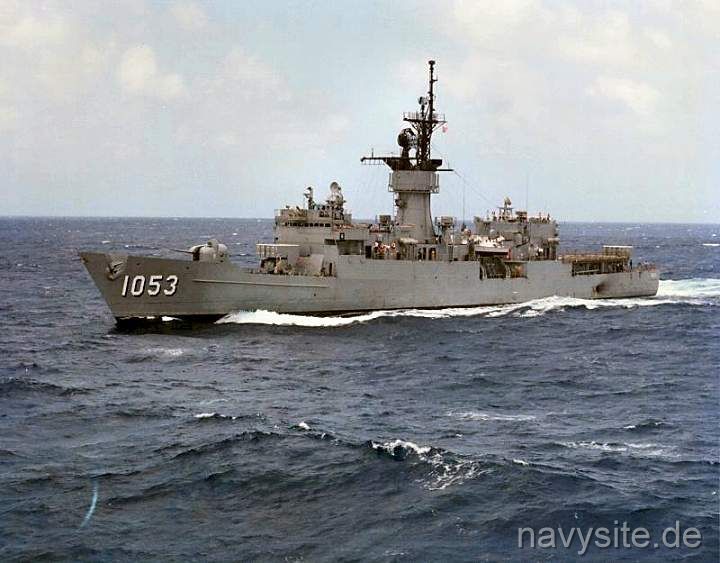 |
The photo below shows the ROARK passing San Padre Island, Tx., on her way to International Shipbreaking, Brownsville, Tx., on June 11, 2004. Photo by International Shipbreaking Corp.
 |
The photos below were taken and contributed by Michael Martin. They show the ROARK being scrapped at Brownsville, Tx., in 2004. The first photo was taken on February 19, 2004, and the second one on February 27, 2004.

 back to top
 Back to Frigates List. Back to Ships List. Back to selection page. Back to 1st page.
