Tudors (1485-1603)


Bernard André, court poet and biographer to Henry VII, recorded the details of the king’s birth in his Vita Henrici Septimi. His passage, reproduced in Chronicles & Memorials of Great Britain and Ireland during the Middle Ages translates as:
King Henry VII was born, while Calixtus the Third was Pope and during the reign of Henry VI, with the highest grace of virtue and integrity, so much so that even to this present day that blessed king is proclaimed far and wide on account of the many miracles which God daily shows for his merits: in the month of January, on the seventeenth day before the Kalends of February, namely on the most fortunate day of Saint Agnes the Second, at the hour ...
Frustratingly, the asterisks mark a blank in the manuscript at the point where the hour of birth is recorded. The date also presents a difficulty. Reference to “the seventeenth day before the Kalends of February” ought to suggest 16 January, since the Kalends mark the first day of the new month (1st February). However, we are told that the birth fell on the feast of Saint Agnes the Second, which indicates 28th January. Historians generally accept the saint’s day as the more reliable detail.
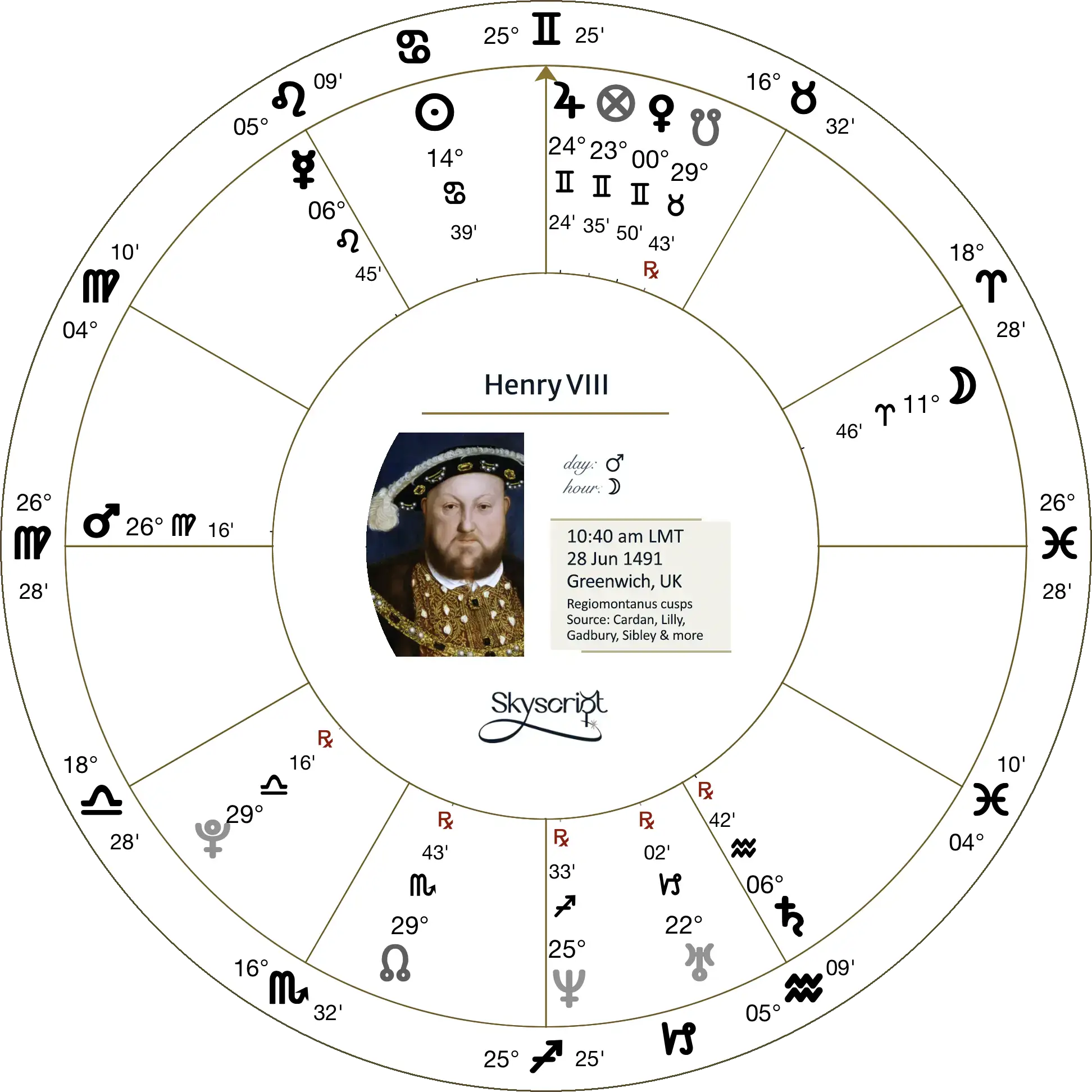


The original chart, from Lilly, EPM, p.10, reproduces Cardan, Gen. exem., p.24. There are no contemporary historical reports that confirm a record Henry’s time of birth, and a currently Rodden-AA-rated chart, giving a time of 8.45 am to place Venus on the MC with 6° f rising, should not be considered reliable. The accounts of Cardan, Gauricus, Gadbury and Lilly all place the Ascendant at the end of Virgo, with Mars rising upon it. Cardan’s discussion of the chart, translated, reads:
But after discussion of this king [Edward VI], I decided to set below the scheme of his father, in which one can perceive three great things. Firstly, as noted, he took six wives, divorcing two, and beheading as many. Venus is with the Tail and the Torch [Aldebaran] a star of the nature of Mars, and the Moon is in the western angle in the dignities of Mars. Mars itself is in Virgo, an unfortunate sign, and square an unfortunate Jupiter. Moreover, he changed legislation for this reason, being enraged with the Pope. This is contingent to the position of Venus, and those things with it, as said; we should also look to that configuration for the signification of religious division; and several eclipses had preceded that, which would be tedious to pursue. (From these two matters, and other causes, as the Bishop of Lisieux told me at Besançon in the two years before this king’s death, seventy two thousand people were sentenced to death and executed under this king, despite him being the ruler of merely one island. So there is little cause for wonder at the Roman emperors, rulers of the whole world and barbarians, when in so great an empire few of them exceeded this number.) Besides this, he was a very wealthy king because of the position of Fortuna and Jupiter, of which the greater part of this wealth was consumed, by the square of Mars, on enemies; since Jupiter is debilitated in both Virgo and Gemini. He was also bountiful, generous, and most splendid, and not removed from patronage of the arts. Perhaps, had he not killed Thomas More, a good, learned man and (I believe) innocent, he might have been excused, and would not have left to his offspring the seeds of such great calamities. Learn, you kings, to refrain from harming the sacred Muses. For if there is no safety for good men, anyone’s desire to do good will be in vain.
(Translation by D. Houlding)


The Elizabethan historian John Stow recorded the details of Edward’s birth in his Annales of England (p.575):
The twelfth of October, about two of the clocke in the morning, was borne at Hampton Court, Prince Edward, and Queene Jane his mother left her life 14. of October.
The earliest horoscope on record is that of Jerome Cardan, who published the chart in 1555 (Gen. Exam., p.6). His judgment is significant since he personally met the young king and was commissioned to act as his astrologer and physician. Cardan adjusted the approximate time using the animodar method of rectification recommended by Ptolemy (Tet., III.2), placing the degree of Saturn upon the midheaven and deriving a time of 1 hour 13 minutes past midnight, with an ascendant at 29°e. He allowed that the horoscope might have been a little later, with the ascendant moved to early Virgo, and reported that other astrologers adjusted the timing of the chart so the midheaven came by direction to the trine of the Moon in the tenth year, when Edward ascended to the throne. (Cardan's chart is shown below, followed by the closest computerised match to the positions he used.)
The Flemish astronomer Jean Stadius subsequently published the chart in his Ephemerides Novae et Auctae (1560), where the birth is timed to:
... the eleventh day of October, at the 13th hour, 51 minutes, at latitude 52½ degrees
Stadius criticised the way that Cardan used Ptolemy’s method and argued instead for a rectification based on evaluation of the active primary directions for several life events. William Lilly also published the chart in his England’s Prophetical Merlin, following Stadius as his source.
Edward died “between eight and nine o'clock on the evening of the 6th [July, 1553]” according to the Imperial Ambassador, Jehan Scheyfve, in his report of the death written the following day. 

Lady Jane Grey, the ‘Nine Days’ Queen’, was a great granddaughter of Henry VII, who was proclaimed Queen of England following the death of Edward VI - an attempt to block Catholic Mary from claiming the throne. She was proclaimed Queen on 10 July 1553 and deposed on 19 July after Mary I successfully asserted her claim. Jane was subsequently beheaded for high treason.
Historians agree that Lady Jane Grey was about 16 years old at her execution, which took place around 10 am on 12 February 1554. No primary source records her date or time of birth, and the year itself is in question. For details of the various birth dates proposed, see birth information given in the Lady Jane Grey reference guide. 


Various sources agree in placing the birth of Mary at “about four o’clock in the morning”. The modern computer calculated chart is set for this time, factoring in the 14 minute offset for LMT.
The historical square chart, shown by Lilly in his England’s Prophetical Merlin shows a different time of 5:56 am. Lilly does not give a source for this horoscope. He may have taken the data from the work of John Dee, who in 1553 was arrested on charges of treason and sorcery for having calculated Mary’s horoscope (he narrowly escaped conviction by insisting that his judgement belonged to natural astrology and learned enquiry, and did not constitute a treasonous act). The chart details match well with a computerised chart cast for the time Lilly used, but the chart is wrong - the planetary positions relate to the same time in 1517, instead of 1516. Lilly has followed usual procedure in assuming that a historical civil date between 1 January and 25 March requires a year adjustment, but in this case that adjustment had already been applied, because the civil date of Mary’s birth was actually 1515. To explain more clearly why this confusion occurred, in Tudor England two systems of year reckoning operated side by side. 1 January began the year in cultural and ecclesiastical contexts, but the civil or legal year began on 25 March, known as Lady Day, the Feast of the Annunciation (celebrating the conception of Christ around the equinox, set as a fixed calendar date nine months before the Christmas celebration of his birth). Dates preceding 25 March were therefore still part of the previous year when recorded in civil documents. Mary’s birth, which falls on 18 February 1516 by modern calendar reckoning, belonged to the closing months of 1515 in the civil calendar (most reliably expressed as 1515/16). Lilly assumes that 1516 is the unadjusted civil year, so advances the horoscope one year too far by applying an extra, unnecessary, correction. Mary’s death is approximately timed for around six o’clock in the morning. One contemporary source places it at “seven hours after midnight”. Another places it at “between 5 and 6 in the morning”. It is said that the time of death was not recorded precisely because she was mostly unconscious in the period leading up to death and the moment she slipped away went unnoticed. 


The square historical chart is from William Lilly’s England’s Prophetical Merlin. This reproduces the horoscope published by Francesco Giuntini (Latinised Junctinus, 1523–1590), who includes it in his Speculum Astrologiae (vol.I, p.685). Giuntini’s Latin commentary, translated, reads:
This most serene Queen, in her geniture, has five planets in their essential dignities: namely, Jupiter and Venus in their domiciles; the Moon in its exaltation and joy; Mercury in its triplicity; and Mars in its decan, whence she acquired the paternal inheritance and kingdom. Indeed, the great conjunction, celebrated in the year 1484, which falls by degree in the royal house [10th] at 21 degrees Scorpio, showed her great power and authority, signifying honour, a life embellished with bright distinction, making her illustrious and crowned. Likewise, Venus with Mercury in her own domicile bestows gentle speech, eloquence, and favour among all nations; and the Moon in Taurus [in its joy in the 3rd house] undoubtedly signified an uncommon skill in diverse languages, and knowledge of many sciences.
Contemporary state documents place the birth at “about 3 o'clock in the afternoon”. Giuntini’s horoscope is carefully calculated for 3 hrs 39 mins after true noon (equating to 3:33 pm LMT). Modern calculation agrees closely, and the minutes of the cusps agree exactly if the coordinates for London are rounded to the nearest degree. However, this does not suggest knowledge of a precise time since the Ascendant (15°j57) has been set by the animodar method of rectification – recommended by Ptolemy where only the rising sign is reliably known (Tet., III.2). The method matches the Ascendant to the degree and minute of the planet that governs the degree of the preceding lunation. Here that is Mercury (placed in the nativity at 15°g57), the preceding lunation having the Sun above the Earth at 20°f.
(Translation by D. Houlding)
Elizabeth’s death is roughly given by modern historians as between 1 a.m. and 3 a.m. on the morning of 24 March 1603. The most precise time is given in the contemporary memoir account of Sir Robert Carey (p.479), who had arranged to be alerted as soon as the Queen had passed. He reported that “between one and two o’clock on Thursday morning”, he received the news that the “Queen was dead”. 


The original chart, from Lilly, EPM, p.19, is timed for 9:10 am. This agrees with the detail recorded by George Buchanan, who later became the tutor for King James. In his Rerum Scoticarum Historia (1582, p.521) he wrote of Mary, Queen of Scots:
“… decimo nono die Iunii paulo post horam nonam aequinoctialem filium peperit, cui postea Iacobo Sexto nomen fuit
James I died during a violent attack of dysentery, at Theobalds House, Cheshunt, England on 27 March 1625. Some chroniclers say about eleven oclock in the morning, others say noon.
– on the nineteenth day of June, a little after the ninth equinoctial hour, she gave birth to a son 


Charles was born in Dunfermline, Scotland, on 19 November 1600 JC (equating to 29 November 1600 GC). The general time of his birth was recorded by George Nicolson, the English Ambassador to Scotland, who wrote to Sir Robert Cecil, the English Secretary of State, the following day: “at 11 of the clock the Queen was delivered of a son”. A chart set for that time places 6°f on the ascendant.Historical accounts of clock times were expected to be imprecise and in need of rectification. John Gadbury undertook a detailed rectification in his 1659 text, The Nativity of the Late King Charles I, later summarised in his Collectio Geniturarum, p.15. His chart is shown above in its original form and in modern format as the closest computerised match. Charles’s reign appeared inauspicious from the start. A major outbreak of plague struck England in 1625, following the death of his father, an ill-omen that flowed around reports that the late king had been poisoned (a point asserted by William Lilly). Parliament was moved to Oxford that year to avoid infection, and the new king’s coronation in London was delayed, then held as a low-key event in February 1626, ultimately hurried to ensure Charles was invested in time for legislation he sought to press through Parliament. It was a grey, bitterly cold day; it snowed (5RL). His Catholic queen refused to attend the coronation because it was conducted by Protestant ministers, and Charles controversially chose to wear white rather than the traditional regal purple. He saw this as a symbol of spiritual purity, but for others it brought to mind an ancient prophecy of a British ‘White King’ who becomes increasingly impotent, is surrounded by enemies on all sides, and is eventually killed. Lilly later published various versions of this prophecy in 1644. William Lilly published the chart for the “exact time of the King’s death”. There is a typographical error in his diagram, which gives the time as “4H 4Min PM”. Reconstructing the details shows that 2:04 pm is intended, which accords with widespread historical reports that Charles was beheaded shortly after 2 pm. |
||||||||||||||||||||||||||||||||||||||||||||||||||||||||||||||||||||||||||||||||||||||||||||


