
This article was first published on Skyscript in August, 2003

On December 14, 1911, the great era of Polar exploration came to a climax as Norway’s Roald Amundsen conquered the South Pole. His British competitor, Robert Scott, arrived a month later, but tragically died with four of his men on the return journey, just a few miles from the next supply post. Scott became a legend: Britain’s heroic symbol of ‘the solid stuff of national character’ for which men will ‘do or die’. Amundsen, the victor, suffered a backlash of scorn.
The contrast between the personalities of the two men and the consequences of their journey is remarkable. Joined in a common tale, each ultimately died a hero. Here Norwegian astrologer Lars Widding explores their lives, characters and achievements by comparison to their birth charts.
“No man has ever reached his goal and found himself so diametrically opposite his real goal” – Amundsen wrote these words in his journal just after reaching the South Pole, thinking of how his original intention had been to conquer the North Pole. In September 1909 he had prepared his expedition, with intentions to explore the polar basin, when the news about Peary’s success at the North Pole arrived. The Arctic was taken. Amundsen decided immediately to go for the only undiscovered land left: the South Pole, and to do so in the deepest secrecy. Having a Sun-Uranus conjunction, Amundsen was quite capable of a sudden turn of direction. Also of keeping it secret with the Moon in Scorpio as ruler of his 12th house Sun.
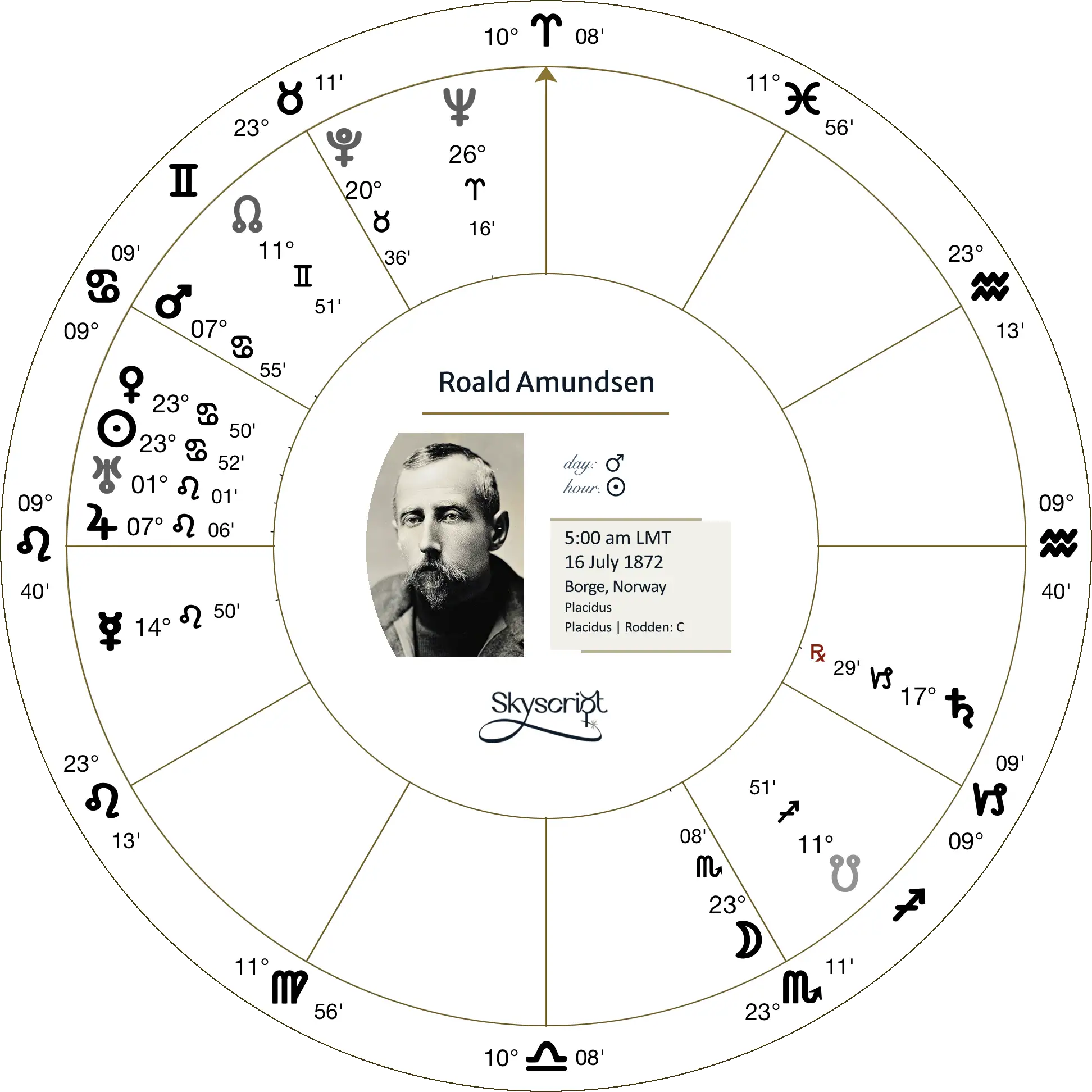
The situation was delicate; Scott had already declared his second expedition to the Antarctic and had, by general opinion, the right to go for the Pole. But Sun-Uranus is not very impressed by public opinion, although Amundsen was vulnerable to it. Sun conjunct Venus in Cancer in the 12th house square Neptune, gives him away as highly sensitive. With the Sun as the ruler of the 2nd house, this trio of planets also influenced his economic affairs. Like many times in his life, he had at this point large debts, and badly needed a success.
Contrary to Scott, Amundsen had a deep passion – close to obsession – for exploration of sub-zero environments. The Moon is in Scorpio, the sign of fixed water or ice, opposing Pluto. From a young age he began exercising systematically, aiming to prepare his body and mind for the journeys he longed to make. Jupiter on the Ascendant is a strong statement for his hunger to explore and experience adventure. In accordance with the Moon in Scorpio, his mother wanted him to study medicine. He obliged her and became a less than eager and below average student. When she died he followed his own star.
Amundsen was the first to sail through the Northwest Passage. In this period he spent time with, and learned from, the Eskimos: how they dressed, built igloos, drove their dogs and prepared furs. When Amundsen led his party to the South Pole he had already learned the craft of surviving in polar regions. This good sense is shown by Saturn in Capricorn on the cusp of the 6th house opposing Sun-Venus in Cancer. He is willing ‘to do’, and able to get satisfaction from the tedious work of preparing and perfecting. As a result he has been referred to as the only true professional polar explorer. This was also very necessary for making his Neptunian dreams come to life.
Reading both Scott’s and Shackelton’s books on their previous attempts, Amundsen learned from their mistakes. In his journal he wrote: “The English have loudly and openly told the world that skis and dogs are unusable in these regions and that fur clothes are rubbish. We will see – we will see...” In Iceland there is a proverb: “If you spend enough time outdoors, you become a pagan”. Having the advantage of growing up in close contact to nature, Amundsen observed “the British Antarctic explorers’ main weakness is that they try to live too civilized, and fight against nature”. Practically inclined, Amundsen let the dogs clean the lavatories by eating the excrements. He had other things to take care of.
In September, during a Mercury retrograde period, his party made their first attempt. Amundsen was eager to start, he had to reach the Pole first to avoid disgrace. But the Antarctic winter was not quite over and it was still too cold. They had to turn back and, due to a hasty order, the men got separated from each other. Some were in danger. As transit Saturn at 20° b was activating Amundsen’s Pluto-Moon opposition, his leadership was challenged. Hjalmar Johansen, who had as much polar experience as Amundsen himself, criticised ‘the boss’ openly. Amundsen reacted in his Scorpionic way and Johansen was frozen out. Both men felt betrayed by the other.
Three months later, Amundsen led his company of men and dogs more effectively and with good margins to their goal. The men would arrive back at the main camp weighing more than they did when they left. He’d wondered whether he should leave a can of petrol in the tent erected at the South Pole, but decided against it; surely Scott would have enough equipment and provisions. As he stood and pondered the irony of being at the opposite point of his original desire, transit Neptune at 23° Cancer was conjoining both Sun and Venus. Neptune was also squaring its own natal position in the tenth house of public reputation, and would continue to do so for a long period ahead. That was one area of his life he would not be able to control.
Although much celebrated on the return to civilization, many were not at ease with the secrecy involved. The leader of the Royal Geographic Society had already spoken: “What rascals these poles are producing... Amundsen has been deliberately forming a plan to steal a march on Scott. He is a blackguard”.
Also, in Norway, some were anxious that his unorthodox methods could have disturbed the young nation’s connections with England. When the news of Scott’s death came out, Nansen himself had to speak on Amundsen’s behalf. Even if he was the one who lived to tell the tale, it was Scott’s rendering of his own journey, full of heroic sentiment and tragedy, that caught the public’s attention and feelings. The dead man’s tale made a victim of the survivor.
With the strong emphasis on Neptune and the 12th house in Amundsen’s chart, it is safe to assume that Scott and his men’s fate affected him deeply. At the same time he got more bad news. Hjalmar Johansen, who had a past of alcoholism and depression, had committed suicide after his return to Norway.
The Moon in Scorpio opposing Pluto made Amundsen an intensely private person, who did not open himself to others. Not the one to let old grudges go himself, he could not reconcile himself with the British reaction. In scorpionic fashion, resentment turned to bitterness over the years. The librarian at the Royal Geographic Society characterized Amundsen as the unhappiest polar explorer he ever met.
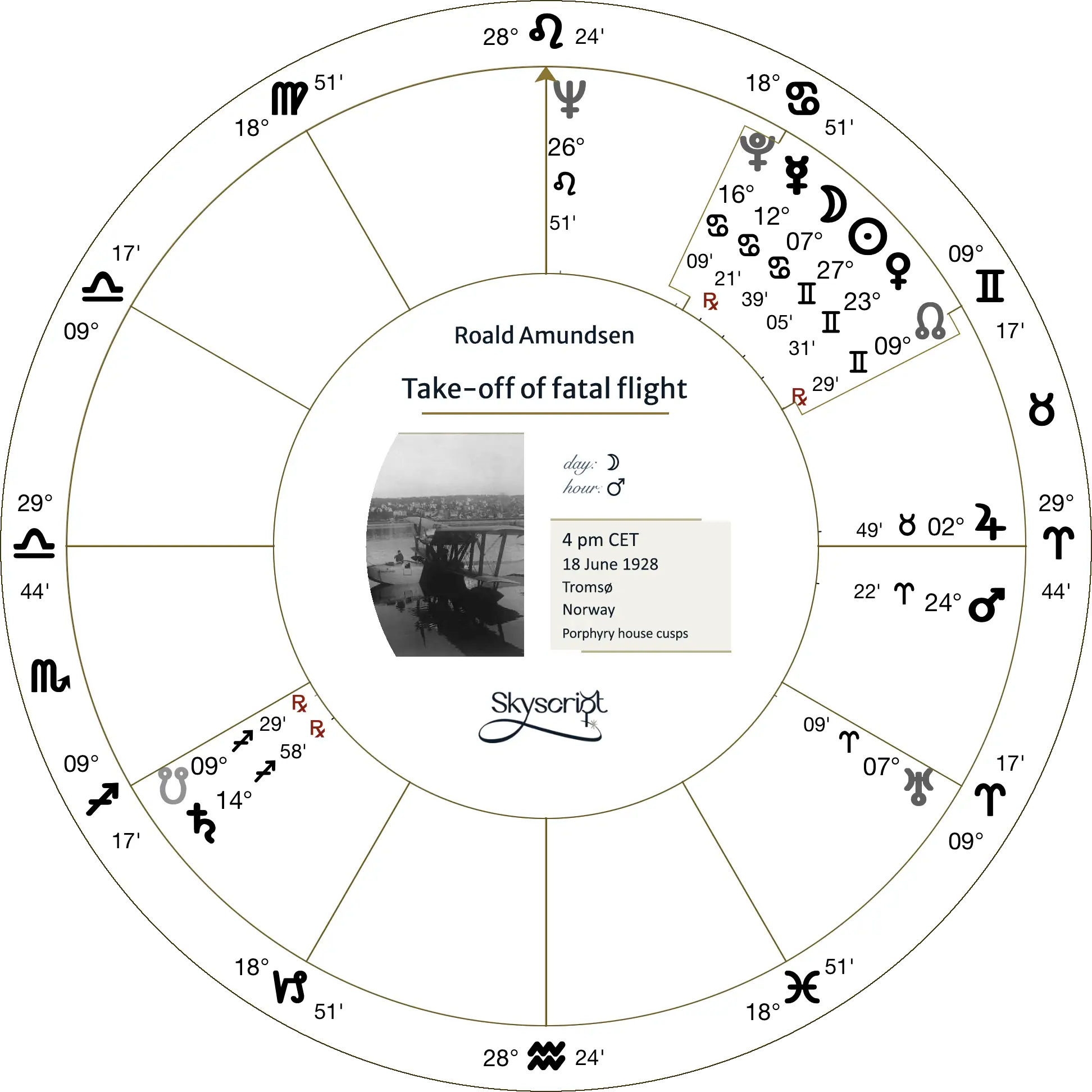
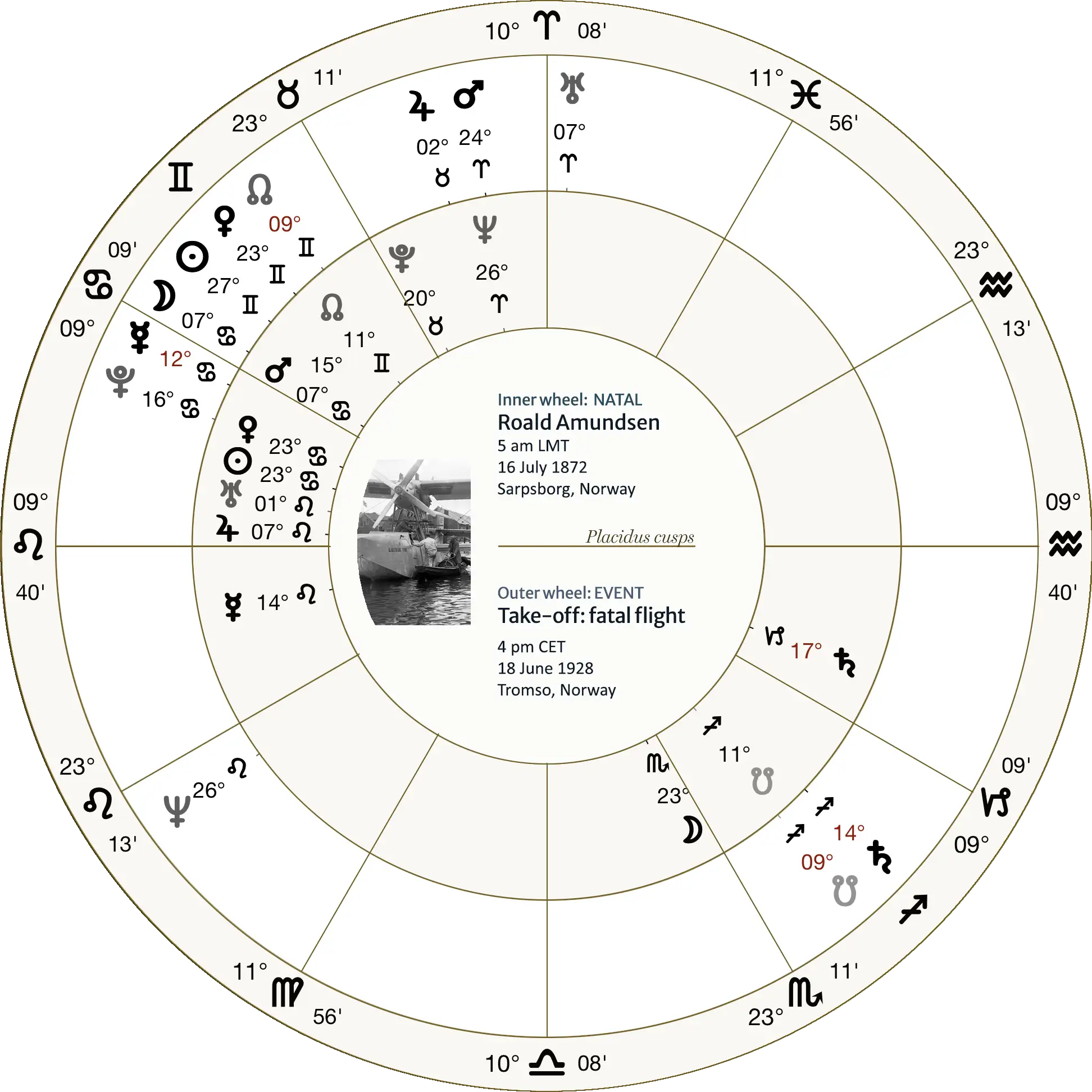
In 1928, a former companion of Amundsen, Umberto Nobile, crashed on Svalbard in an attempt to reach the Arctic in an airship. Although they had fallen out publicly and were not on speaking terms, (or possibly because of that), Amundsen volunteered for a rescue operation. They left Tromsø in the French airplane Latham, at 4 pm on 18 June and were never seen again. The chart for the time of take-off has 5 planets in the 8th house, including Mercury retrograde conjunct the Moon in Cancer, and both squaring Uranus: not the best time to travel by airplane over water. Neptune is on the MC, descriptive for a rescue mission with an unknown destination and a flight that ends in disappearance. Mars was also transiting Amundsen’s natal Neptune as the Moon was transiting his natal Mars.

On 17 January 1912, Scott and his party of four stood heartbroken at the South Pole. They had travelled for 80 days under extreme circumstances, just to find Amundsen’s tent left there the month before. Inside was a letter addressed to the King of Norway, and Scott was kindly asked to bring it back in case something happened to the Norwegians. It has been said that Scott was, in that instant, reduced from being a polar explorer to a messenger boy.
At that point in the party’s journey there were tragedies behind them and in front of them. They had started with dogs and horses to help them, but they had to drag the sleighs themselves most of the way. There were none skilled in managing dog-sleighs and the horses very soon died in the cold, deep snow.
By the middle of March the company was reduced to three as they set up their last and sixtieth camp. Both Evans and Oates had died from exhaustion and severe frost bites. Oates had developed gangrene in his feet and could only move slowly at great pain. He was slowing the others down and knew very well what had to be done. While striving with numb fingers to open the tent he looked back at his companions and delivered the classic line: “I am just going outside and may be a while”. His body was never found.
Due to bad weather and complete exhaustion the company stayed in the tent until their deaths around 29 March. Scott wrote many letters and kept writing in his diary. He was worried his leg would have to be amputated. He was far from his hopes of promotion, honour and success, and closer to being a leader of a catastrophic expedition. Still, or maybe because of that, in his letters he concentrates on ideals around bravery, heroic suffering and willpower. And these qualities were present in abundance.
Half a year later the tent was found with the bodies of Scott, Bowery and Wilson inside, still in their sleeping-bags. Their grave was marked by a cross made of skis. In hindsight, a rather ironic comment both to their lack of training, and to the old British approach to polar exploration: ‘No dogs, no skis’.
Lacking a birth time for Robert Falcon Scott, the chart is set for noon on his birthday: 6 June 1868. The Moon was either at the end of Sagittarius (which fits with a description of his mother as “a very devoted Christian, never questioning the view of the Church of England” - Scott adored and idealised his mother all his life, and also supported her financially after his father and brother had died), or it was in early Capricorn, disposited by Saurn in Sagittarius.

Sagittarius is the sign of expectancy, and with Saturn there is a tendency to have high hopes on behalf of yourself – a need to fulfil them in a very real way. In this sign we meet our beliefs, what inspires us, and our search for the truth. Saturn retrograde states that you need to ‘search on’, you have not found the truth yet. Saturn retrograde might also point to Scott’s father, when he decided to sell the brewery he led and owned, and just let himself and the family live off the money with no other income. After some years he went bankrupt, to the surprise of the family who knew nothing of the real financial state.
To take a position of mental flexibility and really involve yourself and follow your heart is important for success with the north node in Leo and its ruler, the Sun in Gemini. Quite the contrary of Amundsen, Scott never had any inclination for snow, low temperatures and polar adventure. When he applied for the position as the leader on his first expedition, it was considered a smart career move. Now this sounds much more in tune with south node in Aquarius and ruler Saturn in Sagittarius. To promote the career by going on a long and hard journey with scientific instruments for the benefit of mankind.
The nodal axis is also reflected in his style as a leader. Caught up in his naval background, he was distant and impersonal. He could not seem to get on friendly or personal terms with his crew without fearing for his position. It can be hard to get over the fence of rigid, old belief systems with Sagittarius Saturn square south node in Aquarius.
Uranus is conjunct Mercury in Cancer. This combination gives a style of communicating which from time to time made him come across as unpredictable with the odd emotional outburst. He became highly-strung under pressure and would suddenly change plans. In Uranian manner, he could also be very set in his own frame of mind. When – at last – receiving news about Amundsen’s change of plans (which meant that he suddenly had an opponent), Scott decided that things should go on as if Amundsen had not existed. Scott was at the same time open to new ideas - like trying motorized sleighs. Not at all the easiest person to sort out.
Scott was prone to moodiness and could spend much time in his cabin, worrying and going over details. Mercury square Jupiter-Neptune can have difficulties with discerning important elements from mere trifles, and might need assistance when it comes to judging situations objectively. Not to mention when it comes to organizing a dangerous expedition.
In 1903 Scott had made a first and unsuccessful attempt for the South Pole, with the ship Discovery. As he watched the launching of Terra Nova, the ship that now would bring them to the bottom of the world, his thoughts were ahead of him: “I just wish to finish the work begun in the Discovery. Then I’ll get back to my job in the Navy”.
Saturn also shows the quality and nature of our boundaries and psychic defences. A classic defence against overwhelming circumstances is denial through idealising. With Saturn in Sagittarius, idealization as protection is very likely. This is demonstrated in some of his last words: “Had we lived, I should have had a tale of hardihood, endurance, and courage of my companions which would have stirred the heart of every Englishman”. Clearly the description of the journey stirs the heart, Englishman or not. And the qualities of hardihood, endurance and courage are present in abundance, with Jupiter in Aries and Mars conjunct Pluto in Taurus.
The image of exhausted horses standing up to their bellies in snow is stirring on several levels. Besides the obvious suffering involved, there is the symbolism of not being connected to your instinctual nature. As any man is a part of his time, this might be the case for the whole nation in the post-Victorian age, but Scott and his expedition was confronted with this in a direct way. In his horoscope Chiron the centaur has a prominent place - 0° a, the first degree of the zodiac. So we have an image of wounded instincts, and a wounded leader and explorer. But not one lacking in qualities of hardihood and endurance. Mars conjunct Pluto in the sign of Taurus has a tremendous amount of physical energy and stamina, and also has a need to go to the outer limits of one’s strength and will-power. But this energy can also be used to just keep on keeping on, in the tracks already laid down.
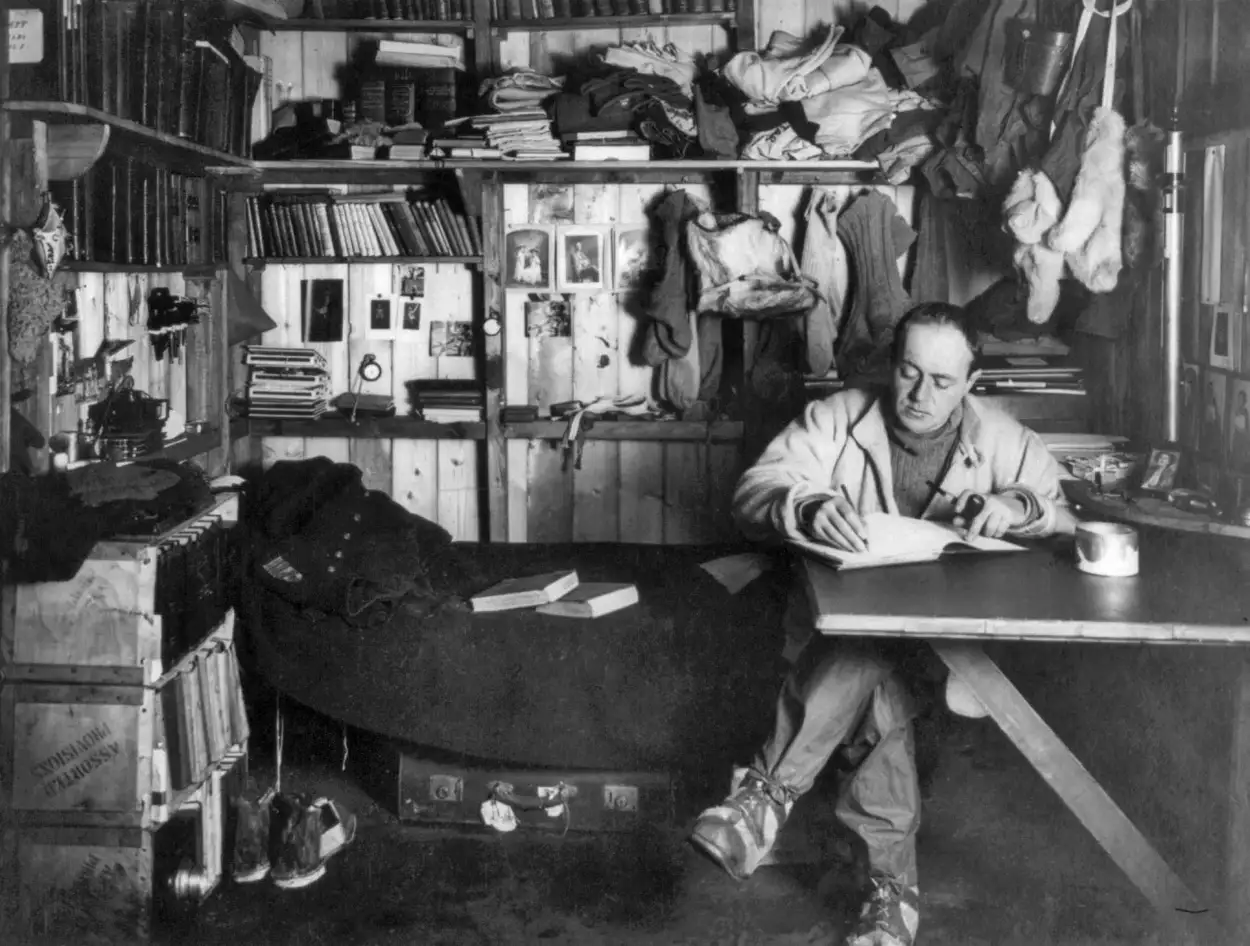
The capacity of Mars-Pluto in Taurus to relate to the very earthiness of life seems not to be developed to the same extent as the idealism in the chart. One might wonder if his inability to tolerate the sight of blood illustrates this on a symbolic level. Like Amundsen, Scott was very fond of animals, but his love was of the distant and sentimental kind. He never worked close with them or actually related to them. Oates remarked in a letter that Scott was only too happy to stay in his cabin instead of seeing to the horses. As an eager scientist, he spent long hours filling his journals with observations made on solitary walks.
The transits made during the last journey are quite telling. Transit Jupiter was in Sagittarius, passing from a conjunction with natal Saturn to an opposition with the natal Sun. In the same period, transit Saturn in Taurus was making two passes over natal Pluto. His tendency to prefer the map instead of the actual terrain was brought to a head, and he was confronted with it. You might say that he was taking a big bite, only to find out that it was more than he could chew. Refusing to spit it out, he choked on it.
But he does not regret it in his last letter to his wife: “How much better it has been than lounging about in too great comfort at home. What tales you would have had for the boy, but oh, what a price to pay”. Eager to communicate his experiences and his own view, he writes a number of letters during the last days in the tent. Displaying a talent for writing, storytelling and myth-building that is worthy of a Mercury-Uranus square Jupiter-Neptune.
On 12 February, 1913 The Times wrote: “We owe honour and gratitude to Captain Scott and his companions for showing that the solid stuff of national character is still among us, and that men are still willing to be ‘killed in action’ for an idea”.
Apart from the fact that in eighteen months WWI would begin, it is interesting to observe that Scott’s Mars (12° b) is exactly conjunct Mars in the UK chart of 1801. In that national horoscope Mars is in the 8th house of death, opposing Neptune in Scorpio and squaring Venus in idealistic Aquarius. ‘Killed in action for an idea’ indeed. As far as this T-square is concerned, a good hero is a dead hero it seems.

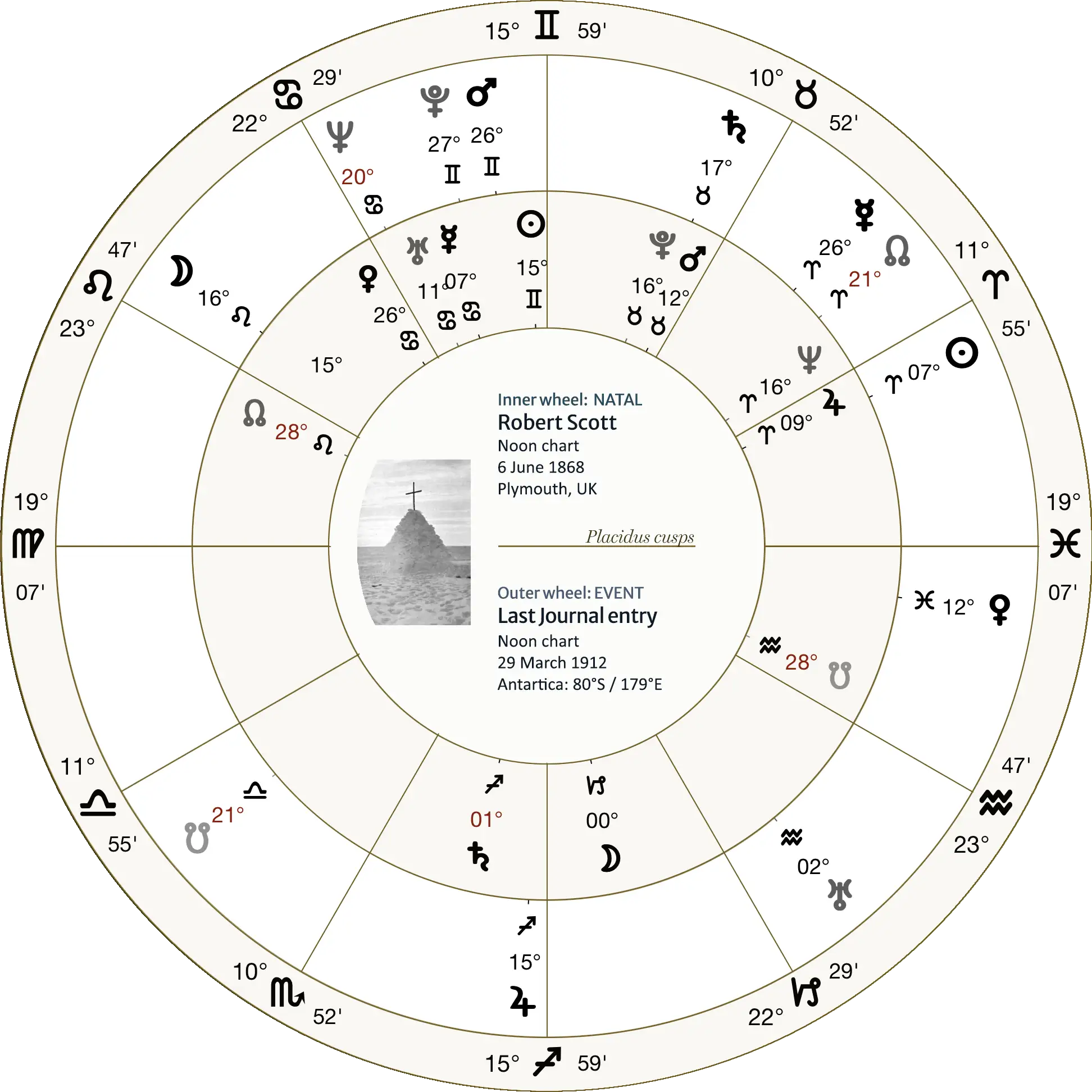
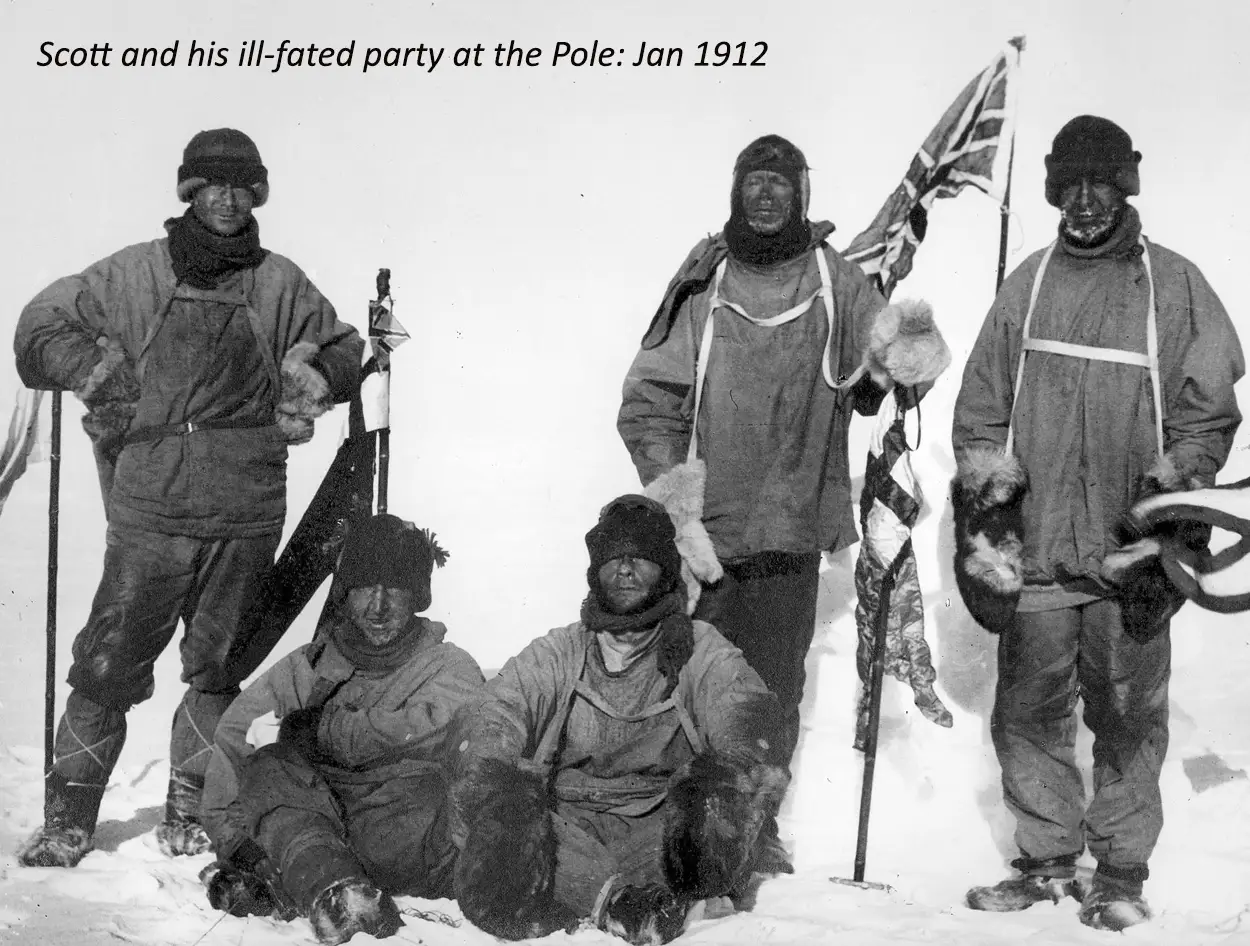
Scott's death in the ice occured sometime around the lunar eclipse of 1st April 1912 - at 5 12° g / 0 12° a this aligned with the nodal axis of the UK national chart. Two weeks later, within that same lunation (which had a partile Mars-Pluto conjunction) the UK would suffer the tragedy of the sinking of the Titanic, after it struck an iceberg on 14 April 1912
 © Skyscript; Lars Widding, 2003


