This is part of a connected series on shipping and travel-related astrology. For the introduction and outline, see here.
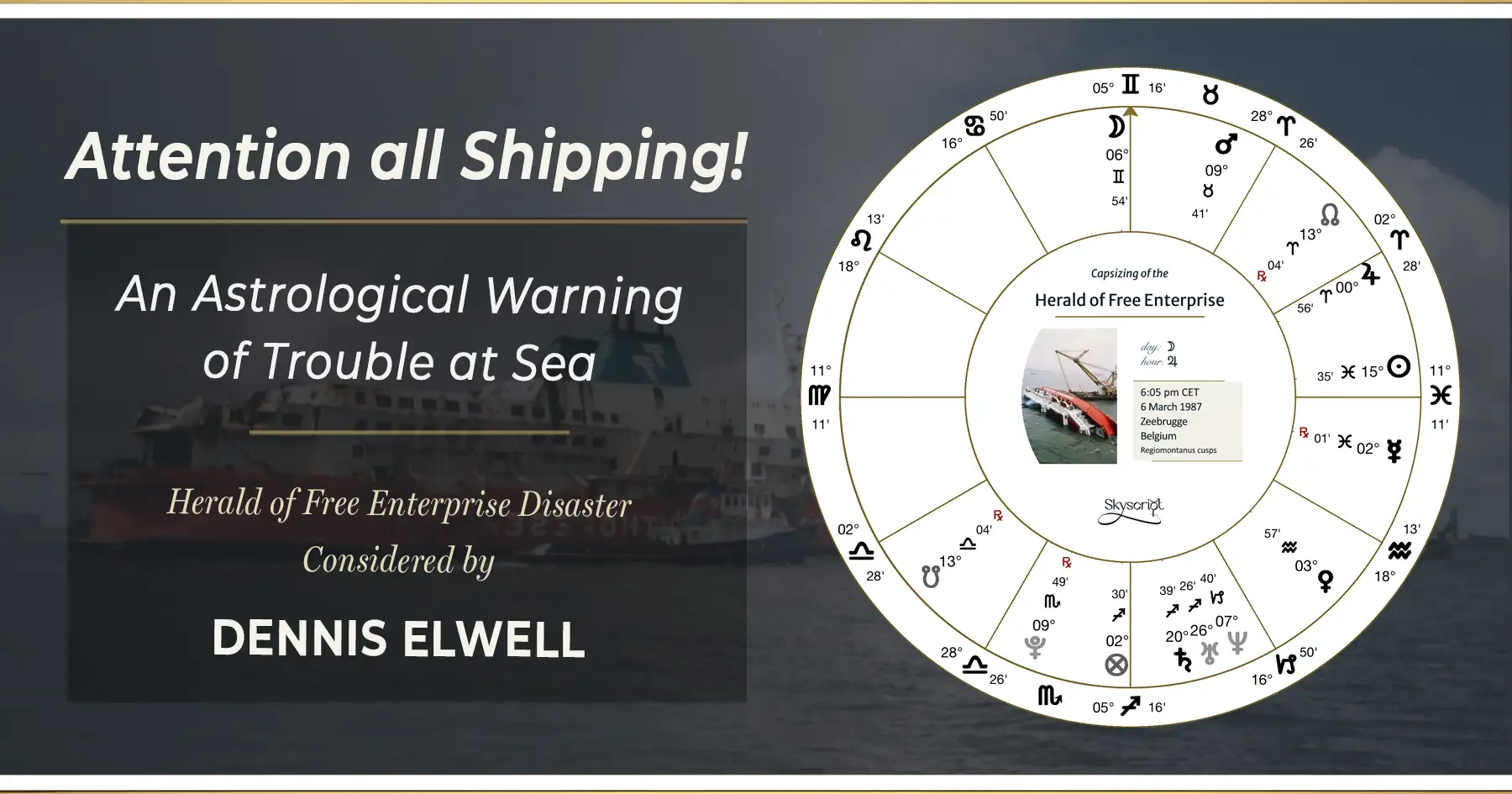
In 1987 Dennis Elwell attracted considerable attention in the UK press. Within days of forewarning two British shipping companies of potential trouble at sea, one of them met serious misfortune with the loss of the MS Herald of Free Enterprise. Elwell’s attention to the prospect of shipping disaster was prompted by the March 1987 solar eclipse in Pisces. The following account is extracted from his notes.
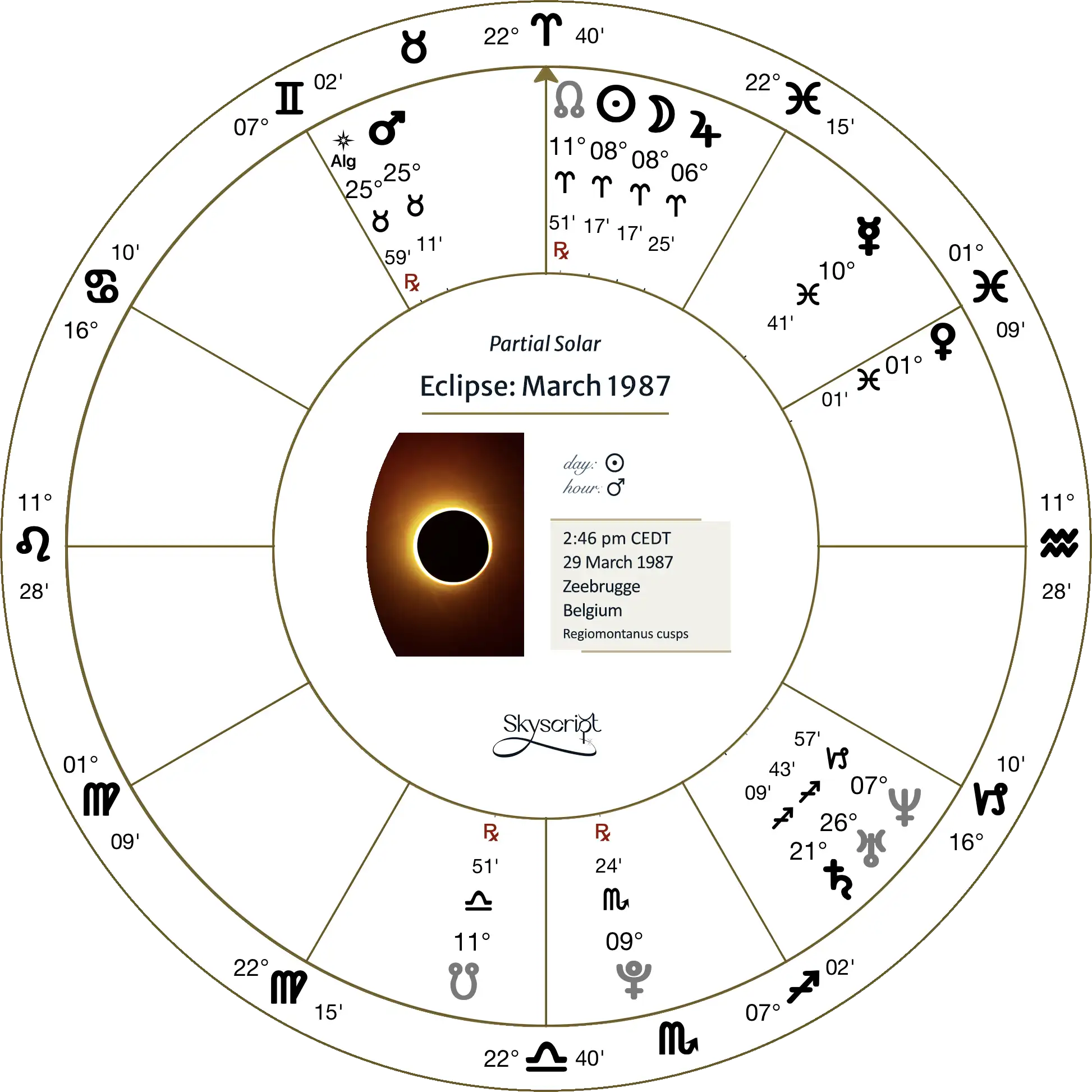
Elwell’s Commentary:
The March 1987 eclipse was raising the temperature of a square between Jupiter and Neptune, planets which, when working together, indicate both sea travel and big ships. Eclipses bring the matters signified into high profile, and tend to be associated with misfortunes, although positive outcomes are also possible.
I sent identical registered letters to two shipping carriers to alert them to the potential hazards. I wrote:
The emphasis is on the sudden and disruptive. While I am not in the prediction business, it would be no surprise to find that, at the very least, sailing schedules were upset for some unexpected reason. But there has to be a possibility of rather more dramatic eventualities, such as explosions.
The letter specifically mentioned the Titanic, comparing the eclipse with the one that coincided with her sinking in 1912.
I made it clear to the companies that, if they were ready to co-operate by providing more data, it might be possible to pinpoint the dangers with a view to mitigating them. Moreover, that because of the nature of these influences, one could expect not just one but a run of similar events. (It is an astrological commonplace that the effects of the eclipse can last up to a year or more: thus 5 months after the Titanic went down with a loss of 1500 lives, the sinking of a Japanese steamer, SS Kiche Maru, killed about 1000.)
Only 9 days after P&O replied that their procedures were designed “to deal with the unexpected from whatever quarter”, their ship, the Herald of Free Enterprise, capsized at Zeebrugge with the loss of 188 lives. Immediately the scale and unexpectedness of the tragedy was compared to the Titanic.
Journalists examined the correspondence and a number of national newspapers carried the story of ‘the warning ignored’. But, terrible as the tragedy was, in the scale of disasters it was not exceptional and it had to be supposed that the energies of the eclipse had not yet been exhausted. Later that year the worst ocean accident ever occurred, the loss of the MV Dona Paz, with a toll of 2000-3000 lives. For that disaster Uranus (sudden mishaps) and Neptune (the seas) had returned to the places they occupied at the March eclipse. (The same day’s newspapers reported another 55 dead when a freighter, the MV Binter, the sank in the Java Sea.)
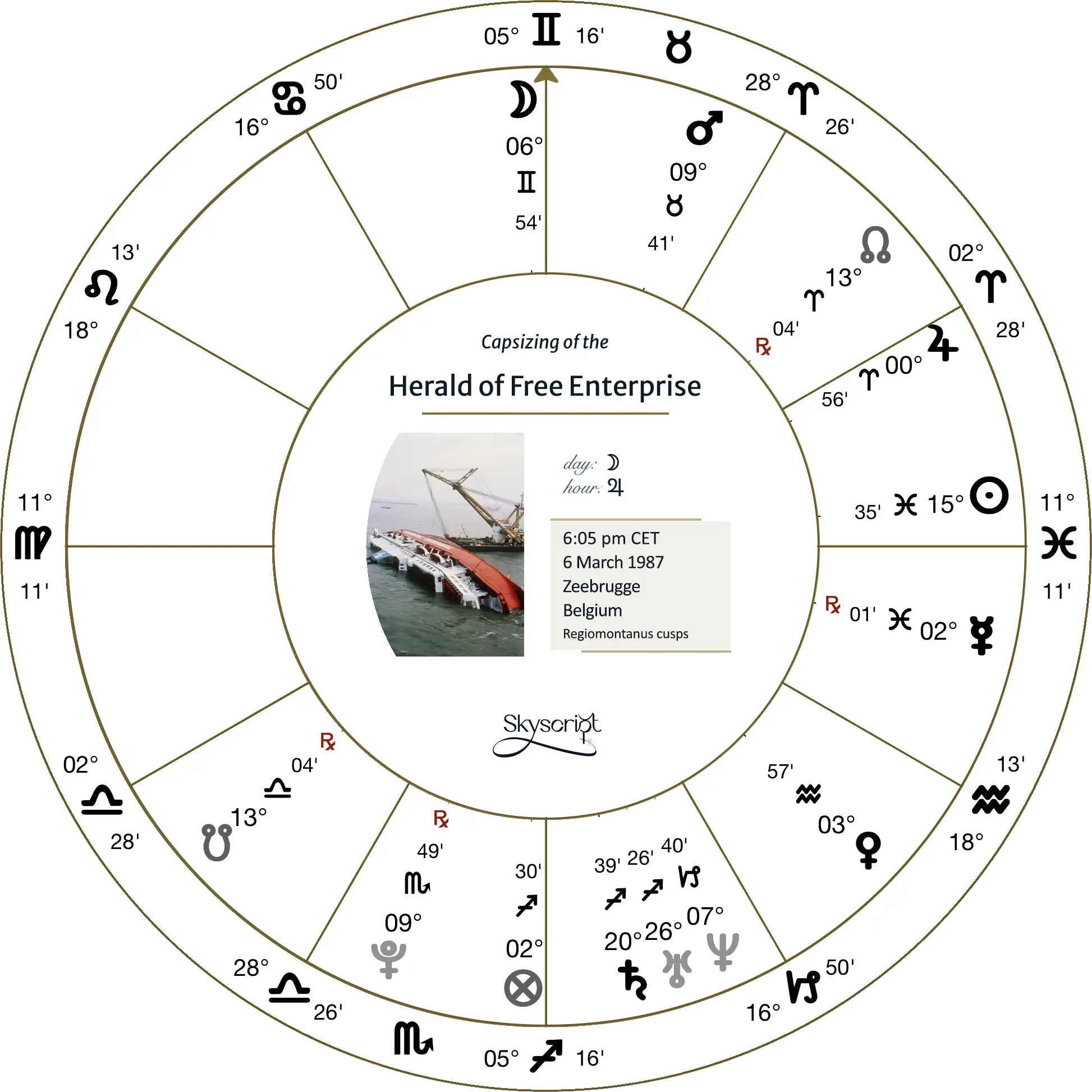
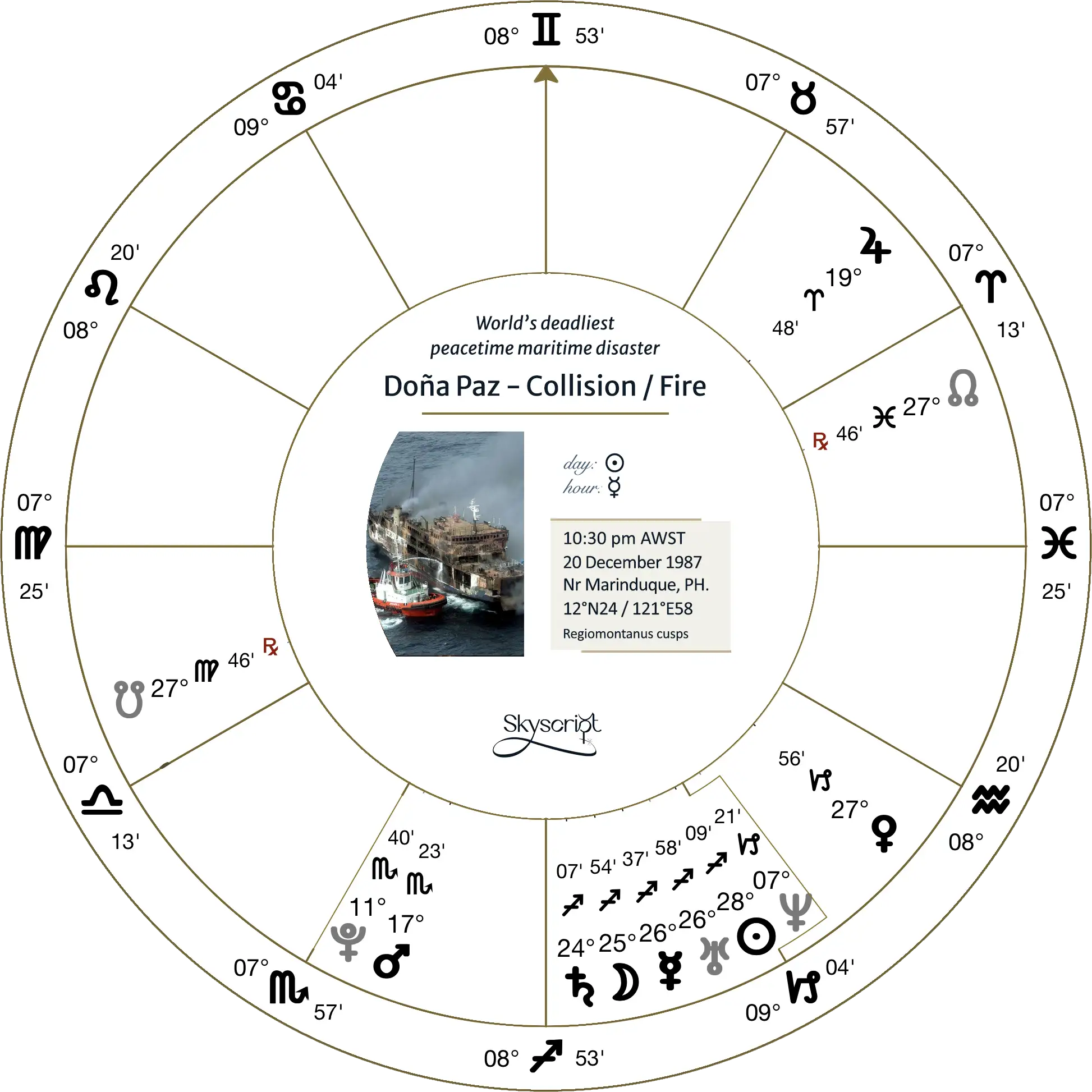
Because the universe functions all-of-a-piece similar events tend to bunch. It was no surprise that 7 weeks after the Herald of Free Enterprise disaster there was another ferry mishap in the Channel when the MV Hengist was in collision with a French trawler, which, like the Herald of Free Enterprise, suddenly capsized, drowning 3 of the crew. On May 30 there was yet another collision in fog in the Channel, between a tanker and a cargo ship, with a threat of a disastrous oil spillage and fire.
Such coincidences do not go unremarked. The satirical magazine Private Eye headed one item Townsend Thorsen ferry arrives shock, which went on:
Port officials at Dover were stunned last night by the unprecedented safe arrival of a Townsend Thorsen ferry. Said a shocked harbour master: “it was amazing. It just sailed in and docked. Everybody got off and there was no need for any rescue operation”. An immediate inquiry has been called to investigate the incident.
This was a bad year for ferries. Early in July, 390 people died when a barge capsized while crossing a crocodile infested African river. Another ferry capsize occurred in the Philippines, killing 38. The Dona Paz was yet another ferry. On the whole, shipping tragedies hit a peak. Figures later released by Lloyd’s Underwriters showed that more people died at sea during 1987 than in any other year since records began.
All through 1987 the name Herald of Free Enterprise was being drummed into the British national psyche. When news of the tragedy broke I was taken aback by the name of the vessel. In the astrologer’s vocabulary, Jupiter stands for the ideal of liberty and freedom. The sign Aries is the most enterprising of all and, being the first sign of the zodiac, stands for ‘firsts’ - trailblazers, pioneers, forerunners and hence heralds.
The eclipse of March was falling on Jupiter as it reached 7° Aries. As mentioned, at the eclipse Jupiter was configured with Neptune (a planet of the sea) so a ship with this kind of name would automatically have a question mark over it. This interpretation of the cosmic symbolism was later confirmed for me from another source. I was interested to find out whether this vessel could have been identified in advance, given the co-operation of P&O. I accordingly wrote to the master, Captain David Lewry, to ask for his birth data and months later had a reply from his wife. By one of those ‘coincidences’ we come to expect when we start to look behind the scenes, David Lewry was born with Jupiter at 7° Aries. So Jupiter in his birth chart was also being picked out by the eclipse, as was Jupiter in the sky at the time of the eclipse.