From:
http://spaceflightnow.com/news/n1001/09marslife/
BY CRAIG COVAULT
SPACEFLIGHT NOW
Posted: January 9, 2010
The team that found evidence of Martian life in a meteorite that landed in Antarctica believes that during 2010, by using advanced instrumentation on now three Martian meteorites, it will be able to definitively prove whether such features are truly fossils of alien life on the Red Planet.
This new information goes well beyond the updated findings released by NASA in November 2009 about signatures for magnetic type bacteria.
"We do not yet believe that we have rigorously proven there is [or was ] life on Mars." says David S. McKay, chief of astrobiology at the NASA Johnson Space Center.
"But we do believe that we are very, very close to proving there is or has been life there," McKay tells Spaceflight Now.
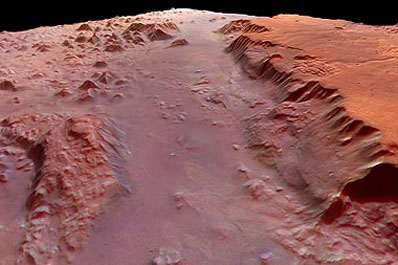
Researchers believe that the Allen Hills meteorite where initial evidence for life on Mars was found was blasted out of the area of Eos Chasma near the far horizon in this ESA Mars Express image. The canyon feeds into the larger Valles Marineris canyon near a feature named "Orson Welles." Credit: ESA
|
"The possibility of life on Mars has become a scientific issue of profound importance and great public interest," Michael Meyer, the NASA Headquarters senior scientist for Mars exploration, told an audience of several hundred scientists at the recent American Geophysical Union meeting in San Francisco.
And in a 2009 editorial, The Economist, a highly regarded British publication, also noted the explosion of both public and scientific interest in Mars saying "the possibility of life on Mars is too thrilling for mankind to ignore."
In the mid-1990s, when the JSC team found what it interprets as Martian fossils inside a meteorite that landed near Allen Hills in Antarctica, it was the only example at the time of suspected fossils in a meteorite from Mars.
The team, however, believes it has since tripled its fossil-like data by finding more "biomorphs" (suspected Martian fossils) inside two additional Martian meteorites, as well as more evidence at other spots in the Allen Hills meteorite itself.
| | 
Meteorite scientists document a new find in the Antarctic. The Antarctic Search for Meteorites Program (ANSMET) is funded by the Office of Polar Programs of the National Science Foundation (NSF). Credit: ANSMET/NSF
|
Remarkably, some of the most striking new evidence for life on Mars is being found inside in a meteorite that has been sitting in the British Museum of Natural History in London for nearly 100 years, says McKay.
Had British researchers examined their "Nakhla" meteorite with readily available electron microscopes and other tools like those used by the U.S. team, the new evidence for life on Mars could have been a British discovery, rather than an American one.
The Houston-based scientists believe the age spread of their data, from 3.6 billion to 1.4 billion years ago, shows that a planet-wide network of micro-organisms came to life underground on Mars 3.6 billion years ago during the first billion years after Mars had formed along with the rest of the planets in the solar system.
Mars was much warmer and wetter with a much thicker atmosphere then. Simple life forms were beginning to form on Earth at about the same time.
Scientists are able to tell that the meteorites came from Mars by measuring the noble gases trapped in the rocks and also by their geologic character. The noble gas ratios measured to determine Martian origin are helium, neon, argon, krypton, xenon and radon.
The twin Viking landers of the mid-1970s measured Martian surface gas compositions in great detail, and the now more than 80 meteorites have been found and designated as being from Mars.
They all have internal gas compositions that match the Viking lander data, as well as Mars rock compositions measured by spacecraft at the planet.
"Similar biological type findings in three different meteorites that also correlate well with ancient Earth organisms considerably broaden the evidence for at least past life on Mars," says geologist Everett K. Gibson, co-leader with McKay and Kathie Thomas-Keprta on the JSC Mars life study team.
According to the JSC team, the three Martian meteorites with the apparent fossil signatures include what appear to be mats of bacteria and specific other biological signatures that are common to all three meteorites.

Scanning electron microscope image of what JSC researchers believe are the fossil remains of a once-living Martian bacterial mat was found in the Nakhla meteorite from Egypt in storage at the British Museum of Natural History. Credit: NASA
|
They are also highly similar to undisputed micro-fossil life of ancient organisms found in Earth's rocks like Columbia river basalts in Washington state.
In its November update, the Mars team said that for more than a decade after the Martian meteorite data were first presented in 1996, opponents of the life theory argued that fossil-shaped features and associated chemical purity was just as likely caused by the thermal/shock event that blasted the material off Mars in the first place.
But new research led by Thomas-Keprta of the Allen Hills team in Houston has now proven the thermal theory is invalid. She says that finding strengthens the team's argument that uniquely-shaped "magnetic bacteria" features found in the meteorite were indeed formed by biologic activity on Mars and not some non-biologic thermal event.
The new information from the team here goes well beyond the magnetic bacteria that dominated the NASA November release. McKay and co-leader of the Mars life team, JSC geologist Everett K. Gibson, have since provided Spaceflight Now with much more detail on two other major areas that will be the focus of more verification work starting this year.
Noted astronomer the late Carl Sagan often said "extraordinary claims require extraordinary evidence," and the Johnson Space Center Mars life team believe they now have, or by year's end will have, such evidence.
The two new areas involve:
More advanced instruments: Powerful analysis hardware that was unavailable or less capable when the Mars meteorite life analysis began in 1994 is about to be used on the samples in all three meteorites. This includes more capable High Resolution Electron Microscopy tools and a major new tool -- an Ion Microprobe analysis system.The Microprobe system will fire a focused stream of ions onto the biomorph/micro-fossil samples. The ions will flash the sample into plasma containing multiple constituents. A powerful spectrometer will then suck that in and out the other side read out constituents of each sample down to parts per billion level for each chemical or mineral constituent. Those ratios will then be used to determine whether the feature has its origin in non-living Martian geology or something biologic that was previously life on Mars.
The new ion microprobe system should also provide the team with even higher optical resolution than the electron microscopes they have been using while also adding a major new chemical analysis dimension, says McKay.
Triple the meteorite samples: The JSC team is finding more micro-fossil evidence of life in the Allen Hills meteorite discovered in 1984 that in 1996 provided initial evidence of Martian life.The team calculates that the Allen Hills meteorite is made of 4-billion-year-old Martian rock carrying fossil evidence of life dating back to 3.6 billion years.
This is an extremely old sample not comparable to anything on Earth today because all of Earth's crust has been processed and reprocessed as part of Earth's plate tectonics. The sample is already proving the presence of water on Mars back to its early days as a planet. If the fossil evidence is confirmed, it will prove that organisms existed on the planet within about 1 billion years of its formation.
After the initial Allen Hills announcement made in 1996 with President Bill Clinton, the Houston team began to search for similar life examples in other meteorites from Mars. And they found that evidence in the already famous Nakhla meteorite that fell near the town of Nakhla, Egypt, in 1911. Nakhla fell in about 40 pieces weighing about 20 lb. total.
The largest sample set from that meteorite has been in the British Natural History Museum in London and virtually all of several pieces of Nakhla, which put on a spectacular show of flaming debris, smoke trails and sonic booms when it arrived at about 9 a.m. local time in the Nakhla region of Egypt south of Cairo.
A local farmer claimed that one piece struck and killed a dog. But scientists believe the story was dreamed up by the land owner at the time seeking to boost prices for buyers seeking to purchase pieces.
Then in 2000 a Japanese search team found another meteorite from Mars in Antarctica. It is designated Yamato 593 and also contains signs of fossil life similar to that seen in the Allen Hills and Nakhla meteorites. Both the Nakhla and Yamato life forms date to only about 1.4 billion years old, if it can be proved more definitively.

Features similar to a fossil of bacterial matting has also been found in the Yamato 593 meteorite discovered by the Japanese in 2000 in Antarctica. Credit: NASA
|
The new evidence for life on Mars is being substantially increased by the discovery of such potential Martian fossils in additional meteorites beyond the original meteorite discovered in 1984 at Allen Hills Antarctica, says McKay.
Answering whether life, even single-celled organisms, formed on another planet is one of the most profound questions in modern science, especially if the answer is positive.
If that can be verified soon, it will also play a major role in Mars space mission operational decisions and the formation of new exploration policy by NASA and the White House. Examples are:
More focused Mars life strategy: NASA's original strategy was to "follow the water" then shift to a strategy of "follow the carbon." The strategy now, however, has been changed again and the new motto pulls no punches. It now simply reads "find direct evidence for seeking out life," says Meyer. That role will first fall to the Mars Science Laboratory rover undergoing final assembly for launch in September 2011.
Next rover site selection: The Mars Science Laboratory (MSL) rover, named Curiosity and planned for launch in September 2011, will be specifically targeted for landing at a carbonate-rich site. It will be equipped to specifically look for Martian life as well as habitable areas for Martian organisms. MSL will be NASA's first dedicated astrobiology mission to Mars since the two Viking landers in 1976. Data from the meteorites will be very important in the analysis of MSL life-related findings, Gibson says.
Life's role in the solar system: If the meteorites' biomorphs prove to be true fossils of Martian life, the data will play a huge role in the assessments for life elsewhere in the solar system, such as in the ice-covered oceans of Jupiter's moon Europa. NASA plans to launch in 2020 a major new outer planets spacecraft -- the new Europa Jupiter System Mission -- to orbit Europa and assess the potential for life there.
Life's role in the Milky Way: Positive life determinations from the three meteorites would play a role in the assessment of life on Earth-like planets in the galaxy being sought out by the new Kepler observatory spacecraft that has already discovered five Jupiter-size planets in orbit around distant stars.
Broader study of carbonates: McKay says that all three of the meteorites contain substantial carbonate rock where the apparent fossils are located. Neither rover on the Martian surface has been able to study carbonate rock. If Opportunity can last another year, it will reach Endeavour crater, where such high priority carbonate rock is assessable.
Rover Opportunity drive strategy: The Mars Reconnaissance Orbiter (MRO) spacecraft has found clay-bearing rocks lying directly in the path ahead for the Mars rover Opportunity. It will reach its 6th anniversary on Mars on January 24th and is driving dozens of feet each day toward Endeavour crater that is surrounded by carbonate-rich rock types like that holding fossils in the meteorites. If it can survive another year to drive the final 7-8 mi. to Endeavour crater, the rover will be able to image and analyze this totally new rock type never visited by a rover before. As a carbonate like that in the meteorites, the area ahead of Oppy could have provided a wet, warm, and non-acidic habitat for the formation of life on Mars, Steve Squyres, rover principal investigator, tells Spaceflight Now."Even though we do not think the Endeavour crater is where these meteorites came from on Mars, any information that Opportunity could provide on the layering of similar carbonate rocks would be very useful to us," said Gibson.

Johnson Space Center team believes pits in Nakhla meteorite were left by living bacteria. Some of remaining bacteria is also in each pit. Credit: NASA
|
The other rover, Spirit, marked its 6th anniversary on Jan. 4, but NASA is resigned to declaring Spirit's roving days are over where it has been stuck since April in water and volcanically altered soils near the equator on the opposite side of Mars from Opportunity. Given Spirit is stuck for good, the science team is now preparing a detailed stationary spacecraft science program for Spirit but may try and run and steer its stuck wheels even deeper to tilt its solar array deck more toward the sun so the spacecraft can survive at least one more winter on Mars.
Analysis of the Allen Hills, Nakhla and Yamato meteorites show the rock was blasted from depths as shallow as one-half mile and as deep as four miles. This puts them directly in the subsurface water table of Mars, Gibson said.
Maria Zuber, who heads MIT's Department of Earth, Atmospheric and Planetary Science addressed the latest Mars water data this week at the American Astronomical Society meeting in Washington, D.C.
"Recent observations of Mars from orbiting and landed spacecraft have dramatically changed our understanding of the distribution and amount of water at and beneath the surface throughout the planet's history," says Zuber.
"There is definitive evidence for a watery past, including standing water on the surface, during Mars' early history, and the details of the global hydrological cycle, groundwater upwelling and aqueous chemistry have been elucidated.
"There is evidence that much past surface water is currently stored in the upper crust in the planet's impact-generated regolith," she says. "And present-day Mars contains abundant water ice within a meter of the surface," says Zuber.
The "biomorph" features discovered in the Yamato 593 meteorite look identical to those found inside the Allen Hills and Nakhla meteorites says McKay.
Those Martian samples are also contained along with a mineral substrate called Iddingsite. In such material, the presence of carbonate is a giveaway for what on Mars would have been an underground aquifer with substantial water to generate this type of sample, McKay tells Spaceflight Now.
The Iddingsite deposits continue to form and change the longer water flows through the rock providing additional evidence about the life forms that create tiny biomorphs -- the early stage for fossils that are most abundant with Iddingsite.
Not only is there now abundant evidence for underground Mars life, the Japanese Yamato and Egyptian Nakhla samples, as well as increased samples of apparent fossils, look identical to samples in the Allen Hills meteorite.

Antarctic Search for Meteorites Program map of Antarctica shows the major search area for meteorites where ice moving toward mountains moves meteorites to the surface, where they can be easily seen. Allen Hills (AH) region is at the bottom while Yamato area is at top. Credit: ANSMET/NSF
|
"Every biologist that I have shown these new Nakhlite and Yamato pictures to agree that they are microbial remains and fossils," McKay says.
And all of them look very similar or identical to the Earth fossil life examples found in Columbia River basalts in Washington State.
The Martian samples have been recovered from Martian depths ranging from an estimated one-half mile below the surface to as much as about 4 miles deep.
Allen Hills team members tell Spaceflight Now that this is especially fortuitous because many assessments about where Mars life would most likely survive is underground, out of reach from solar radiation and where aquifers most likely exist to hold life-giving water.
This is also because those depths match assessments on where the underground Martian water table would have been the most active. Many Mars Reconnaissance Orbiter and Mars Global Surveyor images show what appear to be discharges of water from canyon and crater walls.
That data was summarized initially before the Society of Photo-Optical Instrumentation Engineers.
NASA rolled out the findings again in greater depth before the American Geophysical Union Meeting last week in San Francisco. That meeting was attended by 16,000 international scientists and managers who work in the field of geology, geophysics and other exploration related fields.
Some of the data described here was prepared by McKay initially for presentation to the Society of Photo-Optical Instrumentation Engineers.
"The biomorphs in these last two meteorites are nearly identical, supporting our hypothesis that they formed on Mars," McKay told Spaceflight Now.
He also noted that the similarity of the biomorph features across the three main Mars meteorite samples also argues against contamination by material that instead may have formed on Earth.
And Nakhla also scores big when it comes to "following the carbon."
"We see considerable carbon in Nakhla," says McKay.
He cited the work of University of Arizona geoscientist Dr. A.J. Timothy Jull, who has shown that at least 70 percent of the carbon in Nakhla is not from Earth but had to come from Mars.
The new Martian life evidence has come to light just as President Barack Obama is examining increased funding for NASA.
That federal budget decision is being made in the wake of presidential review commission findings that the agency needs at least $3 billion more annually to develop new launchers and spacecraft that would both replace the space shuttle and send astronauts beyond Earth orbit with Mars the ultimate destination before mid-century.
That Mars is the ultimate destination is pretty clear in the report by a team headed by Norm Augustine, former CEO of Lockheed Martin. But how to go about it remains the bigger unanswered question.
Independent researchers in New Mexico and Hawaii say images and geochemical data from MRO and the European Space Agency Mars Express orbiter indicate that the Allen Hills meteorite was blasted out of the southern end of the vast Valles Marineris in a canyon at a junction called Eos Chasma.
In a striking coincidence, this location believed the source for the first meteorite found to carry evidence of Mars life to Earth is fed directly by a channel named after the late "Orson Welles."
In 1938 he panicked the entire U.S. with his Halloween radio news bulletin broadcast of H.G. Wells fiction "War of the Worlds" about the first Martian landing in New Jersey.
This is the second of a pair of articles updating the analysis of evidence for life on Mars carried to Earth in meteorites. The first appeared in Spaceflight Now on Nov. 24, 2009.


