Showing posts with label techtip. Show all posts

Thursday, December 29, 2011

My Facebook Rant

[EXPLICIT] This post includes explicit language. I was in a Mood.

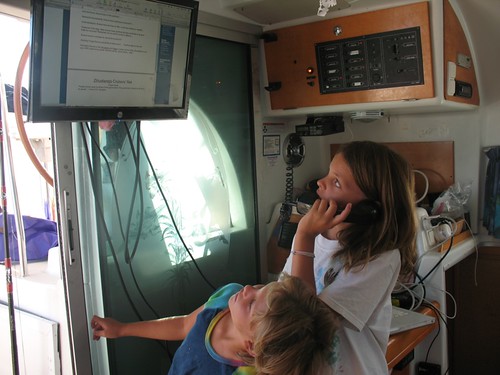
Mom's Scoping the Business
Uploaded by toastfloats
I am not a great fan of Facebook. Its user interface lacks elegance, and Zuckerberg's machiavellian approach to privacy is profoundly annoying. It is, however, the AOL of its time. All the people we want to know, all the people with whom we are interact, they live on Facebook. We are, in a word, stuck.

Stuck with the fat ads. Those assholes. I have never in my life clicked an ad for botox, a fad diet, or magical ways to get rid of belly fat. Nevertheless, the pricks that wrote the algorithm on Facebook insist that because I am a woman of a certain age with children, these are my Must See adverts. I imagine a pimply faced, sun-deprived graduate of the Stanford comp sci department sitting in a cubicle in Silicon Valley tweaking the selection algorithm to prioritize diet ads above every other possible option for all self-avowed females who also admit that they eat. I have down-voted these ads countless times. In vain, I once attempted to up-vote a series of "Have Sex with this Russian Beauty" ads that somehow slipped through Facebook's no-porn policy. I figure if I'm having sex with Russian beauties with enormous tits, I am clearly comfortable with my extra tonnage and don't need any further assistance. My next foray will be to up-vote anything having to do with a penis. Penile implant surgery on my non-existent manly appendage would be vastly more appealing to me than a magically surprising way involving eggs and a tire to resize the waistline.

Stuck with the crazy as chick who I vaguely remember from high school who posts semi-nude photos of herself, the one probably also clicking those belly fat ads. How the hell do these make it into my feed, anyway? I mean, yeah… at one point I was stupid enough to agree to join the group devoted exclusively to my fellow high school alumni. I was a problem child. As I had zero social life in high school, loathed most of those people at the time, and abandoned my hometown with no regrets nearly 20 years ago never to return, I'm not sure what the hell I was thinking. I just spent the last 5 years utterly sabotaging the usual geek's revenge of owning the companies where my former class mates work as well as sporting a better hair cut, gorgeous eye candy husband, and fantastically higher standard of income. I suspect that no one 'back home' is going to be impressed with the fact that DrC and I dropped out as it rings eerily familiar to so many of them. I have no interest in their lives or their children, and I am utterly convinced that the feeling is profoundly mutual. So I unsubscribed or declicked or unchecked or something which was another completely pointless exercise. Once a relationship lives on Facebook it is like a stain on a white fiberglass boat deck and remains forever to remind you of the error of your ways. 

Stuck with requests to take this or that poll, join this or that cause, or participate in this or that quiz. I believe that Facebook proves we are all monkeys banging away at the keyboard attempting to produce Shakespeare and instead generating enough demographic data to keep a football stadium full of marketing executives cumming in their boots till they all pass out in brand awareness nirvana. What these clicks do not do is make a damn bit of difference in the greater scheme of things. There are ways that social media is a force for change. Facebook is not a participant in any of them. 

That Steep, Really...
Uploaded by toastfloats
I think the only thing more annoying than a Facebook friend who plays Farmville, participates in every poll, and feels compelled to Share every link in their feed, is a relative who insists that Facebook is the anti-christ, refuses to check their pages, and then whines that they have no idea what's going on in your life because you "don't write any more." Wake up and smell the bits, people. The letter is dead. Frankly, so is the phone. If you want to know what I had for lunch, by all means look it up. I have absolutely no privacy any more, but don't expect me to spoon feed you. This is a pull economy. If you want it, pull it down; I will never send it to you again. You should be thanking me for not filling your life with a monthly, landfill-worthy missive detailing the size of the growth on my nose and the length of the seaweed on Don Quixote's transom. It is so much easier to avoid my drivel now than it ever was before. Just get Facebook to stop displaying it. Oh wait… good luck with that.

Techies know Facebook is crap, hate the cascading absurdity of Facebook's privacy setting changes, and would like to put a gun to head of every Zynga developer and executive while forcibly requiring them to grow strawberries on a real farm surrounded in singing and dancing middle school students dressed as badly drawn mange characters. Nevertheless, it is foolish for us to believe it is going to go away or that we can convince our family and friends of the superiority of any other social network. What we need is time. In the list of great where are they now social sites, we have Orbit, LiveJournal, AOL, and -- perhaps most memorably -- MySpace whose decline and fall signals in my opinion one of the greater triumphs of form and function over sheer numeric dominance. Like Rome, the British Empire, and American Hegemony, Facebook will ultimately fail to be replaced by something even yet more inane and intrusive. 

As long as it includes a heads up display and lets me down vote the bitch who cut me off on the highway this morning, I'll be there.

Saturday, January 01, 2011

Communication on the High Seas (Part 2)

“Is that French?”
“Yeah, but I think it's Canada. Don't get excited. We're not there yet.”
~ dialog between two cruisers halfway from Mexico to French Polynesia


Lagoon Litter Box
Lagoon Litter Box
Originally uploaded by toastfloats.
In Part 1 of this series about Communicating on the High Seas, I talked about VHF. While good for short range, VHF is seriously hampered by distance and physical obstacles such as mountains, buildings, and cruise ships. For long range, we rely on our SSB.

Single Side Band (SSB) radio seems like an expensive and persnickity technology to add to your boat. I readily admit that for weekend cruisers – perhaps even for coastal cruising – an SSB isn't really a critical necessity. If you rarely leave sight of land and that land is the U.S., Canada, or other countries with extremely well deployed and powerful marine VHF radio networks, you can forego the hassle and expense. On the other hand, an SSB brings a few really nice advantages to the boat that even in the Pacific Northwest and Mexico, we on Don Quixote were very glad to have. For those planning longer, transoceanic journies, an SSB is about as non-optional a piece of equipment as radar.

Our ICOM802 has proven a solid, reliable addition to the boat. Other cruisers will swear by their brand or model. I can't speak to the comparative value in SSB models. I just know two really important bits about Don Quixote's radio:

It works.
It is load.

Loud in SSB terms is a Good Thing. Generally, it means that the unit is well-powered, the settings are configured correctly, and – probably most importantly – the unit is grounded properly and has a well founded antenna. Folks troubleshooting SSB radios say that grounding and antenna are the two most common issues with these units. I can't tell you how many stories we've heard about $1000 electronic paperweights revived by changing the connections someplace deep in the bowels of the boat. Troubleshooting an SSB is about the fastest way to go mad on a boat as comes immediately to mind.

Because of these known issues, DrC took two measures which he offers on the off chance that one or both are the magical sauce which blessed us with a loud SSB:

Copper Foil – He lined the entire port bilge with copper foil and connected it to the SSB ground.

Split Lead Antenna - I'll defer to Panbo this subject. DrC installed an Gam split lead antenna on the port side spreader. Again, don't know why or how, but our system works. This could be the mojo.

Now that you have an SSB, some pro with squinty eyes and leather skin installed it, and you've copper-plated the hull, let's talk about why an SSB is a must-have on Don Quixote.

Weather – You North Americans are so spoiled. I remember the days when we could just tune the VHF to the US or Canadian weather channel and get an up-to-date report on weather conditions. Not so much any place else. I bet Europe broadcasts weather, too... probably other folks as well. Mexico doesn't bother – even assuming you speak Spanish well enough to understand it – and obviously no one is keeping station in the middle of the Pacific. Fortunately, pretty much every report, fax, GRIB, and weather service is available over the SSB. What doesn't publish directly over the radio waves, you can subscribe to indirectly via a mail service such as WinLink or SailMail.

Email – Which gets me to my favorite SSB feature, electronic messaging. Drop yourself mentally back to the days of 2400 baud dial-up modems, and you can honestly say that your boat has “access” to the Internet. Text only, true. Yet, do not discount how useful it is to exchange messages with family, destination contacts, and the world. If you're clever, you can set up your blog, Facebook account, Twitter, and other social media to accept content from your SSB address, enabling you to continue to broadcast the contents of your lunch to all and sundry from the middle of nowhere.

News? In English?
News? In English?
Originally uploaded by toastfloats.
Cruiser Nets – Everywhere we've been or plan to visit, we have been able to participate in regular cruiser nets. These daily events serve cruisers as combined weather report, social opportunity, and safety net. Cruisers exchange information on conditions, arrange meetups, and coordinate passages. Where we personally found a net the most useful was during the hurricane season in the Sea of Cortez. However, Pacific Puddle Jumpers from prior years report that the PPJ net will become our lifeline during our months on the Coconut Milk Run. It surprises us not at all, and we're looking forward to sharing our experiences over the airwaves with our fellow jumpers.

Entertainment – And if all that were insufficient to convince you of the usefulness of an SSB, you can always listen to the radio as … yes... a radio. If you really want to listen to the news, you can. If you really want to.

Sunday, December 19, 2010

Communication on the High Seas (Part I)

“You can get Internet in the middle of the Pacific? No way!?” – Typical reaction when I post from the ocean

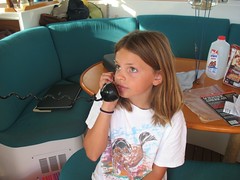
Give Em Sh* Mom!
Give Em Sh* Mom!
Originally uploaded by toastfloats.
Yes way. And at the same time, no... not really.

In a series of articles, I plan to discuss at length the various means that boats in general and Don Quixote in particular communicate with the rest of the world. We'll start this series with radios, in particular, the VHF.

Don Quixote is equipped with two forms of radio communication: VHF and SSB. VHF (Very High Frequency) radio is used for relatively short-range voice communication. It is used by local emergency services, for example, within a municipality. Essentially, VHF is good only for line of sight, though every once in awhile weather conditions will refract signal to our radio from up to 100 miles away.

We use the VHF primarily to communicate with our fellow cruisers and occasionally with naval authorities or other types of ocean travelers such as the big ass floating hotel about to run us down in the middle of the night. Somewhat illegally, we also use the VHF ship-to-shore with the hand held whenever we send crew off the boat and on to the dry. This leads me to a few recommendations for those preparing to cruise:

Security Measure – Do not stint on a good quality, high-powered VHF radio. If you can't tell someone your boat is sinking, you're going to be in a whole lot of water with nothing to hold on to and no one coming to your rescue.

Social Impact - The VHF is the cruiser party line. I don't mean beer and silliness, though there is some of that too. I'm suggesting that without a really good radio you will be completely cut off from the people who are your best resource for advice, assistance, and companionship.

Mirror to Helm - Make sure you can at least hear your VHF at the helm. If you can, put a radio at the helm as well as down below... and if you can only have one, the helm station is more important. When you are about to be run over by an asshat weekender, you don't want to release the helm to run below to yell at him over the VHF.

Handhelds - I recommend one or more handheld VHF radios. Walkie-talkies work, but they do not work nearly as well. I know that at $100 plus a pop, it may seem extravagant. I can't tell you, though, how many times we wished for more than the one we have. The scenario is mostly one of the family splitting up in town or on remote islands. DrC heads off to rummage for hardware, Toast to find the markets, the girls to locate ice cream and entertainment venues. Reliable communication is a boon in these situations.

Radio Protocol - Teach everyone on the boat to master the VHF. One afternoon up in Desolation Sound we listened helplessly over the VHF as the Canadian Coast Guard tried to talk sense into a woman whose husband was disabled – perhaps with a heart condition, hard to tell. It wasn't voyeurism, we literally had no choice. We were underway and so required to leave our radio on the dedicated marine channel... and she literally had no idea how to change channels. I didn't know whether to feel sorry for her or shake both her and her husband until their teeth rattled. She had no idea how to operate the boat or the radio, read the GPS, or describe her vessel. Don't do that to your crew. Even underage crew can become radio experts. Aeron was running net control down in Zihau at age 7.

Family Channel - However, this scenario of everyone in the crew with and on the radio leads to another tip, the family channel. The VHF spectrum in the nautical world consists of roughly 30 channels accessible for receive and transmit by most marine radios. Of those, no small fraction are dedicated to a specific, single purpose. For example, in virtually all U.S. waters Ch. 16 is used exclusively by nautical authorities and for ship-to-ship hails. A private yacht monitors Ch. 16 but rarely uses it except to signal intentions to nearby vessels and to hail authorities or other boats. On establishing contact with another boat, you must immediately switch channels. Authorities will direct you to another channel, but it's a good idea to have a number in mind in advance when calling your own crew. There are two reasons for this: First, getting both parties to actually hear a number on a busy channel can sometimes be surprisingly difficult. Second, you might not want the entire anchorage following you and your spouse as you switch channels to argue about what to have for dinner that night. The girls, in particular, attracted lurkers... benign, loving and friendly fellow cruisers who just enjoyed their piping voices and ridiculous requests as we'd head off to another channel to discuss whether or not they could have their third ice cream for the day. Agree in advance that the family always switches to 72 or 68 or ... pick your channel. Program it into your radios as a favorite. Then when you hail family, just say, “Switch to the usual” and off you go. Pick a channel way up there out of the way of most local traffic.

* * *

One of our greatest pleasures in Mexico was watching the kids – ours and those from other boats – blossom into radio experts. VHF protocol teaches us all how to respect and listen, choose our words carefully, and communicate clearly and precisely. Use your radio as a teaching tool and trust that you'll never regret spending the extra money on this particular piece of equipment.

The Girls on the Net
Originally uploaded by toastfloats.

Saturday, December 11, 2010

Good Crew

It Was His Idea
It Was His Idea
Originally uploaded by toastfloats.
I wouldn't say that DrC and I are experts at being crew or hiring crew. We've taken on a few, volunteered ourselves on occasion. We've read numerous accounts and spent hours and hours drinking beer with both captains and crews. Over time we've developed a laundry list of attributes and behaviors which we believe make “good crew.” I'd like to offer these to readers of my blog as a starting point for a discussion. For those in particular with experience on either side, let me know what you'd add or change about this list.

A lot of being good crew is about being a courteous guest. It is also about being a competent, contributing employee. Crewing on someone else's boat can open opportunities to learn, travel, and expand your understanding of the cruising life. It is not, however, an easy role to undertake. Here are our thoughts:

Pack Light – Add-on crew doesn't live on the boat. As a result, your stuff is extra, and it will be hard to wedge into existing lockers which are chock-o-block with stuffed owned by the owner's family. Ideally, all you bring with you can fit into a single duffle which you can comfortably fit on your bunk … even when you are yourself lying in that bunk. A small day pack with your electronic toys (e.g. laptop, iPod, books) is also acceptable if it too can fit on the bunk and do double-duty as a pillow.

Be Prepared – Like a Boy Scout, assume responsibility for your own gear. From foulies and life jacket to iPod/laptop chargers and reading material, supply it yourself. Ask the captain in advance regarding linens (towels, bedding), fishing gear, and items. Personally, I'd also take my own GPS, charting tools, handheld VHF, and personal EPIRB since no boat can have too many redundant safety and communication systems.

Food Issues – It is really amazing how many captain-crew relationships die on the issue of food. Set expectations between you and the captain regarding your dietary requirements, food preparation, and clean up responsibilities before you leave the first port and the last grocery store. The more open-minded and less picky an eater you are, the better. And while you shouldn't expect surf-and-turf with fine cabernets every night, you should be fed well. At minimum, crew and captain should eat from the same trough – and yes, we have heard of boats with the captain drinking the expensive chardonnay and the crew expected to survive on reconstituted gatorade drink mix. If you have special, specific dietary requirements, it is your responsibility to be up front in advance. For some items such as your favorite salad dressing, salsa, or tea, bring your own. Someday remind me to explain to you why I must have rice cakes during night helm watches.

Set Expectations in Advance – The pre-negotiation required for food can and should be extended to just about every boat issue. In particular, make sure you understand what the captain expects regarding watch schedules and boat maintenance. You don't want to learn two days out of port that the captain plans to sand down and revarnish the teak deck during your voyage... and you've been volunteered to do the work.

You Are a Consultant – I have a rule as a consultant which I believe applies well to being a crew member. You are on the boat because you know stuff and can do things. In exchange for your labor and expertise, you are “paid” in room, board, transportation, and sometimes even money. If you believe a captain is making a mistake and you have experience and advise to offer, it is your responsibility to do so. Once. However, if the captain chooses to ignore you and your life is not in any danger, keep your mouth shut. Captains need to break things; It's part of their learning process as both sailors and managers. The title captain – like manager, director, vice president, team lead, or doctor – does not confer infallibility, but for most newbies, it feels like it should. Only after breaking something expensive and/or inconvenient do most newly minted authority figures understand that nothing magical happened to transform them when their title changed.

When to Mutiny – On the other hand, no matter how valuable the lesson is to your manager, a captain doesn't have the right to break crew in the process. This isn't the British Navy in the 1700's. No, a boat in the middle of the ocean isn't a democracy. But if your life is in danger and your captain is a royal flaming idiot, you have the right to mutiny. We read about these accounts in sailing magazines, online, and in books. Sometimes, you really have no other choice. While I don't want to blame the victim, my recommendation here is not get on a boat with a captain whose expertise is considerably below your own AND the captain appears to be completely disinterested in taking your recommendations in serious conditions. Hard to figure that out in advance; Try anyway.

Take the Drugs – If you have any tendency to nausea, start taking Meclazine a day before you board. Keep taking it until I tell you to stop. If you start to feel gimpy, take the drugs immediately. Do not use the trip as an opportunity to experiment with holistic herbs, naturopathic patches, acupressure bands, or tantric chants. Unless you know that one or more of these work on you already, save them for your own boat. You have the right to drive your own family nuts, but you have a responsibility on someone else's boat to not vomit on the cabin sole if you can possibly avoid it.

Pitch In – As crew, you should help whenever and where ever you can. Show up prior to departure ready to assist with loading and provisioning. Contribute to cooking, K.P. and boat maintenance during the journey. Don't leave the boat on arrival until the boat is clean and buttoned down tight. Your contributions will ease relations between you and the rest of the crew. More practically, it'll give you something to do and an opportunity to see that the work is done carefully and correctly the first time.

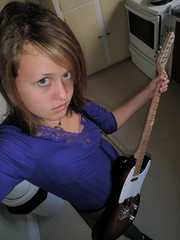
Our New Electric Guitar
Originally uploaded by toastfloats.
Entertain – Find some way to contribute to the social well-being of your boat as well. Do you play an instrument? Sing? Tell stories? You could bring cards or small, lightweight games such as Yahtzee, chess or mancala. Be generous with the use of the media – music, books, or movies – that you packed. Maybe no one will take you up on your social offers, but the offers nevertheless indicate your desire and willingness to be a part of the lives your fellow travelers.

* * *

Now your turn. What would you add, remove or change about this list?

Friday, December 03, 2010

Registering for International Service and Rescue

SSB Station
SSB Station
Originally uploaded by toastfloats.
UPDATE 7/12/2010: Incorporate comments from readers.
Virtually every country on the globe with navigable waterways has a maritime search and rescue service of some sort. Larger nations with highly capable navies and marine services offer considerable protection and support to the vessels traveling in and near their waters. An important part of preparing yourself for cruising is to enable your vessel to communicate automatically to these services, particularly in emergency situations.

First, a few acronyms and definitions:

Digital Selective Calling (DSC) – A designation under the GMDSS “primarily intended to initiate ship-to-ship, ship-to-shore and shore-to-ship radiotelephone and MF/HF radiotelex calls. DSC calls can also be made to individual stations, groups of stations, or "all stations" in one's radio range.”[1]

Federal Communications Commission (FCC) – The United States federal agency responsible for registering and maintaining radio communication licenses.

FCC Registration Number (FRN) – A unique number used by the FCC to identify license holders. This abbreviation is used synonmously as the username on the FCC web site. The idea is that a single FRN can be used to register multiple radio operators and devices. If you already have a HAM and/or operator license, you probably were prompted to register with the FCC. At that time, you would have been assigned an FRN. If not, the first step is to go to register on the FCC web site and obtain an FRN.

Global Maritime Distress Safety System (GMDSS) -- “An internationally agreed-upon set of safety procedures, types of equipment, and communication protocols used to increase safety and make it easier to rescue distressed ships, boats and aircraft.”[2] While small craft are not required to maintain radio equipment capable of participating in the GMDSS, it is a very good idea to do so anyway. Most SSB radios include DSC capacity which enables them to participate in the GMDSS.

Maritime Mobile Service Identity (MMSI) – “A series of nine digits which are sent in digital form over a radio frequency channel in order to uniquely identify ship stations, ship earth stations, coast stations, coast earth stations, and group calls.”[3] For US flagged vessels, you can register with a third-party such as BoatUS for an MMSI valid for coastal waters in the United States. However, you must register with the FCC when taking your vessel outside U.S. waters.

SA – When you register a wireless device with the FCC, you must select a radio service type. An SSB radio on a recreational vessel is considered a Maritime Mobile device of the category “SA – Ship Recreational or Voluntarily Equipped”. According to the FCC “Smaller ships used for recreation (e.g., sailing, diving, sport fishing, fishing, water skiing) are not required to have radio stations installed but they may be so equipped by choice. These ships are known as "voluntary ships" because they are not required by treaty or statute to carry a radio but voluntarily fit some of the same equipment used by compulsory ships.”[4]

Universal Licensing System (ULS) – An online tool maintained by the FCC for the purpose of using “any PC with Internet access to research, manage, renew, and pay any applicable fees for your wireless licenses through a password-protected account.”[5] The FCC site is, to be blunt, very poorly organized. Use this link to go directly to the ULS home page. Typical of most cruisers, Don Quixote's ULS account includes: the captain's radio operator license, our HAM and SSB call signs, and our international MMSI.

The two principle methods used by cruisers to communicate distress automatically are an EPIRB and the emergency signal issued by an SSB radio. An Emergency Position-Indicating Radio Beacon (EPIRB) is a dedicated device which broadcasts a maritime distress signal. As of February 1, 2009, all EPIRBs carried by U.S. flagged vessels must transmit at 406 MHz, as satellites no longer receive transmissions at 121.5 MHz. BoatUS provides an excellent guide to how an EPIRB functions. A single side band (SSB) radio can transmit a digital signal call. Both of categories of device communicate with the Cospas-Sarsat satellite monitoring system. The system is monitored both domestically and internationally by maritime rescue services.

To take full advantage of publicly available search and rescue services, you must register your emergency beacon and obtain an MMSI. EPIRB and SSBs broadcast a the MMSI to the satellite monitoring system. Since in an emergency, you might not be able to follow up these signals with a call to explain who you are, how many passengers are on your vessel, and what you look like on the water, you must register your devices in advance with this information. In many countries, you can register your device domestically for free. If you plan to spend a long period of time in a single country, it is a good idea to do the research to identify and register with these agencies. For example, in the U.S. you can register your beacon with BoatUS. In New Zealand, you can't register a U.S. device, but you can contact them and they will “keep an eye open” for your beacon. The agency is the Rescue Coordination Centre New Zealand (RCCNZ). I envision this as “a guy” with a stack of email messages next to a radio receiver. It sounds ricky ticky, but the RCCNZ is reknowned for saving people and boats; So however they do it, the system works.

Mera Monitoring the Net
Originally uploaded by toastfloats.
Unfortunately, registering with individual countries does not provide you with comprehensive, global coverage. Vessels which travel in international waters must also contact their domestic communications agency to register for an international MMSI number. Obtaining an international MMSI number ensures that your vessel is included in the International Search and Rescue database. The theory is that this database is maintained throughout the world. If you happen to have an emergency in the Tasmin Sea, both Australia and New Zealand will be able to know from your EPIRB or SSB signal the name and size of your vessel, your emergency land-based contacts, your emergency equipment, and the number of passengers routinely onboard.

The process of registering your emergency devices is fraught with the usual challenges and frustrations associated with government agencies. Everything that follows from this point applies to U.S. flagged vessels only. Readers with vessels flagged in other countries must do the research for their domestic requirements.

Steps to Register Your Emergency Beacon

1. Gather the following:
- FRN username and password – If you do not already have one, go to the ULS home page and register.
- Credit card
- EPIRB identification number – This number can be found on the side of an EPRIB device.
- A computer with a connection to the Internet and either Internet Explorer or Firefox web browser

2. Browse to the ULS home page and log in with your FRN and password.

3. Apply for a new license. As of the time of this writing, the link to apply for a new license is found in the left column.

4. Complete the form as prompted. Note that your vessel is a category SA radio service, you do not already have an MMSI (even if you've registered for a free one with a local service such as BoatUS or RCCNZ). The objective is to associate a new MMSI with your existing EPIRB and ensure that it is registered in the International Search and Rescue database.

5. Pay for the application. As of November 2010, the fee for registration is $160USD.

6. Monitor the ULS until your application is approved. Then print the resulting license. This process can take 10 days to 3 weeks. In our case, it took two weeks.

[1]"Global Maritime Distress Safety System: DSC." Wikipedia, the Free Encyclopedia. Wikipedia Foundation, Inc. Web. 17 Nov. 2010.
[2]"Global Maritime Distress Safety System." Wikipedia, the Free Encyclopedia. Wikipedia Foundation, Inc. Web. 17 Nov. 2010.
[3]"Maritime Mobile Service Identity." Wikipedia, the Free Encyclopedia. Wikipedia Foundation, Inc. Web. 17 Nov. 2010. .
[4]"FCC: Wireless Services: Ship Radio Stations: About." FCC: Wireless Telecommunications Bureau. Web. 17 Nov. 2010. .
[5]"FCC Universal Licensing System (ULS): About ULS: Getting Started." FCC: Wireless Telecommunications Bureau. Web. 17 Nov. 2010. .

Tuesday, November 30, 2010

It Gets Boring

No, I'm Border
No, I'm Border
Originally uploaded by toastfloats.
Research research research. Write write write. As the post on ditch kits a week ago ably demonstrated, our focus is narrowing down on preparing for the Puddle Jump. I can not stress strongly enough to my non-cruising friends and family how very much DrC and I are aware that we are "taking it to the next level." It's a big ocean. Some bits of the trip are ugly. We get it.

We really really get it. So much so that we've doing some pretty heavy research on topics we've largely been able to fudge in the past when we were traveling along the coast line. Granted, certain planning myopia was just stupid (e.g. pathetic ditch kits), but a lot of it was simply unnecessary. For example, why worry about climbing the mast to keep a reef and coral head watch when there are neither reefs nor coral heads?

The results of our research are interesting to another set of the readership of this blog, our fellow cruisers. Many of them are providing the raw data that inform my posts while others are preparing for their own cruises. A very special few are getting ready to Puddle Jump with us next year and will no doubt be reassured that Don Quixote is planning on taking care of herself. Mostly.

So anticipate the periodic posting of incredibly dull articles. The next one in the queue, for example, is on the exciting topic of registering beacons for international search and rescue services. Try not to fall asleep... or better just delete it in bound. I'll tag all these as "Coconut Milk Run" and "techtip" if you want to do some agressive filtering.

Cruisers, all of these technical articles BEG for your input. I may Write Confident (which is somehow analogous to the infamous "Fly Casual"), but DrC and I are fully aware we are missing bits. We received some very useful input on the ditch kit post. Keep the outstanding information coming! We need it, we appreciate it.

Sunday, November 21, 2010

Preparing for Disaster

Captain Potential
Captain Potential
Originally uploaded by toastfloats.
“Opinions are like -holes; Everyone has one. Unfortunately, not so true of ditch kits.” – Toast in a really bad mood after reading a million and one forum entries on the subject

If you are like most cruising sailors, you've made a completely half-assed job of putting together a ditch kit. I believe that the reason most of us do not have really good, well thought out ditch bags is that we are in a collective state of denial. After all, you are not going to need it. Like making a will, a ditch kit acknowledges mortality, puts straight in your face the depressing fact that life is fleeting and boats are friable.

And I confess, while we travelled the coasts of Canada, the United States, and Mexico, our ditch kit was pathetic. Oh we had one... at least we weren't that bad. However, it is true that the kit was neither well thought out nor was it particularly accessible. Had we needed to abandon ship, it is not clear to me that anything about that kit would have saved our lives. We also suffer from the fact-based, catamaran delusion that our boat won't sink. Another interesting trade off in the monohull/multihull debate is that catamarans are considerably less likely to sink to the bottom of the ocean. Most have positive flotation and are even more stable upside-down than right-side up. The situations in which it makes sense to abandon a catamaran rather than just attach yourself to it and ride out whatever broke the boat in the first place are limited to two: your vessel interacts with something super hard that breaks the entire thing into its constituent parts (e.g. a reef or cargo container) or the boat is on fire.

But those two catastrophes can and do happen to catamarans just as they do to multihulls, and it is a foolish crew who does not prepare for the ditch scenario. Even coastal cruisers are not safe from the need to have an emergency ditch plan. Witness the terrible events of the Baja Ha Ha 2009 during which a boat literally swept down the front of a wave and landed on a whale. The whale didn't like it, and the boat sank 5 minutes later. Sank. No more boat. Really. SANK.

This time, the crew of Don Quixote plans to go out with a well-thought out, easily accessible ditch kit and an emergency plan. There is the “abandon ship” option, and there is the far more likely “foundered and/or upside-down” option. We need to have equipment, survival gear, and communications systems figured out in advance. Over the years, we have individually read many accounts of emergency situations and preparedness plans. We have all sorts of ideas. I also made a foray on the Internet to see what the hive mind recommends. Two hours later, my head hurts, my stomach is growling, and I feel considerably less informed than when I started.

One quote that really made me think I found on Boatsafe.com: “While it may come as a surprise to some, by now most boaters realize that the survival equipment stocked in most life rafts, even rafts designed to meet SOLAS requirements, is often inadequate, sometimes woefully so. In many cases not only is the selection and quantity a problem, but the quality of the equipment and supplies is also less than desirable.” Wonderful. So right out of the gate, let us assume that we all need to build a survival bag, even if the boat is equipped with a “fully stocked” life raft. Also, there is duplication between what goes in a ditch kit, and equipment you need to have on the boat ready for regular use. For example, you need to have a handheld VHF and life jackets... but you use these all the time. Part of the “ditch kit” strategy needs to be a plan to gather these disparate bits and get them off the vessel with the crew.

Before I launch into the specifics, my personal editorial team for practical posts like this of s/v Totem and s/v Third Day came back with some questions I'd like to preemptively address:

Are you going to have a life raft or use your dingy as a life raft?”

This is going to probably generate angst, anger, and F.U.D. We are not going with a life raft. I don't think I've ever said this about a blog entry before but... please don't comment on this particular choice (all other comments still welcome!). You'll stir a raging debate that is likely to spiral downward quickly and irrevocably. All I am going to say is that we came to this decision not for financial reasons. Mr. Salty of s/v Totem reminded us to get our survival suits in order. I like to think we would have thought of that eventually, but full credit to our far more experienced friend for getting us moving early on the issue.

“Why would you even bother with a ditch kit if you don't have a life raft? Is it that much more helpful when you're sitting on an upside down hull?”

Yes, it is that much more helpful if you are upside down. In a turtle situation, everything you own is upside down, tossed like hell's breakfast, and mostly in water destroyed – particularly food stores and fresh water. However, if you have a ditch kit, you have all your emergency gear in a single place (accessible from either the topside or when inverted), it is in a dry bag, and it can be taken as a unit outside the boat if you plan to shelter between the hulls on the trampoline for all or part of the time.

As usual, the place that had the best, cleanest, and easiest to understand list was found on Wikipedia. From this and reading a dog-awful number of bickering forum posts, we've decided on the following:

Dedicated Kit – We will prepare a large dry bag with the following dedicated items. This kit will be stored either in the helm locker or in the aft, moulded inset between the transoms. Both areas are highly accessible when the boat is overturned or from a floating craft next to the boat. What goes in the dedicated kit:
- Survival suits
- Small emergency medical kit
- Compass
- Flares, mirror, and smoke signal
- Solar powered AM/FM radio
- Emergency high-calorie rations and/or hard bread
- Fishing kit
- Rainwater collection equipment
- Seawater desalination kit
- Water
- Hatchet and knife
- Waterproof flashlight
- Heaving line
- Rope ladder
- Small sea anchor
- Bailer
- Manual bilge pump
- Bucket
- Water proof matches
- Marine whistle
- Zinc oxide
- Tarp
- Deck of cards
- Paper and water proof pencil (log book)
- Copies of passports, visas, and boat paperwork
- Secondary credit card (the one we don't normally use but is a valid account)

Stored at Navigation Station/Helm – The items that must come with us if we ditch that we use regularly are going to be stored at the helm, in the helm locker or at the navigation table.
- Life jackets
- EPIRB
- SPOT personal messenger (Yes, I know it doesn't work in the middle of the Pacific.)
- Flares
- Solar powered lantern (We use this as a boom, anchor-light. If you don't, put it in the dedicated kit).
- VHF handheld
- GPS handheld
- Boat hook
- Celestial navigation equipment
- 2 5-gallon water jugs
- Doctor's medical bag

Emergency Plan – We have been very successful training the Don Quixote crew on emergency roles. Depending on the type of emergency, each person has a specific series of tasks. If someone is unavailable for their assignment, we know who is to take their place. For example, when there is a Man Overboard, Aeron's responsibility is to stand on the deck and point to the victim, never ever taking her eyes off the victim. She might be the only reason we are able to back track and find someone who has gone overboard. If she -is- the victim or otherwise unavailable, Mera takes her place... and so on. We will develop “Abandon Ship” and “Pitch Poled” assignments and responsibilities and then regularly drill the crew as we have historically done for MOB, fire, and navigational hazard emergencies.

From the Bottom Up
From the Bottom Up
Originally uploaded by toastfloats.
Lamintated Checklists – From s/v Capaz, we learned of the wonders of lamination. They make checklists, inventories, and radio scripts, laminate these instruction cards and place them near the radio and in emergency kits. This is brilliant and deserves an entire, well thought out article of its own that I'll tackle next week. For now, it's just on my list to review the Capaz list, update for Don Quixote needs, and include in the ditch kit(s).

Ditch Kits Plural – Another by-product of research was the notion of individual kits. These are small dry bags with individual water and food, emergency gear, and personal items. The hall mark of several survival accounts I've read is an individual escaping a sinking vessel where other crew and the principle ditch kit and/or life raft is lost, but the individual had their own, much smaller bag of gear which prove instrumental in their own survival.

* * *

Additions, suggestions, and deletions welcome! What do you have in your ditch kit?

Tuesday, February 09, 2010

TechTip: Get Yourself A Good Ride

Short Story
Your dinghy is the only way off the boat short of swimming. Do not skimp.

Long Story
Our first opportunity to prove ourselves and our dinghy mojo came in San Simeon as we travelled down the West Coast. We failed miserably. It wasn't just embarrassing. We made a costly mistake, lost some valuable gear, and nearly decapitated our youngest. It was not a good time had by all. However, dumping our dinghy in the surf early in our Pacific career taught us a very valuable lesson in caution and the value of appropriate equipment for the dinghy. Before you consider cutting corners, remember this important relationship: car is to house as dinghy is to boat. Unless you want to remain housebound throughout your entire cruising life, I strongly encourage thoughtful and copious investment in a quality launch.

Size Matters -- As with an anchor, invest in a dinghy at least one size larger than the directions on the package call for. Don Quixote carries a rigid inflatable which is rated for eight people. We have five. That's about right. We discuss whether or not we'd want a smaller dinghy were it just the two of us, and frankly, neither of us is convinced. A ten foot dinghy for a couple is essentially like owning a minivan or an SUV as a couple. You don't really need it all the time, but when you need to haul something around, it's very nice to have.

Power Up -- It probably goes without saying that a bigger dinghy needs a bigger motor. This is another place you do not want to skimp on either size or quality. When you consider a motor, put it on your dinghy, load up your entire crew plus two bags of groceries, laundry or garbage. If you can plane, the motor is big enough. If you can not, keep looking. Have a mechanic look it over from top to bottom to make sure there are no hidden gotchas. Outboards are pretty easy to maintain, but you want to start with one in very good shape. If you are cruising down to Mexico, I recommend Yamaha motors only because they are absolutely everywhere so finding parts and a mechanic are very easy.

It's Nice to Stay Dry -- Some landings and traverses are going to be drier than others. Equip your dinghy with at least one dry bag. We also recommend a Pelican Case for transporting your computer.

Keep It Together -- When you flip your dinghy -- and you will someday, some place, in some swell -- everything is going to want to escape into the depths. Create a simple clipping system to tie down your dry bag(s) and cases. It doesn't hurt to also have a quick and easy way to nail your shoes into the boat though the ubiquitous presence of Crocs down here pretty much assures your footwear will float. You might have to go swimming, but you'll recover your goods.

Night Lights -- We've seen a few dinghies with really nice navigation lights, usually mounted on the motor. While I like these, you don't have to get that fancy. You do, however, want to have at least a flash light or head lamp for after dark passages. Don't tell me you won't have your dink out at night. We all lose track of the time over sundowners and suddenly realize that the sun is actually down, we're more than a bit snookered, and our boat home is over there in a westerly direction… I think. Use the light to keep other launches from smacking into you as well as a tool to find your own boat. For ideas on how to make your boat uniquely visible at night with a flashlight, see my article on anchor lights.

Tie It Down -- Do not underestimate the power of your dinghy to spontaneously launch itself off a cleat and wander around the anchorage. We use both a strong primary painter which we monitor assiduously for chafe as well as a secondary chunk of line. Double tying the dinghy at night has a secondary advantage in that it makes it a wee bit harder to steal.

Security System -- It's not as dangerous out here as folks might lead you to believe, but of all the types of crime you might be exposed to while traveling, the most probable is "dinghy ransom." You wake up one morning to find your dinghy has miraculously come out of its two ties and moved upwind and across a bar into the care of a very friendly local who will charge you a 300 peso tip to give it back. I've seen several ways to discourage this type of blackmail. Some cruisers actually lift their dinghy on davits or with their main halyard up the side of the boat at night. Others like ourselves cable the dinghy to the boat and the motor to the dinghy. Another creative way to prevent theft is to paint your motor entertainingly obnoxious colors and mark up your dinghy so that it's resale value is minimal.

Wheels Rock -- Retractable dinghy wheels are a hugely valuable addition to your dinghy. They enable a single adult to relatively easily move a large heavy dinghy and motor from the surf up the beach and out of the tide line. A secondary benefit is that as you move into the shallow water, dinghy wheels can partially protect your prop since by the time it's shallow enough to eat your prop, your wheels are hitting the bottom. Without reservation, I recommend getting your dinghy wheels from DaNard Wheels. In addition to an awesome product, he provides unparalleled customer support. The guy is fantastic.

Teenage Driver
Teenage Driver
Originally uploaded by toastfloats.
Hoisting System -- In the northwest, folks often just drag their dinghy around. You don't really see that as much once you head out. The distances you travel are long enough that the loss of efficiency is a big problem, and it's simply dangerous to drag a dink in big wave or swell. So you'll need a simple and highly functional method to move your boat from its secure "passage position" into the water with its motor. An infrequently mentioned yet obvious advantage to catamarans is that you can easily put davits on the back of the boat and haul the dinghy up between the hulls. We've seen similar systems on monohulls with wide afts, and there isn't really any question that davits are the easiest solution. However, I've seen many clever methods to use halyards and lines to quickly move the dinghy from deck to water and back again. Ideally as a safety measure, you'll be able to do this procedure single-handed. I like our boom extender for moving the motor, however it requires two people. Our "next boat" will have a method for me to splash or haul the dink and motor without aid.

* * *

Our dinghy system isn't perfect, but it has served us well for nearly two years. Frankly, our only real problem with Rocinante is our eldest daughter. Watching her zoom around the anchorage makes me dread the looming challenge of teaching her how to operate a car. Ugh. Teenage drivers.

Friday, December 18, 2009

TechTip: Listen to a Book

Short Answer
Since good English language books are hard to find outside of English speaking countries, and you can’t read anyway when you are on watch, download and listen to an audio book from Audible.com.

Long Story
We on Don Quixote have heard too many horror stories of nit wits who set a course on the autopilot, walking away to read, watch a movie, have sex, or take a nap. So we are very careful. Someone is always sitting the helm watching the instruments and the horizon no matter how benign the conditions. If the seas are fairly large or it is the middle of the night, the primary helm is either DrC or myself. However, if the seas are relatively light, there is no significant traffic, or we’re doing rotating night watches, we’ll put one of the girls on the helm. All three can man the helm for at least a half an hour, and Jaime is capable of a full three hour watch. Even a half hour in the middle of the night can do wonders to rest your crew.

However, I have two problems as a sailor on the helm: I get bored easily, and I have a short attention span and get bored easily. No seriously. It’s horrible. I absolutely can not sit still on the helm, particularly on those fortunate days when Mr. Auto Pilot is ably running the show. My solution is podcasts and audio books.

Now if you listen to podcasts already, the rest of this blog is redundant. Audible.com is not only the leading provider of spoken word entertainment, but it is the single largest sponsor of podcasts on the Internet. Audible sponsors pretty much all my favorite podcasters including TWiT, Slate, and the Science Channel.

We download so many hours of free podcasts, it’s a wonder we have time to listen to yet more content. But if even the incredible wealth of free material is insufficient... for example if you are sailing to the South Pacific... then I recommend that you join Audible.com and start downloading books. They are not cheap. I don’t care how many times I hear about how you can get a free book or that it only costs $14.99 per month, that still seems expensive to me. A fifteen dollar book is expensive. On the other hand, an audio book can mean 15 to 30 hours of entertainment which when contrasted with a movie is not a bad price at all. This is also a great way to get best sellers which are otherwise completely inaccessible to a cruiser traveling in distant ports.

To sign up for an Audible account, browse to http://www.audible.com. You can get a code for a free month on sponsored podcasts such as the ones I mentioned above as well as many others. Just check their feeds.

As the sponsored ‘casters so often do when talking about Audible, I shall also include in my endorsement of Audible.com a recommendation of an Audible book. I am currently listening to David Sedaris read his own collection of essays Me Talk Pretty One Day. There is no question this book is better read by the author. Other books which sound better delivered by the author include Steve Martin’s autobiography Born Standing Up, Jon Stewart’s America: A Citizen's Guide to Democracy Inaction, and John Hodgeman’s great sequel More Information Than You Require.

CChummy Today
Chummy Today
Originally uploaded by toastfloats.
Audio books can make a long boring watch pass quickly. They enable a sailor to learn while contemplating the horizon and go a long ways towards easing the difficulty of staying awake through those graveyard shift anchor watches during a strong norther. Hitting a single freighter in the middle of the night would cost far more than a few years’ worth of Audible books. So arguably, it makes Audible a sound economic investment.

Sunday, December 06, 2009

Guide to Reviewing a Catamaran

Which Lagoon Do You Want?
Originally uploaded by toastfloats.
I just completed a totally inadequate review of the Seawind 1160 in a popular cruising magazine and must now rant. Like just about every article written in recent memory about a cruising catamaran, this one told me nothing useful. 

Let me first note what is consistently wrong with these articles which appear in everything from local free circulars and web sites to glossy, expensive sail publications: The author is probably an expert on monohulls with little to no expertise in multihulls in general and cruising catamarans in particular. He will be impressed by/happy with/surprised by the following:
- the spaciousness and comfort of the living quarters
- the speed with which the vessel accelerates to the wind
- the downwind performance
- the stability and comfort at anchor even in considerable ocean swell
- the excellent maneuverability in docking situations with two widely separated motors

He will be disturbed by/unhappy with/dissatisfied with the following:
- the poor upwind performance
- the loud boom or slap when water hits the bridge deck while underway
- the uneven, “hobby horse” motion in choppy seas
- the tendency to “sail around” at anchor
- the poor visibility of the far side of the boat during docking maneuvers

The only thing you have learned thus far is that the author was on a catamaran. Every single cruising catamaran -- ALL of them -- have the above listed advantages and disadvantages when contrasted with their cruising monohull brethren. Without exception. If the author is now done with his 3,000 word review, he shouldn’t get paid.

I am not the catamaran bigot I was two years ago. Years out here have shown clearly why reasonable people can look at multihulls versus monohulls and choose to purchase the later. There are benefits and disadvantages to every style of boat, every model, and category. Catamarans have issues just like ketches, schooners, sloops, fractional rigs, etc. But if you are going to review a catamaran, I need you to describe the performance characteristics of the specific catamaran you are looking at. Don’t tell me what I already know simply because the vessel you are looking at has two hulls.

I recommend that all reviewers of multihull craft -- including individuals considering a catamaran purchase -- ask and make sure you get answered these questions:

  1. Fully loaded, at what wind speed does this catamaran finally start moving?
  2. What is the standard sail package and is it sufficient for the vessel? For example, does it come equipped with a functional light air sail? A bow sprit?
  3. What is the boat’s predicted performance at various points of sail? There is “not going to weather”, and then there is never sailing very well forward of the beam.
  4. Are there dagger boards, and do they improve the performance of the craft?
  5. What provision for bulkhead isolation is standard? Some production catamarans have no sealable bulkheads from stem to stern while others do a very fine job of breaking the boat into discrete, secure chunks improving safety in the event of hull breech or turning turtle.
  6. Are there escape hatches?
  7. Is the galley up or down?
  8. What is the head room in the salon and in the cabins?
  9. What is the ratio of the length to the beam, and what is the beam of the individual hulls?
  10. What is the bridge deck clearance?
  11. Where are the water tanks, and what is their capacity? Ditto fuel tanks. Trim and weight load is a serious consideration on a catamaran.
  12. What is the forward visibility while seated at the helm?
  13. Describe the access to key systems such as the engines, the rudder and throttle controls, and the head plumbing.
  14. What is the theoretical hull speed?
  15. During your sea trial, what fraction of wind speed did you feel you could push the boat to with a strong degree of consistency?
  16. How challenging would it be to single-hand the boat? If the default rig is not configured to easily single-hand, how much would you need to invest to get it there?
* * *

There are many more details I could add. However, even answering this short set of questions would go a long way towards improving the quality and utility of catamaran reviews. It would certainly assist a potential buyer with comparing catamarans across brands, models and years. If you are a catamaran owner seeking to sell your craft, a dealer or a manufacturer, I encourage you to immediately sit down and figure out how to answer these questions yourself. I assure you, DrC and I at least will insist on the answers before we purchase our next boat.
Cat or Mouse?
Cat or Mouse?
Originally uploaded by toastfloats.

Tuesday, November 10, 2009

TechTip: Night Lights


Short Answer: Supplement your LED masthead anchor light with reflective tape and sidewalk lights.

Long Story:
When you live on a boat, you start to count every amp and erg and become quite resentful of energy hogging devices. In this category, the masthead anchor light is a surprising pig. By law and necessity, these lamps are very bright – at least 60 lumens for the average sail boat. An incandescent bulb will draw .8 to 2 amps per hour while an expensive LED variety will pull roughly .1 to .5 amps per hour. Translated, you'll burn through 8 to 20 amp hours a day with an incandescent anchor light or 1 to 5 with an LED. To put that into context, your average solar panel set up is only going to yield 8 to 13 amps an hour during the hottest part of the day. So the first and most obvious tip regarding the masthead anchor light is to switch to LED the next time you fly the mast. As a side note, this will probably take two trips: the first to figure out precisely what kind and size bulb you have, the second to install the new one.

But there are additional considerations when contemplating lighting your boat at night. First, can you find your boat by starlight amongst all the other similar white hulls? Second, will your lights go on automatically when it gets dark? Third, it is useful to know that pangueras do not look up. If your boat isn't lit at the water line, there's a good chance a panga will hit it.

We address all three concerns using very cheap, light-sensitive, solar-powered sidewalk lights. DrC installed mounts made of PVC and zipties on all four corners of the boat. As soon as we drop anchor, the girls drop the lights into their mounts. Our distinctive four orange points make Don Quixote easy to find and to see at night. They are so lightweight, we make a point of removing them while underway. They also do double duty as amber night lights on night passages as we stick them head down around the salon and heads.*

Another trick used by many Mexican cruisers including ourselves is to hang a high-powered LED light from the mid-boom. The law in many anchorages south of the border is not quite as strict regarding the use of an anchor light. Low power, high lumen lights closer to the deck replace high power mast lights on many boats. A little extra money and you can find solar-powered, light-sensitive models. Just don't forget to take these boom lights down before you put up the sail. And remember, you can't use them exclusively as anchor lights in the States or some highly trafficked international ports.

A final suggestion from the Don Quixote files is reflective tape. DrC placed highly reflective, silver tape strips just below the toe rails, on the transom steps, and at intervals up the mast. You can't really see the strips against the white hull and aluminum mast during the day. However, at night you need only sweep a small head lamp or flashlight in our direction and the shape of the whole boat lights up. We've repeated the treatment with our dinghy on the notion that you can never be too visible at night to passing traffic.

Evening in El Burro
Evening in El Burro
Originally uploaded by toastfloats.


Note: It appears that West Marine now has a little solar sidewalk light complete with rail mount for which you will pay $49.99/each. Don't do it. Just get out your saw blade, some zip ties, and a length of PVC, and go to town.

Thursday, October 01, 2009

TechTip: 3 Inch Cargo Strap

Short Answer Three inch polyster cargo strap in large pieces is a very good, relatively inexpensive way to tie down a boat in a hurricane. Get yourself some now.

Long Story Before we left for Vancouver Island, DrC researched some alternatives for a stern tie line. The problem with many solutions is chafe. As the tide goes out, your line often falls on incredibly sharp oyster bed and gets chewed up. He decided to try a 3” cargo strap advertised for its strong holding properties as well as durability in the face of sharp objects.

As a stern tie, this strap worked reasonably well. If you decide to use it for that purpose, make sure you set yourself up with a roller off the stern of the boat. It’s heavy, and it likes to twist. It also doesn’t float. You’ll want to make sure you can easily roll it off and on.

When I arrived in Santa Rosalia just hours before Jimena hit, I was greeted by my fellow cruisers with the most important phrase in hurricane preparation: What line do you have? I pulled out all my dock lines, the jib sheets we’d already planned to replace this fall, our primary and secondary anchor rodes, and the strap. At 300 feet, it made sense to use it to run a line over to the far-side breakwater.

Pros

The strap doesn’t break It has a breaking point of 10,000 lbs. Frankly, unless you plan to hang the boat from the strap, whatever you tie it to is likely to break apart long before the strap snaps. After watching dock lines and anchor rodes snap like threads all over the marina, it was reassuring to have this enormously powerful material holding Don Quixote off the dock. I also used a piece to bridle the boat to a dock piling. There was no question it would hold the boat as long as neither the starboard cleat, nor the bridle attachment point gave way. Consider using the strap around extremely well founded, back plated points such as the stays or even loop it around the mast.

The strap doesn’t chafe Though god knows it tried on the pier, our strap showed no sign of wear after 12 hours of attempting to beat itself to bits on the concrete and wood of the opposite shore.

The strap is relatively cheap We purchased 300 feet for about $125 at strapworks.com a year ago. It looks like it’s running roughly $USD.60/foot right now for the 2 inch. I would call to see if they have the wider widths. You also get a discount at longer lengths. The pricing is considerably less than anchor or dock line.

The strap stores well Once you get roller for it, you can roll this thing up into a neat, small roll and stuff it in an protective bag for dry storage. It certainly takes up a lot less space than a comparable length and strength piece of line or rode.

Cons
The strap doesn’t stretch You need stretch in lines during a hurricane for shock absorption as your boat jounces in the waves. The stretch reduces the jerk against your cleats or other attachment points. As a result, several captains here suggested adding shock absorbers to a strap line or using the strap only as a secondary line in case your standard dock line or rode gives way. When you lose a line, you’ll use anything to keep yourself attached to a pier, breakwater, tree, or other anchor point.

The strap has high windage Do not use it for a long line as we did. A three inch strap has a great deal more windage than a standard piece of rode and will twist and flap and fly in the winds. Cut the long line into chunks and use it for much shorter ties to pilings and dock cleats. Save your dock lines and anchor rodes for any stretches that must go over about 20 feet point to point. Alternatively, I think you could attach this to an anchor as a back up to a chain rode. In addition to providing a secondary hold, the wet weight and its resistance to movement underwater would help hold you down.

The strap doesn’t like knots The stuff is slippery. It likes to come undone. When you tie knots with it, add double, triple or even quadruple hitches.

My boat was saved during Jimena primarily because there were an incredible group of people on the docks throughout most of the storm attending the boats. You are only as safe during a storm as the weakest boat around you. Having said that, I credit our bridle strap and the long line to the off side breakwater for keeping my own boat precisely where I put her -- four feet off the docks and positioned precisely mid-way between two dock pilings.

Wednesday, September 30, 2009

For My Next Hurricane

Holding the Middle
Holding the Middle
Originally uploaded by toastfloats.
As part of the recovery process from Hurricane Jimena, I made it a point to interview my fellow crew and captains as to what worked and what didn’t work. While the consensus was, “No mas hurricano” never again... get the hell out of dodge... there were also many ideas of how to improve the odds for the next one. Just in case. While there are books written on this subject, it never hurts to talk to the people who just lived through a big storm.

Unfortunately, I conducted most of these interviews during the Grace e deos/Soccer party the day after the second time Jimena hit us. The following are the ideas and suggestions I can remember:

More Fenders Everyone wanted more fenders. If you don’t use them, someone else can. Also, fenders need to be blown up so a fender-blower-upper.

More Lines Everyone also wanted at least one more line. Everyone. Little docklines good for tying up to a fuel dock are just not going to prove helpful in a big storm. Get 1” line and store it dry and safe somewhere, ready for a storm. Have at least one, and preferably two pieces of anchor road that are at least 150’ long so that you can run lines a long distance. Four boats in Santa Rosalia had to run multiple lines over 100 feet to a far side breakwater. These lines were critical to keeping those boats from smashing the docks during the storm.

Don Quixote’s Strap More than one captain asked me were we got our 300 feet of 3 inch cargo strap. http://www.strapworks.com. I’ll write a tech tip about how this worked and why.

Alex’s Telcel It was fantastic downloading the latest radar and weather over Maitairoa’s 3G Telcel. Yes, you can get this information over your SSB, but the SSB requires huge bandwidth and doesn’t work so well when there is a lot of electricity in the air. The Telcel modem plugged into Alex’s notebook, used almost no power, and worked all the way through the storm.

Prepare Food for a Passage Treat the storm as a passage when it comes to the galley. Have meals prepared in advance, snacks ready to deliver whenever tired crew come in. Always have hot water ready for coffee, tea, soup, and chocolate.

Clean Everything Before It Hits It is quite possible that boats in Santa Rosalia will not be allowed to do laundry for over four weeks. Make sure all your sheets and towels and clothes are clean in advance.

Get Cash After the storm, no one can take credit cards and the ATM machines are not functional because the phones and power are out. Make sure that you stock up on a substantial amount of cash, preferably in small bills.

Take Your Meclizine If you are prone to sea sickness, you are going to get sick on the dock from the movement during a big storm. Take counter measures in advance.

Manning the Lines
Manning the Lines
Originally uploaded by toastfloats.
Attend the Boat This came as two recommendations: if you can, be near your boat where you can attend the lines, anchor points, and fenders yourself. Boats in other hard hit locations such as Escondido and San Carlos report that attended boats survived, unattended boats broke moorings, drug anchor, or smashed on docks. Staying in a marina with a dedicated, hard working dock crew helps enormously. The boat captains at Santa Rosalia could not say enough positive things about Escaula Nautical Singlar, her staff -- particularly Arturo and Alfonzo -- and her management. Harbormaster Carlos and his team were impressive, courageous, and critical to the survival of the boats in that harbor.

* *

I know quite a few of my readers are fellow Sea of Cortez cruisers. While the storm experience is still fresh in your mind, please add comments and suggestions to this post. If I get enough, I’ll compile them for a second round.

Saturday, May 23, 2009

TechTip: YOTREPS

Short Answer
It's a pain in the neck, but go ahead and set up your YOTREPS account.

Long Story
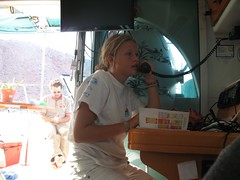
So I have to admit a painful secret for a cruiser – I find the SSB (single side band) radio seriously annoying. I do not gain any pleasure dialing into the morning Amigo or Chubasco cruiser nets and listening to the checkins and weather. The hiss and pop and static make it impossibly challenging to listen to, and I find Don (who does weather every morning on Amigo Net) more than a little frustrating all by himself.

Jaime on the Radio
Jaime on the Radio
Originally uploaded by toastfloats.
But those irritations are actually minor compared to my single biggest beef with SSB systems: the software. Unless I'm missing something, all the software written to connect laptop computers to the SSB were written sometime prior to Windows 95. To a woman steeped in user interface design and super-satured with the daily tactile pleasure of working on a MacBook running Leopard, applications like AirMail, ITS HF Propagation, and WeatherFax are jarring, almost painful experiences. Put these horrid, kludgy ports on Microsoft Vista Home Premium and you have a perfect storm of endless frustration and viscerally disappointing moments.

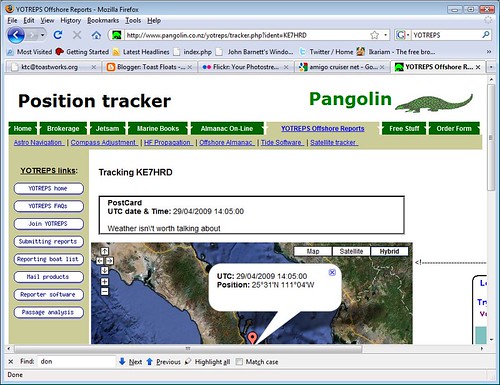
And to make it all worse, you're supposed to use these tools connected in some great network on the air waves to send reports to probably the earliest social network site ever built: YOTREPS. YOTREPS collects the position and weather reports from boats all over the world, sharing them for the public, weather routers, and fellow cruisers. It was built and deployed in the dark ages and as near as I can tell, hasn't been upgraded since HTML 1.0.

I'm sure that circa 1992, YOTREPS plus SailMail plus an ICOM SSB and a Pactor modem were nothing short of miraculous. I have no doubt that at the time, cruisers must have been in heaven. Here was a tool which quickly and relatively painlessly posted to a public web site your latest position. AirMail even has a form built into the interface to prompt you for your position and weather information which it then converts into the text report required by the web site. It must have seemed the height of technology, pushing cruisers to the bleeding edge. In a world driven by Facebook, Twitter, and Flickr, however, this system is not just antiquated, it's comical.

So why am I going to recommend to cruisers-to-be that you invest the time and energy in getting and maintaining a YOTREPS account? Because YOTREPS adds a valuable piece to the communication puzzle. SPOT is a much better tracking system, but it doesn't work in the middle of the ocean. Twitter is a much better way to communicate to your friends and family what you are doing and works perfectly over SailMail, but it doesn't have a map to enable folks to easily track your progress. Finally – and most importantly – YOTREPS is still widely accepted as a resource for weather routers and meteorologists to obtain real-time data about conditions on the high seas. I put YOTREPS in the same necessary evil category as pooper scoopers and mammograms.

Our own communication plan relies on combining the three services: SPOT, YOTREPS, and Twitter to provide a constant stream of information back to the people who worry and care. Now I'll grant you, we may be getting a little carried away with all this tweeting and posting and reporting, but at least there is very little chance anyone will lose us is in the stunningly beautiful wilderness down in the Sea of Cortez.
YOTREPS
YOTREPS
Originally uploaded by toastfloats.

Sunday, January 04, 2009

TechTip - Water Sweet As Wine

Our Water Maker
Our Water Maker
Originally uploaded by toastfloats.

Short Answer: Make your own water maker. It’s cheaper, it makes more water, and you’ll know how to fix it without a high-priced mechanic.

Long Story: DrC just finished making our water maker. We downloaded the plan off the Internet a few years ago. I understand you can now pay to download this plan. I recommend it highly. We’ve met three boats to date who successfully followed the instructions to build and maintain a high-volume water maker. Now we are the fourth who can make the case for a home built job.

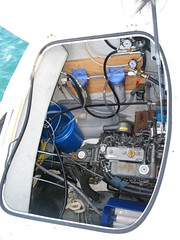
In the interest of fair disclosure, building your own water maker is not for the faint of heart. It took a long time and a lot of hard work. It is also not exactly cheap. The parts for our water maker totaled just under two boat bucks. DrC estimates it took him roughly 50 hours of work effort from start to finish not including what felt like 100s of trips to the hardware store. He does recommend that you build your water maker before you leave the dock. The critical tool is apparently a car to get to a really good hardware store. The most expensive parts are the filter, the pressure vessel, and the pump. The pressure regulator and clutch can also run you some change. You’ll also need space for the installation (~1.5 cubic feet), a thru hull or T off an existing raw water intake, and hydraulic hose to get the water to your tank.


Proud Papa
Originally uploaded by toastfloats.
There are two major advantages to building your own water maker: price to output ratio and maintenance. Even two thousand dollars is cheap for a water maker that puts out thirty gallons an hour. A comparable volume Spectra will run you at least $4,000. For roughly another ~$400 we could double our output to 60 gal/hour with a second filter. We’re considering it, but we’re going to wait until we live with what we have for awhile. Also, we hear folks on the cruiser nets almost daily asking about how to get maintenance for their water makers. There is something of a black box feeling for these devices down here. However, all the boats with hand built jobs tell stories about how a trip to the hardware store solved this problem or that. When you build it yourself you know how to fix it; It’s that simple.

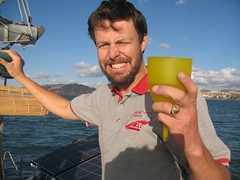
Yesterday, we stood on the deck passing around a glass of clear, clean water. The entire family was grinning like loons. The water tasted like ambrosia after all the effort DrC had put in. So maybe a third advantage of DIY water makers is the sweet taste of accomplishment.

Thursday, September 25, 2008

TechTip - Mal de Mer

Readers asked me to provide more detail about our Counter Sea Sickness Offensive, also known as Operation Ocean Ack. First off... I am not a doctor. I do not play a doctor on T.V. I do not even own a T.V. Do not take anything I say as medical advice. More importantly, do not even think about suing me if you decide to try any of these medications. This is just what is working on s/v Don Quixote.

Short Answer - We use a combination of first level homeopathic remedies and pretty powerful anti-nausea drugs to beat back mal de mer.

Long Story - Sea sickness hits everyone eventually. As with so many salty issues of nautical accomplishment, there are those who have done it, those to whom it will happen soon, and those who lie. This truism holds for everything from running aground to spending 24 hours vomiting in the head. Some day, you will meet a sea condition that will take you down. It doesn’t have to be big sea, choppy sea, or windy sea. It just has to be the sea with your name on it.

Let's start with the most important bit about sea sickness. Once you get sick, it is damn near impossible to stop throwing up. So with every fiber of your being, you need to prevent yourself from getting sick in the first place. And of course, it really appears that all the best 'remedies' for sea sickness start with the recommendation, "Take the day before you go to sea." Gee thanks. So in addition to everything else you must contend with prior to departure, you need to make sure you drug the entire crew.

Because there is an escalating scale to how much you need to intervene to address sea sickness, it is challenging to figure out where you should start your intervention. We like to begin with a highly advanced, pharmaceutical approach and then gently taper back until the boat is running on ginger snaps and Top Ramen. With experience, you’ll know at what point on the escalation path you need select with each crew member.

Open Air Cures - The simplest cure for queasiness is visibility and fresh air. Stop what you’re doing, look up, look around, go out into the cockpit. Take the helm. Put on some really bouncy music that makes you want to dance. Dance on the deck while you stare around. Alternatively, just go to sleep.

Food - Some foods that settled the tummy are ginger snaps, ginger ale, saltines, and graham crackers. My girls also do well pretzels. Think bland, dry, and gentle. Top Ramen and macaroni and cheese are good for hot foods. Stick to non-caffeinated, low sugar, and low acid beverages.

Berkeley Ideas - There are many, many natural and homeopathic methods to stave off sea sickness. I have had a great deal of success with acupressure bands. There are those that swear by the press-on acupressure dots. Papaya enzyme is good as an antacid. You might also try other homeopathic or natureopathic supplements. I haven’t tried any other than papaya so I can’t speak to their efficacy.

Meclizine HCl - DrGeorge recommends an over the counter anti-emetic called meclizine. Look it up. It's good stuff. It doesn't make you drowsy, which is key. You can take 25 mg twice a day starting the day before, and it does a really good job of keeping the beast at bay. DrC and I took it throughout our passage, and neither of us experienced a moment of sea induced queasiness. I did have that one hour of wanting to toss my cookies in sheer unadulterated terror, but I don't think that counts.

More Meds - Crew that have never been sick are recalcitrant and will not take their meclizine in advance. You'd think the stuff was nasty like that grape antibiotic we feed our kids. It's just a small blue pill, for gods sake. But crew will balk and then proceed to get violently ill. At which point you have to go all macho captain on them and law down the medical law. People who do not get better within about 24 hours can actually start doing themselves some pretty serious harm.

Even at this juncture, you have several options. You can try dramamine crushed under the tongue, the meclizine they should have been taking all along, or a club to the head. But if the boat is really rocking and you've got a true sicky aboard, these measures might be too little too late. The problem is that nothing is staying down your boat's victim. Now you need to start getting really personal.

Suppositories - When there is no other way to get meds into a crew member, we intervene with a suppository dose of prochlorperazine 25 mg. It's available by prescription only so you'd need to get this from a doctor in advance. You can probably get some by taking an emergency medicine course and getting the prescription from the instructor. It's very good to have aboard and should only be taken when you simply can't get the crew member to stop vomiting and start sucking down fluids.

Let Me Think
Let Me Think
Originally uploaded by toastfloats.
Points Beyond
- After that, the problem goes beyond my ability to even speculate what you should do. Dehydration can kill so this isn't just an unpleasant problem. Land is your best bet, but if not land you can look at evacuation off the boat, enemas, and other more serious interventions. Fortunately, we have not as yet made it to this step and are unlikely to do so in the near future. Coastal cruising at least ensures that you can generally drop a really sick crew member on to a rock within 48 hours of any location.

Now someone please give me a cure for land sickness.