Saw this Erebus moth outside my apartment yesterday.

Another moth that I see frequently in my garden is Hulodes caranae
Saw this Erebus moth outside my apartment yesterday.
Another moth that I see frequently in my garden is Hulodes caranae
Name : Acherontia lachesis (Fabricius, 1798)
Family : SPHINGIDAE Latreille, 1802
Subfamily : Sphinginae Latreille, [1802]
Tribe : Acherontiini Boisduval, [1875]
Larva host plant :Clerodendrum paniculatum (Labiatae), Stachytarpheta indica (Verbenaceae)

Date : Jan 2011
Location : Namly Avenue, Bukit Timah, Singapore.
Host Plant : Stachytarpheta indica (Verbenaceae)
5th instar:
Pre-pupa:
Just pupated:
Pupa:
Pupation period : 18 days.
Adult:
Saw another moth in my garden a few days ago.
This is one of those small moths that I used to ignore. However since I developed an interest in moths, I now take note of all the moths I find in my garden.
Filodes fulvidorsalis : Crambidae, Spilomelinae
Yesterday morning while I was watering my plants, I noticed something fast flew past me and landed on a plant. On closer examination, I realized it is a hawk moth !
This is the first hawk moth I have seen in my garden (not counting those I reared).
The moth looks familiar, its shape and size are similar to Eupanacra borneensis which I have reared but the markings are different.
Dorsal view:
Ventral view:
After some research, I found out this is E. borneensis after all, but a female. This species exhibits sexual dimorphism !
All the E. borneensis that I have reared thus far are male. I wonder why ? Maybe I should rear a few more to find out what the male/female ratio is like ? Anyway,this is how the male looks like, totally different from the female :

So this moth most likely came from Clementi Woods Park which is just next to my apartment.
I wonder when will it’s close relative, Eupanacra elegantulus, visit my garden ?
This morning a Plain Tiger circled around my garden and eventually landed on my Heliotropium indicum bush !
This is the first new species for my garden in 2010 and this is also a species that I wanted to have in my garden.

By now 11 species of butterflies have visited by garden on the 6th floor !
When I moved to my new place about 1.5yrs ago, I wanted my garden to attract butterflies. Specifically, I wanted the following butterflies to visit my garden :
- Common Birdwing
- Lime Butterfly
- Common Mormon
- Painted Jezebel
- Plain Tiger
- Common Tiger
- Blue and Dark Glassy Tiger
- Peacock Royal
I planted a lot of butterfly larva and nectar plants and 1.5 years later all the above butterflies except Common Birdwing, Common Mormong and Common Tiger have shown their presence. (Isn’t it funny all three have name that starts with ‘Common’).
My Aristolochia tagala vine has started growing and I am hoping I will get to see Common Birdwing around my garden in 2010.

Aristolochia tagala and Tylophora sp
Just now while having my dinner in my balcony a tiger moth (Dysphania sp) flew pass me and landed on a flower ! I immediately went to get my camera and took a few shots. The moth turned out to be Dysphania glaucescen, a geometrid moth, one which I have not photographed before.


Moths from this subfamily are day flying and can be seen around flowering plants during the day.
You can see photo of other Tiger moths from Singapore and Malaysia in my Dysphania Flickr album.
What a good start for 2010
See also :
- Two new species spotted in my garden.
- Gan’s garden butterfly list.
In April I reared a N. hyas larva which is green in color. In May I found one which is brown !

19 May 2009 : mid instar larva
25 May 2009 : Pupa 
02 Jun 2009 : Eclosed, pupation period 7 days
See also Neogurelca hyas breeding record
During a recent GCS gathering, a GCS member told me she had a big green caterpillar eating her Desert Rose (Adenium obesium) plant, a plant belonging to the Dogbane Family ( Apocynaceae )

She sent me a photo and it turned out the caterpillar is another hawk moth caterpillar, the Oleander Hawk-moth - Daphnis nerii.
In Singapore, Oleander Hawk-moth caterpillar is usually found feeding on Madagascar Periwinkle (Catharanthus) , PinWheel Jasmine (Tabernaemontana sp) and Oleander (Nerium oleander), all belonging to the Apocynaceae family.
Name : Macroglossum sitiene Walker, 1856
Family : SPHINGIDAE Latreille, 1802
Subfamily : MACROGLOSSINAE Harris, 1839
Tribe : Macroglossini Harris, 1839
Genus : Macroglossum Scopoli, 1777
Larva host plant : Paederia foetida (Rubiaceae)

Reference : Sphingidae of the Eastern Palaearctic
Life History Record :
- Nov 2001 – Paederia foetida (Rubiaceae)
| Date : 9 Nov 2001 Ovum : Larva : Adult : |
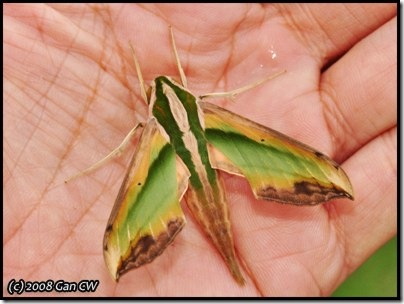
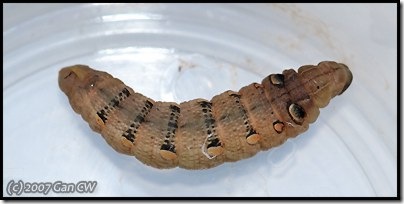
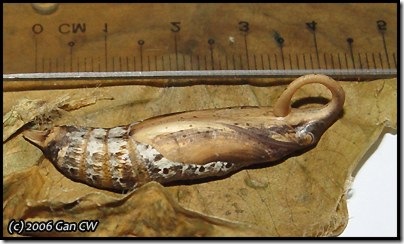
Name : Pergesa acteus (Cramer, 1779)
Family : SPHINGIDAE Latreille, 1802
Subfamily : MACROGLOSSINAE Harris, 1839
Tribe : Choerocampina Grote & Robinson, 1865
Larva host plant : Alocasia, Caladium


Reference : The Sphingidae of Southeast-Asia
Life History Record : Dec 2006, May 2007, Dec 2008
Date : Dec 2008
Source : Joana , GCS Member
Location : Victoria park Road off Farrer Road, Singapore
Host Plant : Caladium bicolor


Date : May 2007
Source : Mark (mm), GCS Member
Location : Sunset Way, Singapore
Host Plant : Leea indica



Date : Dec 2006
Source : Elizabeth
Location : Singapore
Host Plant : Alocasia


Name : Enpinanga borneensis (Butler, 1879)
Family : SPHINGIDAE Latreille, 1802
Subfamily : MACROGLOSSINAE Harris, 1839
Tribe : Macroglossini Harris, 1839
Male 
Female -GanHome_20100111_D4961-640%5B5%5D.jpg "Enpinanga borneensis (f)-GanHome_20100111_D4961-640")
Larva host plant : Dillenia suffruticosa (Simpoh Air)
Reference : The Sphingidae of Southeast-Asia
Life History Record : Mar 2008, Jan 2009
Date : Mar 2008
Source : Gan CW
Location : Clementi Woods Park, Singapore
Host Plant : Dillenia suffruticosa (Simpoh Air)
Dillenia leaves 
Larva : 2nd instar 
Larva : 5th instar and 2nd instar 
Larva : Lateral and Dorsal view
Larva : Pre-pupa
Adult:


-20100123_D6341-480.jpg "Filodes fulvidorsalis (Crambidae, Spilomelinae)-20100123_D6341-480")

![new_YES[1]](https://lowyatch.pages.dev/bl-https://blogger.googleusercontent.com/img/b/R29vZ2xl/AVvXsEj6ZH5hQDOXPbqaU0HnaOdI25cM1z05X2djZ5IJNPrt3-NBcKI0Ey-WFxwRVZoSKafxh0gCkTPi7QZKzg-udWDAjPdcKJW7bx4BhDkROaOe0CPe1_dcRkX894ETiaKEXvLkC1bEz7Qov5RH/s1600-h/new_YES%5B1%5D%5B2%5D.gif "new_YES[1]")

![new_thumbsup[1]](https://lowyatch.pages.dev/bl-https://blogger.googleusercontent.com/img/b/R29vZ2xl/AVvXsEgC9I3yfMHbeAh8Vv2_LneQuhDFGa5gEtWlGW1eBXmv63vRwADP1ZqFKYIzfB2rq0EAI0_nMZXM0xGjzPldLbep2poRhG03QQKVfNFmwZxYBtI1dzutlJCysMu3fuJEtc-5jdZbR_bRUg49/s1600-h/new_thumbsup%5B1%5D%5B2%5D.gif "new_thumbsup[1]")


