 |
| Gabriel García Márquez |
In One Hundred Years of Solitude, TOM SYKES sees the genius in the chaotic (ir)realism of Gabriel García Márquez’s Third World literature of protest
WHAT DO WE MEAN by the term “Third World Literature”? It is potentially a huge category featuring thousands, if not millions of books from all over the globe. We risk complicating things even more by asking a further question: How exactly does Third World Literature function as social protest?
To answer, it may first be worth thinking about “Third World Consciousness,” that is, how men and women in poorer, less-developed regions think and feel about the world and their position within it. These “wretched of the earth,” as Frantz Fanon termed them, are more likely to draw upon myth, fable, superstition, religious belief and metaphysics to make sense of their conditions than citizens of the First World who, as the Senegalese poet Leopold Senghor puts it, “study reality from the coolly detached vantage of clinical scientific observation.”
There are various reasons for this difference: religious faith in the Third World tends to play a larger role in public life and the construction of personal identity than in the secular First World (with the obvious exception of aspects of US society). Another perhaps stronger reason is development; technological progress and economic prosperity has made scientific rationalism the official ideology of the First World whereas other cultures take a more nuanced, holistic view of reality. As Salman Rushdie writes in
Midnight’s Children, “Reality has metaphorical content; that only makes it more real.”
In
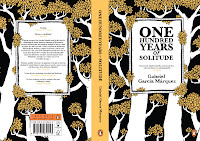
One Hundred Years of Solitude, Gabriel García Márquez commuted Third World consciousness into a literary revolution called “magical realism,” defined by the writer himself as a form that “destroys the lines of demarcation that separate what seems real from what seems fantastic.” García Márquez uses figurative and “irrealist” techniques to retell the turbulent history of Latin America. He also employs absurdist humour to protest all kinds of oppression from bourgeois morality to Roman Catholic orthodoxy to US neocolonialism.

Real history underpins the most fantastical elements of
One Hundred Years of Solitude. Macondo, the novel’s setting, is a fictionalisation of García Márquez’s hometown of Aracataca, Colombia. The 32 civil wars between the Liberals and the Conservatives are inspired by 19th-century Colombian politics. The gringo banana company’s slaughter of protesting workers bears close relation to the Colombian government’s 1928 massacre of striking United Fruit employees. Such references to the historical record are processed by the Third World consciousness of García Márquez into richer allegories and metaphors for the Third World experience as a whole. For example, the banana company subplot is an extrapolation of an actual event in Colombian history into a more general comment on real-life Latin American struggles such as the Cuban and Mexican revolutions. Similarly, the corrupt tyrant José Arcadio who takes “forcible possession of the best plots of land around” and misappropriates funds to buy “Viennese furniture” reminds us of actual generalissimo dictators in both Latin America and elsewhere in the Third World.

While there is plenty of hyperbole in the novel, sometimes what appears to be hyperbole is nothing of the sort; the history of Latin America has been so bizarre that sequences such as the long and arduous journey to found Macondo are more or less accurate.
Some critics cannot suspend their disbelief in magical realist embellishment. García Márquez’s response is that such people’s “rationalism prevents them from seeing that reality isn’t limited to the price of tomatoes and eggs.” In the literary scene of the First World, a dominant paradigm of “realism” obtains, defined by Suzanne Baker as a genre “which draws on a set of narrative conventions designed to create the illusion that the story on the page is ‘real’ or ‘true’ and corresponds in some direct way to the ordinary world of day-to-day life.” However, while realism may purport to “tell the truth,” its flaws are summed up by Terry Eagleton thus: “If realism is taken to mean ‘represents the world as it actually is,’ then there is plenty of room for wrangling over what counts in this respect.”

García Márquez’s magical realism was intended to protest literary forms that had lost their political efficacy. He was well aware of how Soviet socialist realism had been discredited in Stalin’s time, how all those supposedly “authentic” representations of a seemingly utopian society were in fact official lies concealing the deaths of twenty million dissidents. García Márquez distrusted literary realism’s ability to affect political change:
I have a great many reservations about what came in Latin America to be called “committed literature” or the novel of social protest. This is mainly because I think its limited view of the world and life does not help achieve anything in political terms. Far from accelerating any process of raising consciousness, it actually slows it down.
By contrast,
One Hundred Years of Solitude relates the Latin American experience in an apparently more fantastical but in fact more truthful manner, challenging the establishment’s propagandist version of history. As García Márquez says near the climax of the story: “the past is a lie” (403). Many years after the workers’ revolt against the American banana company, the authorities cover up the incident, insisting that “the banana company never existed ... everything had been set forth in judicial documents and primary school textbooks” (390). García Márquez’s fictionalising of such events is an act of progressive revisionism, unearthing the buried, as it were, and revealing the truth of oppression.
García Márquez’s use of hyperbole is an innovative double strategy: on the one hand, his use of fantastical exaggeration is intended to estrange his readers in a Brechtian sense, shocking them out of their complacency and into an ideological re-think. But at the same time, García Márquez amplifies reality, driving home a point by developing it to an almost absurd extent. This often has a satirically debunking effect, highlighting the hypocrisy and stupidity riding a whole herd of sacred cows. For example, the patriarchal machismo of the Buendía family is subverted by Ursula’s almost burlesque performance in the courtroom:
But don’t forget that as long as God gives us life we will still be mothers and no matter how revolutionary you may be, we have the right to pull down your pants and give you a whipping at the first sign of disrespect.
Such an irreal scene demonstrates that the women of the Buendía family are more in touch with reality, undyingly supporting the men as they pursue their harebrained schemes. The stoicism of women in the face of male inertia is summed up by Pilar Ternera’s thoughts: “She had become tired of waiting for the man who would stay, of the men who left, of the countless men who missed the road to her house ...”
When Aureliano Buendía’s orders are “carried out even before they were given, even before he thought of them,” García Márquez is at once parodying military attitudes and metaphorising Aureliano’s psychological descent; “he had begun to lose direction.” A more generalised protest against the stupidity of war can be read into Aureliano’s absurd campaign against Colonel Gerineldo Márquez in which the conflict’s “future direction” can be predicted due to “telegraphic conversations twice a week” between the two men. Later in the book, the government reforms the political system so that the president can remain in power for a hundred years; a clear mocking of Latin American democracy.
Elsewhere, García Márquez ridicules organised religion and the importance of miracles to its dogma by having Father Nicanor levitate into the sky for an hilariously bathetic reason: “The boy ... brought him a cup of hot and steaming chocolate, which he drank without pausing to breathe ... Thereupon Father Nicanor rose six inches above the level of the ground.” This, according to Nicanor, is supposed to be “undeniable proof of the infinite power of God’.
The double strategy used in the novel touches the reader more intimately than, say, a straightforward history book ever could. The deadpan authorial voice of
One Hundred Years of Solitude is the perfect counterpoint to the content of its “tall tales,” making them that much more effective.
One Hundred Years of Solitude must also be lauded as a formal experiment. It is a quite remarkable achievement that a Third World writer was able, in 1967, to prefigure many of the methods and devices of First World postmodernist literature before it had really been established as a movement. The numerous instances of self-reflexivity in the novel, when the veracity of the story is radically called into question, serve García Márquez’s magical realist agenda of blurring the boundary between fact and fiction. When Aureliano Segundo is surprised by a book of fairy stories “that had no cover and the title did not appear anywhere” he asks Ursula if it is “‘true and she answered him that it was.” This can be seen as both a comment on the strategies used in
One Hundred Years of Solitude and a manifesto for magical realism itself. The “double” nature of the novel, its dialectic between real/imaginary, dark/light, tragic/comic and so on, is hinted at by a description of Alfonso’s literary tastes: “His fervour for the written word was an interweaving of solemn respect and gossipy irreverence. Not even his own manuscripts were safe from this dualism.”
Intertextuality operates in the novel as both a homage to and as a protest against the First World. While García Márquez the man was indeed a critic of First World cultural hegemony, he was also an admirer of such First World writers as William Faulkner, James Joyce and Virginia Woolf. Thus, in
One Hundred Years of Solitude, Darwin’s theories are applied irreverently and ironically to the evolution of the cockroach. José Arcadio’s terror of his mother’s authority can be read as a parody of Freud. There are also nods to First World authors of the time such as William Golding and the feral children in his
Lord of the Flies. But perhaps the most overt references are to the Bible and classical mythology. Like the Garden of Eden, Macondo is founded at a time “when many things lacked names.” Later, on it is savaged by natural catastrophes not unlike the punishments Yahweh metes out to mankind in the Old Testament. The rains that eventually wash Macondo into oblivion recall myths of “the great flood” evident in premodern cultures around the globe.
If García Márquez was doing postmodernism before it really existed, then there are other facets of his novel that could be called modernist, except that he “Latin Americanises” this term into “modernismo.” One of the overarching modernist sentiments of
One Hundred Years of Solitude is “history repeats itself,” a phrase coined by Karl Marx. García Márquez puts it like this: “It’s as if time had turned around and we were back at the beginning.” Successive generations of the Buendía family are trapped in a tragic cycle of problems—murder, incest, decadence, betrayal—that they cannot escape partly due to their own errors and personality flaws and partly due to the chaotic, unforgiving temperament of history and nature. The final outcome for all the main characters is therefore a terrible solitude, a prophecy that is uncovered by Aureliano Babilonia at the end of the book: “Races that are condemned to one hundred years of solitude did not have a second opportunity on earth.”
The incestuous relationships that bear pigtailed children can be ascribed to both Macondo’s geographical isolation and the incorrigible sexual appetites of the immoral Buendía men. Ursula comes to lament the “downfall of their line” thanks to these men’s irresponsible preoccupation with “war, fighting cocks, bad women [and] wild undertakings.” Thus, to emphasise the inexorability of this fate, the chronological structure of the novel is more circular than linear, with repetitions of characters’ names, inherited traits (such as the physical strength of the José Arcadio line) and leitmotifs (such as the golden fishes).
What further adds to this atmosphere of hopelessness is the implication that all philosophies and thought systems, be they religion or revolutionary politics or science, are incapable of bringing the world under control. In fact, García Márquez’s fictional universe is governed by the randomness of chance, if it is governed by anything at all. Arguably the most significant events in the novel are total accidents, from the very founding of Macondo in the middle of a swamp to the mysterious death of José Arcadio. The arcane lore of Melquiades’ gypsies and Pilar Ternera’s tarot cards seem to explain the idiosyncracies of the world better than Father Nicanor’s bogus religious doctrines or José Arcadio Buendía’s scientific boondoggles (themselves a pastiche of First World Enlightenment values of progress and civilisation). Indeed, José Arcadio Buendía ultimately loses his faith in science and reason to find himself “completely disoriented” by the “fearful solitude” of the world.
García Márquez also uses magical realist methods to examine the struggle of mankind against nature. The cruelty and harshness of the Latin American landscape is notorious; the early Spanish conquistadors had to traverse huge rivers such as the Amazon, near-impenetrable jungles, arid deserts and treacherous mountain trails. It is a milieu that, as García Márquez puts it himself midway through the novel, is “destined to resist the most arduous of circumstances.” Natural disasters have always been common, with the continent regularly stricken by heatwaves, hurricanes, floods and droughts. One can see the magical realist contrast between those latter two examples.
Thus when García Márquez writes about the four years of rains that follow the massacre of the banana company workers and wipes out the Buendía family’s livestock, he is exaggerating only slightly because such harsh climes are a fact of Latin American—and Third World—life. As García Márquez’s Mexican contemporary Carlos Fuentes writes, the region is “a land incapable of tranquillity, enamoured of convulsion.” Similar to the Greek myth of Prometheus, José Arcadio Segundo tries and fails to harness the power of nature by turning the sun’s rays into a weapon of war.
García Márquez immersed himself in a Third World consciousness to write a formally inventive novel that can also be inserted into the rich canon of protest literature. But exactly how does its protest work? How effective is it? One could argue that the book’s ultimately miserablist conclusion is also conservative; in a world that is cruel and inexplicable, where human agency is doomed to fail, how can there be the kind of political progress that, for example, García Márquez espied in the Cuban Revolution?
Then again, perhaps this is the wrong question to ask. García Márquez was trying to represent Latin America and its political situation as it is and has been, rather than how it should or could be. The value of
One Hundred Years of Solitude as a piece of protest literature then is in what it criticises rather than what it proposes. According to this criterion, we can surely say that the novel’s funny, tragic, ingenious and richly metaphorical critique of myriad issues is a resounding success.
Reproduced from the Annual 2012 issue of Quill magazine


