Katie Reeder and George Hoberg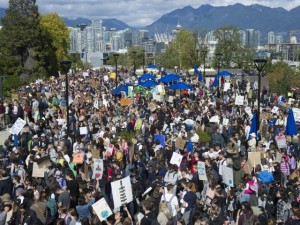
October 18, 2019
The Global Climate Strikes of September 20 and 27, 2019 were a set of large global protests sparked by Swedish activist Greta Thunberg. In Canada, the climate strikes on the September 27 drew 600,000k+ and occurred against the backdrop of an approaching federal election. This post will analyze the impact of the September Climate strikes on the salience of climate change during the 2019 federal election, as characterized by Canadian media. Data used in this analysis was gathered from Dow Jones database, Factiva.
Theory
John Kingdon’s multiple streams framework posits that a ‘policy window’ emerges when the independent streams of problems, politics and policies converge. Windows can be opened by developments in the problems or politics streams. In Kingdon’s conception, a ‘problem’ comes to be defined as such through a focusing event, or as a result of strong responses though ‘formal’ feedback mechanisms (e.g. negative opinion poll) or ‘informal’ feedback mechanisms (e.g. a mass protest). For a policy window to open, however, the problems stream must ‘couple’ with changes in the politics stream, which increases the likelihood that a given issue will take root on a governmental agenda.
Measuring the Impact of Climate Strikes in Canada
The climate strikes of September 27 were a powerful ‘focusing event’ and feedback mechanism to communicate public dissatisfaction with climate action in Canada. In the context of an impending election, the scale of the Canadian climate strikes was also social proof of the salience of climate as a voting issue. Analysis of Canadian news media is one tool to examine the prevalence of climate in coverage of the federal election, and a possible “proxy measure for an issue’s agenda status among policymakers” (Beilmann, Susanne). The climate Strikes, along with several other events, helped drive the issue of climate into closer conversation with the federal election.
Analyzing the relationship between mentions of climate change in federal election coverage is one broad tool to gage the extent to which climate change has become a more significant, or less significant voting issue for Canadians over time. Data from Canadian newspapers over a five-year period illustrate how climate gained traction in coverage of the 2015 Canadian elections compared to those of 2019.
 (Source: Factiva, Region= Canada)
Fig. 1 Mentions of ‘Climate Change’ AND ‘election’ in Canadian news outlets over the past five years. Factiva settings were restricted to ‘Canada’, and timeframe was set to ‘past five years’. All news mentions of ‘election’ were first compiled, then data on articles mentioning ‘election’ AND “climate change” were compiled and calculated as a percentage of total articles overall mentioning “election”.
The term ‘climate’ is mentioned markedly more often in the 2019 elections when compared to the last Canadian federal election year. In 2015, the term ‘climate change’ was mentioned in 6.7% of news articles containing the term ‘election’, while in 2019, 14.4% of articles which mentioned ‘election’ also mentioned ‘climate change’. Using media attention as a proxy measure for issue salience, the data suggest that climate is a more significant voting issue in 2019 than in any historic Canadian election.
While a five-year analysis illustrates the broad changes in climate coverage in election years, this multi-year scale makes it impossible to identify the impact of discrete ‘framing’ events on the coverage of climate in the federal election. Reselecting a narrower study period on Factiva (August 28 – October 11, 2019) enables a more detailed analysis of their interactions.
 (Source: Factiva. Region: Canada)
Fig. 2. Number of articles which mention ‘student strike’ (specifically ‘climate strike’ or ‘student strike’), “’climate change’ AND ‘elections’” from August 28-October 12, 2019. Setting a narrower date range on Factiva enables closer study of how media mentions of ‘elections’ and ‘climate change’ fluctuated near the Climate Strikes or near planned campaign events, such as televised debates.
The first wave of articles mentioning ‘elections’ and ‘climate change’ occurred near September 11, when the Canadian federal election was called. Coverage of the announcement may have surveyed party platforms and speculated about key voting issues, such as climate change. Another wave of interest occurred directly before and after the climate strikes on September 27. The data suggests two things: First, the climate strikes elevated the topicality of climate in elections coverage, independent of reporting on the school strikes (See fig. 2.- The rise in mentions of ‘election and climate change’ rises independent of mentions of ‘elections’ and ‘climate strike’ OR ‘student strike’).
Media focus on climate as an election issue did not evaporate after the climate strikes. Momentum continued. The next rise in mentions on October 3 coincides with the date of GreenPac’s ‘100 Debates on the Environment’ – a coordinated effort to raise the profile of environmental issues by staging a collection of 100 ‘non-partisan all-candidate debates on the environment’ nationwide. Although the mentions climate strikes and student strikes dropped off, the 100 Debates generated similar levels of media attention to climate and the election as the Climate Strikes.
Media attention to climate continued through to the English and French language Leaders Debates of October 7 and 9. Both events allocated time for debate on ‘environmental’ issues, and climate featured prominently in this sections and others. Climate was an arena which candidates used to distinguish themselves from other parties through critique of the effectiveness of opposing climate plans, and by ‘selling’ the benefits of their plans for climate action. Next-day coverage reflected the centrality of climate in the debates and contributed to the two surges of climate mentions in elections reporting.
Overall, climate as a topic featured more than twice as often in coverage of the 2019 federal election than in the election coverage of 2015. The climate strikes of September 27 and the planned events which followed (100 Debates, Climate Strikes) were related to significant spikes in media interest in climate and the elections. The recurrence and fairly consistent distribution of these spikes suggests that interest in climate as an election issue has kept momentum in the media since the climate strikes. A recent Angus Reid poll also suggests that climate is a top issue for voters. The extent to which climate will be one of, if not the defining issue in the upcoming federal election will be the subject of post-election analysis.
Limitations
Analysis of Canadian media content helps to illustrate the relationships between events such as the Global Climate Strikes, 100 Debates on the Environment, and televised debates. However, this measure has several limitations:
- Uncertain Relationship: Graphing media mentions of “climate strike” and “election” (fig. 1 and Fig. 2) presumes that articles mentioning ‘climate change’ and ‘election’ are discussing climate change in relation to an election. It is possible that some journalists may be discussing these issues separately in the same article.
- International Election Coverage: Factiva cannot exclude coverage of foreign elections which also mention ‘climate change’. It is possible that coverage of international elections distorts data in all figures. Setting the parameters to ‘Canada’ limits this data to Canadian news sources which increases the likelihood that Canadian elections were the elections in conversation.
- French Language Exclusion: Search terms were limited to English language news sources. As French media was excluded, data will only reflect the relationship between ‘election’ and ‘climate’ in Anglophone Canada. It is possible that Quebecois news sources would have altered the relationship between the terms: ‘election’, ‘climate’, and ‘climate strike OR student strike’.