Look for Caltech's Mike Brown and Palomar Observatory to be featured in this Thursday's episode of Known Universe on the National Geographic Channel. Check your local listings.
Check out the preview embedded below (and please accept our apologies for the commercial that runs first).
Filming at the Hale Telescope was done last summer. In the episode Mike Brown talks about dwarf planet Eris, a member of Kuiper Belt, discovered by him with images taken with Palomar's 48-inch Samuel Oschin Telescope.
Showing posts with label tv. Show all posts
Showing posts with label tv. Show all posts
Tuesday, May 4, 2010


Friday, October 2, 2009
Star Trek: The Next Generation Visits Palomar
Last week a new release of the Star Trek the Next Generation movies came out in a boxed set on DVD and Blu-Ray. I am not normally in the business of informing my readers of new home video releases, but this one has Palomar Observatory in one of the bonus features.
On the disc for Star Trek Generations is a bonus feature for both the DVD and Blu-Ray releases called Stellar Cartography On Earth.
 The feature is just over seven and a half minutes long and it makes the comparison between the stellar cartography room seen in Star Trek Generations (below) and modern reality.
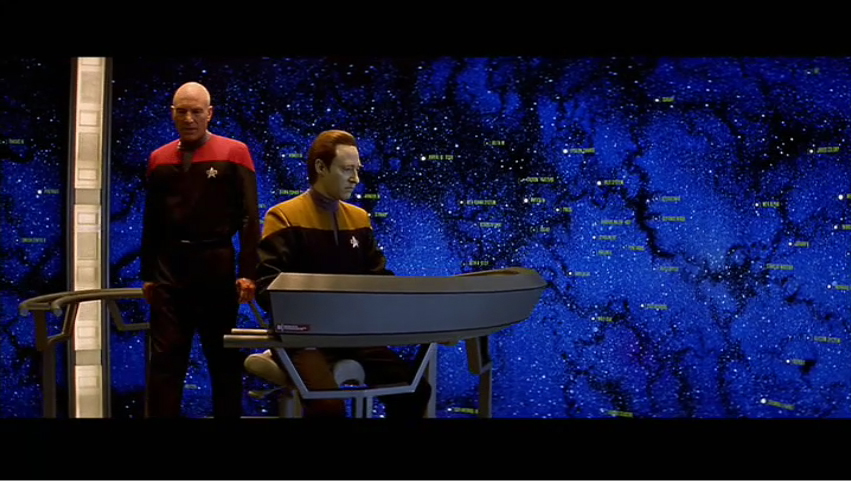 The piece talks a bit about exoplanets, NASA's Great Observatories, Kepler, the proposed Terrestrial Planet Finder mission and Palomar Observatory.
 It features Amy Mainzer (Wide-field Infrared Survey Explorer, JPL), Charles Beichman (Michelson Science Center, Caltech, JPL), Michael Werner (Spitzer Space Telescope, JPL) and um. . . me.
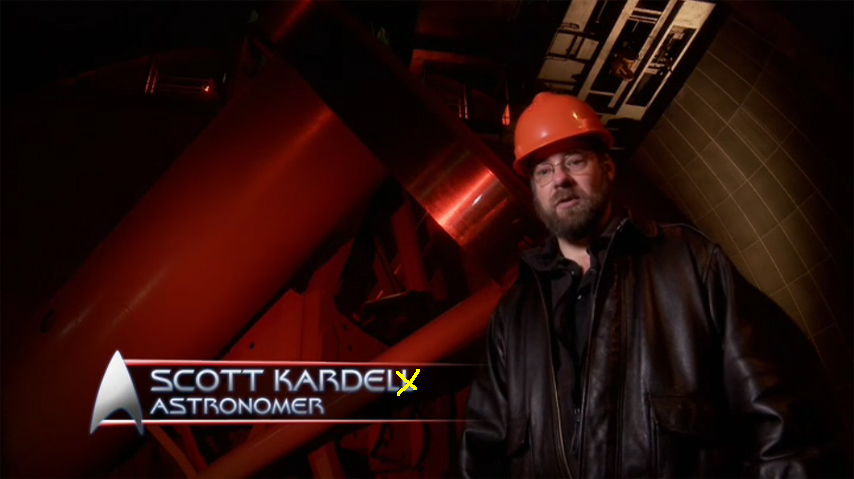 They almost got the spelling of my name right (I x-ed out the extra "L" on the screen grab). It was fun to have them visit the observatory last February and to know that Palomar Observatory is now a very small part of the Star Trek universe.
On the disc for Star Trek Generations is a bonus feature for both the DVD and Blu-Ray releases called Stellar Cartography On Earth.
 The feature is just over seven and a half minutes long and it makes the comparison between the stellar cartography room seen in Star Trek Generations (below) and modern reality.
 The piece talks a bit about exoplanets, NASA's Great Observatories, Kepler, the proposed Terrestrial Planet Finder mission and Palomar Observatory.
 It features Amy Mainzer (Wide-field Infrared Survey Explorer, JPL), Charles Beichman (Michelson Science Center, Caltech, JPL), Michael Werner (Spitzer Space Telescope, JPL) and um. . . me.
 They almost got the spelling of my name right (I x-ed out the extra "L" on the screen grab). It was fun to have them visit the observatory last February and to know that Palomar Observatory is now a very small part of the Star Trek universe.
Friday, May 8, 2009
Porter Garden Telescopes. As Seen on TV!

Back in the 1920s Russell Porter made a number (at least 53, but the exact number is unknown) of Garden Telescopes. There are several of them in the photo of Porter above. Porter's elegant design made them truly remarkable. Look at the right and you'll see one in an open box. At the bottom is the pivoting base which houses the 6-inch, f/4 mirror. There is no tube for the instrument. Instead the bar that extends up holds the secondary mirror and the eyepiece. The design makes it a classic item to display outside, a sundial and a working telescope.
Learn more about them here and see his patent for the design here.
If you have got the money, they are now being reproduced and sold again (but only 200 0f them) by Telescopes of Vermont. Visit their site for more information on these amazing reproductions. Below is a video on how it is done.
The telescope will be included in a segment of CBS Sunday Morning scheduled to air this Sunday, May 10.
UPDATE: CBS Sunday Morning sends this along:
CBS News Sunday Morning will show you the past and the future of telescopes starting with Galileo's heretical look up at the sky 400 years ago. Correspondent Martha Teichner interviewed astrophysicist Neil De Grasse Tyson of the Hayden Planetarium and astrophysicist Mario Livio of the Hubble Space Telescope Science Institute. She also talked to Fred and Russ Schleipman who have recreated the Porter Garden Telescope. You will find science and art, prose and poetry in this CBS News Sunday Morning story.
Friday, May 1, 2009
Astrocast.TV covers The Big Picture
Episode # 14 of Astrocast.TV is now online. The full episode is 25 minutes long. In that Carolyn Collins Peterson presents The Astronomer's Universe which this time covers The Big Picture and the structure of the universe.
Be sure to head on over to watch the show.
Be sure to head on over to watch the show.
Monday, April 13, 2009
Reminder: 400 Years of the Telescope Tonight!
Remember, for those in the San Diego area, that 400 Years of the Telescope is on tonight at 10:30 on PBS. It is a good show and well worth your time.
I am in it, but if you blink at the wrong time you'll miss me.
I am in it, but if you blink at the wrong time you'll miss me.
Friday, April 10, 2009
Alien volcanoes & More!
At 6 pm tonight you can catch author/artist Michael Carroll presenting Alien Volcanoes at the Ruben H. Fleet Science Center in San Diego. I understand that he gives a great presentation, so you should check it out if you can.
If you missed me yesterday on These Days you can catch it here.
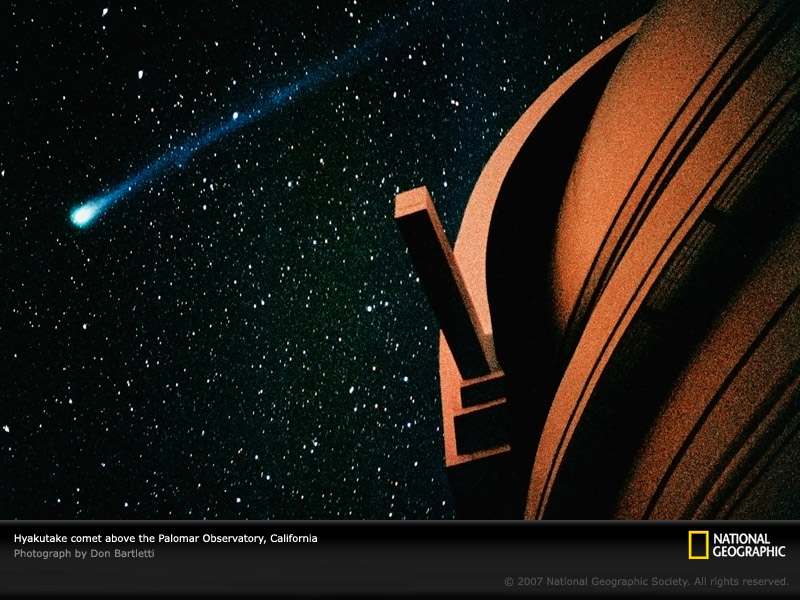
I just found this shot of comet Hyakutake from 1996 taken from just outside the dome of the Hale Telescope. It is available as desktop wallpaper for your computer from National Geographic. Maybe it can help to tide you over until the next bright comet visits our skies.
My next post (later today) will be about something quite cool that happened here earlier in the week.
If you missed me yesterday on These Days you can catch it here.
I just found this shot of comet Hyakutake from 1996 taken from just outside the dome of the Hale Telescope. It is available as desktop wallpaper for your computer from National Geographic. Maybe it can help to tide you over until the next bright comet visits our skies.

My next post (later today) will be about something quite cool that happened here earlier in the week.
Wednesday, April 8, 2009
400 Years of the Telescope on PBS
To continue your celebration of the International Year of Astronomy you should plan on watching 400 Years of the Telescope on PBS.
The folks over at Interstellar Studios have done a fantastic job with the production (Yes, I've already seen it). They visited just about every major telescope on the planet. The documentary is narrated by Neil deGrasse Tyson and features a moving score by Mark Slater, but the stunning imagery of the show (in HD) will overwhelm you.
It will be aired Monday, April 13 @ 10:30 p.m. in San Diego, but be sure to check here to see when and where it will be shown in your area.
You can see the trailer for the program on their website and below:
Tomorrow (Thursday) morning I will be on KPBS Radio's program These Days with Kris Koenig director/producer of 400 Years of the Telescope to discuss the new documentary, the what's new in astronomy and even Palomar Observatory. You should be able to listen live just after 10:00 a.m. PDT or check out the archive of the show later on.
The folks over at Interstellar Studios have done a fantastic job with the production (Yes, I've already seen it). They visited just about every major telescope on the planet. The documentary is narrated by Neil deGrasse Tyson and features a moving score by Mark Slater, but the stunning imagery of the show (in HD) will overwhelm you.
It will be aired Monday, April 13 @ 10:30 p.m. in San Diego, but be sure to check here to see when and where it will be shown in your area.
You can see the trailer for the program on their website and below:
Tomorrow (Thursday) morning I will be on KPBS Radio's program These Days with Kris Koenig director/producer of 400 Years of the Telescope to discuss the new documentary, the what's new in astronomy and even Palomar Observatory. You should be able to listen live just after 10:00 a.m. PDT or check out the archive of the show later on.
Friday, March 13, 2009
Death of a Star on Nat Geo
I was remiss in pointing out that Palomar's Hale Telescope was shown briefly (& mostly for eye candy) last night on Naked Science: Death of a Star on the National Geographic Channel.
The episode chronicles the discovery of the long tail of the star Mira that was found by Chris Martin of Caltech and Mark Siebert of the Carnegie Institution using the UV Galex satellite.
It looks like the show will be repeated on Sunday March 15 @ 2 p.m. As always, check your local listings.
Here's a clip:
The episode chronicles the discovery of the long tail of the star Mira that was found by Chris Martin of Caltech and Mark Siebert of the Carnegie Institution using the UV Galex satellite.
It looks like the show will be repeated on Sunday March 15 @ 2 p.m. As always, check your local listings.
Here's a clip:
Friday, February 20, 2009
Tour de Palomar
The 2009 Amgen Tour of California is in full swing and on Sunday February 22nd they will be cycling up and down Palomar Mountain as a part of the final stage of the race.
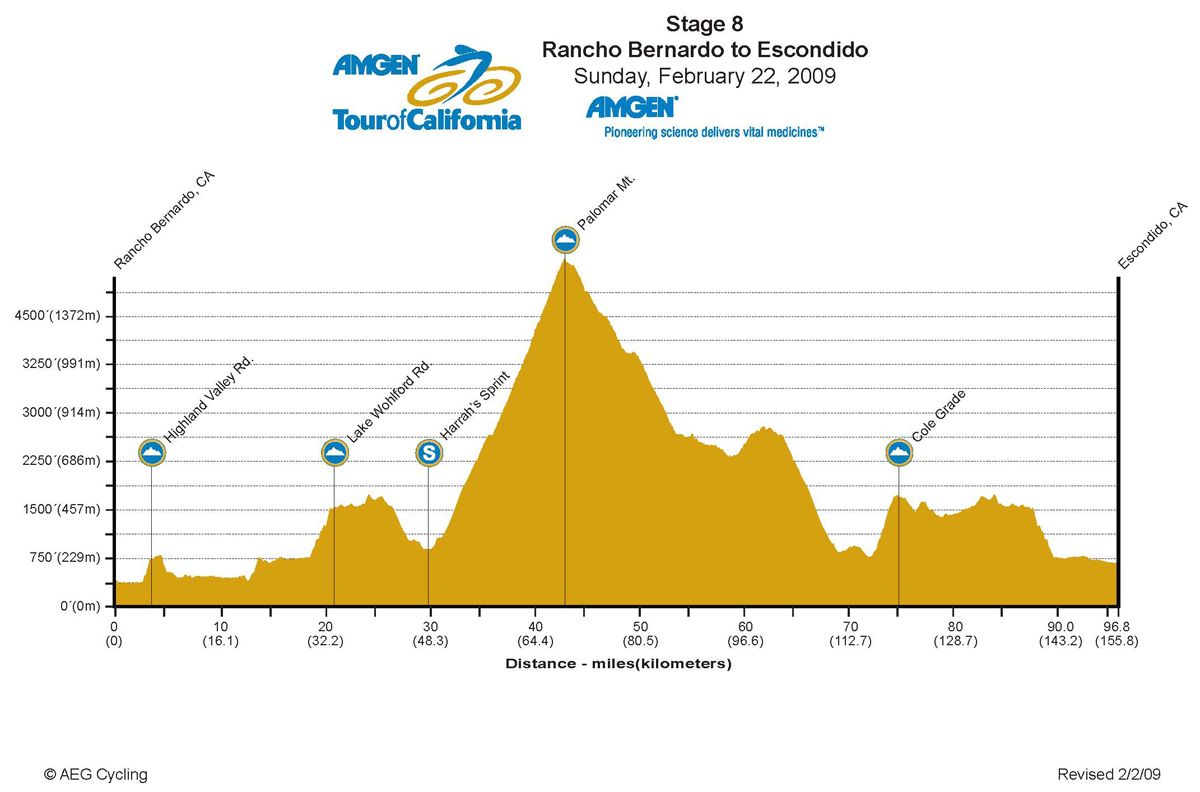 Here's the official profile of Sunday's "Stage 8" of the race. Yes, the vertical scale has been exaggerated.
Any and all visitors that are planing on coming to the observatory this weekend should expect crowds. Cycling enthusiasts are already descending upon the mountain. As of Thursday evening there were already people who had staked out camping spots (even where there isn't camping) on South Grade Road (aka S-6) and at the summit.
Thousands of people are expected to be on Palomar to watch the cyclists climb up South Grade Road, which happens to be the same road the 200-inch mirror came up in 1947. The road's 7% grade will be a challenge for the cyclists and, because they will be going slower, give fans a longer chance to watch them go by.
Visitors wishing to visit the Palomar Observatory will face multiple road closures on February 22nd. The Amgen Tour of California bike race will cause lengthy road closures on all of the roads leading to the area. It is estimated that South Grade Road (S-6) will be closed for six hours beginning at 9:00 a.m. East Grade Road (S-7) and Highway 76 will also face closures due to the event. Anyone wishing to see the Palomar Observatory, that is not already nearby to attend the event, are encouraged to find an alternate date to visit.
For those far away the event can be seen on TV and on the web at Amgen's site. I am not sure if I will see any of it, as I will be helping out the Palomar Mountain Volunteer Fire Department.
For those attending the race, we would like to remind everyone that there is no overnight parking in the observatory's parking lot.
 Here's the official profile of Sunday's "Stage 8" of the race. Yes, the vertical scale has been exaggerated.
Any and all visitors that are planing on coming to the observatory this weekend should expect crowds. Cycling enthusiasts are already descending upon the mountain. As of Thursday evening there were already people who had staked out camping spots (even where there isn't camping) on South Grade Road (aka S-6) and at the summit.
Thousands of people are expected to be on Palomar to watch the cyclists climb up South Grade Road, which happens to be the same road the 200-inch mirror came up in 1947. The road's 7% grade will be a challenge for the cyclists and, because they will be going slower, give fans a longer chance to watch them go by.
Visitors wishing to visit the Palomar Observatory will face multiple road closures on February 22nd. The Amgen Tour of California bike race will cause lengthy road closures on all of the roads leading to the area. It is estimated that South Grade Road (S-6) will be closed for six hours beginning at 9:00 a.m. East Grade Road (S-7) and Highway 76 will also face closures due to the event. Anyone wishing to see the Palomar Observatory, that is not already nearby to attend the event, are encouraged to find an alternate date to visit.
For those far away the event can be seen on TV and on the web at Amgen's site. I am not sure if I will see any of it, as I will be helping out the Palomar Mountain Volunteer Fire Department.
For those attending the race, we would like to remind everyone that there is no overnight parking in the observatory's parking lot.
Thursday, February 12, 2009
Watch the Known Universe

The National Geographic Channel will be showing Known Universe, a three-part special that will air on Sunday, February 15, from 8 to 11 p.m. (Check your local listings for your broadcast time).
The program will feature several people from Caltech: Michael Brown (Rosenberg Professor of Planetary Astronomy & Pluto Killer); Sean Carroll (senior research associate in physics); and astronomer Robert Hurt (Infrared Processing and Analysis Center).
Through a combination of current research data, cutting-edge computer graphics, and everyday examples, Known Universe aims to explain "the most mind-boggling aspects of our universe"—from the size of our solar system to the most powerful explosions, and the dynamic relationship among speed, time, distance, and gravity.
The link above has clips from the show and more cool stuff.
Tuesday, October 21, 2008
Sci Fi Science on TV
Look for Palomar Observatory on Sci Fi Science on Science Channel. If I recall correctly the topic of exoplanets will be discussed and you may be seeing the Palomar Testbed Interferometer, the Sleuth telescope and myself.
The show will air Sunday October 26 at 9:00PM Eastern and Pacific/ 8:00pm Central. As always it is a good idea to check your local listings.

The show will air Sunday October 26 at 9:00PM Eastern and Pacific/ 8:00pm Central. As always it is a good idea to check your local listings.

Wednesday, July 9, 2008
Palomar on TV
You can see Palomar Observatory & JPL's Near-Earth Asteroid Tracking program profiled tomorrow night on the History Channel's Modern Marvels show. It is scheduled to air Thursday, July 10 from 9:00 - 10:00 p.m., but check your local listings.
From the show's website:
From the show's website:
Explore collisions that shake our world from the astronomic to the subatomic. Discover breakthroughs that could make the deadly sport of professional auto racing safer and visit a motorcycle crash test facility and examine two-wheeled accidents in detail. Meet a skydiver who survived a crash to earth from 11,000 feet. An asteroid crashing to earth could destroy our planet--watch as NASA's Near Earth Asteroid Tracking team hunt down dangerous asteroids. Finally learn about scientist's who are creating crashes with colliding subatomic particles in the world's largest machine. Will they unlock the secrets of the universe--or accidentally open a black hole?Yikes! "An asteroid crashing to earth could destroy our planet" ?! Not really, folks. That's just hype to get (scare?) you to watch the show.
Subscribe to:
Posts (Atom)

 Posts
Posts


