
Author’s note: Breaking down Reuters’ report on the GLM-5.5 delay—what’s confirmed, what’s unconfirmed, what each of the two pressures is holding up, and three things teams already running GLM-5.3 in production can do today.
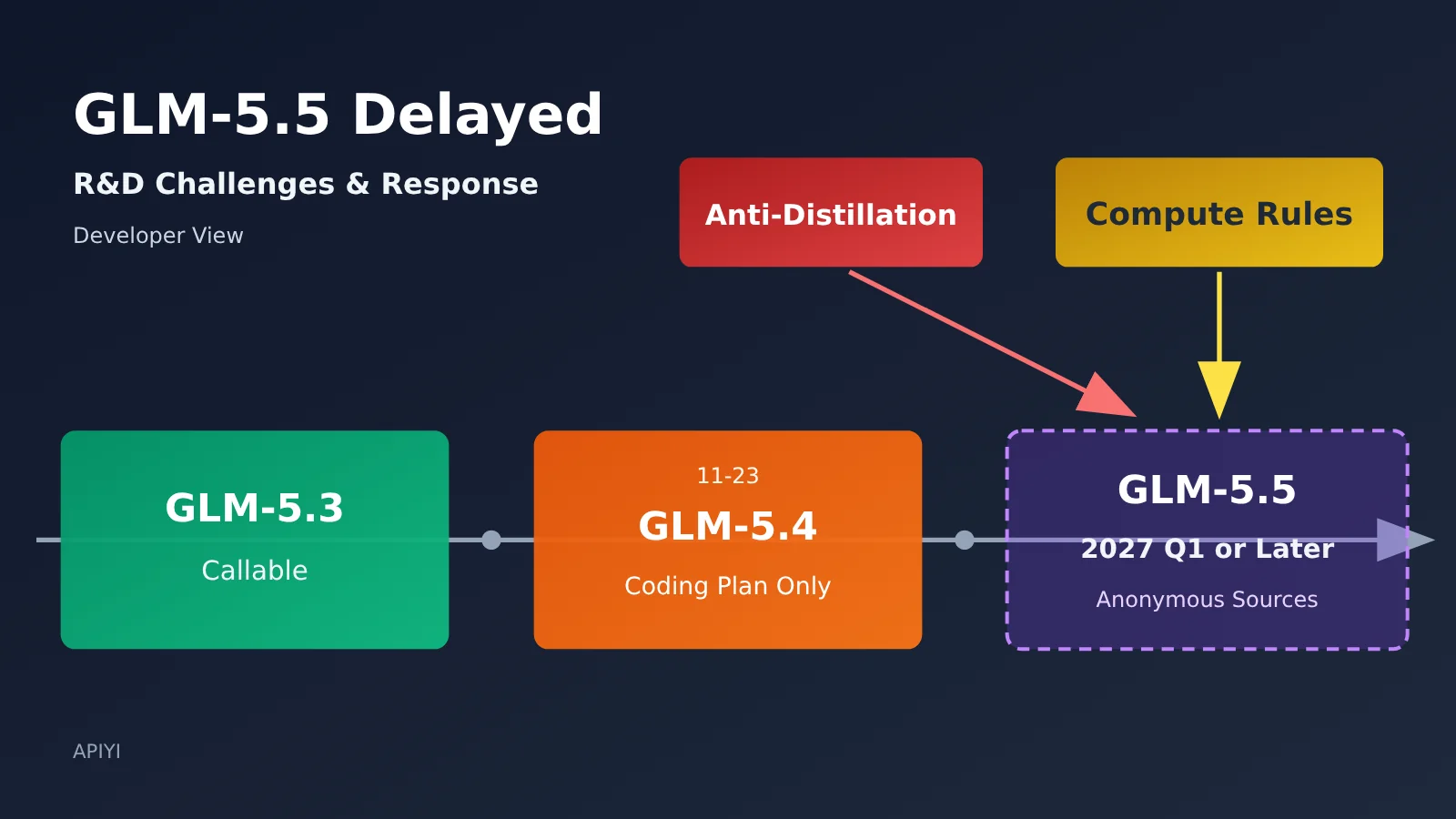
On November 26, Reuters, citing two anonymous sources familiar with the matter, reported that Z.ai’s GLM-5.5—originally planned for release this month with roughly 3 trillion parameters—did not ship on schedule, with the window pushed to Q1 2027 or later. Z.ai did not respond to a request for comment and has never issued any statement about a GLM-5.5 timeline.
This is not an officially confirmed delay announcement, nor is it a “coming soon” teaser. This article separates the report into two layers—what’s confirmed and what’s unconfirmed—explains the two pressures holding it back, and then gets practical about GLM-5.3 pricing and access options you can use today.
Key takeaway: If you’ve already put GLM-5.3 or the GLM Coding Plan into production, by the end of this article you’ll know whether this GLM-5.5 delay means you need to change your architecture right now—and if so, how.
GLM-5.5 Delay: Key Facts at a Glance
When you read this news, the first step is to separate what can be checked item by item from what comes only from anonymous sources. The table below sorts the information available as of November 26 into three categories.
| Item | Details | Credibility level |
|---|---|---|
| Not released as planned | GLM-5.5, originally slated for release this month, has yet to appear | Confirmed (nothing in docs, blog, or model weights repo) |
| Current state of official channels | The docs.z.ai changelog still starts with GLM-5.3-Flash from 8-26; z.ai/blog/glm-5.5 returns 404; zai-org on Hugging Face has no GLM-5.5 repo; the price list has no GLM-5.5 row |
Confirmed (each item verifiable) |
| Reason for delay | Stronger anti-distillation defenses + US compute rules that took effect on 11-19 | Unconfirmed (two anonymous sources) |
| New timeline | Q1 2027 or later | Unconfirmed (anonymous source; Z.ai did not respond) |
| Parameter scale | Reuters says about 3 trillion, adjusted during training; late-October Chinese reports said 2.5 trillion to 3.5 trillion, and earlier versions said 1 trillion and 1.6 trillion | Conflicting figures; no active parameter count |
The parameter item deserves a closer look. The GLM series uses a sparse MoE architecture, so what determines inference cost is active parameters, not total parameters—and no source has yet given GLM-5.5’s active parameter count. So what “3 trillion” means for your bill can’t be worked out right now.
The same report also provided industry context: Moonshot internally expects its six-month release cadence to stretch to 12 months or longer, with Kimi K4 possibly slipping to mid-2027; DeepSeek internally estimates the gap with the US will widen from 3 to 6 months to about 9 months. These are competitive-context figures from the report, not measurements, and that qualifier should be kept when citing them.
The Two Pressures Behind the GLM-5.5 Delay: What Each One Took Away
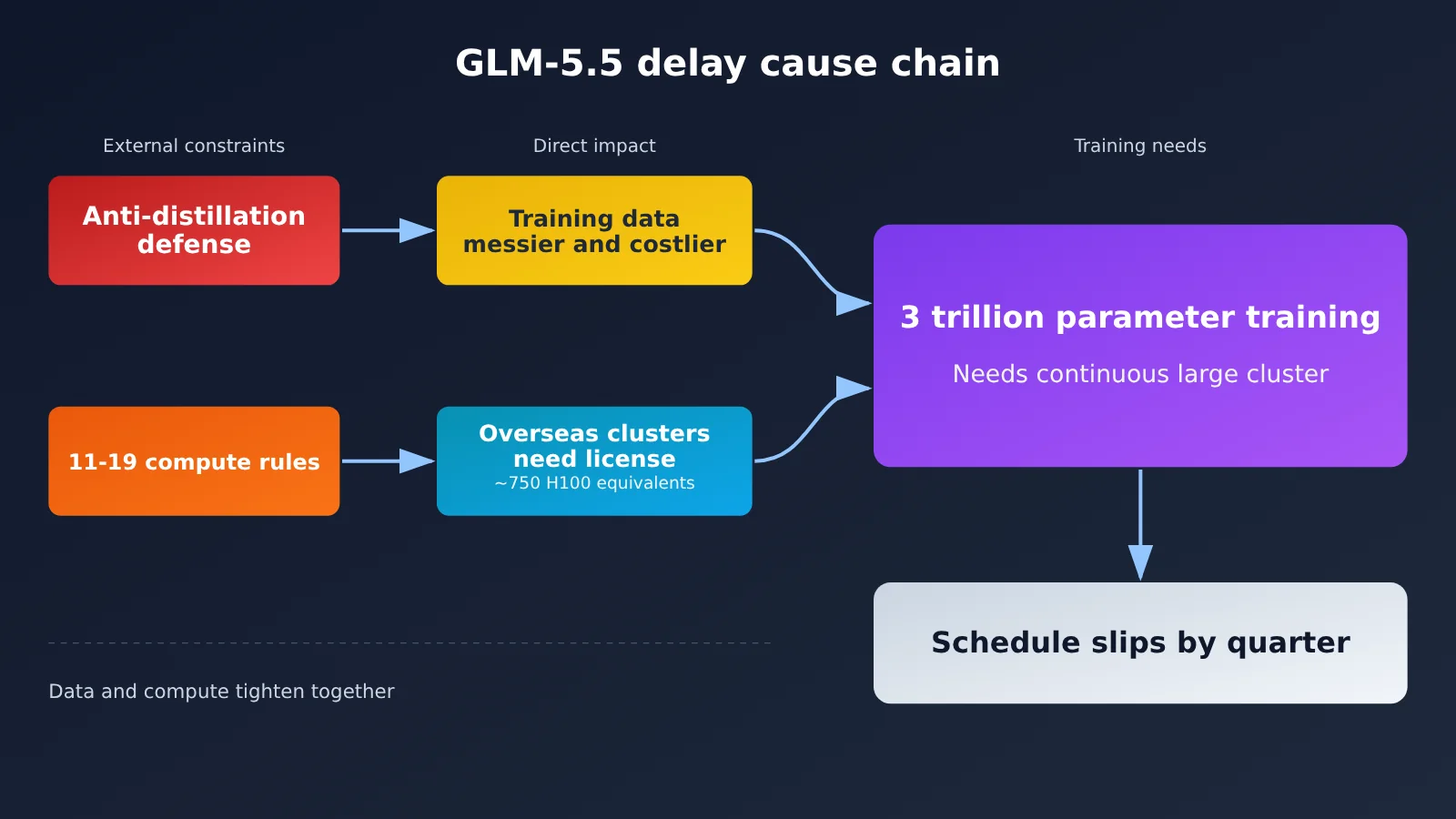
According to anonymous sources, there are two reasons for the delay. They hit different parts of the R&D process: one makes data more expensive, the other makes clusters harder to find.
| Pressure | Details | What It Takes Away |
|---|---|---|
| Anti-distillation defenses | In September, Anthropic said it had identified nearly 200 million Claude interactions suspected of being distillation-related, pointing to developers including Alibaba, Moonshot, and Z.AI; OpenAI has also made similar allegations about people associated with Moonshot. Defenses include rare-phrase fingerprints, deliberately degraded answers, and account-based rate limiting. | Training data gets dirtier and more expensive; cleaning and supplementing data lengthens the training cycle. |
| U.S. compute rules (effective 11-19) | Chinese companies need a license to use large-scale advanced U.S. chip compute in overseas data centers, with a threshold of roughly 750 H100-equivalents; providers already covered have 90 days to obtain a license; advanced chip shipments to Malaysia, Singapore, Indonesia, Thailand, and Brazil are now subject to licensing. | The path to renting overseas compute is blocked; clusters need to be found elsewhere. |
Why GLM-5.5 Slips by Quarters, Not Weeks
Anti-distillation doesn’t stop training, but it lowers the quality of usable data and raises the cost of acquiring it. For a model with roughly 3 trillion parameters, training needs large, contiguous, long-available clusters, and any interruption forces the schedule to be rearranged.
When both data and compute tighten at the same time, the granularity of schedule adjustments naturally shifts from “weeks” to “quarters.” That also explains why the anonymous sources gave a broad window like the first quarter of 2027 rather than a specific date. This article doesn’t predict the GLM-5.5 release date, because there’s currently no verifiable basis for one.
Before GLM-5.5: The GLM-5.4 That Actually Launched on 11-23
In the same week GLM-5.5 went missing, Z.ai rolled out GLM-5.4 on November 23 — but only on the GLM Coding Plan. It adds vision to the flagship line, and subscribers who pick it up get a 50% bump in their weekly quota.
No rate card row, no benchmark table, no model card, no weights repo. Reuters describes it as built on the existing 750-billion-parameter model, running each layer twice (a loop structure), with Z.ai saying it’s comparable to models in the 2-to-3-trillion-parameter range; Z.ai itself hasn’t published a parameter count, and earlier Chinese reports put it at around 700 billion.
There’s a reasonable way to read this move: shipping a minor version on the subscription plan, adding vision, and throwing in extra quota is a way to keep paying users on the current foundation while holding back API pricing and weights. If GLM-5.5 were only weeks away, there’d seem to be little need to cut a derivative of GLM-5.3 right now. That’s inference, not a statement from Z.ai — but it points in the same direction as the anonymous sources.
What the GLM-5.5 Delay Means for Developers
For Teams Already on GLM-5.3
- No forced migration in the short term: GLM-5.3 is still the only version on the GLM flagship line with API pricing, and the delay doesn’t change its availability.
- Don’t treat GLM-5.4 as a replacement: it exists only on the Coding Plan, has no API pricing and no weights, and can’t be called in a production API pipeline.
- Build slack into your roadmap: plans that bet on “switching to GLM-5.5 by end of year” should become “GLM-5.3 runs at least another one or two quarters.”
Impact on Model Selection
The delay itself isn’t bad news — what it exposes is the risk of depending on a single model. When your business only works with one model, your release cadence gets tied to someone else’s R&D cadence. Treating the GLM-5.5 delay as an architecture problem is worth more than reading it as a news item and moving on.
Getting Started During the GLM-5.5 Delay: GLM-5.3 You Can Call Today
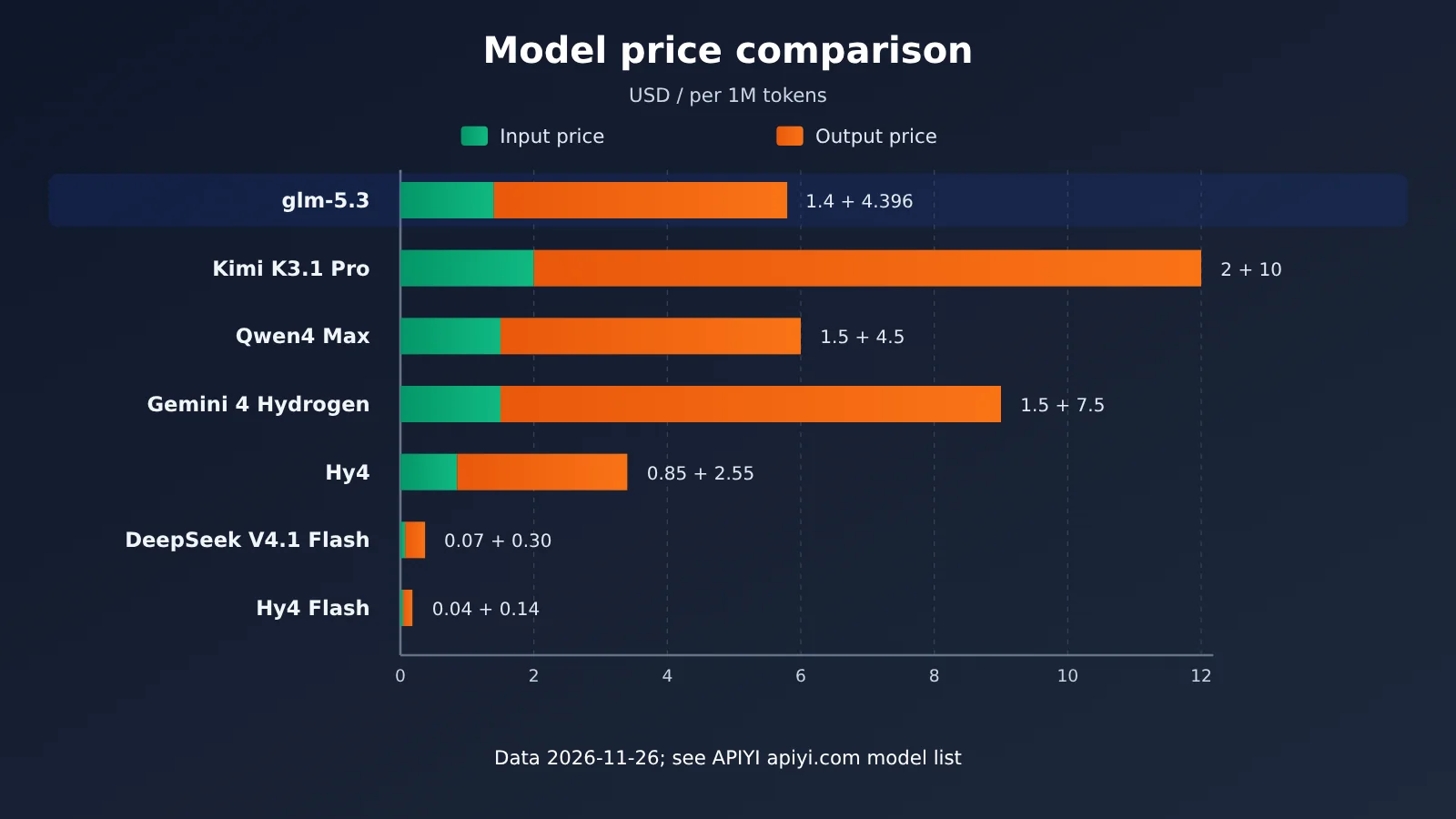
Every call burns tokens, and switching models means switching bills. So first, get a clear look at what the tier you can call today actually costs. The data below is as of 2026-11-26, in USD per 1M tokens; model names and prices are subject to the model list on the APIYI apiyi.com platform.
| Model ID | Input | Output | Cache read | Cache write | Notes |
|---|---|---|---|---|---|
glm-5.3 |
1.4 | 4.396 | 0.259 | Not listed separately; refer to the platform | 1,000,000 context window, 128,000 max output |
glm-5.3-flash |
0.15 | 0.50 | Refer to the platform | Refer to the platform | Cheaper tier from the same family |
glm-5.2 |
1.142 | 3.997 | Refer to the platform | Refer to the platform | Previous-generation flagship |
glm-5.1 |
0.84 | 3.36 | Refer to the platform | Refer to the platform | Earlier version |
The official price for glm-5.3 is 1.40 for input, 4.40 for output, and 0.26 for cache, and APIYI matches the official pricing. It uses the same 753B MoE base as GLM-5.2 and only extends post-training. Thinking mode can’t be turned off, so you need to factor that into your output token estimates.
On APIYI, glm-5.3 has three groups: ClaudeCode (0.95x), Default, and SVIP. The endpoint supports both OpenAI Chat Completions and Anthropic Messages. When integrating, set base_url to https://api.apiyi.com/v1, and put the model name in the model field of the request body, for example "model": "glm-5.3".
🚀 Quick Start: New APIYI apiyi.com sign-ups get free trial credits. You can start by running the same batch of real tasks through
glm-5.3andglm-5.3-flash, compare cost per task, and then decide which tier to use as your primary one.
Coping with the GLM-5.5 delay: 3 things to reduce reliance on a single model
Thing 1: Make the integration thin enough that you only change one model string
Because the model name lives in the request body, the same base_url and the same key can call models from different providers. The catch is that your code can’t have the model name hardcoded in a dozen places. Put the model name, timeout, and fallback model name into config, and give every call site a fallback model name and a timeout budget so a single model can’t block the whole chain.
Cross-model downgrade has to be implemented in your application layer. For example, if the primary model times out or returns an error, resend the request once using the fallback model name from config. The platform won’t do that for you.
Thing 2: Use token groups as a fallback for channel failures
APIYI tokens can each have their own dedicated quota, expiration time, allowed-model whitelist, and group. Consumption, remaining quota, and invocation logs for each token are independently queryable. The docs recommend creating separate tokens for different use cases in production so you can disable them separately and attribute usage.
A token can be configured with up to 1 default group plus 2 fallback groups, and it switches automatically when the primary group is unavailable. To be clear, this is channel-level fallback: it switches between different groups of the same model. It won’t automatically downgrade the request to another model.
| Capability | Who handles it | What problem it solves |
|---|---|---|
| Group fallback (1 default + 2 fallback) | Platform, configured on the token | A channel is unavailable |
| Cross-model downgrade | Your application-layer code | A model is wholly unavailable or underperforming |
| Split tokens by use case | You configure in the console | Usage attribution, separate disablement |
Thing 3: Route traffic across two or three providers by task
Under a single base_url, models from multiple providers are available at the same time. The data in the table below is as of 2026-11-26, in USD per 1M tokens, and subject to the model list on APIYI apiyi.com.
| Model | Input | Output | Available on |
|---|---|---|---|
| Kimi K3.1 Pro | 2 | 10 | APIYI |
| Qwen4 Max | 1.5 | 4.5 | APIYI |
| DeepSeek V4.1 Flash | 0.07 | 0.30 | APIYI |
| Hy4 | 0.85 | 2.55 | APIYI |
| Hy4 Flash | 0.04 | 0.14 | APIYI |
| Gemini 4 Hydrogen | 1.5 | 7.5 | APIYI |
Compare cost per task and failure rate, not unit price. A model with a low unit price but lots of retries isn’t necessarily cheaper on your bill; a model with long outputs and reasoning that can’t be turned off may cost more than the headline number suggests.
GLM-5.5 Delay FAQ
Q1: Has the GLM-5.5 delay been officially confirmed?
No. The reasons for the delay and the Q1 2027-or-later window both come from two anonymous people cited by Reuters. Z.ai did not respond to a request for comment and has not published a GLM-5.5 timeline. All we can confirm is that it still isn’t in the official docs, blog, weights repositories, or price list.
Q2: Can GLM-5.4 replace GLM-5.5?
Not in API scenarios. GLM-5.4 is only available in the GLM Coding Plan, with no API pricing, model card, or weights. For production API pipelines, the flagship available today is still `glm-5.3`.
Q3: Do I need to migrate away from GLM-5.3 now?
There’s no need to migrate because of this news. What’s more worthwhile is to make the model name a config item and prepare a fallback model, so future model switches only require changing one string.
Q4: Can APIYI’s group fallback automatically switch to another model?
No. Group fallback is channel-level: a token can have at most 1 default group plus 2 fallback groups, and it only switches channels when the primary group is unavailable. Cross-model downgrade needs to be implemented in your application layer. For specific configuration, see the token and group documentation at APIYI apiyi.com.
Q5: How do I compare the real cost of multiple candidate models?
Run the same batch of real tasks on each candidate model and record token consumption and failure rate per task. Create a separate token for each candidate model so call logs and consumption can be tracked separately.
GLM-5.5 Delay: Key Takeaways
- Read the story in layers: the fact that it hasn’t shipped is confirmed; the reasons and the new launch window come from two anonymous sources.
- Two pressures: anti-distillation makes data more expensive, and the 11-19 compute rules make overseas clusters hard to rent.
- GLM-5.4 is not an API replacement: it’s Coding Plan only — no pricing, no weights.
- What you can actually call today is GLM-5.3: $1.4 input, $4.396 output, $0.259 cached read per 1M tokens.
- Fallback comes in two layers: the platform handles channel-level group fallback, the application layer handles cross-model degradation.
- Pick models by cost per task: compare failure rates and total consumption, not just unit price.
Conclusion: What to Do Starting Today
The credibility of the GLM-5.5 delay story sits squarely at “anonymous sources + silence from official channels.” No need to overreact — but it shouldn’t be ignored either. What it really reminds us of is this: depending on a single model is an architecture problem, and someone else’s R&D cadence shouldn’t dictate your release cadence.
Three things you can do today:
- Keep the integration thin: model names, timeouts, and fallback models all live in config — switching models means changing one string.
- Split tokens by purpose and set up group fallback: one default plus two fallbacks to survive channel outages.
- Route by task: pick models from two or three vendors and compare cost per task and failure rate on the same batch of tasks.
Our recommendation: on APIYI apiyi.com, run glm-5.3 alongside your other candidate models using the same key, and let real bills — not launch rumors — decide your next move.
📚 References
-
Reuters Exclusive (2026-11-26): the original report on the GLM-5.5 delay, cross-checked against same-day coverage from multiple outlets
- Note: both the reason for the delay and the timeline come from two anonymous sources
-
GLM-5.5 Tracker Page: item-by-item labeling of what’s confirmed, unverified, and retracted
- Link:
modelbrief.app/glm-5-5 - Note: updated 11-26
- Link:
-
Z.ai Official Docs: changelog and pricing table
- Link:
docs.z.ai - Note: as of 11-26, there are still no entries for GLM-5.4 or GLM-5.5
- Link:
Author: APIYI Technical Team
Technical Inquiries: Feel free to reach us through the homepage of the APIYI website. Documentation on model lists, tokens, and group configuration is available in the APIYI docs center.