

Abductive reasoning is a type of logical thinking where we begin with an observation or incomplete information and infer the most likely explanation for it. It does not guarantee a correct conclusion but focuses on choosing the explanation that best fits the available evidence. It is often called “inference to the best explanation” and is commonly used in uncertain or real-world scenarios.
- It is widely used when data is incomplete, helping to form a reasonable hypothesis based on limited evidence.
- It supports decision-making by prioritizing the most plausible explanation among multiple competing possibilities.
Key Principles
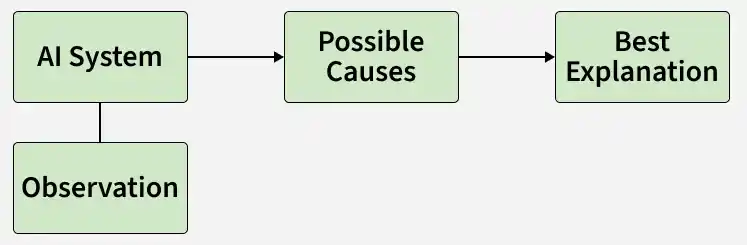
- Observation: An unexpected or unclear situation is identified from the available data.
- Possible Hypotheses: Multiple explanations are generated to account for the observation. In AI systems, this involves exploring different possible causes or patterns in the data.
- Best Explanation: The most suitable explanation is selected based on simplicity, relevance, and consistency with existing knowledge.
Implementation
Let’s consider a medical diagnostic system used to diagnose a patient using abductive reasoning.
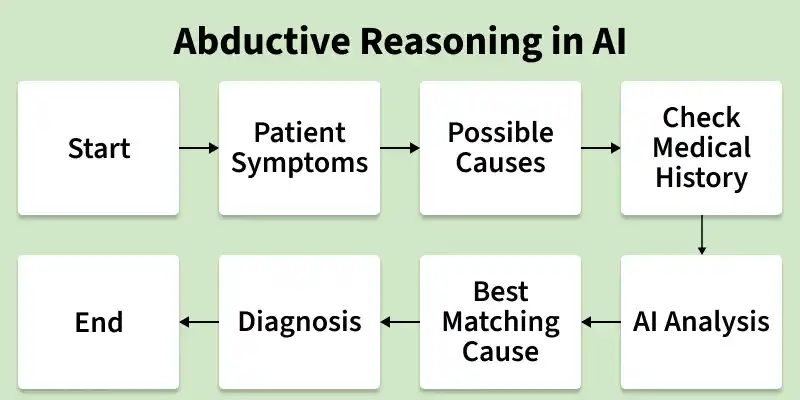
1. Observation: A patient presents with severe chest pain, shortness of breath, and dizziness.
2. Possible Hypotheses:
- The patient is experiencing a heart attack.
- The patient has a severe anxiety or panic attack.
- The patient is suffering from acute indigestion.
3. Additional Information: The AI system accesses the patient’s electronic health records and notes high cholesterol levels and a family history of heart disease.
4. Abductive Reasoning Process: The system evaluates all possible explanations for the symptoms using multiple AI techniques.
- Probabilistic reasoning: Bayesian Networks assign higher probability to the heart attack hypothesis based on strong links between symptoms and medical history.
- Logic-based reasoning: Alternative explanations are generated using ASP-style logic, but they are less consistent with the overall evidence.
- Machine learning support: The system compares the case with past medical records and reinforces the heart attack prediction through pattern matching.
5. Abductive Reasoning Conclusion: Based on symptom patterns, medical history, and learned patterns from past cases, the AI system identifies a heart attack as the most likely explanation.
Applications
- Medical Diagnosis: AI systems identify the most likely disease based on observed symptoms when complete information is not available.
- Fault Detection: It is used in systems to detect the most probable cause of failures in machines or networks.
- Natural Language Processing: AI uses it to interpret incomplete or ambiguous sentences by inferring the most likely meaning.
- Cybersecurity: It helps detect suspicious activities by inferring possible security breaches from abnormal system behavior.
- Expert Systems: It supports decision-making by suggesting the most plausible explanation among multiple alternatives.
Advantages
- Handles uncertainty by making reliable decisions even when full information is missing or incomplete.
- Enables quick conclusions by selecting the most likely explanation from available evidence.
- Highly useful in diagnostics as it supports accurate reasoning in healthcare and system troubleshooting tasks.
- Enhances human-like reasoning by allowing AI systems to form intelligent guesses similar to human thinking.
Limitations
- May lead to incorrect results since the chosen explanation is only the most probable, not guaranteed to be true.
- Relies heavily on knowledge base which means weak or incomplete data can reduce performance accuracy.
- Can produce wrong assumptions when the system’s inference rules or patterns are inaccurate.
- Lacks certainty in outcomes because conclusions are based on likelihood rather than certainty.
