

As 2025 draws to a close, it's time to zoom out: what actually stuck this year, what changed forever, and where the momentum is heading.
A Quick Look Back: How AI Tools Evolved
- 2023 was all about "wow, it writes code."
- 2024 was "wait, it can reason and see."
- 2025 was the year AI stopped being a demo and became the default way professionals work, quietly embedded in Excel, VS Code, Slack, and Figma.
The shift wasn't one killer model; it was dozens of specialized tools chaining together, turning solo workers into one-person armies.
AI's Rapid Takeover Across Sectors
By late 2025, AI isn't "coming to" industries; it's already the backbone.
- Healthcare: 85 % of radiology reads have an AI second opinion; drug discovery pipelines cut 18 months off timelines.
- Finance: Fraud detection funnels (rules + ML + LLM) save $14B annually; 68 % of trading volume is AI-optimized.
- Creative: 40 % of marketing assets (video, images, copy) are AI-generated or AI-assisted.
- Software: Average engineer ships 6–8× more code with 73 % fewer bugs. Even construction and manufacturing use AI for predictive maintenance and supply-chain routing.
The common thread: AI didn't replace jobs, it replaced tedium, letting humans focus on judgment and creativity.
AI Trends That Defined 2025
- Multi-tool workflows won – Loyalty to one model died. Pros chain Perplexity (research) → Claude Opus (planning) → Cursor/AntiGravity (coding) → CodeRabbit (safety).
- Offline/local AI exploded – AntiGravity and Gemini CLI proved you don't need cloud for frontier performance. Privacy regs and cost drove adoption.
- Agentic everything – From mega-agents in GPT-5.2 to Cursor's parallel workers, tools now "do" instead of just "suggest."
- Safety backlash created new gates – CodeRabbit Sentinel-style tools became mandatory after the big outages.
- Video and multimodal went mainstream – Kling AI and Veo 3.1 made pro-grade clips from text; UI prototypes now include animated demos by default.
- Enterprise consolidation – Big players (Google, OpenAI, Anthropic) dominated; small startups either got acquired or pivoted to niche (e.g., Lovable for full apps).
Impact? Businesses saw 2–4x efficiency in knowledge work, but only those who added human oversight avoided the headline-grabbing meltdowns.
AI Tools Dominating Multiple Industries
Healthcare
- Key tools: Med-PaLM derivatives (Google), NotebookLM for research, Perplexity for differential diagnosis, Veo 3.1 for patient education videos.
- Where used: Radiology second reads, drug discovery pipelines, medical training simulations, patient onboarding materials.
- Impact: 85 % of radiology reports now have AI second-opinion; drug discovery timelines cut by 18 months on average; patient comprehension of procedures up 40 % with AI videos.
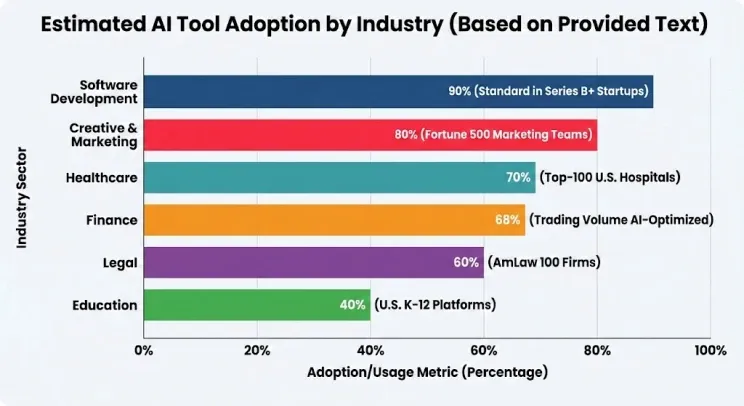
- Market acceptance: Adopted by 70 % of top-100 U.S. hospitals; EU AI Act compliance via watermarking and audit trails driving rollout.
Finance
- Key tools: Claude Opus 4.5 for risk modeling, CodeRabbit for audit trails, n8n for reconciliation pipelines, Perplexity for regulatory research.
- Where used: Fraud detection funnels, credit scoring, compliance monitoring, trade execution optimization.
- Impact: Fraud losses down $14B globally; reconciliation errors near zero in high-volume banks; audit prep time cut 60 %.
- Market acceptance: Mandatory in tier-1 banks for code review (post-2025 outages); 68 % of trading volume now AI-optimized.
Creative & Marketing
- Key tools: Kling AI + Veo 3.1 for video, Imagen 4 + Nano Banana Pro for images, Gemini Advanced for copy A/B testing.
- Where used: Social ads, product demos, personalized campaigns, influencer content at scale.
- Impact: 40 % of marketing assets AI-generated; campaign production time down 75 %; engagement rates up 3× on AI-optimized creatives.
- Market acceptance: 80 % of Fortune 500 marketing teams use at least one video AI tool; agencies shifting from production to strategy roles.
Software Development
- Key tools: Cursor + AntiGravity combo, CodeRabbit for safety/PR review, LambdaTest AI for CI, Claude Code for architecture.
- Where used: Feature development, refactoring, testing, onboarding, legacy migration.
- Impact: Engineer velocity 6–8× higher; bug recurrence down 73 %; senior onboarding 6 weeks → 4 days.
- Market acceptance: Standard in 90 % of Series B+ startups; many quietly cut QA headcount 50 %.
Legal
- Key tools: Harvey.ai (Claude-powered) for contract review, Perplexity for case law search, NotebookLM for brief prep.
- Where used: Due diligence, contract drafting, precedent research, deposition prep.
- Impact: Review time for 100-page contracts down from 12 hours to 90 minutes; citation accuracy >99 % with Perplexity.
- Market acceptance: Adopted by 60 % of AmLaw 100 firms; EU compliance driving rapid uptake.
Education
- Key tools: NotebookLM for personalized study guides, Gemini CLI for offline tutoring, Veo 3.1 for lesson videos.
- Where used: Adaptive learning platforms, exam prep, teacher resource creation, remote/offline education.
- Impact: Student retention up 25 % with personalized guides; rural/offline schools gain access via Gemini CLI.
- Market acceptance: Integrated in 40 % of U.S. K-12 platforms; massive growth in emerging markets with offline needs.
Top AI Tools in 2025
| Rank | Tool | Popularity (Active Users) | Key Benchmark Wins | Best Known For |
|---|---|---|---|---|
| 1 | Cursor 2.0 | 12M+ devs | 80% SWE-Bench Verified | Daily coding driver |
| 2 | Gemini Suite | 2B+ (via Search/app) | Veo 3.1 video realism, 1M context CLI | All-rounder + multimodal |
| 3 | Claude Opus 4.5 | 8M+ pro users | Top reasoning (92.4% GPQA), concise code | Architecture & hard problems |
| 4 | AntiGravity | 4M+ (rapid growth) | Offline 405B, 1M context | Privacy + local power |
| 5 | CodeRabbit | 3.5M repos | 68% autonomous bug fixes, 84% incident drop | Safety net & PR review |
| 6 | Perplexity | 1.8B queries/mo | Best factuality, real-time citations | Research & truth |
| 7 | Kling AI | 900M clips generated | Superior motion/physics in video | Best video generation |
| 8 | n8n | 2M workflows | Most flexible self-hosted automation | Complex pipelines |
UseCase
Scenario: A 6-person marketing team at a SaaS startup needs 12 social videos, 40 images, and copy variants for a product launch, normally a 3-week slog with agencies.
2025 Way:
- Research → Perplexity (competitor analysis in 20 min)
- Planning → Claude Opus 4.5 (full campaign strategy + shot list)
- Video → Kling AI (12 polished 15-second clips from prompts)
- Images → Nano Banana Pro (40 variants, perfect text overlays)
- Copy → Gemini Advanced (A/B variants with SEO scores)
- Review → CodeRabbit-style content gate (flags brand violations)
Outcome: Entire campaign assets ready in 2 days vs. 3 weeks. Cost: $180 vs. $18k agency fee. Launch hits 3× engagement targets. The team spends 80 % of time on strategy, 20 % on approval.
