

Generative AI models rely on vast amounts of data to generate meaningful text, images, code, audio, and other content. However, simply collecting large datasets is not enough—the data must be properly managed throughout its lifecycle to ensure quality, consistency, security, and efficient access.
- Effective data management helps improve model performance, reduces bias and hallucinations.
- It supports scalable AI systems, and ensures compliance with privacy regulations.
Importance of Data Management
Data management ensures that generative AI systems have reliable, secure, and well-organized data throughout their lifecycle, enabling models to learn effectively and generate trustworthy results.
- Provides high-quality data for model training.
- Organizes data throughout the AI lifecycle.
- Ensures secure storage and controlled data access.
- Enables the use of updated and relevant datasets.
- Helps maintain compliance with data privacy regulations.
- Facilitates collaboration across AI development teams.
- Supports long-term maintenance of AI systems.
Data Lifecycle in Generative AI
The data lifecycle in Generative AI is the end-to-end process of managing data from its initial collection to its continuous improvement after model deployment.
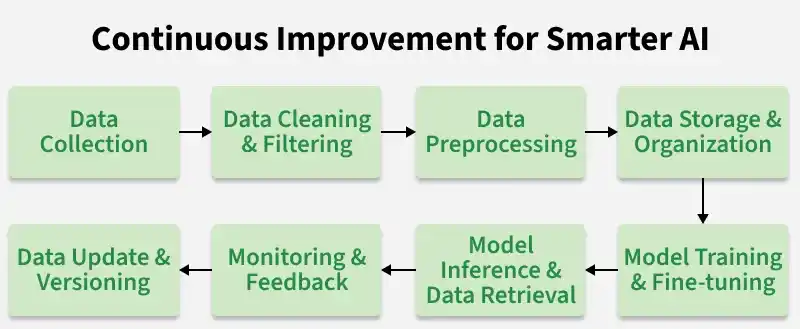
- Data Collection: The lifecycle begins with collecting data from multiple sources relevant to the target application. These sources may include public datasets, enterprise documents, websites, APIs, images, videos, audio files, and user interactions.
- Data Cleaning and Filtering: Raw data often contains duplicate records, missing values, incorrect information, or irrelevant content. During this stage, noisy and low-quality data is removed, inconsistencies are corrected, and harmful or sensitive content is filtered.
- Data Preprocessing: After cleaning, the data is transformed into a format suitable for machine learning models. Depending on the data type, preprocessing may involve text tokenization, image resizing, audio feature extraction, normalization, or document chunking.
- Data Storage and Organization: The processed data is stored in repositories such as cloud storage, data lakes, or databases, where it can be accessed efficiently during model development.
- Model Training and Fine-Tuning: The prepared dataset is used to train or fine-tune generative AI models. During this stage, the model learns patterns, relationships, and contextual information from the data.
- Model Inference and Data Retrieval: Once deployed, the trained model generates responses using user inputs. For applications such as Retrieval-Augmented Generation (RAG), the model may retrieve relevant information from external knowledge bases or vector databases .
- Monitoring and Feedback: After deployment, both incoming data and model outputs are continuously monitored to identify issues such as data drift, outdated information, or poor response quality.
- Data Update and Versioning: The lifecycle concludes by incorporating newly collected data, corrections, and feedback into updated datasets. This continuous update process keeps generative AI systems accurate and relevant over time.
Challenges
- Managing Large-Scale Datasets: Generative AI requires storing and processing massive volumes of multimodal data, making scalability a major challenge.
- Ensuring Data Quality: Inaccurate, duplicate, or outdated data can reduce model performance and lead to unreliable outputs.
- Data Privacy and Security: Protecting sensitive data while complying with privacy regulations is essential throughout the AI lifecycle.
- Handling Data Bias: Unbalanced or non-representative datasets can introduce bias and affect the fairness of generated content.
- Continuous Data Updates: Keeping datasets current with new information without disrupting existing models requires effective version management.
- Managing Data for Retrieval Systems: Maintaining accurate and up-to-date knowledge bases and vector databases is critical for retrieval-based AI applications.
Advantages
- Improves the quality of data used for model training.
- Enables efficient fine-tuning with organized datasets.
- Reduces errors caused by noisy and duplicate data.
- Simplifies dataset tracking through version control.
- Strengthens data security and regulatory compliance.
