

Inductive reasoning in AI is the process of drawing general conclusions from specific observations or past experiences. Instead of starting with fixed rules, AI systems analyze patterns in data to make predictions and improve decision-making in different situations.
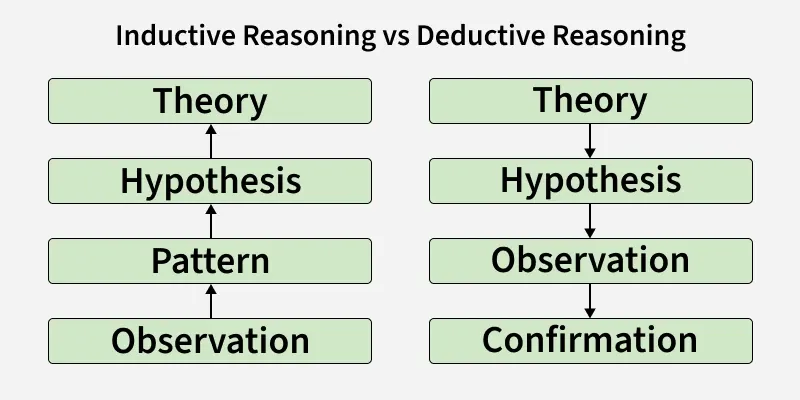
- Follows a bottom-up approach by moving from specific observations to general conclusions.
- Conclusions are probabilistic and may change when new observations are introduced.
Key Principles
- Observation: The process begins by collecting and examining data, events, or situations carefully.
- Pattern Recognition: Repeated trends or similarities are identified from the observations.
- Hypothesis Formation: Possible explanations or predictions are created based on the observed patterns.
- Generalization: Broad conclusions are formed from specific examples or cases.
- Probabilistic Conclusion: The conclusions are likely to be true but are not guaranteed with certainty.
- Iterative Refinement: Conclusions can be updated or improved when new information becomes available.
- Fallibility: Inductive reasoning may sometimes lead to incorrect conclusions if patterns change over time.
Working
- Data Collection: AI systems gather relevant data such as text, images, numbers, or sensor inputs depending on the task.
- Pattern Recognition: The system analyzes the data to identify patterns, trends, or relationships among different features.
- Model Building: Using the discovered patterns, AI builds a predictive model that can make decisions on new, unseen data.
- Testing and Refinement: The model is evaluated on new data and continuously improved if its performance is not accurate enough.
Implementation
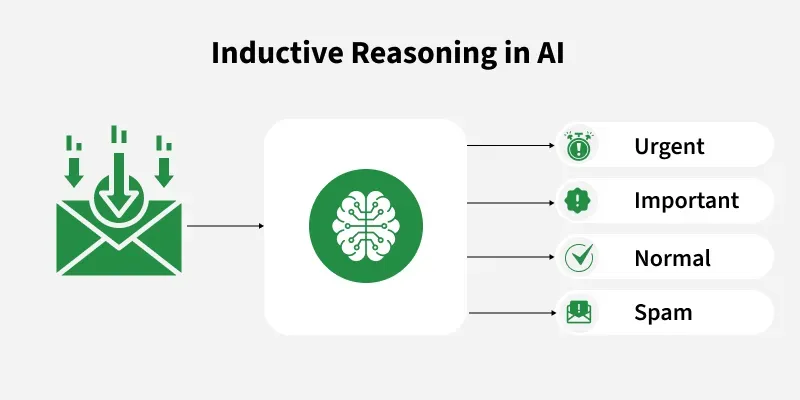
Let’s see how inductive reasoning can be applied in an AI task like email classification:
Scenario: An AI system is designed to classify emails into categories such as "urgent," "important," "normal" and "spam."
Step 1: AI examines thousands of labeled emails, identifying key features like keywords, sender information and the time emails are received.
Step 2: It detects patterns such as:
- Emails with words like “urgent” or “immediately” often labeled as “urgent.”
- Emails with words like “sale” or “offer” are mostly marked as “spam.”
Step 3: Based on these observations, AI creates rules for new emails. For example, if an email from a known contact includes the word “urgent,” it will be classified as "urgent."
Step 4: When new emails come in, the AI applies these rules, classifying them based on the patterns it has learned.
Outcome: The system improves its classification over time, even handling emails it has never seen before by generalizing from past examples.
Difference between Inductive and Deductive reasoning
| Parameters | Inductive Reasoning | Deductive Reasoning |
|---|---|---|
| Definition | We start with specific observations and make general conclusions. | We start with general principles and make specific conclusions. |
| Certainty | Conclusions are probable and based on patterns in data. | Conclusions are certain if the premises are true. |
| Usage | Used in AI, machine learning, and data analysis. | Used in mathematics, logic, and rule-based systems. |
| Flexibility | Flexible, conclusions can change with new data. | Fixed, conclusions remain valid if facts are true. |
Applications
- Spam Filtering: AI learns patterns from labeled emails and classifies new emails as spam or not spam, even when encountering new spam styles.
- Image Classification: AI recognizes patterns in pixel data to classify images such as identifying objects, animals, or faces after training on large datasets.
- Natural Language Processing (NLP): AI analyzes text patterns to determine sentiment (positive, negative, or neutral) and understand unseen text inputs.
- Recommendation Systems: AI studies user behavior patterns to suggest movies, products, or content based on past preferences.
- Fraud Detection: AI detects unusual transaction patterns to identify and prevent fraudulent activities, even when new fraud techniques appear.
Advantages
- Adaptable as it allows AI systems to generalize from past data and handle new, unseen situations effectively.
- Improved cccuracy over time by enabling AI models to refine predictions as more data is learned and processed.
- Handles complex data and helps AI understand and work with unstructured data like images, text, and speech.
- Allows efficient decision making AI to quickly detect patterns in large datasets for fast and reliable predictions.
Challenges
- Overfitting: AI models may learn training data too closely, reducing their ability to generalize to new data and causing poor performance on unseen examples.
- Dependence on data quality: The quality of conclusions depends on input data, and biased or incomplete data can lead to inaccurate results.
- Lack of explanation: Inductive models like deep learning often act as black boxes, making it hard to understand how decisions are made.
- Limited by available data: AI relies on existing data patterns, and insufficient data can result in missed insights or incorrect predictions.
