

Probabilistic reasoning in Artificial Intelligence (AI) uses probability to handle uncertainty and incomplete or noisy information. It helps AI systems evaluate possible outcomes, update predictions based on new evidence and make informed decisions under uncertainty.
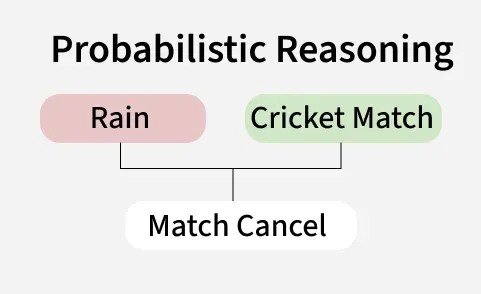
Need for Probabilistic Reasoning in AI
Probabilistic reasoning with artificial intelligence is important to different tasks such as:
- Machine Learning: It helps algorithms learn from incomplete or noisy data, refining predictions over time.
- Robotics: It enables robots to navigate and interact with dynamic and unpredictable environments.
- Natural Language Processing: It helps AI understand human language which is often ambiguous and depends on context.
- Decision Making: It allows AI systems to evaluate different outcomes and make better decisions by considering the likelihood of various possibilities.
Key Concepts in Probabilistic Reasoning
Probabilistic reasoning uses probability to represent uncertainty and make predictions or decisions.
1. Probability: Measures how likely an event is to occur, usually from 0 to 1.
2. Bayes' Theorem: Updates the probability of a hypothesis when new evidence is available.
P(A \mid B) = \frac{P(B \mid A) \cdot P(A)}{P(B)}
Where:
P(A \mid B) : Posterior probabilityP(B \mid A) : Probability of B happening, given A happened.P(A) : Prior probability of A.P(B) : Probability of observing B.
3. Conditional Probability: Measures the probability of an event given that another event has occurred.
4. Random Variables: Represent uncertain values or outcomes that can be modeled using probability.
Types of Probabilistic Models
There are different models that use these concepts to help AI systems make sense of uncertainty. Let’s see some of them:
- Bayesian Networks: They are graphs that show how different variables are connected with probabilities. Each node represents a variable and the edges show how they depend on each other. These networks help us understand how one piece of information can affect another.
- Hidden Markov Models (HMMs): They extend Markov models by introducing hidden states that cannot be directly observed. These models help infer the hidden states based on observable data, using statistical techniques to estimate the likelihood of these unobservable conditions.
- Probabilistic Graphical Models (PGMs): A framework that represents probabilistic relationships using graphs. Bayesian Networks and Markov Networks are common types of PGMs.
- Probabilistic Graphical Models: Represent probabilistic relationships between variables using graphs, making it easier to model dependencies and uncertainty in complex systems.
Techniques in Probabilistic Reasoning
- Probabilistic Inference: Calculates the likelihood of events or hypotheses from available evidence. Methods such as variable elimination and Markov Chain Monte Carlo (MCMC) are used for exact or approximate inference.
- Parameter Learning: Estimates the parameters of probabilistic models from data. Methods such as maximum likelihood estimation and Bayesian estimation are commonly used.
- Decision Making Under Uncertainty: Uses probabilities to compare possible outcomes and select actions based on their expected results. Models such as Partially Observable Markov Decision Processes (POMDPs) can be used when the system has incomplete information.
How Probabilistic Reasoning Enhances AI Systems?
Probabilistic reasoning helps AI systems navigate uncertainty, enabling them to make better decisions even when information is unclear. Let's see how it works:
- Quantifying Uncertainty: Probabilistic reasoning turns uncertainty into probabilities. Instead of a simple “yes” or “no,” it provides a probability, like “there’s a 60% chance of rain tomorrow.”
- Reasoning with Evidence: As new information comes in, AI systems update their predictions. For example, if dark clouds appear, the chance of rain might rise to 80%. This continuous adjustment helps AI stay accurate.
- Learning from Past Experiences: AI systems can improve predictions by learning from historical data. For example, weather predictions become more accurate as the AI system accounts for past seasonal trends.
- Effective Decision-Making: It allows AI to make informed decisions by considering the likelihood of different outcomes. It helps AI weigh possible paths and choose the best option even when the future is uncertain.
Applications
- Medical Diagnosis: Uses symptoms, test results and patient data to estimate the likelihood of diseases and support diagnosis.
- Robot Localization: Uses uncertain sensor data to estimate a robot's position and update it as new observations become available.
- Speech and Language Processing: Handles ambiguity in speech and language by estimating the likelihood of different words, meanings or interpretations.
- Risk Assessment: Estimates the probability of events such as financial losses or fraudulent transactions to support decision-making under uncertainty.
Challenges
- Computational Complexity: Inference can become expensive as the number of variables and dependencies in a probabilistic model increases.
- Uncertain or Biased Data: Poor-quality, incomplete or biased data can lead to inaccurate probability estimates and conclusions.
- Model Assumptions: Incorrect assumptions about relationships between variables can reduce the accuracy of probabilistic models.
- Interpretability: Complex probabilistic models can make it difficult to understand how evidence and probabilities lead to a particular conclusion.
