

Propositional Logic in AI is a knowledge representation method that uses true or false statements to represent facts, combine them using logical operators and derive conclusions through inference.
- Represents knowledge using true/false statements called propositions
- Organizes factual knowledge in a structured way
- Combines propositions using logical connectives
- Supports reasoning and decision-making in AI systems
Concepts
1. Propositions: A proposition is a declarative statement that can be assigned exactly one truth value: true or false.
For example:
- "The sky is blue." (True)
- "It is raining." (False)
Questions and commands are not propositions because they cannot be assigned a true or false value.
2. Logical Connectives: Logical connectives are used to combine simple propositions into more complex ones.
- AND (∧): This operation is true if both propositions are true.
Example: "It is sunny ∧ it is warm" is true only if both "It is sunny" and "It is warm" are true. - OR (∨): This operation is true if at least one of the propositions is true.
Example: "It is sunny ∨ it is raining" is true if either "It is sunny" or "It is raining" is true. - NOT (¬): This operation reverses the truth value of a proposition.
Example: "¬It is raining" is true if "It is raining" is false. - IMPLIES (→): The expression P → Q is false only when P is true and Q is false. In all other cases, it is true.
- IF AND ONLY IF (↔): The expression P ↔ Q is true when both propositions have the same truth value.
3. Truth Tables: Truth tables determine the truth value of logical expressions by evaluating all possible combinations of input values. They provide a complete view of how logical operators affect outcomes.
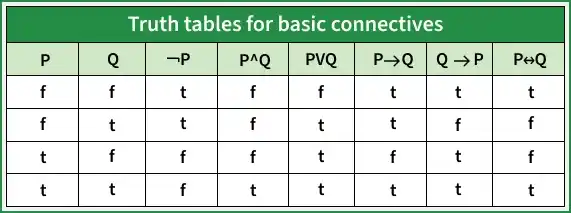
4. Tautologies, Contradictions and Contingencies:
- Tautology: A logical expression that is always true. Example: P ∨ ¬P
- Contradiction: A logical expression that is always false. Example: P ∧ ¬P
- Contingency: A logical expression that can be either true or false depending on the values of its propositions. Example: P ∧ Q
Properties of Operators
1. Commutativity: The order of propositions does not affect the result.
- P ∧ Q ≡ Q ∧ P
- P ∨ Q ≡ Q ∨ P
2. Associativity: The grouping of propositions does not affect the result.
- (P ∧ Q) ∧ R ≡ P ∧ (Q ∧ R)
- (P ∨ Q) ∨ R ≡ P ∨ (Q ∨ R)
3. Distributivity: AND and OR can be distributed over each other.
- P ∧ (Q ∨ R) ≡ (P ∧ Q) ∨ (P ∧ R)
- P ∨ (Q ∧ R) ≡ (P ∨ Q) ∧ (P ∨ R)
4. Identity: Combining a proposition with its identity value leaves it unchanged.
- P ∧ true ≡ P
- P ∨ false ≡ P
5. Domination: Combining a proposition with a dominating value always produces that value.
- P ∨ true ≡ true
- P ∧ false ≡ false
6. Double Negation: Negating a proposition twice gives the original proposition.
- ¬ (¬P) ≡ P
7. Idempotence: Combining a proposition with itself does not change its value.
- P ∧ P ≡ P
- P ∨ P ≡ P
Inference in Propositional Logic
Inference is the process of deriving new conclusions from known facts and logical rules. In AI, it allows systems to reason from existing knowledge and reach logically valid conclusions.
For example:
- Modus Ponens: If
P \rightarrow Q Pis true, thenQmust also be true. - Modus Tollens: If
P \rightarrow Q is true and\neg Q is true, then\neg P must also be true.
For example, if:
P: It is raining.Q: The ground is wet.
Given P, we can infer Q.
These inference rules allow AI systems to derive new information from existing facts and perform logical reasoning.
Applications
- Knowledge Representation: Propositional logic represents facts as true/false statements, allowing AI systems to store and organize knowledge in a structured form.
- Automated Reasoning: AI systems use inference rules such as Modus Ponens and Modus Tollens to derive new conclusions from existing facts.
- Problem Solving and Planning: It can represent goals, actions, preconditions and effects in planning problems, such as those used in STRIPS.
- Decision Making: Logical expressions can be used to evaluate conditions and determine appropriate actions or outcomes.
- Natural Language Processing (NLP): Propositional logic can represent the meaning of simple statements in a logical form, which can then be used for reasoning.
Advantages
- Simple and easy to understand using true/false statements
- Provides a clear and structured way to represent knowledge
- Useful for basic logical reasoning and decision-making
- Easy to implement in AI systems and rule-based models
- Acts as a foundation for more advanced logical systems
Limitations
- Cannot naturally represent relationships and quantified statements, such as “All humans are mortal.”
- Becomes inefficient as truth tables grow exponentially with more propositions
- Works only with true/false values and cannot handle probabilities
- Does not support quantifiers like “
\forall ” or “\exists ” - Cannot handle uncertainty or partial truth values
