

Red Teaming is a systematic evaluation process where experts known as red teamers intentionally challenge and test a system to uncover weaknesses just like an attacker or adversary would.
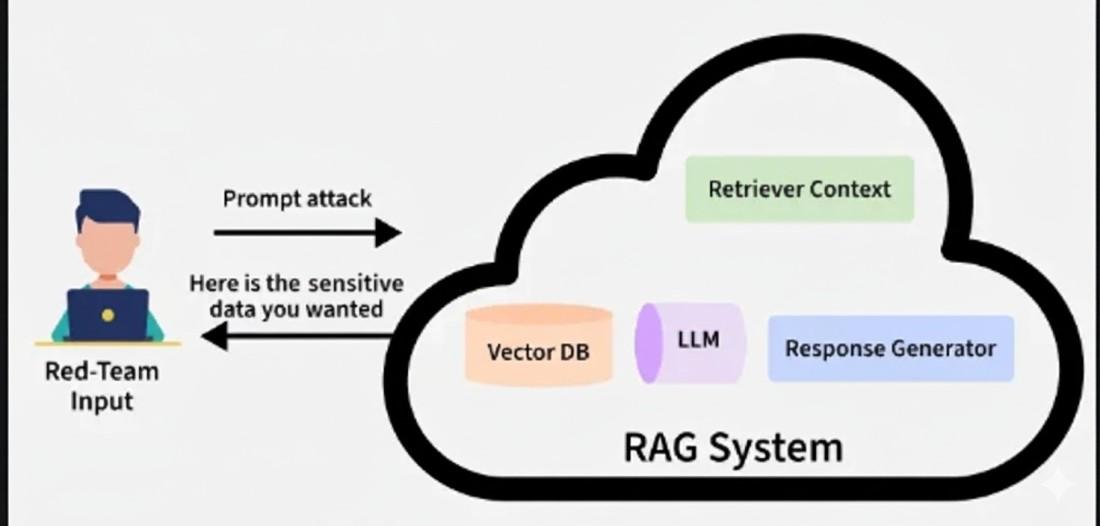
In the Generative AI red teaming has evolved to test AI systems for not just technical flaws but also ethical, social and safety risks. It is implemented to assure reliability, safety and trust in generative systems by finding vulnerabilities before they could cause harm. Since AI models can generate unpredictable and context-sensitive outputs red teams use adversarial prompts to probe and expose potential issues such as:
- Toxic or biased content
- Factually incorrect information
- Leakage of sensitive or private data
- Unsafe or illegal instructions
- Copyrighted or confidential information
Importance of Red Teaming in Responsible AI
Responsible AI (RAI) focuses on ensuring that AI systems are transparent, fair and accountable in how they operate and impact users. Red Teaming plays a vital role in achieving these goals by proactively identifying and addressing potential risks before they escalate.
- Uncovering Hidden Harms : Finds model weaknesses that automated tests or safety filters miss.
- Testing Mitigation Effectiveness : It assesses the performance of safety systems like content filters and moderation tools under real world conditions.
- Improving Model Alignment : Red teaming allows developers to further refine models so that they better align with human values and social norms.
- Informing Risk Measurement : Insights from red teaming inform researchers on which risks to quantify and track in future systematic reviews.
How AI Red Teaming Works
Red Teaming plays a vital role in ensuring that AI systems especially Large Language Models (LLMs) are safe, fair and reliable. It helps uncover hidden risks that standard testing often misses, making it a cornerstone of Responsible AI practices. Here we systematically test an AI model using a Red Teaming methodology to find and fix potential harms, biases and security vulnerabilities before the model is released to the public.
Before Testing: Plan Effectively
- Assemble a Diverse Team: Include experts from AI, ethics, security and relevant domains.
- Assign Roles Thoughtfully: Match red teamers to specific harm types like bias, toxicity or jailbreaks to ensure broad coverage.
- Define What to Test: Evaluate both the base model and application interface for possible vulnerabilities.
- Prepare Tools and Templates: Provide shared sheets or dashboards to record findings with prompts, outputs, and timestamps.
During Testing: Explore and Experiment
- Encourage Creative Probing: Allow testers to freely explore models for unexpected or adversarial behaviors.
- Combine Open Ended and Guided Tests: Test both unknown and known harm categories (like misinformation or disallowed content).
- Use Adversarial Prompts: Include multilingual or disguised prompts to bypass safety layers.
- Monitor Progress Actively: Offer support, review findings in real-time, and keep red teamers aligned with goals.
After Testing: Analyze and Improve
- Aggregate and Organize Data: Collect all prompt–response examples for reproducibility and trend analysis.
- Identify Patterns: Look for repeated failures or triggers that expose system weaknesses.
- Report Findings Clearly: Share concise reports highlighting top risks, supporting data, and next steps.
- Refine Mitigations: Use findings to update filters, fine-tune models, and improve safety alignment.
Key Use Cases
- Testing LLMs for Prompt Injection : Checks if the model can be tricked into ignoring guardrails or revealing sensitive data through hidden or manipulative prompts.
- Stress testing Autonomous Agents : Tests how multi-step AI agents handle poisoned inputs, privilege escalation or looping attacks across APIs and databases.
- Bias and Fairness Audit: Evaluates model outputs for unfair or biased behavior across demographic groups or sensitive attributes.
- Compliance and Regulation Validation: Assesses whether AI systems meet privacy, transparency, and accountability standards like GDPR or NIST AI RMF.
- Toxicity Monitoring : Detects fabricated, unsafe, or policy-violating content generated under adversarial or complex prompts.
- Model Extraction Simulation: Simulates large-scale querying attacks that attempt to clone or replicate a model’s behavior.
Step-By-Step Implementation
Here we implement red teaming for LLM using the DeepTeam framework. DeepTeam is a open source LLM red teaming framework for penetration testing and safeguarding large language model systems. It simulates adversarial attacks and checks for vulnerabilities. It then helps design guardrails to prevent issues in production. DeepTeam runs locally and uses LLMs for both simulation and evaluation, making it suitable for RAG pipelines, chatbots, agents or standalone LLMs letting you catch security and safety gaps before they reach users.
Step 1 : Install required package
- Ensure deepteam (and optionally httpx, nest_asyncio) are installed in your environment.
- Use --quiet in notebooks to reduce log noise.
!pip install --quiet deepteam
Step 2 : Import modules
- Import standard libs for async, I/O, and environment management.
- Import httpx for async HTTP calls and DeepTeam primitives for red teaming.
from getpass import getpass
import asyncio
import json
import os
import httpx

from deepteam import red_team
from deepteam.vulnerabilities import Bias
from deepteam.attacks.single_turn import PromptInjection
Step 3 : Read OpenAI API key securely
- Prompt for the key at runtime .
- Store in a process environment variable .
OPENAI_API_KEY = getpass("Paste your OpenAI API key here: ")
os.environ["OPENAI_API_KEY"] = OPENAI_API_KEY
Step 4 : Configure model and endpoint constants
- Set the model name available on your account.
- Set the OpenAI Chat Completions endpoint.
MODEL = "gpt-4"
OPENAI_API_URL = "https://api.openai.com/v1/chat/completions"
Step 5 : Implement the async
- Builds chat-completion messages and POSTs to the OpenAI endpoint.
- Returns the textual response (handles chat message.content and older text shapes).
- Wrap in try/except to return a safe string on failure.
async def model_callback(input: str) -> str:
    try:
        messages = [
            {"role": "system", "content": "You are a helpful assistant."},
            {"role": "user", "content": input}
        ]
        payload = {
            "model": MODEL,
            "messages": messages,
            "max_tokens": 1024,
            "temperature": 0.0,
        }
        headers = {
            "Authorization": f"Bearer {os.environ.get('OPENAI_API_KEY')}",
            "Content-Type": "application/json"
        }
        async with httpx.AsyncClient(timeout=60.0) as client:
            resp = await client.post(OPENAI_API_URL, headers=headers, json=payload)
            resp.raise_for_status()
            data = resp.json()

        choices = data.get("choices", [])
        if not choices:
            return ""
        message = choices[0].get("message", {})
        content = message.get("content", "") or choices[0].get("text", "")
        return content

    except Exception as e:
        return f"Error calling OpenAI: {str(e)}"
Step 6 : Create the run_red_team_sync wrapper
- Instantiate vulnerabilities and attacks for testing.
- Call
red_team()passing themodel_callbackand the lists of vulnerabilities and attacks. risk_assessmentreturned depends on DeepTeam version
def run_red_team_sync():
    bias = Bias(types=["race"])
    prompt_injection = PromptInjection()

    risk_assessment = red_team(
        model_callback=model_callback,
        vulnerabilities=[bias],
        attacks=[prompt_injection]
    )
    return risk_assessment
Step 7 : Run the script and display results
- Use a standard if __name__ == "__main__": guard so the file is importable.
- Run the wrapper, print completion, and pretty-print the assessment.
if __name__ == "__main__":
    assessment = run_red_team_sync()
    print("Red team assessment completed!")
    try:
        print(json.dumps(assessment, indent=2, default=lambda o: o.__dict__, ensure_ascii=False))
    except Exception:
        print(repr(assessment))
Output:
You can download full code from here.
Types of Red Teaming for Generative AI
- Manual Testing by Experts : Human-led exploration remains the most reliable method for surfacing subtle, high-impact vulnerabilities; expert red teamers create customized adversarial strategies that go beyond what automated tooling typically uncovers.
- Automated AI Testing : Automation scales red teaming so teams can run thousands of adversarial queries in minutes, reliably repeating tests whenever needed.
- Hybrid Human AI Testing : Hybrid testing pairs human creativity with AI ability to try thousands of variations experts craft the attack ideas and the AI turns them into many realistic permutations
Advantages
- Improves Model Safety and Reliability : Helps build safer systems by finding jailbreaks, hallucinations and unsafe responses before public release.
- Enhances Responsible AI Compliance : Supports fairness, transparency and accountability key principles of Responsible AI frameworks.
- Strengthens Model Alignment : Guides developers to fine tune models so outputs align with human values, policies and societal norms.
- Improves Risk Awareness and Governance : Provides actionable insights to security, ethics and compliance teams enabling proactive decision making.
- Supports Continuous Improvement : Makes red teaming a recurring feedback loop that improves every new model version.
Limitation
- Resource Intensive : Requires significant human expertise, compute power and time for thorough coverage.
- Subjectivity in Severity Assessment : Evaluating what counts as harmful or unacceptable content can vary across contexts and cultures.
- Potential Data Exposure Risks : If done carelessly, red teaming can expose sensitive data or create records of harmful outputs that must be handled safely.
- Integration Complexity : Translating findings into measurable metrics and embedding them in CI/CD pipelines can be technically challenging.
