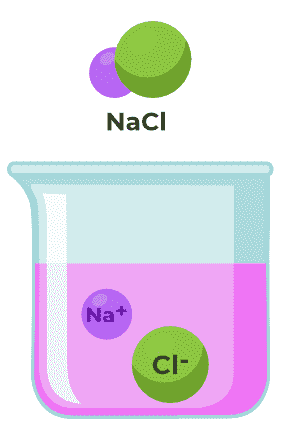
Acids, bases and salts are important chemical substances that we use in daily life. They have different properties and show different reactions. The study of acids, bases and salts helps us understand many chemical processes such as digestion, cleaning, medicines, and industrial reactions.
- Acids in our stomach help in digestion (HCl).
- Bases are used in soap and detergents.
- Salts like common salt (NaCl) are essential for food.
- Antacids are used to treat acidity.
Acids
- The term acid is derived from the Latin word ‘acidus’ or ‘acere’, which means sour.
- The most common characteristic is their sour taste.
- An acid is a substance that renders an ionizable hydronium ion (H3O+) in its aqueous solution.
- It turns blue litmus paper red.
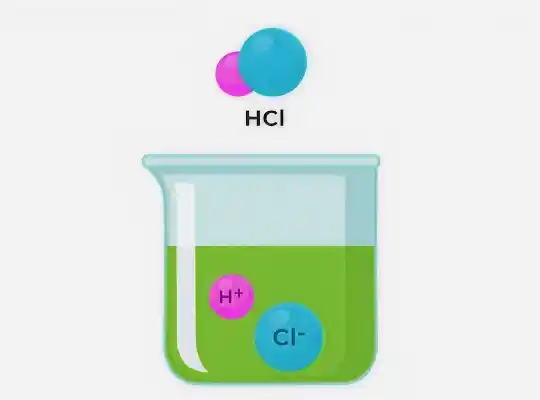
Acids can be present in a variety of things, including food, but their presence in several fruits is particularly notable.
Example:
- Curd - Lactic Acid
- Vinegar - Acetic Acid
- Orange - Citric Acid
- Tamarind - Tartaric Acid
- Tomato - Oxalic Acid
- Lemon - Citric Acid
When acids react with metals, hydrogen gas is produced. All acids have hydrogen as a component.
Metal + Acid ⇢ Salt + Hydrogen
Properties
- Acids are substances that produce hydrogen ions (H⁺) when dissolved in water.
- They have a sour taste, but they should never be tasted in the laboratory because they can be harmful.
- Acids turn blue litmus paper red and do not affect red litmus paper.
- They react with metals such as zinc and magnesium to form salt and hydrogen gas.
- Acids also react with metal carbonates and metal bicarbonates to produce salt, water and carbon dioxide gas.
- When acids react with bases, they form salt and water in a reaction called neutralisation.
- Acidic solutions conduct electricity because they contain free hydrogen ions.
- Acids have a pH value less than 7, and the smaller the pH value, the stronger the acid.
- Strong acids are corrosive in nature and can cause burns on skin and damage materials. They also change the colour of indicators such as phenolphthalein (colourless in acid) and methyl orange (red in acid).
Classifications
Acids can be classified in different ways to better understand their properties and behaviour in chemical reactions. One common method is the classification of Acid based on their strength and origin.
1) On the Basis of Origin
On the basis of origin, acids are further classified into different types depending on their source.
a) Organic Acids:
- The acids that come from organic matter like plants and animals are known as Organic Acids.
Example: citric acid (Citrus fruits), Acetic acid (Vinegar), Oleic acid (Olive oil), etc.
b) Mineral Acids:
- The acids that come/are produced from minerals are known as Mineral Acis or Inorganic Acids.
- These acids do not contain carbon.
Example: H2SO4, and HCl. HNO3, etc.
2) On the Basis of Strength
On the basis of strength, acid can be classified
a) Strong Acids:
- A strong acid is one that can be totally or nearly completely dissociated in water.
- Example: Sulphuric acid, Nitric acid, Hydrochloric acid, etc.
H+ + H2O ⇢ H3O+
HCl(aq) ⇢ H+(aq) + SO4-(aq)
H2SO4(aq) ⇢ 2H+(aq) + SO4-(aq)
b) Weak Acids:
- A weak acid is one that does not completely dissociate or dissociates very little in water.
- Example: the acids that we consume on daily basis like citric acid, acetic acid, etc.
CH3COOH(aq) ⇢ CH3COO-(aq) + H+(aq)
HCOOH(aq) ⇢ HCOO-(aq) + H+(aq)
Bases
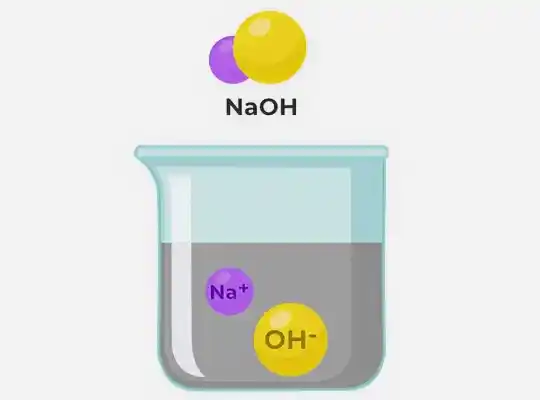
- Bases are ionic substances that when dissolved in water produce negative hydroxide (OH) ions.
- An ionic compound is one that contains a negative non-metal ion and a positive metal ion that is held together by an ionic bond.
Properties
- Bases are chemicals that, when dissolved in water, produce the hydroxide ion (OH).
- Bases have a harsh taste and caustic properties. They frequently have a slick, soapy feel about them.
- Bases are excellent conductors of electricity and have a pH of more than 7.
- Soap molecules are formed when bases combine with oils and grease.
- Red litmus paper is converted to blue litmus paper by bases.
- Bases have a proclivity for corroding metal surfaces.
- When they come into contact with acids, they respond quickly.
Classification
To understand their behaviour and uses, Base can be classified into different types based on factors such as their strength and solubility in water. This classification helps in studying the properties and reactions of different bases.
1) Strong Bases
- In the acid-base reaction, a strong base is described as a basic chemical substance that can remove a proton (H+) from (or deprotonate) a molecule of even a relatively weak acid (like water).
- Hydroxides of alkaline earth metals and alkali metals, such as Ca(OH)2 and NaOH, are two common examples of strong bases.
Example: Sodium hydroxide - NaOH, Lithium hydroxide - LiOH, and Potassium hydroxide - KOH.
2) Super Bases
- Because their conjugate acids, amines, stable hydrocarbons, and dihydrogen, are extremely weak, Group 1 salts of hydrides, amides, and carbanions tend to be stronger bases.
- In general, these bases are made by mixing conjugate acid with pure alkali metals like sodium.
- They are known as superbases, and keeping them in water is nearly impossible because they are classified as stronger bases than the hydroxide ion.
- As a result, conjugate acid water is deprotonated.
Example: Sodium hydride (NaH), Sodium amide (NaNH2), and Butyl lithium (n-C4H9Li).
3) Weak Bases
- A weak base is one that does not completely ionize in an aqueous solution or one whose protonation is incomplete.
- At 25 °C, the equilibrium constant for the above-mentioned reaction is 1.8 x 10⁻⁵, implying that the degree of ionization or reaction is quite minimal.
4) Lewis Bases
- A Lewis base, also known as an electron-pair donor, is a molecule that has a high-energy pair of electrons that can be shared with a low-energy empty orbital in an acceptor molecule to form an adduct.
Reactions of Acid and Base
The Acid and Base (chemistry) can react with different substances such as metals, metal carbonates, metal oxides, and with each other
1) With Metals
- Acids react with metals to form salt and hydrogen gas. This reaction shows one of the important chemical properties of acids.
Acid + Metal → Salt + Hydrogen(H2)
- During this reaction, the acid provides H⁺ ions and the metal displaces hydrogen from the acid, forming hydrogen gas.
Examples:
- Reaction of zinc with hydrochloric acid:
Zn + 2HCl \rightarrow ZnCl_2 + H_2
- Reaction of magnesium with sulphuric acid:
Mg + H_2SO_4 \rightarrow MgSO_4 + H_2
2) With Metal carbonates and Bicarbonates
- When acids react with metal carbonates or metal bicarbonates, they form salt, water and carbon dioxide gas.
Metal\ Carbonate + Acid \rightarrow Salt + Water + Carbon\ Dioxide
Metal\ Bicarbonate + Acid \rightarrow Salt + Water + Carbon\ Dioxide
- Carbon dioxide gas is produced, which turns lime water milky.
- Effervescence (bubbling) is observed due to CO₂ gas.
- This reaction is commonly used in baking (baking soda reaction).
Examples:
- Reaction of Sodium carbonate (Na₂CO₃)with hydrochloric acid (HCl).
Na_2CO_3 + 2HCl \rightarrow 2NaCl + H_2O + CO_2
- Reaction of Sodium bicarbonate (NaHCO₃) with hydrochloric acid (HCl).
NaHCO_3 + HCl \rightarrow NaCl + H_2O + CO_2
3) Acid with Base
- When an acid reacts with a base, they form salt and water.
- This reaction is called a neutralisation reaction because the acid and base neutralise each other’s properties.
Acid + Base \rightarrow Salt + Water
Examples:
- Reaction of Hydrochloric acid (HCl) with sodium hydroxide (NaOH).
HCl + NaOH \rightarrow NaCl + H_2O
- Reaction of sulphuric acid reacts with potassium hydroxide
H_2SO_4 + 2KOH \rightarrow K_2SO_4 + 2H_2O
pH of Acid and Base
The pH value of acid and base is commonly used to determine the strength of acid and base in a quantitative manner. The logarithm of H+ ion concentration is defined as pH, which stands for the Power of Hydrogen. Any material or solution's pH value indicates whether it's acidic, neutral, or alkaline.
pH scale
A pH scale is a tool for determining acid and base concentrations. The scale goes from zero to fourteen, with zero being the lowest and fourteen being the highest. A litmus test reveals whether a substance is acidic or basic. The colour of the paper matches the pH scale numbers, indicating the sort of chemical being tested.
pH value
The acidity of the solution increases as the pH value decreases from 7 to 1, i.e. a solution with a pH value of 2 is more acidic than a solution with a pH value of 3. The alkalinity of a solution increases from 7 to 14 (in the opposite direction of acidity), i.e. a solution with a pH of 11 is more alkaline than a solution with a pH of 9.
.png)
Strength of Acid and Base
Acids are defined as substances with a pH less than 7.0. As the amount of H+ ions in the solution increases, the value decreases. Strong acids are compounds that rapidly release H+ ions or are completely ionizable in solution. As a result, strong acids have a lower pH value, close to 0 to 1. The higher the concentration of H+ ions in the solution, and hence the stronger the acid, the lower the pH value.
Example: Hydrochloric acid, Sulfuric acid, Nitric acid, Perchloric acid, Chloric acid, etc.
- Strong acid or base: A strong acid is an acid that completely ionises in water to produce a large number of hydrogen ions (H⁺). A strong base is a base that completely ionises in water to produce hydroxide ions (OH⁻).
- Weak acid or base: A weak acid is an acid that partially ionises in water and produces fewer hydrogen ions. A weak base is a base that partially ionises in water.
Theories of Acid and Base
To better understand the behavior and properties of Acid and Base (chemistry), scientists proposed different explanations known as theories of acids and bases. These theories describe how acids and bases behave in chemical reactions and help in identifying them in different conditions.
1) Lewis Concept of Acids and Bases
- According to Lewis, "Acids are the substance which accepts an electron pair and are electrophilic in nature i.e. they have incomplete valance orbital which can accept electron pairs."
- Examples of Lewis acids are, Cu2+, Fe3+, etc.
- Similarly," Bases are the substance which has an electron pair in their outermost valence shell and they can easily donate those electron pair, they are nucleophilic in nature."
Example: Cl-, NH3, etc.
2) Arrhenius Concept of Acids and Bases
- According to Arrhenius, "Acids are the substance that on dissolving in water releases H+ ions." These H+ ions combine with H2O molecules to form hydronium ions (H3O+).
- Examples of acids are HCl, H2SO4, etc.
- Similarly, "Bases are the substance that on dissolving in water releases OH- ions."
Example: NaOH, Ca(OH)2, etc.
3) Bronsted Lowry Theory of Acids and Bases
- "Acids are the substance which is categorised as protons (or H+) acceptors whereas bases are the substance which accepts protons (or H+) from the water."
- The limitation of this theory is that it is unable to explain the acidic behaviour of BF3 and AlCl3 as they lack to give protons in their aqueous solution and still are considered to be acidic.
Salt
A salt is a substance formed when an acid reacts with a base in a neutralisation reaction. In simple words, a salt is made up of the positive ion (cation) of a base and the negative ion (anion) of an acid.