

The Four Color Theorem and Kuratowski's Theorem are two fundamental results in discrete mathematics, specifically in the field of graph theory. Both theorems address the properties of planar graphs but from different perspectives.
In this article, we will understand about Four Color Theorem and Kuratowski’s Theorem in Discrete Mathematics, their definition, examples, and semantic differences between them.
Table of Content
Four Color Theorem in Discrete Mathematics
In 1852, Francis Guthrie, a student of Augustus De Morgan, a notable British mathematician and logician, proposed the 4-color problem. He defined the problem in terms of maps that meet specific requirements, such as not having any holes and connecting every region (e.g. country or state) so that no region exists in two or more non-contiguous sections.
Guthrie asserted that with such maps, no more than four colors would be required to color the map so that no two adjacent parts were the same color.
If the regions of Map M are colored so that adjacent regions are different, then no more than 4 colors are required.
Every planar graph is 4-colorable (Vertex Coloring) but when a triangle is a graph or sub-graph we need only 3 colors.
Four Color Theorem Definition
The Four Color Theorem states that any planar graph (a graph that can be drawn on a plane without any edges crossing) can be colored with at most four colors such that no two adjacent vertices share the same color.
Mathematicians had been attempting for years to come up with a sophisticated proof (of a color theorem) along the lines of the Six Color Theorem or the Five Color Theorem, and using the brute force method almost appeared like hacking the process.
Every planar graph can be colored in four different ways.
Vertices and edges are found in graphs. We want adjacent vertices/ regions to be of different colors.
For over a century, the theorem has remained unproven. Kenneth Appel and Wolfgang Haken provided the first accepted proof in 1976 using a computer.
We can convert the map into a graph where each region corresponds to a vertex and each boundary between regions corresponds to an edge. The problem was reduced to check an unavoidable set of configurations. Then it was confirmed that every configuration in this set is reducible. Then a computer was used to check the reducibility of each configuration.
How to Color?
Take any map and divide it into a set of connected regions: R1, R2 ... Rn with continuous boundaries.
There must be some way to assign each region Ri -> in the set {R, G, B, Y}, such that if two regions Ri and Rj are “touching” (i.e. they share some nonzero length of the boundary between them), they must receive different colors.
Example - Four Color Theorem
1. The four-color map is shown below :
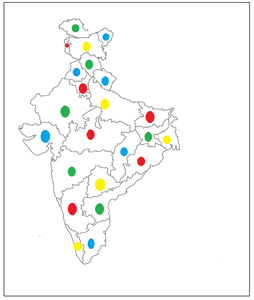
Here, as you can see, every region that touches another region has a different color than the touching one & we required a total of a maximum of four colors to color this map - Red, Green, Blue & yellow.
2. The transformation of an uncolored Map G into a colored Map is shown below -
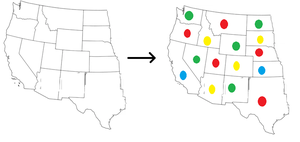
Here you can see that every region that touches another region has a different color than the touching one & we required a total of maximum four colors to color this map - Red, Green, Blue & yellow.
3. The transformation of an uncolored Map H into a colored Map is shown below -
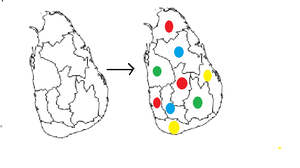
Here also you can see that every region that touches another region has a different color than the touching one & we required a total of a maximum of four colors to color this map - Red, Green, Blue & yellow.
Applications of Four Color Theorem
- Map Coloring
- Frequency Assignment
- Computer Graphics
- Puzzle Games
- Network Design
- Scheduling
- Graph Theory
Kuratowski’s Theorem in Discrete Mathematics
Kuratowski established the theorem establishing a necessary and sufficient condition for planarity in 1930. The theorem states that -
"If G is non planar if and only if G contains a sub-graph that is a subdivision
 of either K3,3 or K5."
Kuratowski’s Theorem Definition
Kuratowski's Theorem characterizes planar graphs. It states that a graph is planar if and only if it does not contain a subgraph that is a subdivision of either K5 (complete graph on five vertices) or K3,3 (complete bipartite graph on six vertices, three of which connect to each of the other three).
To prove this theorem, we'll go through some definitions and make sure that both K3,3 and K5 are non-planar. Let's have a look at K3,3.
Proposition 1 - K3,3 is not planar.
Proof:
Now, we will prove it by contradiction.
Say, to the contrary, that K3,3 is planar. Then there is a plane embedding of K3,3 satisfying :
Then, by Euler's Formula : v − e + f = 2, where v = total vertices, e = no of edges , f = total faces.
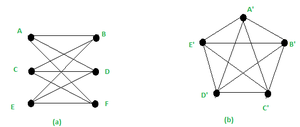
In figure (a), the bi-partite graph : v= 6 and e= 9.
As K3,3 is bipartite, there are no 3-cycles in it(odd cycles can be there in it).
So, each face of the embedding must be bounded by at least 4 edges from K3,3.
Moreover, each edge is counted twice among the boundaries for faces.
Hence, we must have : f ≤2 *e/4
⇒ f ≤ e/2
⇒ f ≤ 4.5.
Now put this data in the Euler’s formula :we get : 2 =v−e+f
⇒ 2 ≤ 6−9 + 4.5
⇒ 2 ≤ 1.5, which is obviously false.
So, we can say that K3,3 is a non-planar graph.
Proposition 2 - K5 is not planar.
Proof:
Every planar graph must follow : e ≤ 3v − 6 (corollary of Euler’s formula)
For graph (b) in the above diagram, e = 10 and v = 5.
LHS : e = 10
RHS : 3*v - 6 = 15 - 6 = 9
⇒ 10 ≤ 9, which is not true.
So, we can say that K5 is a non-planar graph.
Example - Kuratowski’s Theorem
1. Prove that : A planar graph's sub-graphs are all planar.
Proof:
Let G be the graph & P be its sub-graph.
There exists a planar embedding of G, if G is planar. In the planar embedding of G, we can locate the vertices and edges of every sub-graph P of G.
This is how a planar embedding of P is created.
2. A non-planar graph's subdivisions are all non-planar.
Proof:
Assume that for G, a planar embedding of its subdivision, P, exists.
We acquire a planar embedding of G and find G planar when we remove the vertices formed in edge-subdivisions and reconstruct the original edge (without affecting the shape and position of the path).
As a result, if G is non-planar, so is every subdivision (P) of G.
Solved Examples
Example 1: Four Color Theorem Application
Problem: Given the following map of neighboring regions, color it using the minimum number of colors such that no adjacent regions have the same color.
[Imagine a map with 6 regions, where each region borders at least 3 others]
Solution:
We can represent this map as a planar graph where each region is a vertex, and shared borders are edges.
Since this is a planar graph, we know from the Four Color Theorem that four colors will be sufficient.
We can color the regions as follows:
Region 1: Red
Region 2: Blue
Region 3: Green
Region 4: Yellow
Region 5: Red
Region 6: Blue
Verification: Check that no adjacent regions have the same color.
Example 2: Kuratowski's Theorem Application
Problem: Determine whether the following graph is planar:
[Imagine a graph with 6 vertices where each vertex is connected to every other vertex except one]
Solution:
This graph has 6 vertices and 14 edges.
To use Kuratowski's Theorem, we need to check if this graph contains a subgraph that is a subdivision of K5 or K3,3.
Upon inspection, we can see that by removing one edge, we get K5 (complete graph with 5 vertices).
Therefore, this graph contains a subdivision of K5.
According to Kuratowski's Theorem, this graph is not planar.
Example 3: Combining Both Theorems
Problem: You're designing a circuit board with 7 components. Each component needs to be connected to 4 others. Can you design this on a single-layer board (no crossings), and if so, how many different colors do you need to color the regions?
Solution:
First, let's check if this graph is planar using Kuratowski's Theorem:
The graph has 7 vertices, each with degree 4.
Total number of edges = (7 * 4) / 2 = 14
This is too many edges for a planar graph with 7 vertices (max would be 3n - 6 = 15 for n > 3)
Upon closer inspection, we can find a K3,3 subgraph.
Since the graph contains K3,3, it's not planar according to Kuratowski's Theorem.
Therefore, you cannot design this on a single-layer board without crossings.
If we were to design it with crossings and then consider coloring the regions:
We can't apply the Four Color Theorem because the graph isn't planar.
The number of colors needed could be more than four.
Conclusion: The circuit cannot be designed on a single-layer board, and if implemented with crossings, it might require more than four colors to color the regions.
Problem 4 : Determine if the graph K3,3 is planar.
Solution:
K3,3 is one of the Kuratowski graphs.
By Kuratowski's Theorem, K3,3 is not planar.
We don't need to check for subdivisions as this is the graph itself.
Problem 5: How many edges does a planar graph with 8 vertices have if it has the maximum number of edges possible?
Solution:
For a planar graph, the maximum number of edges is 3n - 6, where n is the number of vertices (for n > 3).
With 8 vertices: 3(8) - 6 = 24 - 6 = 18 edges.
Problem 6 : In a certain country, there are 10 states. Each state borders exactly 3 other states. What's the minimum number of colors needed to color a map of this country?
Solution:
This describes a 3-regular planar graph with 10 vertices.
Since it's planar, we can apply the Four Color Theorem.
The Four Color Theorem states that any planar graph can be colored with at most 4 colors.
Therefore, the minimum number of colors needed is at most 4
Problem 7: Prove that K5 (complete graph with 5 vertices) is not planar.
Solution:
K5 has 5 vertices and 10 edges.
For a planar graph with 5 vertices, the maximum number of edges is 3n - 6 = 3(5) - 6 = 9.
Since K5 has more edges than this maximum, it cannot be planar.
Alternatively, K5 is one of the Kuratowski graphs, so by Kuratowski's Theorem, it's not planar.
Problem 8: A graph G has 7 vertices and 12 edges. Can you determine if it's planar based on this information alone?
Solution:
For a planar graph with 7 vertices, the maximum number of edges is 3n - 6 = 3(7) - 6 = 15.
G has 12 edges, which is less than 15.
Therefore, based on this information alone, we cannot determine if G is planar.
It could be planar, but we would need to check for K3,3 or K5 subdivisions to be certain.
Problem 9: You have a cube and want to color each face so that no adjacent faces have the same color. What's the minimum number of colors needed?
Solution:
We can represent this as a planar graph where each face is a vertex and adjacent faces are connected by edges.
This results in a planar graph with 6 vertices.
By the Four Color Theorem, we know that at most 4 colors are needed.
However, for a cube, we can actually do it with 3 colors (opposite faces can have the same color).Therefore, the minimum number of colors needed is 3.
Problem 10: Given a graph with 6 vertices where each vertex is connected to every other vertex except one, is this graph planar?
Solution:
This graph has 6 vertices and 14 edges (each vertex has degree 4).
If we remove any edge, we get K5 (complete graph on 5 vertices).
Therefore, this graph contains a subdivision of K5.
By Kuratowski's Theorem, since it contains a subdivision of K5, this graph is not planar.
Practice Problems on Four Color Theorem and Kuratowski’s Theorem
1).Consider a graph G with 9 vertices and 20 edges. Is it possible to determine whether G is planar based on this information alone? If yes, is it planar? If no, what additional information would you need?
2).You are given a map of 12 countries. Each country borders at least one other country, and no country is completely surrounded by just one other country. What is the maximum number of colors you might need to color this map so that no adjacent countries have the same color?
3).Prove or disprove: Every graph with 4 or fewer vertices is planar.
4).Draw a graph that has exactly one K3,3 subgraph and no K5 subgraph. Is this graph planar? Explain your reasoning.
5).A certain graph H has 8 vertices and 18 edges. It does not contain any triangles (cycles of length 3) Can H be planar? Justify your answer.
6).You're designing a circuit board with 6 components. Each component needs to be connected to exactly 3 others. Can this be done on a single-layer board without any crossings? If so, how many colors would you need to color the regions of this board?
7).Consider the Petersen graph, which has 10 vertices and 15 edges. Is this graph planar? If not, explain why using Kuratowski's Theorem.
8).Create a planar graph with 7 vertices that has the maximum number of edges possible for a planar graph. How many edges does it have?
9).Is it possible to have a planar graph with 100 vertices and 300 edges? Justify your answer.
10).You have a tetrahedron (a pyramid with a triangular base) and want to color each face so that no adjacent faces have the same color. What's the minimum number of colors needed? Can you relate this to the Four Color Theorem?
Semantic Difference between Four Color Theorem and Kuratowski’s Theorem
| Feature | Four Color Theorem | Kuratowski’s Theorem |
|---|---|---|
| Main Focus | Coloring of planar graphs | Characterization of planar graphs |
| Historical Significance | First major theorem proven using computers | Fundamental characterization of planarity in graphs |
| Applications | Map coloring, frequency assignment, circuit design | Planarity testing, graph drawing, topological studies |
| Graph Type | Applies to all planar graphs | Identifies non-planar graphs by forbidden subgraphs |
| Proof Method | Proof by exhaustion using computer assistance | Combinatorial and structural proof |
Related Articles:
Summary
The Four Color Theorem and Kuratowski's Theorem are fundamental concepts in graph theory, a branch of discrete mathematics. The Four Color Theorem states that any planar map can be colored using at most four colors such that no adjacent regions share the same color. This has applications in map coloring, scheduling, and resource allocation. Kuratowski's Theorem provides a method to determine whether a graph is planar by stating that a finite graph is planar if and only if it doesn't contain a subgraph that is a subdivision of K5 (complete graph with 5 vertices) or K3,3 (complete bipartite graph with 3 vertices in each partition). These theorems are interconnected as they both deal with planar graphs: Kuratowski's Theorem helps identify if a graph is planar, while the Four Color Theorem describes a property of all planar graphs. Together, they provide powerful tools for analyzing graph structures, solving coloring problems, and understanding the limitations and properties of planar embeddings, which are crucial in various fields including computer science, network design, and circuit layout.
