

Microservices is an architecture where an application is divided into small, independent services that communicate over a network. Each service handles a specific function and can be developed and deployed separately.
- Services can be built using different programming languages and frameworks.
- Each microservice is loosely coupled and can be developed, deployed, and scaled independently.
Example: An e-commerce platform uses separate microservices for product catalog, user authentication, cart, payments, and order management, which communicate through APIs.
Real world Applications
Microservices architecture is widely used in modern applications where scalability, flexibility, and independent service management are important.
- Amazon: Initially a monolithic app, Amazon uses microservices early on, breaking its platform into smaller components. This shift allowed for individual feature updates, greatly enhancing functionality.
- Banking & FinTech: Independent services for accounts, transactions, fraud detection, and customer support, ensuring high security, reliability, and compliance with financial regulations.
- Healthcare systems: Patient records, appointment scheduling, billing, and reporting as separate services, improving data management, scalability, and system reliability.
- Uber: By switching from a monolithic structure to microservices, Uber operations were become smoother, resulting in increased webpage views and search efficiency
Working
The working of microservices architecture focuses on dividing the application into small, independent services that collaborate to perform different business functions.
- Business Function: Each microservice handles one specific feature, such as authentication or product management.
- API Communication: Services exchange data with each other through APIs.
- Independent Operation: Each service runs independently and communicates using HTTP or messaging.
- Request Handling: User requests are routed to the required service for processing and response.
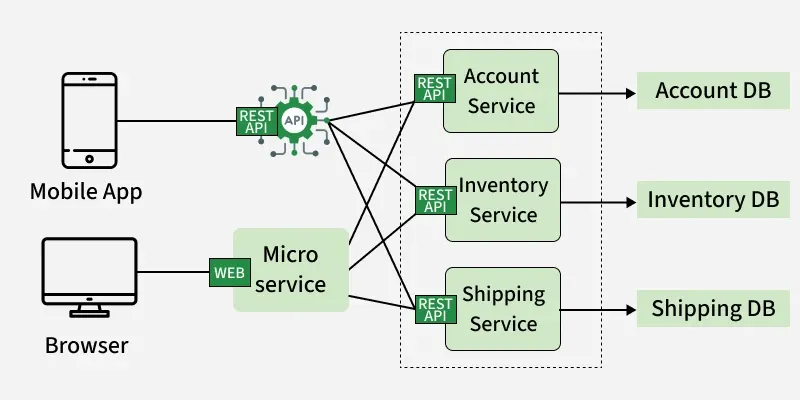
Components
Main components of microservices architecture include:
- Microservices: Small, independent services that focus on a specific business capability and can be developed, deployed, and scaled independently.
- API Gateway: A single entry point that routes client requests to the appropriate microservices and handles common concerns like authentication.
- Service Registry and Discovery: Maintains information about available service instances and enables dynamic service-to-service communication.
- Load Balancer: Distributes incoming traffic across multiple service instances to improve availability, performance, and reliability.
- Deployment & Infrastructure: Docker containerization microservices, while Kubernetes manages their deployment, scaling, and orchestration.
- Event Bus / Message Broker: Enables asynchronous communication between services through messaging while reducing direct dependencies.
- Database per Microservice: Each microservice owns its dedicated database, ensuring data isolation, loose coupling, and independent scaling.
- Caching: Stores frequently accessed data in memory to reduce database load and improve application response time.
- Fault tolerance and resilience: Keeps the system stable during failures using mechanisms such as circuit breakers, retries, and fallbacks.
Real-World Example of Microservices
Understand the Microservices using the real-world example of Amazon E-Commerce Application:
Amazon’s online store runs on many small, specialized microservices, each handling a specific task. Working together, they create a smooth shopping experience.
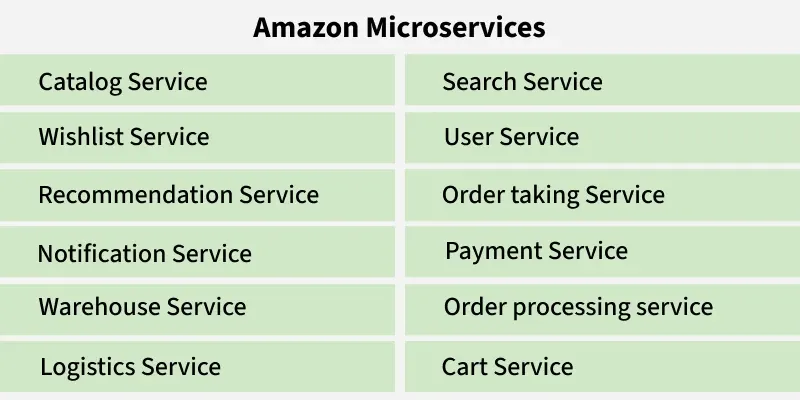
The microservices involved in Amazon E-commerce Application:
- User Service: Handles user accounts and preferences, making sure each person has a personalized experience.
- Search Service: Helps users find products quickly by organizing and indexing product information.
- Catalog Service: Manages the product listings, ensuring all details are accurate and easy to access.
- Cart Service: Lets users add, remove, or change items in their shopping cart before checking out.
- Wishlist Service: Allows users to save items for later, helping them keep track of products they want.
- Order Taking Service: Processes customer orders, checking availability and validating details.
- Order Processing Service: Oversees the entire fulfillment process, working with inventory and shipping to get orders delivered.
- Payment Service: Manages secure transactions and keeps track of payment details.
- Logistics Service: Coordinates everything related to delivery, including shipping costs and tracking.
- Warehouse Service: Keeps an eye on inventory levels and helps with restocking when needed.
- Notification Service: Sends updates to users about their orders and any special offers.
- Recommendation Service: Suggests products to users based on their browsing and purchase history
Migrating from Monolithic to Microservices Architecture
Below are the main the key steps to migrate from a monolithic to microservices architecture:
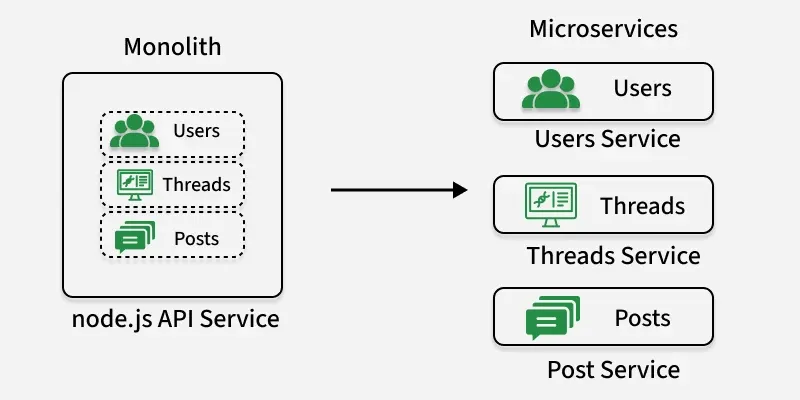
- Step 1 – Assess Monolith: Analyze the existing application and identify components suitable for microservices.
- Step 2 – Define Services: Divide the application into separate business functions or capabilities.
- Step 3 – Gradual Migration: Use the Strangler Pattern to replace monolith components step by step.
- Step 4 – Define APIs: Create clear APIs for communication between microservices.
- Step 5 – Set Up CI/CD: Automate testing and deployment for faster, reliable releases.
- Step 6 – Service Discovery: Enable microservices to dynamically find and communicate with each other.
- Step 7 – Logging & Monitoring: Track service performance and quickly identify issues.
- Step 8 – Manage Security: Apply consistent security, authentication, and other shared concerns.
- Step 9 – Improve Iteratively: Continuously refine microservices based on feedback and requirements.
Challenges
While microservices provide many benefits, they also introduce certain complexities that organizations must manage carefully.
- Managing service communication, network latency, and data consistency can be difficult.
- Decomposing an app into microservices adds complexity in development, testing and deployment.
- Network communication can lead to higher latency and complicates error handling.
Related Article: Microservices Vs Monolithic Architecture
