

Session-Based Authentication and JWT Authentication are two common methods used to verify a user's identity and control access to applications.
- Session-Based Authentication stores user session data on the server and uses a session ID to identify authenticated users.
- JWT Authentication uses a signed token stored on the client, allowing users to authenticate without maintaining server-side sessions.
.webp)
Session-Based Authentication
Session-Based Authentication is an authentication method in which the server creates and maintains a unique session for each user after a successful login. The server stores the session data, while the client stores only a session ID (usually in a cookie) to identify the user.
- The server uses the session ID to retrieve user information, such as identity and permissions, for each request.
- Sessions are typically stored in server memory or a database and expire after inactivity or a fixed time for better security.
Example: Online banking applications use session-based authentication to keep users logged in during a session. Once the session expires or the user logs out, they must sign in again to access their account.
Working
Session-Based Authentication creates and stores a user session on the server after successful login. The client uses a session ID to access protected resources.
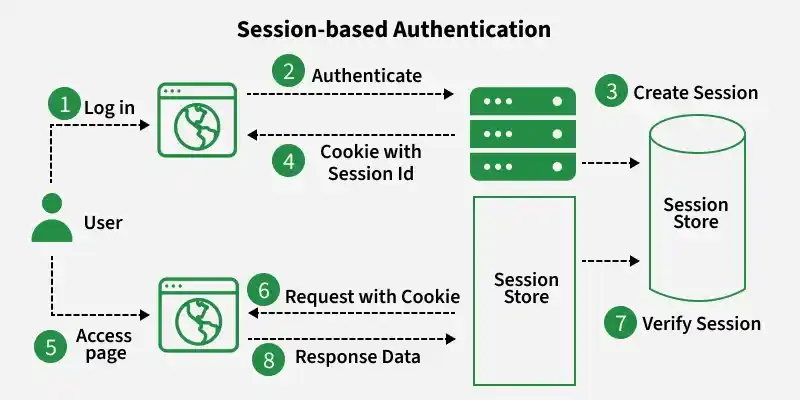
- The user logs in by entering valid credentials.
- The server authenticates the user.
- The server creates a unique session and stores it in the session store.
- A cookie containing the session ID is sent to the user's browser.
- The user requests a protected page or resource.
- The browser sends the session ID cookie with the request.
- The server verifies the session ID using the session store.
- If the session is valid, the server returns the requested data.
Advantages
Session-Based Authentication offers secure server-side session management and is ideal for traditional web applications.
- Stores session data securely on the server.
- Sessions can be easily invalidated during logout.
Limitations
Session-Based Authentication has some limitations, especially in large-scale distributed environments.
- Requires server-side storage for session data.
- Less scalable in distributed or load-balanced systems.
JSON Web Tokens (JWTs)
JSON Web Tokens (JWTs) are a token-based authentication mechanism used to securely transmit user information between a client and a server. A JWT contains a header, payload, and signature, allowing the server to verify the token without storing session data.
- After a successful login, the server generates a JWT, which the client sends with future requests for authentication.
- JWTs are stateless, making them suitable for scalable and distributed applications without maintaining server-side sessions.
Example: Applications like Spotify or Netflix use JWT authentication in their APIs. After logging in, users can access different services by sending the JWT with each request instead of creating a new session.
Working
JWT Authentication generates a signed token after successful login. The client stores the token and sends it with each request for verification.
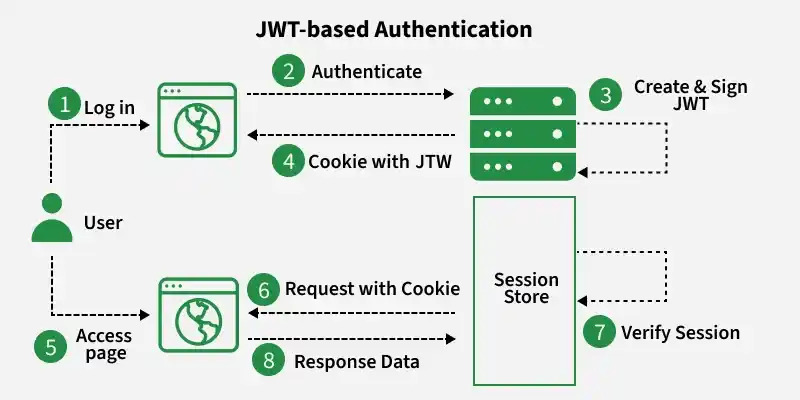
- The user logs in by entering valid credentials.
- The server authenticates the user.
- The server creates and signs a JWT.
- The JWT is sent to the client and stored (usually in a cookie or local storage).
- The user requests a protected page or API.
- The client sends the JWT with the request.
- The server verifies the JWT signature and validates the token.
- If the token is valid, the server returns the requested data.
Advantages
JWT Authentication provides stateless authentication, making it ideal for scalable and distributed applications.
- Eliminates the need for server-side session storage.
- Highly scalable for APIs, microservices, and distributed systems.
Limitations
JWT Authentication has some limitations that should be considered during implementation.
- Revoking a JWT before it expires is difficult.
- Tokens must be stored securely on the client.
Differences between Session-Based Authentication and JSON Web Tokens (JWTs)
Below are the differences between Session-Based Authentication and JSON Web Tokens (JWTs)
| Session-Based Authentication | JWT Authentication |
|---|---|
| Stores user session data on the server. | Stores authentication data in a signed token on the client. |
| Session information is maintained on the server. | Authentication is stateless; the server does not store session data. |
| Requires a session ID (usually stored in a cookie) for authentication. | Requires a JWT token to be sent with each request. |
| Less scalable because the server manages active sessions. | Highly scalable since no server-side session storage is required. |
| More suitable for traditional web applications. | Commonly used in APIs, SPAs, mobile apps, and microservices. |
| Vulnerable to session hijacking and CSRF if not properly secured. | Requires secure token storage and signature verification to prevent misuse. |
| Increases server memory usage due to session management. | Reduces server overhead by eliminating server-side session storage. |
When to Use Session-Based Authentication Vs JWT Authentication
The choice between Session-Based Authentication and JWT Authentication depends on your application's architecture, scalability requirements, and security needs.
| Scenario | Recommended Authentication |
|---|---|
| Traditional websites | Session-Based Authentication |
| Banking and financial applications | Session-Based Authentication |
| Content Management Systems (CMS) | Session-Based Authentication |
| Enterprise intranet applications | Session-Based Authentication |
| REST APIs | JWT Authentication |
| Single-Page Applications (SPAs) | JWT Authentication |
| Mobile applications | JWT Authentication |
| Microservices architecture | JWT Authentication |
| Cross-domain authentication (SSO) | JWT Authentication |
| Cloud-native and distributed applications | JWT Authentication |
