
Image: The APEX Telescope, Chajnantor, Chile. Credit: J. Vieira/APEX (MPIfR/ESO/OSO)
I am going to have so much fun with this, and as a blogger, my role is to make the science "fun and engaging" for a whole new generation of non-sciency people!

I could have gone with any of:-
Blondes in Space!
Hair Salon at the end of the universe!
So long and thanks for all the perms!
The hairdresser's guide to the galaxy!
Photo Credit: Newfreephotos.com
Ah.....where do I start.
Reece Witherspoon in Legally Blonde, showed us how important it was, - you can win lawsuits with a good knowledge of haircare products.
Australian cricketers know they are about to loose the Ashes when the English cricketers start spending more money on hydrogen peroxide - yes those blonde tips. There is a mathematical relationship between confidence and expenditure on hydrogen peroxide.
However, life on this planet depends not just on a good stylist, hydrogen peroxide also plays a key role in the chemistry of water and ozone in our planet’s atmosphere. Ozone protects us from harmful radiation, but can fluctuate in our upper atmosphere and this chemistry is widely studied here on earth. So want about Space - is it out there?
Submillimetre astronomy is a relatively unexplored frontier in astronomy and reveals a Universe that cannot be seen in the more familiar visible or infrared light. It is ideal for studying the "cold Universe": light at these wavelengths shines from vast cold clouds in interstellar space, at temperatures only a few tens of degrees above absolute zero.
The European Southern Observatory (ESO) today announced that astronomers had detected
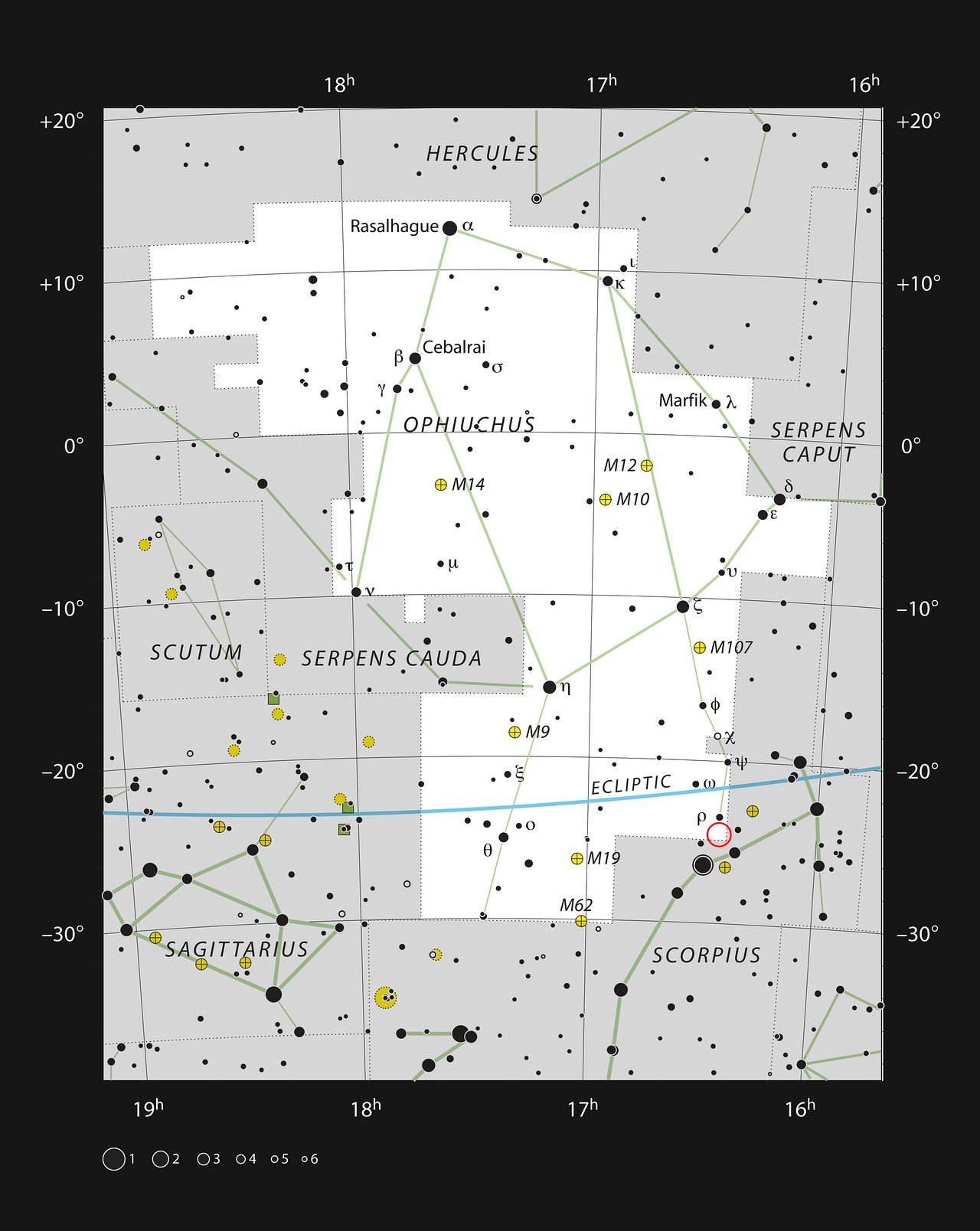
Hydrogen Peroxide - H2O2 in a gas cloud in our own galaxy, near the naked eye star, Rho Ophiuchi in Ophiuchus. This is a beautiful area of the night sky instantly recognizable by keen astro-photographers.
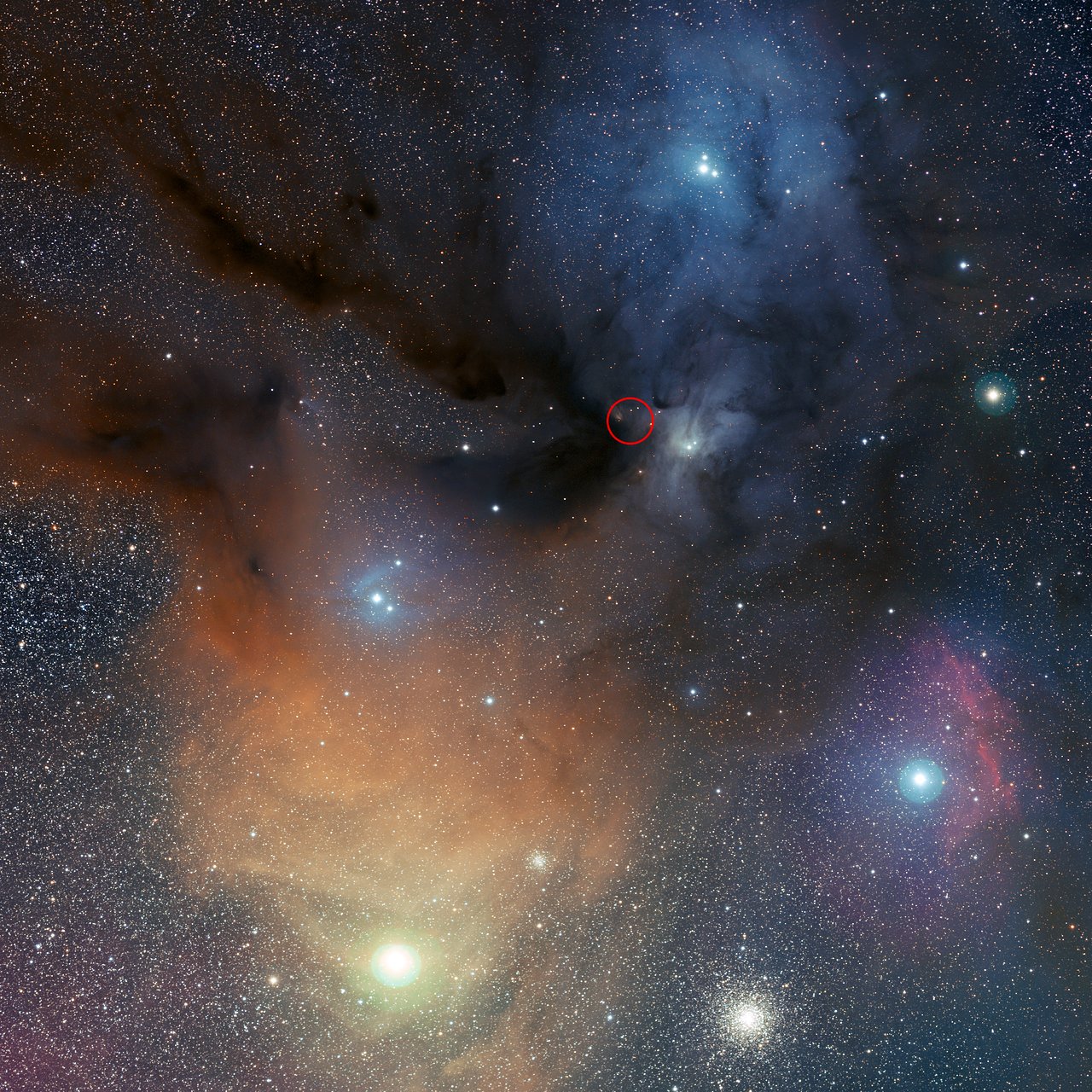
Image Credit: ESO/S. Guisard (www.eso.org/~sguisard)
How did they do that - flux capacitor hooked up to a hair dryer?
An international team of astronomers made the discovery with the
Atacama Pathfinder Experiment telescope (APEX), situated on the 5000-metre-high Chajnantor plateau in the Chilean Andes. They observed a region in our galaxy close to the star Rho Ophiuchi, about 400 light-years away. The region contains very cold (around -250 degrees Celsius), dense clouds of cosmic gas and dust, in which new stars are being born. The clouds are mostly made of hydrogen, but contain traces of other chemicals, and are prime targets for astronomers hunting for molecules in space. Telescopes such as APEX, which make observations of light at millimetre- and submillimetre-wavelengths, are ideal for detecting the signals from these molecules.
Image Credits: ESO, IAU and Sky & Telescope
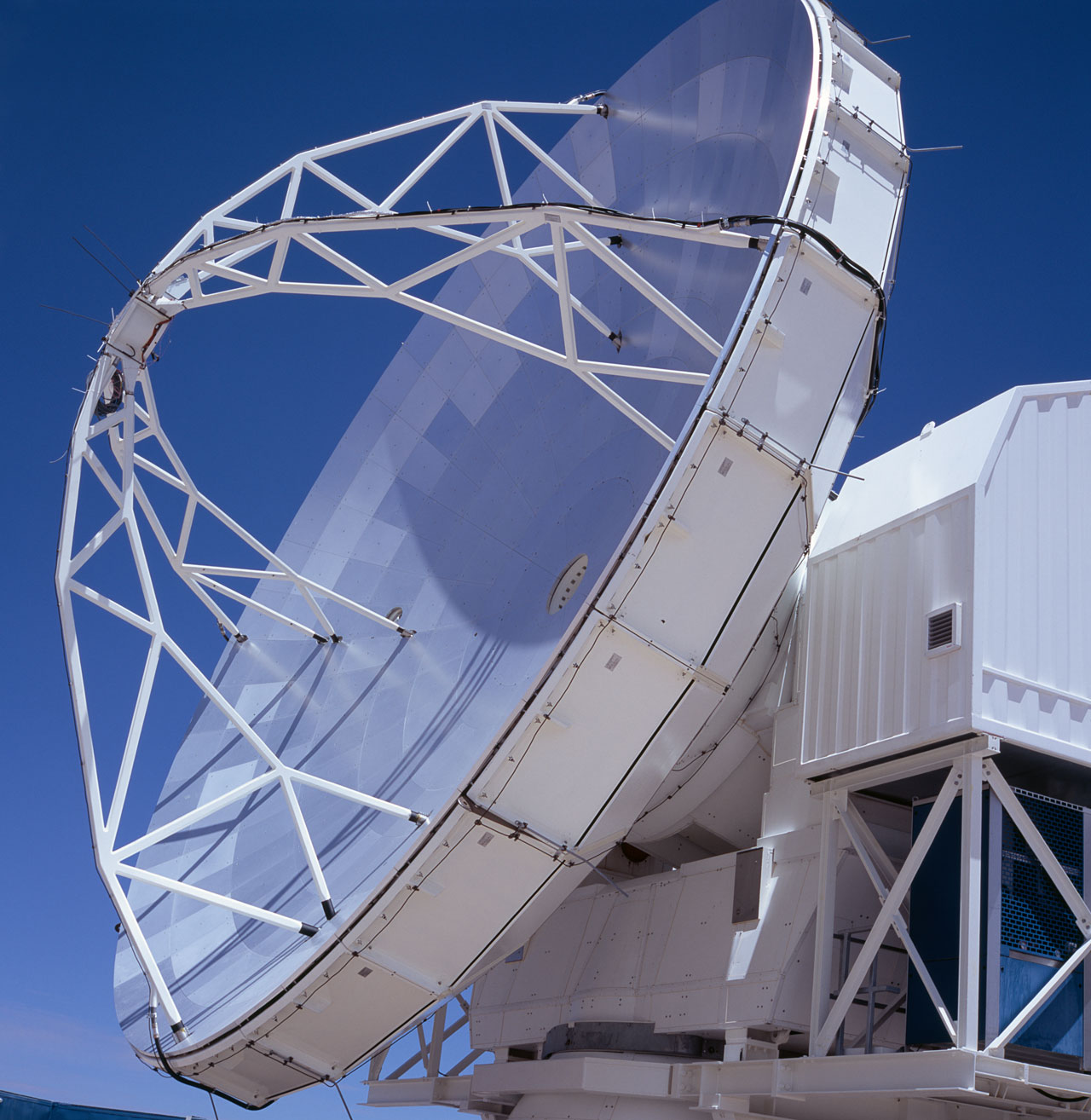
Now that is one serious telescope, APEX is a collaboration between the Max-Planck Institute for Radio Astronomy (MPIfR), the Onsala Space Observatory (OSO) and operated by ESO.
“
We were really excited to discover the signatures of hydrogen peroxide with APEX. We knew from laboratory experiments which wavelengths to look for, but the amount of hydrogen peroxide in the cloud is just one molecule for every ten billion hydrogen molecules, so the detection required very careful observations,” says Per Bergman, astronomer at Onsala Space Observatory in Sweden. Bergman is lead author of the study, which is
published in the journal Astronomy & Astrophysics.
ESO, the European Southern Observatory, is the foremost intergovernmental astronomy organisation in Europe and the world’s most productive astronomical observatory. It is supported by 15 countries: Austria, Belgium, Brazil, the Czech Republic, Denmark, France, Finland, Germany, Italy, the Netherlands, Portugal, Spain, Sweden, Switzerland and the United Kingdom. ESO carries out an ambitious programme focused on the design, construction and operation of powerful ground-based observing facilities enabling astronomers to make important scientific discoveries.
Hydrogen peroxide is thought to form in space on the surfaces of cosmic dust grains — very fine particles similar to sand and soot — when hydrogen (H) is added to oxygen molecules (O2). A further reaction of the hydrogen peroxide with more hydrogen is one way to produce water (H2O). This new detection of hydrogen peroxide will therefore help astronomers better understand the formation of water in the Universe.
So why all the fuss you ask?
“
We don’t understand yet how some of the most important molecules here on Earth are made in space. But our discovery of hydrogen peroxide with APEX seems to be showing us that cosmic dust is the missing ingredient in the process,” says Bérengère Parise, head of the Emmy Noether research group on star formation and astrochemistry at the Max-Planck Institute for Radio Astronomy in Germany, and a co-author of the paper.
The new discovery of hydrogen peroxide may also help astronomers understand another interstellar mystery: why oxygen molecules are so hard to find in space. It was only in 2007 that oxygen molecules were first discovered in space, by the satellite Odin.
Congratulations to the international team on another great, exciting discovery, using the ESO/APEX telescope at Chajnantor.
So I'll sign off with - do Astronomer's really have more fun? Absolutely!


 An international team of astronomers made the discovery with the Atacama Pathfinder Experiment telescope (APEX), situated on the 5000-metre-high Chajnantor plateau in the Chilean Andes. They observed a region in our galaxy close to the star Rho Ophiuchi, about 400 light-years away. The region contains very cold (around -250 degrees Celsius), dense clouds of cosmic gas and dust, in which new stars are being born. The clouds are mostly made of hydrogen, but contain traces of other chemicals, and are prime targets for astronomers hunting for molecules in space. Telescopes such as APEX, which make observations of light at millimetre- and submillimetre-wavelengths, are ideal for detecting the signals from these molecules.
 Now that is one serious telescope, APEX is a collaboration between the Max-Planck Institute for Radio Astronomy (MPIfR), the Onsala Space Observatory (OSO) and operated by ESO.


