Showing posts with label Reference. Show all posts

27 December 2019

Book Beginning: The Complete Review Guide to Contemporary World Fiction by M.A. Orthofer

http://www.rosecityreader.com/

Book Beginnings is a weekly meme hosted by Rose City Reader Share the first sentence (or so) of the book you are reading, along with your initial thoughts about the sentence, impressions of the book, or anything else the opener inspires.

More than anywhere else in the world, it is domestic fiction that dominates bookstore shelves, best-seller lists, and media and review coverage in the United States. Tens of thousands of new works of fiction are published annually here, the vast majority by American authors. Most of the rest were also originally written in English, and only a few hundred are translated works of fiction. In almost every other country, foreign literature occupies a central and prominent position, but in the United States it seems to sit far more precariously on the fringes.


I've been interested in reading literature in translation for a long time. Luckily with the advent of the internet a lot of information has appeared about novels translated into English, sometimes too much information. I was looking for a more general overview of this literature, and happened upon this book which covers that exact topic. Huzzah!


13 September 2019

Book Beginning: Frommer's EasyGuide to London 2019 by Jason Cochran


Book Beginnings is a weekly meme hosted by Rose City Reader. Share the first sentence (or so) of the book you are reading, along with your initial thoughts about the sentence, impressions of the book, or anything else the opener inspires.
Whether you realize it or not, London shaped your destiny. There's hardly a corner of the globe that London, as the seat of England's government, hasn't changed.


I'm in London this week for my Vacation Beginning and I've read nearly all of this book. I checked it out of the library first and to me it was much better than the other London book I had already bought, so I bought my own copy of it. It spends less time on finding accommodations and more on letting you enjoy your trip. Recommended for your next trip.

06 September 2019

Book Beginning: Europe Through the Back Door by Rick Steves

http://www.rosecityreader.com/

Book Beginnings is a weekly meme hosted by Rose City Reader. Share the first sentence (or so) of the book you are reading, along with your initial thoughts about the sentence, impressions of the book, or anything else the opener inspires.

Eating in Europe is sightseeing for your taste buds. Every country has local specialties that are good, memorable, or both.


I'm cheating a bit this week. All I'm reading is travel tip because I leave on a vacation to England and Ireland soon. So this is the first two sentences from the chapter called "Eating" in this very useful Rick Steves book which has the subtitle "The Travel Skills Handbook". Great preparation for going to Europe and enjoying your trip, whether you've been there before or are on your very first trip abroad. Highly recommended!


01 July 2019

Urban Pigment Foraging

 Make Ink: A Forager's Guide to Natural Inkmaking
 Jason Logan; conversation with Michael Ondaatje
 Abrams, 2018
 191 pages


With a background in chemistry and a love of both colorful arts and crafts and fountain pen inks, this book reached out and grabbed me from the start. It's a combination of a coffee-table book with gorgeous pictures, an ink-making recipe book, and a study of the culture of inks and colors.


The forward is by Michael Ondaatje, the Sri Lanka-born Canadian author of "The English Patient" and other works. As someone who even now writes all his first drafts with pen and ink, he felt compelled to meet the ink maker. He writes of their meeting:
We sat down in his kitchen and it felt like being introduced to someone with the skills of some lost medieval craft. What he did seemed a blend of alchemy with foraging and some possibly illegal art of cooking.
At the end is a transcription of a conversation between Logan and Ondaatje. They talk of foraging, the relationship between words and drawings, strange old techniques of ink making, and ink making around the world.

The publisher's description of the book:
The Toronto Ink Company was founded in 2014 by designer and artist Jason Logan as a citizen science experiment to make eco-friendly, urban ink from street-harvested pigments. In "Make Ink", Logan delves into the history of inkmaking and the science of distilling pigment from the natural world. Readers will learn how to forage for materials such as soot, rust, cigarette butts, peach pits, and black walnut, then how to mix, test, and transform these ingredients into rich, vibrant inks that are sensitive to both place and environment. Organized by color, and featuring lovely minimalist photography throughout, "Make Ink" combines science, art, and craft to instill the basics of ink making and demonstrate the beauty and necessity of engaging with one of mankind's oldest tools of communication.
Having read about producing black walnut ink before, I was expecting natural ink making to involve plant parts and maybe a few chemical stabilizers. What I didn't expect was that urban detritus could turn into ink as well. But Logan see possibilities everywhere in the urban environments around him. From pieces of rusty metal to copper wires to pieces of drywall, he is willing to try them all. Of course, most of the pigments in the recipes do come from nature - acorns, oak galls, pokeberries, and grape vines all contribute their colors, often in surprising ways. Dark purple buckthorn berries result in green ink!

The last section presents images created with his inks by many artists and writers to whom he sent samples. In addition, throughout the book there are stunning full-page pictures of his ink testings and paintings. There are some examples of writing, but note that this type of ink is not for use in fountain pens, only with dip pens or brushes.

This is a fascinating book, even if you don't plan on harvesting rusty bedsprings from beside the roadways in your town. After reading it, the produce at the farmers' market and the herbs and spices in my kitchen cupboards began to look like ink ingredients to me. And I'm sure there will be plenty of acorns and black walnuts around this fall. Some experimenting of my own is coming soon!


Further Reading

The publisher, Abrams, has images from the book here:
https://www.abramsbooks.com/product/make-ink_9781419732430/

05 August 2018

Short Reads Short Reviews #3: Grammar Snobs

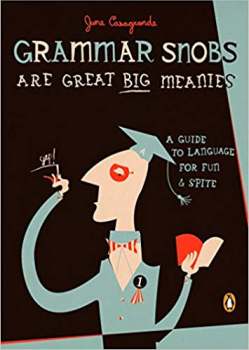
Grammar Snobs are Great Big Meanies: A Guide to Language for Fun and Spite
June Casagrande
Penguin, 2006
199 pages


I plan on doing some creative writing this fall, so I checked out a small book on grammar in order to brush up on the subject. The book is a compilation of Casagrande's columns in the Los Angeles Times newspaper, with 62 short chapters. Her style is very casual and easy to read. It's also unexpectedly snide, sarcastic, and funny.


http://www.amazon.com/exec/obidos/ASIN/0143036831/ref=nosim/webxina/

Although you might not be able to define the word "grammar", you will probably remember hearing about most of the topics when you were in school: punctuation, clauses, dangling participles, possessives, etc.  Happily, I remembered most of it fairly accurately. I think that anyone who reads a lot of literature will have the same reaction, but it's always good to revisit the topic now and then.

The area that I found the most enlightening was the subjunctive mood. I vaguely recall the topic in high school Latin class and now it pops up as I try to teach myself Spanish. So what is it? Basically the subjunctive form of a verb is used when making a statement that is hypothetical or contrary to fact. "I wish I were better at Spanish." "I wish I had taken an umbrella today." As it turns out, I did know how to use it, but I didn't know what it was called!

The one caveat I have about this book is that you should read it in small doses. In her effort to make the subject entertaining instead of intimidating, the author has gone overboard with the snide and sarcastic comments. She gets downright nasty about many well-known authors she considers to be grammar snobs. Plus there are lots of silly asides about her life that I found uninteresting. Overall, though, it's a breezy, easy way to check your grammar savvy.


11 June 2018

Know Thy Women Authors: Abbot to Zwicky

The Feminist Companion to Literature in English: Women Writers from the Middle Ages to the Present
Isobel Grundy, Patricia Clements, and Virginia Blain, editors
Yale University Press, 1990
1,231 pages


This whopping great tome was bought sight-unseen online for $4 (!) with free shipping. Usually I try to take a reference book out of the library first, to investigate, to see if I really need/want it. But this time I just went for it, because $4. And I am very glad I did!


 From Eleanor Hallowell Abbot (page 1) to Fay Zwicky (page 1,203), one finds 2,700+ annotations of women authors from the Middle Ages to 1985. At 500 words or less, each entry is brief but informative, giving parents, literary siblings, birth and death dates, short life synopses, and major works. The later entries have more detailed biographical information, as one would expect. The book includes

not only English women, but women writing in English in several national traditions, including African, American, Asian, Australian, Canadian, Caribbean, New Zealand, South Pacific, the British Isles; ... not only the canonized genres, but also diaries, letters, writing for children, and popular forms to which women have been relegated and which, often with joy, they have claimed.
Introduction, p. vii

The date selected for the endpoint is 1985, and the introduction says it does not include "women writing wholly or mainly since 1985". The book has not been updated since its publication, and I wouldn't expect it to be, since the web makes so much information available cheaply, and print books are so expensive. However I don't feel this is a hindrance. Books written by women since 1985 are fairly well-known or at least discoverable via the web. Whereas women writing in the Middle Ages and for hundreds of years after that are not so easily accessed or discovered.

As a book meant for browsing rather than straight reading cover-to-cover, it is great fun. When I see a new-to-me author mentioned in a blog, I grab it (carefully so as not to strain a muscle), and check her out. Or opening it up to a random page and reading a few entries may lead me to my library's online catalogue and placing a hold on a new-found treasure.

I imagine many libraries have a copy in their reference sections, although usually those types of books cannot be checked out. I did see other inexpensive used copies floating around the web, if you are inclined to buy one all for yourself.