Showing posts with label Writing. Show all posts

11 November 2019

To Semicolon or Not to Semicolon

Semicolon
The Past, Present, and Future of a Misunderstood Mark
Cecelia Watson
Harper Collins, 2019
213 pages


I was amused to find a whole book written about one little punctuation mark, and purporting to present its history no less. Ordinarily one does not worry about a punctuation mark's past, just how it should be used now. So, being the word nerd that I am, I had to check it out.


Venice, 1494: Aldus Manutius, printer and publisher, decides to put a comma and a colon together, thereby creating a mark for a mid-length pause, shorter than a colon, longer than a comma. In those days grammar rules had not yet been created and codified and it was every writer/printer/publisher for themself! The marks were often thought of as denoting pauses for reading passages aloud; pauses that would help convey the meaning of the words.


The author follows the semicolon from its birth through subsequent centuries of use and controversy. It is quite amazing how many people have passionate reactions to the mark, both pro and con, even into the twenty-first century! Many examples of how it's used are given, with quotes from works by Milton, Martin Luther King Jr, Raymond Chandler, and Herman Melville.

"Moby-Dick", a favorite novel of mine, is discussed in a long section of the chapter "Semicolon Savants". Apparently Melville's famous book contains about 210,000 words with 4,000 semicolons.

The semicolons are "Moby-Dick's" joints, allowing the novel the freedom of movement it needed to tour such a large and disparate collection of themes. page 36.

Despite the eye-catching title, most of the book is about grammar rules, how we got them, the so-called Grammar Wars, and the edicts of style guides like the "Chicago Manual of Style". That list may sound dry and academic, but the text is lively and has fun examples. If you are fascinated by words and how they are used, or confused by grammar rules, this book should entertain you.


25 November 2018

The Unthinkable Mind

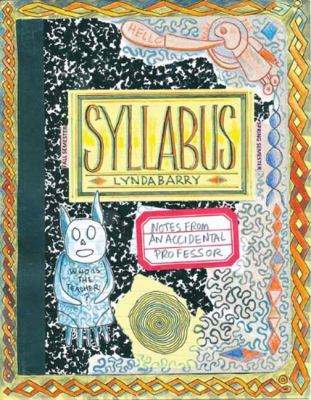
Syllabus: Notes from an Accidental Professor
Lynda Barry
Drawn & Quarterly, 2014
200 pages


It's going to take me a while to digest this book. On my first try, it stymied me. What WAS it? A comic book? A graphic novel? It had colorful but messy, seemingly unrelated pages and sentences, some handwritten, some typed, in many different colors and styles. Confusing sensory overload. I returned it to the library.


http://www.amazon.com/exec/obidos/ASIN/1770461612/ref=nosim/webxina/

Second try. Well, this is about or from a course Lynda Barry taught at the University of Wisconsin at Madison (my alma mater), so it must make some kind of sense. I'll just try reading it page-by-page, word-by-word, image-by-image and see how it goes.

Got it! I think. Maybe thinking too much was the problem. Apparently this is the syllabus from the interdisciplinary course, The Unthinkable Mind, that Barry taught at Madison in spring 2012, when she was named an Interdisciplinary Artist in Residence. She soon became a fellow at the Wisconsin Institute for Discovery, and then an associate professor of interdisciplinary creativity -- thought to be the only joint faculty position in interdisciplinary creativity in the country. Her courses are cross-listed in the departments of Art, Science, and English!

From the Syllabus alone, I can't quite envision this course, but I have found the original description published by UW Madison when it was offered in Spring 2012.

Course Description

Open to both graduate and undergraduate students from all academic disciplines, the focus of this class will be the relationship between the hand, the brain, and spontaneous images, both written and visual. No artistic talent is required to be part of this class, but students should have an active interest in spontaneous memory and ideas, how pictures and stories work, how the brain works, and what the biological function of the thing we call ‘the arts’ may be.

Class time will be used for active studio work, creating projects entirely by hand, evenly divided between writing stories and making pictures. Students will be required to complete a handmade book by the end of the semester and to teach at least one off-campus writing or picture making workshop using the techniques developed in this class.

The book's review in the London (Canada) Free Press by Dan Brown says:
It is not a graphic novel per se, but the cartoon equivalent of free-form jazz; there is a structure, but that structure is just something on which to hang big philosophical questions, such as "If the thing we call 'the arts' has a biological function, what is it?"

Lynda Barry - Self Portrait

Plain words cannot convey the reality of this book or the course. Once I spent time decoding it, absorbing it, immersing myself in it, I was hooked. It's an intense experience, this blending of writing, drawing, and listening, one I want to repeat. My copy of "Syllabus" should arrive soon! This time through I plan on taking the course, or duplicating what I can on my own. I want to do a lot of writing and crafting in the coming months, now that I have closed my online shop. Barry's way of experiencing the world and interacting with colors, pencils, images, and sounds might just help me become more creative and productive. It will certainly be a lot of fun.

Below I am listing quite a few resources that relate to Barry and her books - she has published a lot of them. Do check out the sample "Syllabus" pages posted online by the publisher to get a better idea of what is contained within this amazing book! I highly recommend jumping into Barry's wild and colorful world!


Further Reading


A 9-page PDF excerpt from "Syllabus" provided by the publisher:
https://www.drawnandquarterly.com/sites/default/files/docs/samples/SYLLABUSwebcerpt.pdf

The Tumbler account for her classes:
http://thenearsightedmonkey.tumblr.com/

Her author page at her publisher, with links to many podcasts and videos with Lynda
https://www.drawnandquarterly.com/author/lynda-barry

Brain Pickings article with lots of page images and good analysis:
"Lynda Barry’s Illustrated Field Guide to Keeping a Visual Diary and Cultivating a Capacity for Creative Observation"
https://www.brainpickings.org/2014/12/02/lynda-barry-syllabus-book/

05 August 2018

Short Reads Short Reviews #3: Grammar Snobs

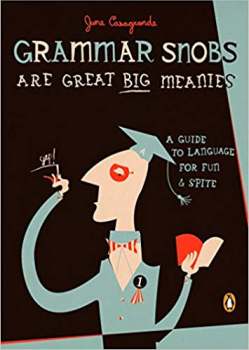
Grammar Snobs are Great Big Meanies: A Guide to Language for Fun and Spite
June Casagrande
Penguin, 2006
199 pages


I plan on doing some creative writing this fall, so I checked out a small book on grammar in order to brush up on the subject. The book is a compilation of Casagrande's columns in the Los Angeles Times newspaper, with 62 short chapters. Her style is very casual and easy to read. It's also unexpectedly snide, sarcastic, and funny.


http://www.amazon.com/exec/obidos/ASIN/0143036831/ref=nosim/webxina/

Although you might not be able to define the word "grammar", you will probably remember hearing about most of the topics when you were in school: punctuation, clauses, dangling participles, possessives, etc.  Happily, I remembered most of it fairly accurately. I think that anyone who reads a lot of literature will have the same reaction, but it's always good to revisit the topic now and then.

The area that I found the most enlightening was the subjunctive mood. I vaguely recall the topic in high school Latin class and now it pops up as I try to teach myself Spanish. So what is it? Basically the subjunctive form of a verb is used when making a statement that is hypothetical or contrary to fact. "I wish I were better at Spanish." "I wish I had taken an umbrella today." As it turns out, I did know how to use it, but I didn't know what it was called!

The one caveat I have about this book is that you should read it in small doses. In her effort to make the subject entertaining instead of intimidating, the author has gone overboard with the snide and sarcastic comments. She gets downright nasty about many well-known authors she considers to be grammar snobs. Plus there are lots of silly asides about her life that I found uninteresting. Overall, though, it's a breezy, easy way to check your grammar savvy.


19 July 2018

Short Reads Short Reviews #1: The First Five Pages

The First Five Pages
Noah Lukeman
Simon & Schuster, 2000
208 pages (197 pages plus an index)


For my first Short Reads Short Reviews book, I chose a nonfiction title about writing and publishing a novel. Noah Lukeman is a literary agent who has read many, many manuscripts and has decided to help authors make their books more publishable.

http://www.amazon.com/exec/obidos/ASIN/068485743X/ref=nosim/webxina/
 

It is not about how to write a novel but about the pitfalls an author can fall into because of carelessness, laziness, or ignorance, or maybe hubris. His introduction states:

There are no rules to assure great writing, but there are ways to avoid bad writing. This, simply, is the focus of this book: to learn how to identify and avoid bad writing.

There are three sections containing a total of 19 chapters, each discussing one type of bad writing -- giving examples, solutions, and often clever exercises to perform on your own text. Preliminary Problems has five chapters on very basic mistakes that will likely get your manuscript rejected out of hand by most agents or editors. Grimy pages, improper formatting, and poor use of adverbs, adjectives, similes, and metaphors are marks of an amateur. The five chapters on Dialogue discuss topics such as melodramatic or humdrum dialogue between characters. The largest section, The Bigger Picture, talks about everything else, from viewpoint to showing versus telling to tone, focus and setting.

I found this a very valuable read even before I begin to write during NaNoWriMo (National Novel Writing Month) this November. And after November ends I certainly need to reread it as I begin to edit my manuscript. I liked its practicality, and the way it showed me an editor's view of a new manuscript from an unknown writer. If you want to write either fiction or nonfiction, maybe even poetry, you need to read this!


FURTHER READING

Mr. Lukeman has written two other books on getting published, which he has released bundled into one free edition, available from his personal website in several formats including PDF, Kindle, and iTunes. Just scroll to the bottom of the web page.

"How to Write a Great Query Letter: Insider Tips and Techniques for Success"
"How to Land (and Keep) a Literary Agent"
http://www.lukeman.com/landaliteraryagent/index.htm