Showing posts with label Spring Buildup. Show all posts

November 27, 2011

Discouragement

Well it is the end of November already…..  And I have not written a blog post since May.  It’s not that I was lacking material to write about (the bees always provides that).  It’s just that by the middle of June I was discouraged with the progress of my efforts. 
Perhaps some of you may have better suggestions for me regarding my beekeeping efforts.

As you can probably tell from the post title, this year was another bad year for me and the bees.

In late winter we always hope for a productive year, but for the past three years the bees have not produced honey for us.

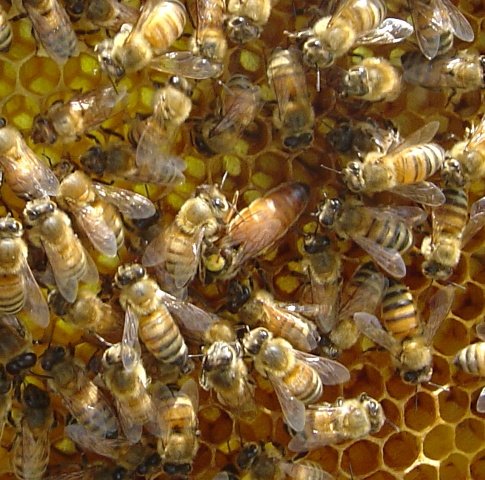
 Left:  Bees feeding on sugar candy and pollen patty


The season started slowly.  It was a rainy spring, and the spring lasted much longer than usual.

Spring actually arrived a few weeks early.  But the cold wet weather kept the bees inside the hives and not collecting honey and nectar.

Right:  Foraging worker bee


During the summer we had just the right about of sun and rain, no drought, plenty of flowers, plenty of work for the bees to do, but I could tell that the nectar flow was sporadic.

One day the bees would be flying like crazy, the next there would be very little activity.

As I look back on the season I cannot point to one thing that went  wrong.  It must have been a culmination of many factors.

My biggest problem this year was robbing.  I thought it would be smart to start the new colonies way across the property from the old ones.  The new location would offer more sun light during the winter months.


 Left:  Weak hive being fed sugar syrup from a division board feeder.  These feeders were robbed out by strong colonies nearby


This was an attempt on my part to decrease the winter losses by allowing the hives to warm up a little more on sunny winter days than the older hives have the darker old location (we’ll see how this works).  I also thought that by moving the new hives away from the older hives there would be less opportunity for robbing to start.

Well I was I ever wrong. 

The new hives which had a smaller population of bees were continually robbed out not only of any sugar syrup I was feeding them, but also of any stores of nectar that they were collecting themselves.  Without stores of honey and pollen the new colonies would not increase. 

I tried feeding the sugar syrup into the small hives first, then the larger hives….  I tried feeding  the sugar syrup into the larger hives first, waiting a day, then feeding syrup to the smaller hives.

I even resorted to building a feeding station away from the hives, that all the bees could access and get syrup.

Nothing I tried worked….  Yes the bees from all the hives would come and take 5 gallons of sugar syrup from the yard feeder in two days, but as soon as it ran out, the strong hives would return to robbing out the weaker hives.   

I also did not like feeding wasps, hornets, and yellow jackets with my precious public sugar syrup feeder.

So the fat hives got fatter, and the weak hives got weaker and died out.

Although the larger hives produced a surplus crop of 60 pounds of honey, I could not trust the honey since it was probably mixed with sugar syrup.

I fed all the honey back to the hives.

All this robbing was not conducive to increasing our hive numbers.  New packages, hive splits, and nucs brought on site from other locations were all destroyed by the robbing bees. 

Only three hives survived the summer and will be over wintered.

Then there was the small hive beetle……  I’ll talk about that next time.
And there's next year.....  There's always next year.

May 30, 2011

May Bee

The long holiday weekend finds me posting my first blog post for the month of May.


Left:  A worker bee collecting pollen and nectar from our peach tree.


For some reason we have experienced a 90% loss of our over wintered hives this season.

Two hive have died in the month of April alone. Not usual once they make it through March

The longer than average, and cooler, spring has not helped us much. We experienced cool rainy wet weather for almost two weeks in the middle of May, not conducive for brood rearing by already weakened hives.

Last week however, the cold wet weather broke, and we are now experiencing warmer days. That means happy days for the bees who are now able to fly and collect the much needed nectar and pollen for the spring buildup.

Today I started rearing a small number of queens.


Right.  Newly grafted plastic cell cups.  These cells were wet grafted using royal jelly saved from queenrearing in 2010.


It takes 16 days for a queen to grow under the proper conditions. I took newly hatched eggs from three of my hives and wet grafted them into artificial cell cups. Wet grafting is the process of placing a small drop of royal jelly in the bottom of each artificial cell cup, and floating a young larva onto it. (a 50 / 50 mix of plain yogurt and water will do as well for a priming medium)

Eggs from the different hives were grafted into different color cell cups. Red, yellow, and black cups were used. This will allow me to tell which hive the larva was grafted from later on.

The cells were placed into a cell bar and installed in a cell starter hive.

I create my cell starter hives by taking a 5 frame nuc box with a division board feeder half full of sugar syrup, add a frame of nectar and a frame of pollen.

I have modified the nuc box so it has a screened bottom. The entrance is closed so the bees will not be able to leave.

Before I graft the artificial cells, I shake nurse bees (from frames of open brood) into the 5 frame nuc box. I use at least three frames of nurse bees, and two frames of bees from adjoining frames. Of course before I do all this I find the queen, in the contributing hive, and make sure she is not shaken into the cell starter hive!

I took my grafted cell bar frame and installed it in between the pollen and nectar frames.

The trapped nurse bees will have nothing to do but feed the young larva. Because the cell starter is queenless they will build queen cells out of the young larva.

I will wait 24 hours and check to see how many of the grafts were accepted.

Our package bees were delayed from the supplier down south. Many orders were canceled. They must have been having a difficult time there as well.

Last week we finally received our new bees. They had a long trip from Florida, traveling by night, the truck would stop for the day to allow the bees to fly. It took several days to make the trip, and the trailer of bees arrived late one night. About 20 volunteers enjoyed unloading them off the trailer.

We must have been quite the site to the neighbors….. a mass of beekeepers with flashlights (and head lamps) scurrying round a dirt road, walking to and forth, unloading over 200 packages of bees. I know I received at least one strange look from passer buy on the main road. What are you doing walking at the side of the road in a full bee suite? They must have said!

That being said I brought my bees home and installed them the next morning. They were not happy to see me….. I guess they were grumpy from they’re long trip. Several met me with the message I should leave them alone. But…. Then… You have to show them who’s boss! (bees don’t listen well)


Left:  A cell starter colony mad up of a division board feeder, a frame of pollen, grafted cells, a frame of open nectar, an undrawn frame, and nurse bees.


The first nucleus of bees was installed without event. Five full frames of bees, honey, and brood were installed on previously drawn out comb. They were very active, fliying the next day in the warm sun.

I noticed that the second nucleus of bees had a recently emerged queen cell, capped brood, but no eggs or larva…. I did see a queen though.


Right:  A well feed queen larva.  The nurse bees have added royal jelly to the cell.  The larva floats on the royal jelly and eats it as it grows.  It will take 16 days for the queen to grow from an egg to a fully developed virgin queen.


She must have emerged during the long trip from Florida… But had she mated? Or was she still a virgin, unable to lay worker eggs? I would have to wait to see.

Two days later I checked the hive…. No eggs or brood…. But the queen was still there. Perhaps I would have to replace her with a laying queen…. If one could be found this time of year…..

Two days after that I checked the hive again…. Yes, there were new eggs laid in many cells. I guess this queen might just be fine. Perhaps she had mated during the trip north, while the truck was stopped in another state, and had managed to find her way back to the truck before it continued on.

Perhaps she has a little Pennsylvania or Georgia influence in her now! If you know what I mean!

Maybe she will be just fine…..


Maybee

April 25, 2011

Pieces Of April

It is the last week of April and the flowers are just starting to bloom!

Three weeks ago we had our first Crocus pop its head out of the ground and open up so the bees could collect some fresh pollen.

 Right:  Worker bee brings white pollen back to the hive


We have had a lot of rainy weather, which is typical for this time of year, but the temperatures have been cooler as well. My year to year records show that we are running about three weeks behind last year, and about a week behind “normal” with the spring foliage.

On warm days the bees are flying, bringing back small bundles of yellow and white pollen on their hind legs. This could only mean that there is brood rearing taking place inside the hive.

Left:  Warm days finally allow the bees to fly and gather nectar and pollen.


This is the time of year that the bees need to quickly build up in number s in order to take advantage of the spring honey flow we have here on the cape.

Starting mid May to around the end of July is our only real honey producing time here on Cape Cod.

This year the cooler temperatures have hindered the buildup. At least in my hives!


Right:  A worker bee collects pollen from a white Crocus flower


This weekend I will begin to feed them sugar syrup, which will help stimulate brood rearing as well.

I guess when the queen sees supplies being brought into the hive she feels comfortable enough to begin laying and laying eggs.


Left: Another worker bee collects nectar


Our scheduled delivery of packaged bees from down south have bee delayed for a second time this season. I have not heard the reason why, but perhaps they are having as much trouble with their bees as we are here in the North East.

Temperatures reached the high 60’s yesterday and today allowing an increase in the bees activities.

With the forsythia in full bloom there is much pollen to be gathered. My peach tree is just starting to bloom and I know the Red Maple is not far behind.


Right:  Pollen patties and sugar candy placed in the hives allow the workers to feed even on cold wet days when they cannot forrage.


My battle with the mice in the shed continues.

Each time I pick up a box, or a bucket I find the evidence of mice damage. Chewed gloves, newspaper, and table cloths litter the corners of the space.

I found one dead family inside the garden tool box.

How they managed to get in will remain a mystery forever.

But these things too will pass. And for now I am anticipating a good honey season.

After the last two bad ones, it is the least that mother nature can do,

June 9, 2010

Strange Ideas

May and June have been good to the bees here on Cape Cod. For the first time in many years we actually had “spring”.


Right:  Two of the packages of bees we installed in May


Typically here the temperatures stay cold (because we are surrounded by water on three sides), until the end of may. Then suddenly it is HOT….. Until September.

This lengthened spring with nice weather has allowed the bees to take full advantage of the honey flow. I guess it is the least mother nature could do for us after last spring.


Left:  Empty packages on top of the newly created colonies.  In three weeks the bees have drawn all the comb in the first boxes.  The second deep brood chambers were added to these hives last week


Both Kona queens were accepted by their colonies, and have been diligently laying a thousand eggs each day for the past two weeks. Their patterns are beautiful. They are laying a solid worker cell pattern. I am pleased. The queens are only limited by the ability of the workers to produce new comb, and the amount of honey an pollen being stored.

I also managed to obtain a Minnesota Hygienic Queen two weeks ago. I recently discovered that this particular strain of honey bee has their roots in the old “starline” strain of bees. The Starline breed was sold by Dadant and Sons many years ago. They were the first bees I kept in my early years of beekeeping. My uncle and grandfather, who got me started in beekeeping, swore by them.

I remember that I did not know much at that time about beekeeping, and made many mistakes. Those starline bees lasted for years without any help from me. Year after year they would product honey, capped with the whitest wax I have ever seen. Alas they are no longer produced.

We will see how their great great great cousins do!


Right:  Honey supers (top thin boxes) have been added to the strong colonies.  The hive on the far left was the hive that had the two queens last month.  Mother and daughter existed side by side for over a month.

The Kona queens are installed in the two far right colonies


The one queen I kept from my queen rearing project last summer is doing outstanding. Honey supers have been added and the bees are busy filling the empty comb with honey.

Honey supers were added to the colonies last week. Within 24 hours the bees were working the comb, storing nectar, which will be turned into honey over the next two months.

I have the habit of obsessing about ideas that pop into my head. An idea will come to me, and I will spend much of my free time thinking about it, sketching it, drawing it, planning it.

This past winter I had two such apparitions, or perhaps I should call them obsessions.

I am about 80% complete with the fabrication of the second. I share here.


Left:  My latest bee endeavor....  Any guesses?

Click on the photo to enlarge.


Can you guess what it is?

Yes… It does have to do with beekeeping.

May 2, 2010

One little nasty bee

May has arrived. The apple trees are blooming and the temperatures reached into the high 70’s this weekend.

The bees were flying , collecting pollen and nectar.


Above:  Bees were working the apple blossoms
this past weekend.

As usual I conducted hive inspections Saturday. I was curious to see how the hive with the superseded queen was doing. Upon inspection I found new eggs, and larva.

She is laying, but she is very small, much smaller than the queen she replaced.

I have read recently that queens raised in an emergency situation, such as she was, are not as good. She will do for now until a suitable replacement is available later in the spring.

The workers seem to like her, and she is laying eggs. Another week will tell how her "pattern" is . Will she lay in every cell, or will there be many empty cells?


Left:  Collecting nectar


I continue to feed the bees sugar syrup at a slow pace, about a quart a week. I have had conditions in the past where the bees have stored so much sugar syrup that the queen has run out of room, and the colony goes into "swarm mode".

For now we just want to stimulate the queen into laying eggs…. A lot of eggs. The main honey flow is only three weeks away.


Right.  Another bee works the apple blossoms.


One of the hives has been experiencing what beekeepers call “dwindling”. The hive came through the winter well, but has slowly been shrinking in size despite my efforts. They were down to about 100 bees so I took one frame of larva, and one frame of emerging brood from one of the strong colonies and added them to this hive to strengthen it. I also shook in two frames of nurse bees. I am hoping that this hive will do a "U" turn and start to increase.

This weeks inspections found another surprise. A very strong colony with no eggs, larva, or brood. This could only mean one thing… the queen has gone missing. They did have two queen cells that I left for them.

This particular hive is one of two packages of bee we received from Georgia last spring. This hive is the meanest in the apiary (it is only moderately aggressive, and then only when they have been disturbed for a while). You can work them for about five minutes before you have about ten guard bees buzzing at you. Of course the condition of a missing queen, and no brood did not make them any happier.

One of the guard bees followed me around the rest of the day. Buzzing at me.

Even the next day he was "waiting" for me in the yard. He was determined to get me!


Left:  A guard bee watching over the opening of the inner hive cover of my nasty hive.


I said…. “its not my fault your queen went missing…. Maybe she left because you are so mean!”


I managed not to get stung though.

March 22, 2010

Spring Has Sprung

The first day of spring has arrived! And it has arrived in beautiful fashion!

Temperatures rose into the low 70’s this weekend, allowing for a quick inspection of the hives.

The crocus flowers are blooming, allowing the bees to collect much needed spring pollen. The pollen they collect will be used to boost brood production as they “build up” in size in preparation for the spring honey flow.

 
Right:  The first Crocus to emerge on our property, and a week early too!


The warm temperatures over the past few days have been a wonderful reminder of days to come.

Several times I found myself sitting out near the hives just watching them fly in and out, heavily burdened with yellow packages of pollen on their back legs. Some bees were busy dragging out the dead from winter loses, while others just seemed happy to get out and into the sun shine.

I have been keeping a written record of the progress of the hives over the past years, and I am happy to report that the crocus bloom is running about a week ahead of schedule…. An early spring.

I guess the Ground Hog was wrong!

Left:  A worker bee returning to the hive with some of the first spring pollen.


As I mentioned the rise in temperature allowed a quick inspection of some of the hives. Sure enough, young brood, and capped larva were observed on two if not three frames of bees. The queens probably started laying eggs sometime in February.

Some cells and already emerged, perhaps these were the bees I watched taking their first orientation flights in the sun.

Pollen patties were once again added to the hives. I have been surprised how quickly they have been consumed. Each colony has been through a patty a week since the beginning of March. In a few more weeks we will begin providing sugar syrup to the hives to imitate the collection of nectar. This will stimulate the queens to lay even more eggs, and cause the hives to build up faster.


Above:  With the cover and inner cover removed you can see the new small hive beetle trap installed.  The trap is baited with an attactant oil.  The bees will chase the beetles, and the beetles should enter the trap to hide, where they will meet there demise.  You can also see a new pollen patty just added to the colony along with the remains of the white bee candy.  The yellow "frame" to the far right is a division board feeder which will be used to feed the bees sugar syrup next month.


Now is our buildup time. The more bees in the colonies come May. The more honey will be on the hives in August.

Some dead hive beetles were found on the sticky boards below the screened bottom boards. This indicates that some hive beetles are continuing to survive, with the bees, through the winter. I purchased two different types of beetle traps to use in addition to the bottom board traps I have been using. These new traps fit between the frames in the upper hive body. They are baited with an attractant oil. I have not used these before. I hope they work. The next inspection will show if this trap works.


Left:  Progress of the mead I started in February.  You can see how much it has cleared over the past month.  To the right is a photo taken at the height of fermentation. 
I plan on drinking this mead while we are extracting honey this Septermber!


The bee candy was once again added where needed, even though there is still abundant honey still in the combs. The bees have now been “trained” to feed off of this candy, although with so much honey left in the comb these hives will have to be watched carefully for swarming in the months to come.

I had quite the feeling of accomplishment this weekend. It is nice that all of the hives survived this winter. Perhaps, after 31 years, I have finally figured out how to prepare them for winter.

Or perhaps, I was just lucky.


March 8, 2010

If I knew then what I know now

This blog post will be an examination of my queen rearing attempts over the past three years with conclusions regarding correct and or incorrect processes.

My queen rearing project began out of a desire to see my bees survive the damp cape cod winters. I had been experiencing a 50% to 80% loss of colonies from year to year.

Left:  Example of bee larva of various ages.


I along with many beekeepers have noticed that over the past 30 years it has been harder and harder to keep bees. I have seen winter hive looses, not to mention summer hive losses, increase year after year.

I remember when I was 17 years old with my first hive of bees. They were Starline hybrid bees, and I knew next to nothing about keeping them. The hive survived for years on its own. Now that would seldom if ever happen. A hive that is not carefully kept and attended to will probably die the first season. Trachea, and Verroa mites along with the small hive beetle, as well new bee viruses, not to mention colony collapse disorder have devastated the bee population.

Right:  Queen Pupa of the development age from different size queen cells.  These queens were grafted on the same day.  Their developmental variation is probably due to the age of the larva at the time they were grafted.


In breeding and mass production of queens have weakened the genetic quality of our bees. Queens that would once last four or five years need to be replaced every two.


 Left:  A steady hand is needed to transfer the fragile larva from the comb into the artifical cell


 So what have I done about it? Well three years ago I started learning how to raise queens of my own. With both success and failure.

2007 (year 1). I experimented with two methods of queen rearing. The miller method, and the Doolittle method. I quickly became apparent to me that the Doolittle method allowed me much more control over the queen rearing process.

Right:  Larva after being grafted.  These larva should be only three days old.  Their various ages can bee seen by the degree of curviture of the larva.  Three day old larve look like a comma.  Some of these grafts appear to be 4 or 5 days old.  This would result in poor quality queens.


Positive

I learned how to graft (I was dry grafting at the time) larva into artificial cells.

I learned how to create a cell starter colony

I learned how to create a cell builder colony

I learned how to create queen mating nucs.

I was able to have 10% of my grafts accepted by the cell builder colony (9 out of 90 grafts)

Good size queen cells were created by the cell builder colony

I had 8 queens emerge

Queens were of adequate size.

I had 3 queens mate and start laying

 
Left:  Two days after grafting and being placed in a cell builder, you can see the larva floating in a pool of royal jelly.  You can also see how the nurse bees have started to add wax to the plastic cell as they start creating the queen cell.


Negative

Only 10% of my grafts were accepted

No queens survived into 2008


2008 (year2). I continued to experiment with the Doolittle method of queen rearing. I started to learn more about bee genetics and the importance of the Drone (male). I took a queen rearing class and discovered that if the artificial cells were primed with royal jelly, or even plain yogurt, better grafting results could be obtained.

Left:  My first queen cells from 2007.  You can see how large they are.  This is due to the proper age larve being grafted into the cell, and the fact that only 8 cells were accepted and fed by the nurse bees.  The cell builder colony was not over whelmed by the number of queen cells.


Positive

I raised queens three times that spring.

Wet grafting of larvae improved my acceptance rate to 90%

Grafting 90 cells yielded 80 queen cells.

I raised 15 mated queens that season.


Negative

Queen cell size was very small. This was partly due to my over whelming my cell builder hives with too many queen cells. I believe that I also grafted larva that was 4 or 5 days old not 3 as I should have. This resulted in smaller cells and smaller queens.

I had a problem creating nucs. I was not as organized as I should have been. I attempted to make splits from nearby colonies. 50% of the nucs created returned home to the mother hives abandoning the queen cells and brood placed in the nuc. The previous year I had used relocated bees to create the nucs. That method worked much better.

Right:  Queen cells from 2008.  You can see how small the cells are.  This was probably due to the number of grafts placed in the cell builder and the age of the grafted larva being too old.


I had problems with small hive beetle larva infesting two of the nucs creating a situation where the bees abandoned the nuc. This was probably due to the low numbers of bees remaining in the nucs thus creating stress within the nuc colony.

Queen quality was poor due to the small cell size. I did not attempt to over winter any of the queens.


2009 (year 3). I continued with the Doolittle method of queen rearing. It was an extremely cold wet spring. The colonies would not buildup and missed the main honey flow (May, June, and July). All the colonies were starving in August, a time where there should have been 60 pounds of surplus honey on each hive. Since there was no promise of honey that season two of the colonies were used for queen rearing.


Left:  Grafts from 2009.  Better cell size, but still too small.


Positive

I continued having great success with grafting and acceptance of the grafts. This improved to a 95% acceptance rate.

I learned how to create and use, with success, a queen right cell builder colony.

Grafted three cycles of queen cells over a two month period.

Raised 25 queens.

Learned how to bank queens.

One queen was overwintered and has survived.

 
Right:  More small queen cells


Negative:

Queen cells were small again. It became apparent that I was grafting larva that was too old. During one cycle, queens emerged two days before the expected age of 16 days old destroying 19 queen cells.

I had the same problems with creating mating nucs. Many queens were lost because the workers returned to the mother colonies.

I became allergic to bee stings


2010 (year 4). We will see, won’t we!


Spring

Spring
Peach Pollen

Spring Pollen

Spring Pollen

Queen Cell

Queen Cell
Well Fed Queen Cell

Marked Queen

Marked Queen
Queen produced from my second graft attempt