This weekend on Cape Cod was beautiful. Temperatures reached just above 70. This gave me the opportunity to get into some of the hives for a quick check.
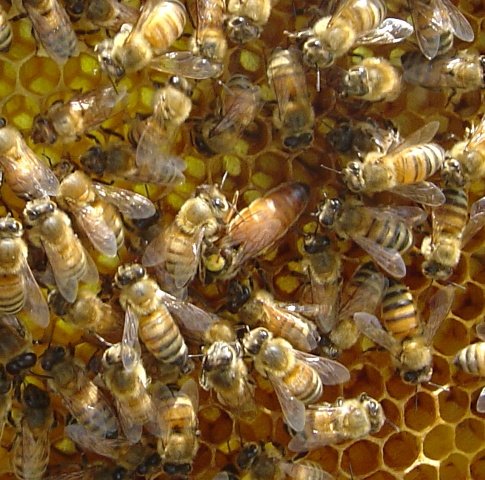
Right: A strong hive for the first week of April. With 7 frames of bees, emerging brood, eggs, and larva, this hive needs more room.
Sure enough all the hives I checked had capped brood, eggs, and larva. Their strength ranged in size from three frames of bees up to eight.
One of my hives has been flying very strongly the past week or so. Something told me that I should look at them! I opened up the hive. I found eggs, larva, capped brood, and the queen! I also found two queen cells! I thought to myself… Isn’t it a little early for that?
Left: One of the two queen cells found in this colony. The queen was found with plenty of eggs. She is getting old, going into her fourth season. Are they trying to replace her, or are the planning to swarm? Time will tell.
This particular hive had a bad infestation of mites last fall. This particular hive of bees has had a bad case of mites for the past three years. Each fall I have had to treat them, and each spring they surprise me on how great they come through the winter.
This particular queen is three years old. She was purchase from a breeder from Vermont. She has outperformed most of the other queens in my apiary year after year. There was plenty of worker brood, larva, and eggs. I find it hard to believe they would be replacing her. Perhaps the bees felt congested, with the brood trapped between frames of capped honey (from last year) and new pollen.
I destroyed the queen cells and moved some empty comb near the brood. This should allow the queen more room to lay. I also place an empty brood chamber above them.
Right: A closeup of one of the two queen cells.
An inspection next week will tell if they are happy with the changes, or if there mind is made up to swarm!
Or perhaps this is just an early sign of a great honey season, or lots of swarms!
Showing posts with label Swarming. Show all posts
April 4, 2010
December 30, 2008
A Happy Beekeeping New Year
Well as you can tell, I have not been a consistent blogger in 2008, only one entry. Well I’ll use the excuse that I was too busy keeping my bees! Or should I say… building them.
Left: A wild swarm of bees we removed from a picknic table at the local conservation area. As you can see, this swarm was very small.
.
.
.
.
.
.
.
.
.
The other swarm was gathered from a storage shed at the Otis Air Force Station, right next to the airstrip. The swarm had established itself inside the storage shed, accessing their new home through rusted holes in the siding. Comb had been built attached to various packs and boxes which contained who knows what. We spent a good part of a day removing items to access the bees. They had built beautiful curved comb attached to the metal siding of the shed, and everything else. In a way, it was a shame to remove them. It took us a while to cut out the comb and attached bees and install them into a hive. What a challenge. Bees were flying and honey was dripping everywhere. We neglected to bring a bucket to put the extra honeycomb in, so we used an empty rifle locker. Bees were stuck to everything!
Left: A wild swarm of bees we removed from a picknic table at the local conservation area. As you can see, this swarm was very small.
.
.
.
.
.
.
.
.
.
As you can see from previous entries, I started 2008 with only 3 surviving hives, out of 10 strong wintered over hives from the previous fall. With much effort I built those three hives into 8, while harvesting 60 lbs of honey, and rearing about 20 queens. Some of those queens failed, some are now reining in my hives, and some of the better queens were sold to fellow local beekeepers here on the cape. We had a great time with the bees this year.
The bees are sure amazing architects!
.
.
.
.
.
.
.
.
.
.
.
.
.
.
.
.
.
.
Some of our adventures included gathering two wild swarms. One was found in the middle of a local conservation area, attached to the corner of a metal picnic table. The site was right against one of the capes largest ponds in the middle of nowhere. The swarm was probably two miles from the nearest beehive. I think the swarm was from a wild hive.
Left: A close up of the swarm, now acutaly an established colony. Where is the queen? We did find her (by luck) and put her into the new hive. Click on the photo for an enlarged view
.
.
.
.
.
.
.
.
.
The other swarm was gathered from a storage shed at the Otis Air Force Station, right next to the airstrip. The swarm had established itself inside the storage shed, accessing their new home through rusted holes in the siding. Comb had been built attached to various packs and boxes which contained who knows what. We spent a good part of a day removing items to access the bees. They had built beautiful curved comb attached to the metal siding of the shed, and everything else. In a way, it was a shame to remove them. It took us a while to cut out the comb and attached bees and install them into a hive. What a challenge. Bees were flying and honey was dripping everywhere. We neglected to bring a bucket to put the extra honeycomb in, so we used an empty rifle locker. Bees were stuck to everything!
.
Right: My first attempt a queen rearing this spring. See how small the cells are. I destroyed all these cells and started over. These cells were dry grafted. On my next attempt I primed the cups and got a 85% acceptance rate.
.
.
.
.
.
.
The biggest challenge I had this year was keeping the bees in the mating nucs. I had about a 60 percent success rate with keeping the bees in a nuc. Some would abscond, or return to the parent colony, or migrate to a neighboring nuc. I had two nice queens, and established colonies abscond due to small hive beetle infestation. As we discussed at the bee association, this pest is increasingly becoming a problem. I believe my beetle problem came with the packages of bees I received from Georgia two years ago. They have increased unchecked for two years, and I saw many of them in my hives.
.
Left: Removed queen pupa. These queens are all the same age. You can see how the cell size effects the development of the queen. Larger queen cells mean larger queens. Larger queens mean more overies and better laying.
.
.
.
.
.
I was just thinking today that the 2009 beekeeping season has already started. The work we do in preparing the hives for winter will have a great effect on the condition of the bees this spring. This year some of the hives have been wrapped in black building paper. It is my understanding that the wrapped hives will be about 5 degrees warmer than the unwapped hives. We will see how this works out.
.
Right: This is what it is all about.... The beekeepers reward.... Honey right from the extractor. We harvested 60 lbs this year.
.
.
.
.
.
.
.
.
My new years resolution is to maintain this blog. If you read this, post a message. Let me know what you think.
.
Right: My friend, and fellow beekeeper, Gene and I on extraction day!
.
.
.
.
.
.
.
.
.
.
.
And have a happy new year!
Labels:
Beekeeping,
Grafted Queen Cups,
Mating Nuc,
Nuc,
Queen Cup Frame,
Swarming
June 7, 2008
The queens are coming the queens are coming
Well this is my first blog entry of 2008.
It has been a very difficult beekeeping season for me. We started the winter with nine very strong colonies with young queens. By May we were down to four. That’s over a 50% loss of hives. Of those four, one is very weak, two are average, and one is extremely strong.

Left: A dead hive. This hive was lead by one of the queens I raised last summer. Most of the time you can never figure out what happened. This hive stayed in the bottom box and never moved up to the upper box where there was plenty of honey and candy feed. They starved to death inches away from abundant supply
.
.
.
.
That’s beekeeping. Everything was picture perfect in the fall, by spring the story changes.
Of the six queens I raised last year, only two have survived. One survivor was given to a local beekeeper last fall. The other is leading the week colony in our bee yard.

Left: A cell builder hive with two cell cup holding frames installed. These bees do not have a queen, and will quickly turn the grafted cells into queen cells.
.
.
.
.
.
.
.
.
The honey flow is occurring here on Cape Cod, it started about two weeks ago. The bees are quickly storing nectar in the cells, ripening it into honey.
I have been watching my colonies closely for signs of swarming. So far all I have seen are queen cell cups, the cells that queens could be raised in. There have been no attempts by the bees to swarm this year. I have found that if you stay ahead of the bees, and provide them with young queens (introduced in the fall), and plenty of room ahead of schedule, they stay contented in their hives.
I have had no signs of disease or mites in any of the colonies this spring. That’s encouraging. You can see from past blog posts that last year we battled the worst infestation of verroa mites I have ever seen. It is interesting to note that the worst infested hives last year are the strongest this year, even though all the hives were treated.
Right: A frame of young eggs and larva from my strong hive. These young female larva are the offspring from my strongest queen. I want more queens like her.
.
.
.
With swarm season on, we received our first call to collect a wild swarm of bees from the local conservation area. The swarm was hanging off of the corner of a picnic table. You can’t find an easier location than that!. We just put a hive under them, and they dropped right in. This will help make up our winter losses.
Right: Some of the 75 grafted queen cups I made today. They were installed into the cell builder shortly after this picture was taken.
.
.
.
With swarm season on, it is time to try my hand at queen rearing again.
Last week I set up a “Cell Builder” hive. A cell builder is a queenless hive which contains emerging bees, nurse bees, brood, pollen, and nectar. In other words a strong young hive which does not have a queen. Since they do not have a queen, and no young larva to use to raise a queen, they will be primed for my grafts. Grafting is a method of queen rearing where you transfer four day old larva into special cells. These special cells are then built into queen cells by the bees.
Today I inspected all the hives, took young larva from my strong hive, and graft 75 cells cups. These cell cups were then installed into the cell building hive. I’m sure the bees were happy to see the young larva, and have the opportunity to raise some queens.

Left: A closeup of the grafts. You can see the small 4 day old larva floating on a layer of royal jelly.
.
In 24 hours I can look to see how many of the larva they accepted, and decided to grow into queens.
It has been a very difficult beekeeping season for me. We started the winter with nine very strong colonies with young queens. By May we were down to four. That’s over a 50% loss of hives. Of those four, one is very weak, two are average, and one is extremely strong.

Left: A dead hive. This hive was lead by one of the queens I raised last summer. Most of the time you can never figure out what happened. This hive stayed in the bottom box and never moved up to the upper box where there was plenty of honey and candy feed. They starved to death inches away from abundant supply
.
.
.
.
That’s beekeeping. Everything was picture perfect in the fall, by spring the story changes.
Of the six queens I raised last year, only two have survived. One survivor was given to a local beekeeper last fall. The other is leading the week colony in our bee yard.

Left: A cell builder hive with two cell cup holding frames installed. These bees do not have a queen, and will quickly turn the grafted cells into queen cells.
.
.
.
.
.
.
.
.
The honey flow is occurring here on Cape Cod, it started about two weeks ago. The bees are quickly storing nectar in the cells, ripening it into honey.
I have been watching my colonies closely for signs of swarming. So far all I have seen are queen cell cups, the cells that queens could be raised in. There have been no attempts by the bees to swarm this year. I have found that if you stay ahead of the bees, and provide them with young queens (introduced in the fall), and plenty of room ahead of schedule, they stay contented in their hives.
I have had no signs of disease or mites in any of the colonies this spring. That’s encouraging. You can see from past blog posts that last year we battled the worst infestation of verroa mites I have ever seen. It is interesting to note that the worst infested hives last year are the strongest this year, even though all the hives were treated.

Right: A frame of young eggs and larva from my strong hive. These young female larva are the offspring from my strongest queen. I want more queens like her.
.
.
.
With swarm season on, we received our first call to collect a wild swarm of bees from the local conservation area. The swarm was hanging off of the corner of a picnic table. You can’t find an easier location than that!. We just put a hive under them, and they dropped right in. This will help make up our winter losses.

Right: Some of the 75 grafted queen cups I made today. They were installed into the cell builder shortly after this picture was taken.
.
.
.
With swarm season on, it is time to try my hand at queen rearing again.
Last week I set up a “Cell Builder” hive. A cell builder is a queenless hive which contains emerging bees, nurse bees, brood, pollen, and nectar. In other words a strong young hive which does not have a queen. Since they do not have a queen, and no young larva to use to raise a queen, they will be primed for my grafts. Grafting is a method of queen rearing where you transfer four day old larva into special cells. These special cells are then built into queen cells by the bees.
Today I inspected all the hives, took young larva from my strong hive, and graft 75 cells cups. These cell cups were then installed into the cell building hive. I’m sure the bees were happy to see the young larva, and have the opportunity to raise some queens.

Left: A closeup of the grafts. You can see the small 4 day old larva floating on a layer of royal jelly.
.
In 24 hours I can look to see how many of the larva they accepted, and decided to grow into queens.
June 8, 2007
The Mother Of All Queens

This week was an exciting beekeeping week for me.
.
A swarm of bees high in a scrub pine tree
.
Last Friday I went to visit a fellow beekeeper (John), at his home. He his hive had swarmed a day earlier, and we were going to inspect his hive to see what condition they had been left in. I have never worked with a more gentle bee. We probably did not have to use any smoke or where a veil or gloves.
.
.

A closer look at the swarm
.
Inside the hive we found four queen cells. The hive was started last year, and according to John over-wintered well. Our inspection showed that only 13-14 of the frames in the double brood chamber (of 20 deep frames) had been drawn out. Of course the bees were working on storing honey in the honey super though. The brood chamber was crowded with honey. This is probably the reason the hive swarmed. It was honey bound. Any extra room the bees were making by building comb was being filled with honey. There was no place for the queen to lay, so the bees must have felt crowded even though there were 6 or 7 empty frames in the brood
chamber and plenty of space in the honey super. As happens more times than not on Cape Cod, the swarm ended up landing at the top of a large scrub pine tree. It is hard enough getting a swarm out of a scrub pine, never mind them being 80 feet up in the air..
John with his bees
.
John had contacted another beekeeper who brought over an empty nuc box and had placed it up in the tree (about 12 feet up) in hopes that the swarm would find it and make it their new home. John would have then had two hives of bees.
On Saturday I worked my bees. Three of the hives were examined for swarm cells. My strong hive had started building cells, but there were no eggs in them. Since there were so many bees I took three frames, Two capped brood and one with eggs and young larva, and placed them in a nuc box with a division board feeder filled with sugar syrup. I assumed that the bees would realize they had no queen and build queen cells from the larva. Empty drawn comb was placed in the old hive where the frames had been taken. Since this strong hive contains the queen I want to breed, I prepared a special frame of foundation and placed it in the center of the brood chamber. I plan to raise new queens (by the miller method) from this frame once the old queen lays eggs in it. I had planned to come back in 4 days to remove the frame, but mother nature delayed me with cold wet weather this week. Temperatures dropped to the low 40’s and it was wet.
.A special frame (miller method) prepared for raising queens
.
There was a short break in the weather today. Clouds and rain are expected to move in tonight for the weekend. In beekeeping you need to take your opportunities when they come.
My first step was to create a queenless cell builder hive. I spent the winter researching queen rearing, and dreaming about my plans to raise queens for myself and my beekeeping friends. A queenless cell builder hive is a deep box of bees with specific types of frames of bees. The order I used was as follows (from left to right) Open nectar, Capped Brood, Capped Brood, Pollen, Empty space, Eggs & Larva, Empty space, Pollen, Capped Brood, Open nectar.

.
My Cell Bulder Hive notes from this winter.
.
The eggs from the “mother queen” are placed in the empty spaces. I ended up taking frames from my two strongest hives, since I have been concerned they might swarm within the next few weeks. The cell builder needs to be continuously fed, so a hive top bucket feeder was installed on top of the inner cover of the cell builder.
The next step was to examine the “miller” frame I had installed on the 1st, to see if the bees had drawn out the comb, and if the queen had laid eggs in it. Sure enough I pulled out the frame to find the queen walking across it. The bees had drawn out almost the entire frame. There were eggs mixed with nectar in the frame. I gently moved the “mother queen” off the frame into the hive, and placed frame with the eggs into the cell builder.
.The assembled cell builder with space for eggs. The fifth frame is the miller frame taken from the "mother hive".
.
The order of frames I used is as follows (from left to right) Open nectar, Capped Brood, Capped Brood, Pollen, Empty space (miller frame), Eggs & Larva, Empty space, Pollen, Capped Brood, Open nectar.
.
Now the timing begins. It takes 16 days to raise a queen from egg to adult. I will assume that the frame of eggs is 1 to 2 days old. That means that any queen cells raised from this frame of eggs would be ready to hatch on June 22nd. Each queen cell will need to be placed in a separate mating hive prior to the emergence of the virgin queen. More on that next time.
.
.The finished cell builder with a hive top feeder and cover.
.
Of course with all these manipulations something was bound to happen. As I was examining the “mother hive” I knocked over four boxes of bees. While my back was turned they tipped over and came crashing down to the ground. Boy were their a lot of bees flying around. It took about half an hour to put the hive back together again with the frames back in their respective places. I did find the “mother queen” and she looked unharmed.
.
.
.
The next hive inspection in a few days will reveal if she is still laying eggs as well as she has been.
.
.
Below. My first "intended" queen cell. This one cell was built by the bees in the Nuc box I created on June 1st. The queen quality cannot be determined because the age of the larva used to create this cell was uncontroled. The cell is capped and should emerge within 5 days.

Labels:
Beekeeping,
Cell Builder,
Feeding,
Queen Rearing,
Swarming
May 31, 2007
A load of hay
"A swarm of bees in May is worth a load of Hay.
A swarm of bees in June is worth a silver spoon.
A swarm of bees in July ain’t worth a fly."
This is an old beekeepers saying. Apparently in the 1700’s a load of hay was worth mor
e than a silver spoon!
.
Michael near a swarm of bees we had in 2002
.
The saying means that if you capture a swarm of bees in May, chances are that they will produce enough honey to survive the winter, and maybe some extra for you.
If you were to capture a swarm of bees in June, they would probably produce enough to survive the winter.
If you captured a swarm of bees in July, chances were that they would not have enough time to produce enough numbers, comb, and honey stores to survive the winter.
The main honey flow is on here on Cape Cod. Our honey flow starts the end of May and continues to the start of August. That gives the bees two months to produce enough honey to keep them and me happy through the winter months.
There is a small honey flow in the fall of most years, but I allow them to keep that honey for themselves.

All of the hives were inspected over the long holiday weekend. There were no swarm cells (queen cells) found in the hives. Honey supers (boxes) were added to the strong colonies that will need more space to expand into.
.
With any luck next week’s inspections will show signs of nectar storage in these boxes.
.
A closer look at the 2002 swarm
.
I place a ross round honey comb super on each of my strong hives. These are always a favorite at our local fair and sell out quickly.
.
The weather has been beautiful here on the cape this week. Low 80’s with no humidity! Of course you know the saying on Cape Cod.
“If you don’t like the weather…. Just wait a minute”
Yesterday I received a call from an fellow beekeeper in a neighboring town. Apparently his one hive swarmed. He had started the hive last year, and added his honey supers early thinking this would be enough to keep them. Unfortunately for the next month second and third year hives need to be intensely managed in order to insure that swarming preparations are not begun by the bees. It is their natural tendency to reproduce, and swarming is the process through which a hive of bees reproduces.
The bees will decide to produce one or more queens. Once the queen cells are capped, half the hive along with the old queen leave the colony and find a new home.
.
A ross round honey comb super ready to be placed on the hive
.
It is quite the amazing thing to see. Tens of thousands of bees run out of the hive and take flight in a cyclone of activity. It is like being in a dirt devil of bees. Unfortunately for the beekeeper, he has just lost his honey producing work force, and the existing hive is left with an unpredictable future. If all goes well a new virgin queen will emerge within a weeks time.
.
Then within another 7 days she will take several mating flights, and if she is successful or does not get eaten by a bird, or does not get lost, in another few days she will start laying eggs again.
.
The end result is a loss of ten thousand worker bees, the old queen, a months worth of egg production, and this years honey crop. It will take the bees the rest of the summer to replace what it has lost.
.
.
With that said… Watch your bees carefully this time of year, you can rest in the winter
A swarm of bees in June is worth a silver spoon.
A swarm of bees in July ain’t worth a fly."
This is an old beekeepers saying. Apparently in the 1700’s a load of hay was worth mor
e than a silver spoon!.
Michael near a swarm of bees we had in 2002
.
The saying means that if you capture a swarm of bees in May, chances are that they will produce enough honey to survive the winter, and maybe some extra for you.
If you were to capture a swarm of bees in June, they would probably produce enough to survive the winter.
If you captured a swarm of bees in July, chances were that they would not have enough time to produce enough numbers, comb, and honey stores to survive the winter.
The main honey flow is on here on Cape Cod. Our honey flow starts the end of May and continues to the start of August. That gives the bees two months to produce enough honey to keep them and me happy through the winter months.
There is a small honey flow in the fall of most years, but I allow them to keep that honey for themselves.

All of the hives were inspected over the long holiday weekend. There were no swarm cells (queen cells) found in the hives. Honey supers (boxes) were added to the strong colonies that will need more space to expand into.
.
With any luck next week’s inspections will show signs of nectar storage in these boxes.
.
A closer look at the 2002 swarm
.
I place a ross round honey comb super on each of my strong hives. These are always a favorite at our local fair and sell out quickly.
.
The weather has been beautiful here on the cape this week. Low 80’s with no humidity! Of course you know the saying on Cape Cod.
“If you don’t like the weather…. Just wait a minute”
Yesterday I received a call from an fellow beekeeper in a neighboring town. Apparently his one hive swarmed. He had started the hive last year, and added his honey supers early thinking this would be enough to keep them. Unfortunately for the next month second and third year hives need to be intensely managed in order to insure that swarming preparations are not begun by the bees. It is their natural tendency to reproduce, and swarming is the process through which a hive of bees reproduces.
The bees will decide to produce one or more queens. Once the queen cells are capped, half the hive along with the old queen leave the colony and find a new home..
A ross round honey comb super ready to be placed on the hive
.
It is quite the amazing thing to see. Tens of thousands of bees run out of the hive and take flight in a cyclone of activity. It is like being in a dirt devil of bees. Unfortunately for the beekeeper, he has just lost his honey producing work force, and the existing hive is left with an unpredictable future. If all goes well a new virgin queen will emerge within a weeks time.
.
Then within another 7 days she will take several mating flights, and if she is successful or does not get eaten by a bird, or does not get lost, in another few days she will start laying eggs again.
.
The end result is a loss of ten thousand worker bees, the old queen, a months worth of egg production, and this years honey crop. It will take the bees the rest of the summer to replace what it has lost.
.
.
With that said… Watch your bees carefully this time of year, you can rest in the winter
Subscribe to:
Posts (Atom)
Spring
Peach Pollen
Spring Pollen
Queen Cell
Well Fed Queen Cell
Marked Queen
Queen produced from my second graft attempt