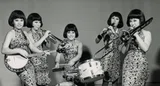
Tokyo Happy Coats “Oku no Hosomichi ” 【Bonus Track 18】 SN Productions co-founder Mr.Shattuck, last testimony<4>。


(12.09.2016./Courtesy of Library of Congress、Veteran's Heritage Project)
This article has been prepared as a Japanese satellite content with the permission of Mr.Roy Baugher, a Tokyo Happy Coats researcher from the United States. The Japanese and English versions of this article have been prepared with the permission of Library of Congress and Imprints of Honor, which conducted the interviews.
About "Alonzo Bain Shattuck Collection"
Title: Alonzo Bain Shattuck Collection
Narrator: Alonzo Bain Shattuck
Interviewer: Barbara Hatch
Location: Fountain Hills, Arizona, USA
Date: 12 September 2016
Citation: Veterans Heritage Project, Barbara Hatch, and Alonzo Bain Shattuck. Alonzo Bain Shattuck Collection. 1944. Personal Narrative.

ー12.Shattuck starts business in Japan.
BH: And what made you stay in Japan then?
AS: I had an opportunity to go into business for myself.
BH: What kind of business did you do?
AS: Well, during the time that I was in Yokohama, I became a Shriner, and I was president of the Shrine Club of Yokohama. And we decided as a group that we wanted to do something with the crippled children, and we wanted to do a, like a wing, but not a building, but what do you say, finance an iron lung, which they didn't have in those days in Japan.

AS: And one of the guys who was a member of the Shrine Club, two of them actually, were civilians who were there on business in Japan, but they were Shriners from way back. They were older men. And they suggested that they knew some wrestlers that might go over that they didn't have wrestling in Japan. They had sumo, but not American style, that it would be a show that we could raise some money. And I was president of the Shrine Club, and we did that. And the next thing that happened, we did it a second time and brought Joe Louis over. I've got pictures with him at the Shrine Club.
AS: We brought him over as a referee, and he did some exhibition boxing. This is after he lost the championship. And from then it morphed into other promotions. Just as the head of the Shrine Club, I was in charge. And then I was offered to take over some entertainment, different types of entertainment, booking around with the government, with the Army. And it sounded pretty good to me. It was interesting, and I got into it.

ー13.Shattuck enters show business.
AS: I had my own booking agency. I brought Perez Prado, Louis Armstrong, The Ink Spots, Martha Graham, Johnny Ray. They were the big acts. We did that once in every six months to a year. I put them in the theaters, and then did an Army tour with them. And then I had just regular acts that we hired and put on shows for Army clubs, mainly in Army clubs, and in some of the Japanese theaters, depending on the type of act it was. And from that I got involved with building radios, when it was a new thing. I had a good friend of mine who was a technician with RCA, and he wanted somebody to go in business with. We were not building them, but we were assembling them with our own name on them and exporting them, selling them to importers from the States. And in 1960, we decided that we really wanted to profit properly, because they were selling in the United States at that time for about $75. And we were getting like 15, 20 percent over our cost in Japan from an importer. So I went to New York to open our own office, which I did, until the big companies, Japanese companies, started coming in. Our profit margins got squeezed, because we really had to buy the stuff from the Japanese companies.
BH: The components and stuff.
AS: Yeah. And they came in and couldn't compete with them. From there I went to Mexico, and from Mexico back to the States, and then to Brazil.
BH: And then all was still doing radio stuff?
AS: No.

ー14.Shattuck leaves Japan for Mexico and Brazil.

BH: I mean, I know it's not part of your military story, but what business were you in by then?
AS: Well, I went to Mexico actually on an in-and-out basis for my accountant, who had sponsored two men from New York to set up a diamond cutting company in Mexico City. And they were very good diamond cutters and very lousy businessmen. And my accountant in New York that I hired for the radio business, I had a desk in his office. He was at 1890 Broadway, right by Columbus Circle. He had a whole floor there. So he asked me—I sold everything that we could build in radios in ten days in a month, and the rest of the time I had nothing to do. So he asked me to go down to Mexico for him and try to arrange the business end of the diamond cutting. And while I was there, I met some other people, and the radio business started going downhill because of the price situation. And I got a Butler Building [Butler Manufacturing] franchise, so I had a Butler Building business in Mexico City.
BH: And then what did you do in Brazil?
AS: I built a Japanese Buddhist temple and sold space to the Japanese community, which is the largest Japanese community outside of Japan, to keep the ashes of the cremated. We had a big park, a copy of the famous Golden Pavilion from Kyoto. I duplicated it exactly. The outside, inside wasn't.
BH: So the temple looked like the one there in Kyoto then?
AS: Exactly.
BH: Wow.
AS: I had two Japanese—I call them artists, they were carpenters—who I built in concrete and covered it in wood, and they covered it to look exactly like the original. I can show you pictures of it.
BH: Yeah, we'll have to do that. Let me change this tape.
[INTERRUPTION]
AS: And when I came up from Mexico, he asked me to come with his company. And I was the president of one of the subsidiaries in Fresno, California, and the executive vice president of the parent corporation in Boston. But while I was in Fresno, a neighbor worked for the big winery. I'll think of it in a minute. But he was one of the vice presidents or something there. And he asked me to join the Wine and Food Society, which I don't know if you're familiar with it. The International Wine and Food Society, you can have from 18 to 22 members, and all supposed to be from different businesses. And they meet once a month, and each one person takes a turn at putting on the dinner and the wine and laying it out, and then you critique it. Everybody says what they think was right and what was wrong with it. What was the point of my saying that?
BH: Well, I'm sure there wasn't an Iranian in there, was there?
AS: Yeah, this is what started me on the thing. There was one of the—I think he was a cousin of—he was some way related to the Shah [Mohammad Reza Pahlavi (1919-1980)]. And he was a vinicologist [sic], and he came to the United States as a professor at Fresno State College, which is one of the finest vinicology [sic] programs in the United States, is there in Fresno. Of course, the Valley is all grapes anyway. And he became a member. And every one of us would—there was one other guy we did at his house once, but the rest of us would pick a restaurant and do everything, arrange everything with a restaurant for the dinners. But the dinner that he had, we had at his house with the servants, delivery servants. He was a professor at the college and lived in a mansion. But it was funny. I can't remember what his—he was a relative of the Shah.
BH: His name wasn't Pahlavi, was it, like the Shah? The Shah’s name was Reza Pahlavi.
AS: Pahlavi, that was their family name, yeah.
BH: Right.
AS: No, I think his name was Pahlavi. It's been a long time ago. It was in '70, 1970.
BH: Yeah, the Shah was kind of put out around the late '70s. After I left, they had the revolution, and that's when he was—
AS: Yeah, I think he was out. I went to Brazil in '74, and I think I was in Brazil when he was out. Some of my time element gets—