

API Testing is a type of software testing that verifies whether an Application Programming Interface (API) works correctly and meets functional, reliability, performance, and security requirements. It checks the communication between software components without relying on the user interface.
- Validates request and response behavior of APIs.
- Ensures data is exchanged correctly between systems.
- Helps detect issues early before UI testing starts.
API
API (Application Programming Interface) is a set of rules and protocols that allows different software applications to communicate and exchange data with each other. It acts as an intermediary that enables one system to request data or services from another system.
Example: When you use a weather app, it sends a request to a weather API to fetch live weather data from the server and display it in the app.
API Request-Response Flow
The API request-response flow describes how a client application communicates with a server through an API to request or exchange data. The server processes the request, interacts with the database when required, and returns the appropriate response to the client.
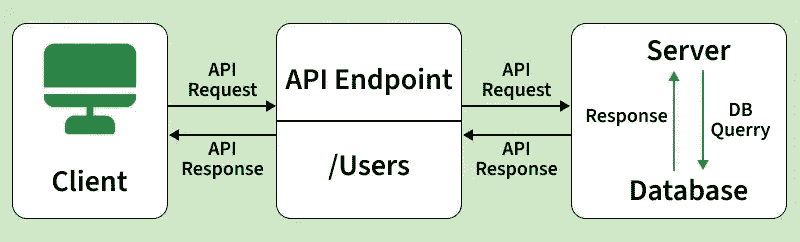
- Client: Sends an API request to access or modify a resource.
- API Endpoint: Receives the request and identifies the requested resource or operation, such as /users.
- Server: Processes the request, applies business logic, and determines whether database interaction is required.
- Database: Stores and retrieves application data based on the server's request.
- API Response: The server sends the result back to the client through the API.
API Testing Process
The API testing process involves a systematic set of steps to verify that APIs function correctly, handle errors properly, and meet functional, security, performance, and reliability requirements.
- Understand API Requirements: Review the API documentation, requirements, endpoints, business rules, request formats, and expected responses.
- Identify Test Scenarios: Identify positive, negative, boundary, authentication, authorization, and other relevant test scenarios.
- Prepare the Test Environment: Configure the required API endpoints, environments, authentication credentials, test data, and dependencies.
- Create Test Cases: Define test steps, input data, expected results, and validation criteria for each scenario.
- Send API Requests: Execute API requests using appropriate HTTP methods, parameters, headers, and request bodies.
- Validate API Responses: Verify status codes, response body, headers, schema, data, error messages, and response time.
- Execute API Tests: Perform the applicable functional, negative, security, performance, regression, and other API tests.
- Analyze and Report Defects: Compare actual and expected results, identify failures, and report defects with relevant request and response details.
- Retest and Perform Regression Testing: Retest fixed defects and verify that changes have not affected existing API functionality.
- Generate Test Reports: Document test results, defects, coverage, and overall API quality.
API Testing Types
Here's a breakdown of the main types of API testing:
- Functional Testing: Checks whether the API works correctly according to requirements and returns expected results.
- Integration Testing: Ensures the API works properly when combined with other systems, databases, or services.
- Load Testing: Measures API performance under expected user traffic and workload.
- Stress Testing: Tests the API beyond its limits to identify breaking points and failure behavior.
- Security Testing: Verifies that the API is protected against threats like unauthorized access and data breaches.
- Validation Testing: Confirms the API meets specifications such as data format, schema, and required fields.
- Regression Testing: Ensures recent changes do not break existing API functionality.
- Fuzz Testing: Sends random or invalid inputs to check how the API handles unexpected data.
- Contract Testing: Validates that the API follows the agreed contract between client and server.
- End-to-End Testing: Tests complete workflows involving multiple APIs and systems together.
- Mocking / Simulation Testing: Uses mock APIs or servers to test functionality without relying on real services.
API Test Case Design
API test cases should be designed systematically to validate both expected behavior and error handling under different conditions.
- Positive Test Cases: Verify that the API works correctly with valid inputs and returns the expected response.
- Negative Test Cases: Verify how the API handles invalid, missing, or incorrect inputs and returns appropriate error responses.
- Boundary Value and Edge Case Testing: Test minimum, maximum, empty, null, and unusual input values to ensure the API behaves correctly under extreme or unexpected conditions.
- Data-Driven Testing: Execute the same test cases with multiple sets of input data to validate API behavior across different data combinations.
- Validation Checks: Verify the response format, required fields, data types, status codes, headers, and business rules.
HTTP Methods
HTTP methods define the type of action that a client wants to perform on the server.
| HTTP Method | Description | Example Use |
|---|---|---|
| GET | Retrieves data from the server | Fetch user details |
| POST | Sends data to create a new resource | Create a new user |
| PUT | Updates an existing resource completely | Update full user profile |
| PATCH | Updates part of an existing resource | Update only email address |
| DELETE | Deletes a resource | Delete a user record |
HTTP Status Codes
HTTP status codes indicate the result of an API request and help identify whether the request was successful, redirected, failed because of the client, or failed because of the server.
| Category | Description |
|---|---|
| 1xx – Informational | Indicates that the request was received and the process is continuing. |
| 2xx – Success | Indicates that the request was successfully received, understood, and processed. |
| 3xx – Redirection | Indicates that the client must take additional action to complete the request. |
| 4xx – Client Error | Indicates an error caused by the client, such as an invalid request or unauthorized access. |
| 5xx – Server Error | Indicates an error on the server side while processing the request. |
Structure of a URL in API
A URL (Uniform Resource Locator) specifies the location of a resource on a server and provides the information required to access it. In API testing, understanding the structure of a URL helps testers construct API requests and interact with specific resources.
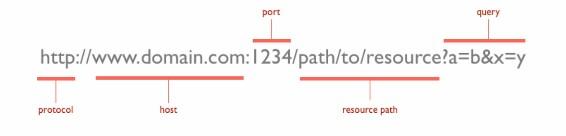
Parts of a URL Explained
- Protocol (http://): Specifies the protocol used for communication between the client and server, such as HTTP or HTTPS.
- Host (www.domain.com): Specifies the domain name or IP address of the server hosting the resource.
- Port (1234): Specifies the network port used to communicate with the server. It is optional and is usually omitted when the default port is used.
- Resource Path (/path/to/resource): Specifies the path to the requested resource or API endpoint.
- Query Parameters (?a=b&x=y): Provide additional key-value parameters to customize the request, such as filtering, searching, or sorting data.
Example: Weather Data Retrieval
A weather application sends a request to an API to retrieve current weather information for a specific location.
API Request
- Endpoint: /weather
- Method: GET
- Query Parameter: location=New+Delhi
Request: GET /weather?location=New+Delhi
Sample API Response
{
"location": "New Delhi",
"temperature": "28°C",
"condition": "Cloudy"
}
Test Cases
- Verify that the response contains all required fields, such as location, temperature, and condition.
- Verify that the API returns 200 OK for a valid request.
- Validate that the returned weather data corresponds to the requested location.
- Verify that the response time is within the defined acceptable limit.
- Send invalid or missing input and verify that the API returns an appropriate error response.
- Verify that the response contains the expected data types and formats.
Common Bugs in API Testing
API testing can identify various defects related to functionality, requests, responses, data, authentication, authorization, security, integration, and performance.
- Performance Issues: The API may respond slowly, show high latency, or fail under heavy traffic.
- Incorrect Response Structure: The response may not follow the expected JSON or XML structure.
- Security Issues: Weak authentication, authorization flaws, or exposure of sensitive data may exist.
- Input Handling Errors: The API may not handle valid, invalid, or boundary input values correctly.
- Improper Error Messages: The API may return unclear, missing, or incorrect error responses.
- Missing or Incorrect Functionality: Expected operations may be missing, incomplete, or implemented incorrectly.
- Reliability Issues: The API may fail intermittently, return inconsistent results, or behave unpredictably.
API Testing Tools
There are several tools available to automate and streamline API testing. Here are a few popular ones:
- Postman: A popular tool used to send API requests, test responses, and automate API testing easily.
- SoapUI: A tool mainly used for testing SOAP and REST APIs with advanced functional and security testing features.
- JMeter: An open-source tool used for performance and load testing of APIs and web applications.
- Rest Assured: A Java-based library used for automating REST API testing with simple and readable code.
- Karate: An automation tool that combines API testing, performance testing, and UI testing in a single framework.
Challenges in API Testing
API testing involves several technical and operational challenges that can affect test accuracy, reliability, and overall software quality.
- Complex authentication mechanisms such as OAuth 2.0, JWT, API keys, or multi-factor authentication can make API testing difficult.
- API endpoints, request formats, and response structures may change frequently during development, which can impact test stability and maintenance.
- APIs often depend on third-party or external services that may be unavailable, slow, or unstable during testing.
- Maintaining valid, consistent, and reusable test data for different scenarios can be challenging.
- Different API versions may behave differently, leading to compatibility and maintenance issues.
