November 17, 2026
|
5 min read


Updated: November 16, 2026
Published: February 12, 2026
Blazingly fast way to build, track and deploy your models!
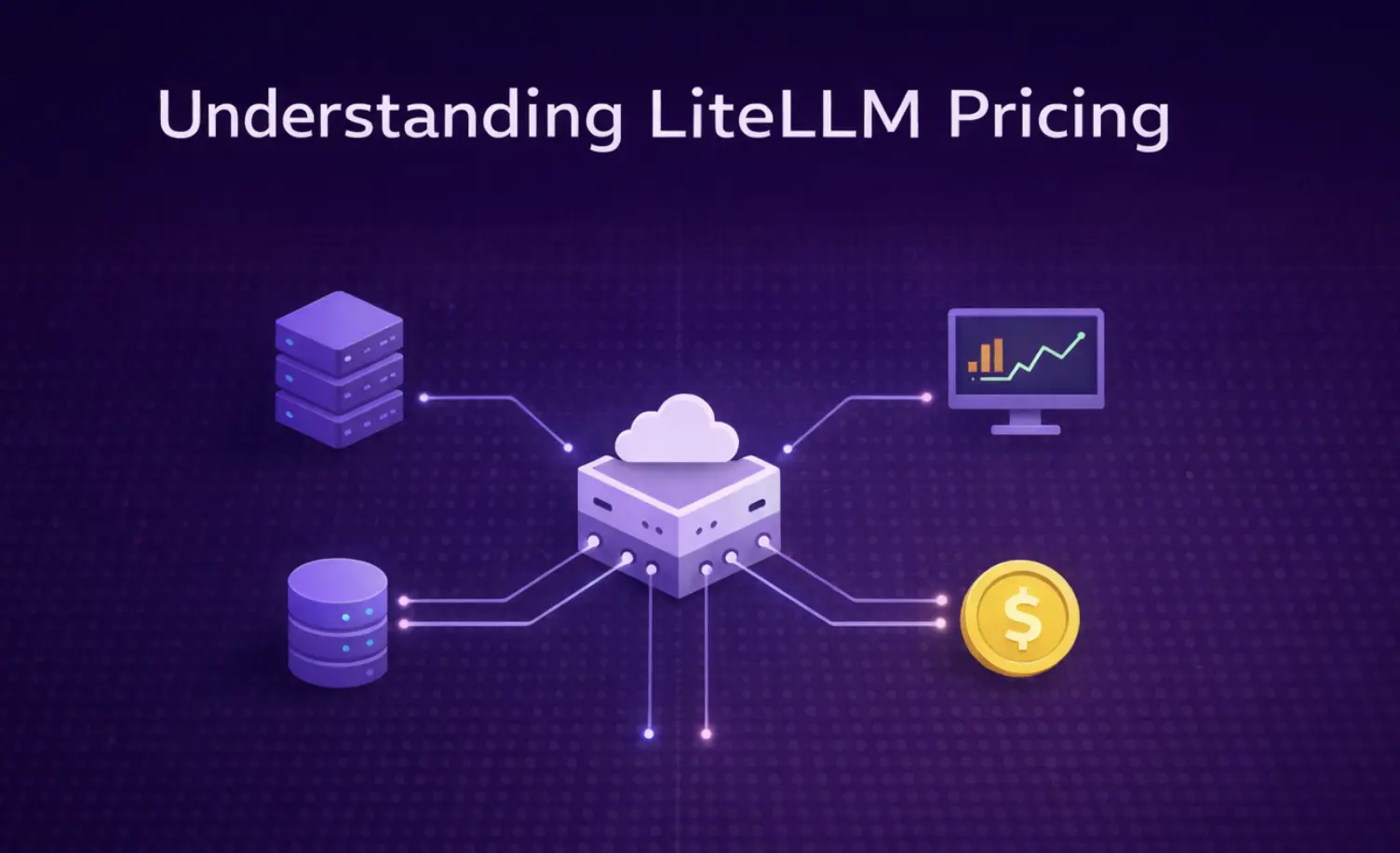
LiteLLM looks free, and the software is. What teams actually pay for is everything around it: servers, a database, monitoring, upgrades and the person who gets paged when the proxy falls over. This guide breaks down what LiteLLM costs in 2026, what the Enterprise tier adds, and when a managed gateway is the cheaper option.
LiteLLM is an open-source Python SDK and proxy server that lets you call 100+ LLM providers through one OpenAI-compatible API. It started as a wrapper library for OpenAI, Anthropic, Azure, Vertex AI and Bedrock and grew into a gateway with virtual keys, budgets, rate limits, fallbacks, logging and an MCP gateway. You deploy it on your own infrastructure and maintain it yourself. If you are new to the category, start with our explainer on LLM routers and gateways.
LiteLLM has three cost layers, and only one of them is a license.
An optional Enterprise license sits on top for teams that need governance features and support.
According to LiteLLM's Enterprise documentation, the open-source gateway covers most routing needs, and the paid tier adds identity, audit and support features. The table below summarizes the split as published today.
Enterprise is billed annually and sized to usage, and LiteLLM lists it as talk to sales with a 30-day trial. Earlier guides, including earlier versions of this one, quoted $250 per month for a Basic tier and $30,000 per year for Premium. LiteLLM no longer publishes those numbers, so treat them as dated and ask for a quote. For feature detail, see our LiteLLM Enterprise breakdown.
The $0 license is why teams start here. The bill shows up in five places.
Initial setup typically takes weeks of senior engineering time: containers or Kubernetes, load balancing, CI/CD and monitoring hooks. After that, patching, scaling and incident response add up to roughly 10 to 20 hours a month. At a $150,000 salary, 20 hours a month is about $1,730.
The open-source proxy logs requests and exposes Prometheus metrics, but you still need a place to store, search and alert on them. Teams usually add a log stack, Grafana dashboards, alerting and OpenTelemetry tracing, which can add a few hundred dollars a month plus tuning time.
LiteLLM stores virtual keys, budgets, rate-limit state and request logs in a database. In production that means a managed instance with backups and high availability, often $100 to $400 a month.
You own vulnerability scanning, patching, secrets handling, access control and audit evidence. That load became more concrete this year. LiteLLM's PyPI package was compromised in March 2026, when versions 1.82.7 and 1.82.8 shipped credential-stealing code (HiddenLayer write-up), and a malicious 1.107.0 release was reported on October 21 (Rescana summary). Both were pulled quickly, but a proxy that holds every provider key is a high-value target. If you self-host, pin exact versions, verify hashes and never pull a latest tag in production.
Open source means community support. There is no SLA, and a critical bug is resolved on the maintainers' timeline unless you buy Enterprise.
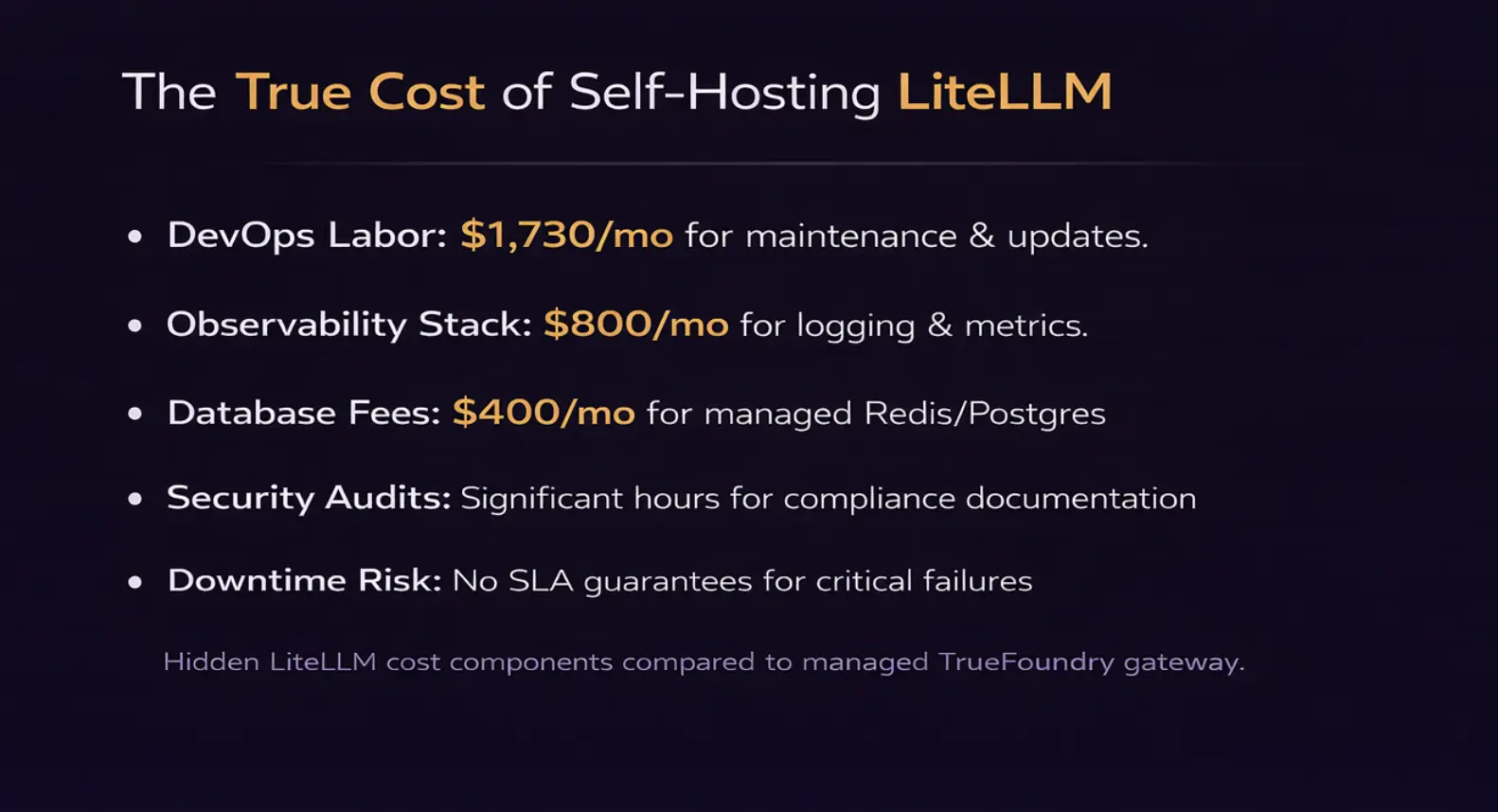
The table below is our own illustrative estimate for a mid-sized team running LiteLLM on AWS at moderate traffic. It uses assumptions, not measured data, so replace the numbers with your own.
Setup time and incident costs come on top. Because labor dominates, the self-hosted bill stays roughly flat as traffic grows, while per-seat or per-request vendor pricing scales with usage. That is why break-even depends on your volume and team, not on a fixed threshold.
You already have a strong platform team. If you run Kubernetes, a mature observability stack and an on-call rotation, the added effort of one more service is small.
You need full infrastructure control. Air-gapped environments, strict data residency rules or sector regulation can rule out a third-party SaaS gateway. LiteLLM Enterprise supports air-gapped deployment for this case.
You are building a multi-tenant platform. If you need custom billing, quota logic or white-label dashboards per customer, owning the proxy code is an advantage.
Your needs are simple. Basic routing, fallbacks and a few budgets work well on the free tier.
You operate at very high volume. At large scale, fixed engineering cost becomes a smaller share of total spend, so get quotes from both sides.
Here is how the options compare using each vendor's published information as of November 2026. TrueFoundry figures come from its pricing page. For a longer feature comparison, see TrueFoundry vs LiteLLM.
Two points stand out. LiteLLM has caught up on MCP, so that is no longer a differentiator. And self-hosting is not exclusive to LiteLLM: TrueFoundry's Enterprise plan deploys into your VPC or on-prem, with the platform managed for you. TrueFoundry provider costs are pass-through, so you pay model vendors directly and only pay TrueFoundry for the gateway.
Time to production. Standing up and hardening a proxy takes weeks. A managed gateway can be live the same day.
Engineering focus. The gateway is critical infrastructure but rarely a competitive advantage, and every hour spent operating it is an hour not spent on product.
Support and SLAs. Without Enterprise, there is no one to call. That matters when the gateway sits in front of every model request.
Supply-chain exposure. A self-hosted proxy means you decide when and how to upgrade, and you carry the risk when a dependency is compromised.
Compliance work. SOC 2, HIPAA or ISO audits need evidence for patching, access control and audit logging, and with a self-hosted proxy you produce all of it.
TrueFoundry's AI Gateway gives you the same one-endpoint model access with the operations handled for you. Teams use it for MCP governance, budgets and rate limits, guardrails, model routing with fallbacks, and request-level traces. The Developer plan is free for small teams, Pro is $25 per user per month, and Enterprise adds VPC and on-prem deployment, data residency, audit exports and SLAs. If you are comparing several options, our OpenRouter alternatives guide covers the wider field, and LiteLLM vs OpenRouter compares the two aggregator styles.
LiteLLM is free to use and not free to run. For teams with a capable platform group, strict control needs or very high volume, it is a solid choice. For most others, the engineering time, patching burden and missing SLAs make a managed gateway cheaper in practice. Whichever way you lean, price the full stack, not the license, and test on a slice of real traffic before committing. For more cost-saving ideas, read our LLM cost optimization guide.
The software is free, but running it is not. You pay for compute, a database, monitoring, security patching and the engineering time to operate it. A realistic production total is often a few thousand dollars a month, most of it labor.
LiteLLM does not publish Enterprise pricing. It is sold as an annual license sized to your usage, with a 30-day trial available and purchase through AWS or Azure Marketplace. Older guides quoted $250 per month and $30,000 per year, so confirm current figures with LiteLLM sales.
Yes. The LiteLLM proxy includes an MCP gateway that gives agents a single endpoint for MCP tools, with access control by key, team and organization.
The core proxy is open source under the MIT license. SSO is free for up to five users, and beyond that you need an Enterprise license. Features such as audit logs, SCIM and SLA-backed support are also Enterprise-only.
You can audit LiteLLM's code, but you own patching, secrets handling and upgrade hygiene. Its PyPI package was compromised in March 2026 and a malicious 1.107.0 release was reported in October, so pin versions, verify hashes and keep provider keys out of the proxy environment. A managed gateway moves that operational work to the vendor.
Yes. If you use standard features such as the unified API and basic routing, migrating to another OpenAI-compatible gateway like TrueFoundry mostly means changing the base URL and re-creating keys and budgets. Heavy customization to LiteLLM's code makes migration slower.
TrueFoundry AI Gateway delivers ~3–4 ms latency, handles 350+ RPS on 1 vCPU, scales horizontally with ease, and is production-ready, while LiteLLM suffers from high latency, struggles beyond moderate RPS, lacks built-in scaling, and is best for light or prototype workloads.




The latest news, articles, and resources sent to your inbox