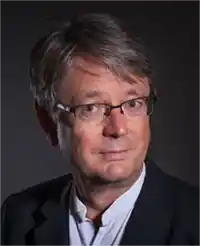
An Interview with Patrick Curry by Garry Phillipson
An interview with
Patrick Curry
This interview was recorded by Garry Phillipson in October 2025 and was first published on Skyscript in November 2025.

Patrick Curry is a writer and scholar living in London. He holds a PhD in the History and Philosophy of Science and has been a Lecturer at the universities of Kent (Religious Studies: Cultural Study of Cosmology and Divination) and Bath Spa (Sophia Centre: Cultural Astronomy and Astrology). An early sign of his ongoing engagement with astrology’s philosophical issues is his 1983 paper, ‘An Aporia for Astrology’, available on www.cosmocritic.com – a site for which he is a contributor, editor and reviewer. He is the author of, among other books, Prophecy and Power: Astrology in Early Modern England (1989, second edition 2004); A Confusion of Prophets: Victorian and Edwardian Astrology (1992); and Astrology, Science and Culture (2004, with Roy Willis). His most recent book is Art and Enchantment: How Wonder Works (2023). More information can be found on www.patrickcurry.co.uk
Q Patrick, you are an astrologer, a philosopher of astrology, a historian of astrology, a Tolkien scholar, an ecologist and a writer on enchantment. Is that a reasonable summary, or have I left something out? And is there a common thread to all of these interests?
A Almost; I would add ‘student of divination’. As for a common thread, it’s pretty obvious that all those activities, practices or discourses fall outside what modernists take seriously are therefore marginalised, mocked and/or ignored. So that is what I’ve taken up.
Q Are you happy for your birth chart to appear in this interview, and if so what are the details and your source for them please?
A 4:55 pm – 24 March 1951 – Winnipeg, Canada. (Birth certificate.)

Q What do you think are the key factors in your chart for anyone who wants to understand what you’re like?
A The Sun, Moon and Ascendent, of course. Having Sun in Aries (it’s all about me) and Moon in Libra (it’s all about others) is confusing for everyone, including me. Having Virgo rising (including Saturn Rx in the 1st house) is really no fun for an Aries. On the other hand, it has saved my life a few times.
Plus two complexes, so to speak: (1) the Sun opposed by Saturn (hard on self-confidence and aware of limitations: both unwelcome to the Sun) and squared by Uranus (making and/or experiencing unpredictable changes, restlessness). And (2) the Moon in Libra conjunct Neptune (boundary issues anyone?), opposed by Mars conjunct Mercury (probably my ruling planet, btw) in Aries, which leaves me constantly trying to integrate, or at least balance, the emotional/psychic with the dynamic and intellectual. (So trying to closely define something as ineffable as enchantment [see below] is a perfect project for me.)
Q I believe you use a relocated chart (relocated to London) – what are the key differences between this and your original natal chart, and do these fit with your experience of your experiences in the UK and Canada respectively?
A The relocation is a supplement to the nativity, not a replacement, but I find it works well. Which is not surprising, since I left the land of my birth at 15 and have now lived in London for over 50 years!
Interestingly (perhaps), the natal Ascendent (mid-Virgo) is almost exactly the relocated MC, so transits to either set of angles apply. And the ruler of the 4th house (home) in both my nativity and relocated map is the same: Jupiter. (It could be Neptune in one of them, but I don’t accept/use house rulerships with the trans-Saturnian planets.) But perhaps still more to the point, the Sun in my relocation falls in the 4th house; i.e., I feel deeply at home here.
In any case, for whatever reasons I have torn up my roots in North America and replanted them in the British Isles; and they’ve taken. So maybe that’s another argument for using the relocation map.
Why do I feel so at home here? Hard to say. Some match between my character/temperament and that of the place. (Places have personalities too, of course.) Also, for those from the former colonies – as well as for literary Anglophones generally – England (and in some cases, such as mine, Ireland) is still, to a significant extent, the cultural mothership.
Q How did you first encounter astrology? How and when did you learn to interpret charts?
A Here is my trajectory, without later understandings ever altogether replacing earlier ones.
I grew up with astrology, learning from my older sister what started with sun signs but grew into essentially Theosophical, ‘spiritual’ astrology. (In the Canadian midwest in the mid-1960s! That’s quite a cultural reach.) A birthchart was a map of the incarnated soul, etc.
The second phase happened when I discovered ‘psychological’ – meaning Jungian – astrology with the work of Dane Rudhyar and Liz Greene, especially her book Saturn (1976). (It was my privilege to take lessons from Liz in the mid-1970s.)
The third phase developed out of my encounter with the work of Geoffrey Cornelius – especially, eventually, The Moment of Astrology (1994) – and others at the Company of Astrologers. Astrology as essentially divinatory made ever-increasing sense to me, and still does.
One thing I never became was a ‘traditional’ astrologer. I respected it but was wary of losing sight of the wood for all the technical trees.
Another thing I never became was a ‘scientific’ astrologer. I was sufficiently involved with the Gauquelins (whom I knew) and their research to realise that even if it could ‘explain’ certain astrological principles – which remains less than entirely clear, even after all these years – it would never stretch to actual astrological practice. So, in an ironic way, I agree with Geoff Dean that astrology isn’t ‘scientific’ – only that it is none the worse for that. Better, in fact, for being free of the curse of scientism. But even if there is any scientific evidence for astrology, so to speak, Dean would try to destroy it. (If anyone is going to find it, it will be Graham Douglas: a real scientist.)
Q Was there a time when you thought you would become a professional astrological consultant, and if so what happened to that aspiration?
A There was, but beginning in very late 1975 I had an epiphany in which I realised I had to go back to school – i.e., resume my BA, which I had dropped out of four years earlier. And I think one of the factors was a feeling of growing steadily more, and uncomfortably so, out of the general cultural loop. So I wanted to reconnect with at least some of that. Which I did, at UCSC and with the last lessons of Gregory Bateson, a rogue anthropologist whose impact on me was life-changing, before going on to do an M.Sc, and then a PhD in London. But this new direction included cutting back on practising astrology.
However, as per my Saturn continually trying to repair bridges that my Uranus has blown up, I gave astrology a new lease in my life by studying it academically, especially historically. So in 1984 I organized a (pioneering, if I may say so) conference on the history of astrology at the Warburg Institute. The papers were published in 1987 as Astrology, Science and Society (Boydell).
Then I finished a PhD in the department of the history and philosophy of science at University College London in 1987. My thesis was on the decline of astrology in 17th and 18th century England, which became Prophecy and Power: Astrology in Early Modern England (Polity, 1989 and a 2nd edn in 2024). (A major influence was the great socialist historian E.P. Thompson.)
Other books followed: A Confusion of Prophets: Victorian and Edwardian Astrology (Collins & Brown, 1992) and, with the anthropologist Roy Willis, Astrology, Science and Culture (Berg, 2004). (Over the years I kept on writing books on other subjects, too: Ecological Ethics, Tolkien, and Enchantment. More information is on my website.)
Nick Campion and I were joint Lecturers in the new MA programme in Cultural Astrology and Astronomy at the Sophia Centre, Bath Spa University in 2002. In 2006, I moved as Lecturer to the MA programme in the Cultural Study of Cosmology and Divination at the University of Kent (until 2009).
Following on from then, I’m proud to have helped supervise two successful and important PhD theses: Garry Phillipson’s Astrology and Truth: A Context in Contemporary Epistemology (University of Wales Trinity St David, 2020) and James Brockbank’s The Responsive Cosmos: An Enquiry into the Theoretical Foundations of Astrology (University of Kent, 2011).
Let me mention one more thing. At a conference on the history of astrology in Amsterdam in 2004, I gave a paper entitled ‘The Historiography of Astrology: A Diagnosis and a Prescription.’ This appeared as an ‘Epilogue’ (they didn’t know where else to put it, lol) in Horoscopes and Public Spheres: Essays on the History of Astrology, ed. Gunther Oestman, H. Darrel Rutkin and Kocku von Stuckrad (Walter de Gruyter) in 2005. My apparently outrageous prescription was that in order to be a good historian of astrology, who can do justice to your human subjects, you have to have experienced the truth of astrology in action; their own moment of astrology, we could say. (Not, NB, that you have to be an astrologer!)
Relatedly, in my entry on William Lilly for the Oxford Dictionary of National Biography, I concluded that it was extremely difficult for us now to understand and appreciate him, because he “was a genius at something – judicial astrology – which modern mainstream opinion has since decided is impossible to do at all, let alone do well or badly”.
What (if anything) was gained by astrology’s brief moment of glory in the academy? (‘Cultural astronomy’, whose study continues, is something quite different.) When its study hasn’t required a reduction to – or ‘material’ for – history, sociology, etc., but sought rather to illuminate the subject, I think it has made available a new richness and depth of self-understanding to astrologers and other-understanding to scholars. But this movement, as such, has now largely passed, although there are still some fine individual scholars such as Dorian Greenbaum.
Q In recent years, much of your work has concerned enchantment. For the benefit of anyone who is unfamiliar with your books on the subject, could you give an idea of what the term means? And, in particular, how does it relate to astrology?
A At the heart of enchantment is a particular moment (‘short but deep’, as one person put it) and precise place (not just space) of sheer existential wonder. And what is the moment of astrology – when the cosmos, through a horoscope, speaks to an intimately personal matter at hand – but one of wonder? So I segued from the experience and idea of the moment of astrology to asking questions like, What is that moment? What is happening when it takes place? What conditions favour it? And so on. I’m still trying to answer them.
As for my Tolkien work, The Lord of the Rings without enchantment is unimaginable.
Q What changes, if any, would you like to see in the way people engage with astrology?
A I’m glad you asked me that :-)
Of course, these three desiderata are not going to happen. Astrologers, and ordinary people who come into contact with them, will continue to crave ‘occult’ insider knowledge about the future; will continue to lust after the certainty that science seems to offer, and the prestige and respect it brings; will continue to talk of stellar ‘influences’ ‘making’ things happen or people do things. Hi ho, eh?
Meanwhile, this ancient, rich and subtle language, rooted in the Earth2 and crowned with the stars, will continue to quietly offer wisdom to those who have ears to hear.
|
Garry Phillipson is a tutor and supervisor for MA and PhD students of Cultural Astronomy and Astrology with the Sophia Centre. His interests include the philosophy, practice and history of astrology; and religious thought and practice, particularly Theravadan Buddhism, Advaita Vedanta and neo-Advaita. Garry read philosophy at the University of East Anglia and completed his PhD in 2020. His doctoral thesis, ‘Astrology and Truth’, discusses the truth-status of horoscopic astrology in the context of western epistemology. He is the author of Astrology in the Year Zero (London: Flare, 2000, now available in second edition) and has written and spoken about astrology, and strategies for its comprehension, in many settings. Along with Kirk Little he curates the website Cosmocritic.com – a repository of freely downloadable resources with a focus on the philosophy of astrology. |
| 1 |
Wittgenstein: “We must do away with all explanation, and description alone must take its place”. |
| 2 |
See Spike Bucklow, The Year (London: Reaktion Books, 2025). Also the paper ‘Grounding the Stars’, available at www.patrickcurry.co.uk. |