
Search the Site with

|
Search the Site with
|
 General Characteristics Crew List Memorabilia Cruise Books Accidents aboard the Ship USS Texas' Commanding Officers History of USS Texas USS Texas Disposal Image Gallery to end of page
 |  |
USS TEXAS was the second ship in the VIRGINIA-class of nuclear powered guided missile cruisers and the third ship in the Navy named after the state of Texas. Last homeported in Bremerton, Wash., she was laid up there after decommissioning and later went through the nuclear recycling program at the Puget Sound Naval Shipyard.
| General Characteristics: | Awarded: December 21, 1971 |
| Keel laid: August 18, 1973 | |
| Launched: August 9, 1975 | |
| Commissioned: September 10, 1977 | |
| Decommissioned: July 16, 1993 | |
| Builder: Newport News Shipbuilding Co., Newport News, Va. | |
| Propulsion system: two D2G General Electric nuclear reactors | |
| Propellers: two | |
| Length: 585 feet (178 meters) | |
| Beam: 63 feet (19.2 meters) | |
| Draft: 31,5 feet (9.6 meters) | |
| Displacement: approx. 11,300 tons full load | |
| Speed: 30+ knots | |
| Aircraft: none and no helicopter landing capability | |
| Armament: two Mk-26 missile launcher for Standard missiles (MR) and ASROC, two Mk-141 | |
| Crew: 39 Officers, 539 Enlisted |
 back to top go to the end of the pageback to top go to the end of the page
Crew List:
This section contains the names of sailors who served aboard USS TEXAS. It is no official listing but contains the names of sailors who submitted their information.
back to top go to the end of the pageback to top go to the end of the pageUSS TEXAS Cruise Books:
back to top go to the end of the pageAccidents aboard USS TEXAS:
| Date | Where | Events |
|---|---|---|
| July 19, 1983 | Brisbane, Australia | USS TEXAS is holed above the waterline after hitting a quay while leaving the port of Brisbane, Australia. |
back to top go to the end of the pageUSS TEXAS' Commanding Officers:
| Period | Name |
|---|---|
| August 12, 1975 - January 27, 1979 | Captain Peter B. Fiedler, USN |
| January 27, 1979 - March 19, 1982 | Captain Ramon R. Owens, USN |
| March 19, 1982 - July 5, 1985 | Captain William D. Andress, USN |
| July 5, 1985 - August 6, 1988 | Captain George M. Miller, USN |
| August 6, 1988 - June 25, 1991 | Captain William K. Gautier, USN |
| June 25, 1991 - July 16, 1993 | Captain Neil M. Brennan, USN |
back to top go to the end of the pageHistory of USS TEXAS:

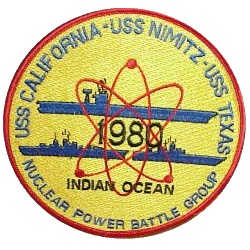 Originally designated DLGN 39, a nuclear-powered guided-missile frigate, USS TEXAS was built by Newport News Shipbuilding and Dry Dock Company in Newport News, Virginia. Her keel was laid on August 18, 1973. On June 30, 1975, she was reclassified as a guided-missile cruiser and redesignated CGN 39 as part of the Navy's general reclassification of surface combatants. TEXAS was launched on August 9, 1975, sponsored by Mrs. Dolph Briscoe, wife of the Governor of Texas.
Following construction, fitting out, and sea trials, TEXAS was commissioned at Norfolk, Virginia, on September 10, 1977, with Capt. Peter B. Fiedler Jr. as her first commanding officer. Norfolk became her initial homeport. TEXAS was equipped with two General Electric D2G nuclear reactors driving two shafts, providing a sustained speed in excess of 30 knots. Her original armament included two twin-arm Mk 26 guided-missile launchers for Standard surface-to-air missiles and ASROC anti-submarine weapons, two 5-inch/54-caliber Mk 45 guns, and Mk 46 torpedoes. The ship was also originally fitted with a helicopter landing platform and a below-deck hangar served by an elevator. Additional weapons, including Harpoon anti-ship missiles, Phalanx close-in weapon systems, and Tomahawk cruise missiles, were installed during later modernizations.
Following commissioning, TEXAS began a nine-week combat-system evaluation program. The trials included testing the ship's radar, missile fire-control systems, sonar, communications equipment, and other components of her weapons and command systems. In October 1977, TEXAS visited Naval Weapons Station Yorktown, Virginia, to load ammunition and guided missiles. She subsequently proceeded to Guantanamo Bay, Cuba, for refresher training during November. These exercises included navigation, engineering, damage control, air defense, surface warfare, and anti-submarine warfare training.
During the first three months of 1978, TEXAS conducted further evaluations of her propulsion and weapons systems in the Virginia Capes and Caribbean operating areas. The tests included operations at different speeds, assessments of engineering equipment, missile-system checks, and additional training for the ship's crew. On March 28, 1978, TEXAS entered Newport News Shipbuilding for a Post-Shakedown Availability. During the availability, deficiencies identified during initial trials were corrected, and additional maintenance and equipment modifications were completed. The availability ended on July 31, 1978, allowing TEXAS to resume operational training with the Atlantic Fleet.
During the remainder of 1978, the cruiser conducted independent exercises along the U.S. East Coast and near Roosevelt Roads, Puerto Rico. These activities included missile and gunfire training, anti-submarine warfare exercises, navigation evaluations, and engineering drills. Periods at sea alternated with maintenance and preparations at Norfolk. On January 27, 1979, Capt. Ramon R. Owens relieved Capt. Peter B. Fiedler Jr. as commanding officer.
During the first half of 1979, TEXAS completed additional training and preparations for her first overseas deployment. The cruiser was assigned to the battle group centered on the nuclear-powered aircraft carrier USS NIMITZ (CVN 68). The nuclear-powered guided-missile cruiser USS CALIFORNIA (CGN 36) was also assigned to the formation.
On September 10, 1979, the USS NIMITZ Battle Group departed Norfolk for deployment to the Mediterranean Sea. TEXAS accompanied the carrier, providing air-defense, maritime surveillance, and escort capabilities. During the initial phase of the deployment, TEXAS operated in the U.S. Sixth Fleet area of responsibility. The battle group conducted exercises in the Mediterranean, including air-defense training, anti-submarine warfare operations, communications exercises, and tactical maneuvering with other American and allied naval forces. TEXAS also served as flagship for Commander, Cruiser-Destroyer Group One during the deployment. Her command-and-control facilities supported the coordination of surface combatants and their assigned warfare missions.
The Mediterranean phase included visits by the battle group to ports in Spain, Italy, Egypt, Tunisia, and Greece. The deployment also involved routine replenishments at sea and surveillance of Soviet naval activity in the Mediterranean. On November 4, 1979, Iranian militants occupied the American embassy in Tehran and took American diplomatic personnel hostage. The incident led to a prolonged confrontation between Iran and the United States. American naval forces were subsequently directed to strengthen their presence in the Indian Ocean and Arabian Sea. The USS NIMITZ Battle Group was among the forces reassigned to the region.
On January 4, 1980, USS NIMITZ, TEXAS, and USS CALIFORNIA departed their Mediterranean operating area and proceeded toward the South Atlantic.
The three nuclear-powered ships sailed around the Cape of Good Hope without requiring underway fuel replenishment for their propulsion plants. The transit covered approximately 11,500 miles at an average speed of about 25 knots. On January 14, 1980, the battle group passed to the operational control of Commander in Chief, U.S. Pacific Command. On January 23, the three ships arrived in the Arabian Sea, joining other American naval forces already operating in the Indian Ocean.
The region became the principal operating area for the remainder of the deployment. TEXAS conducted carrier escort, air-defense, maritime surveillance, and anti-submarine warfare operations while the American naval presence was maintained during the Iranian hostage crisis. The cruiser also participated in regular tactical training, aircraft surveillance, and coordination with other ships operating in the northern Arabian Sea. During this period, TEXAS and the other ships of the battle group were operating at what became known as Gonzo Station, an operating area in the northern Arabian Sea used by American carrier forces during the crisis.
In April 1980, the U.S. government authorized Operation Eagle Claw, an attempt to rescue the American hostages held in Tehran. The operation involved helicopters operating from USS NIMITZ, together with Air Force transport aircraft and special operations personnel. On April 24, 1980, helicopters from the carrier flew toward a remote desert landing site in Iran, designated Desert One. Mechanical failures and severe weather reduced the number of available helicopters below the minimum required for the mission, leading to the decision to abort the operation.
During preparations to withdraw from Desert One, an RH-53D helicopter collided with an EC-130 transport aircraft. The resulting fire killed eight American servicemen.
TEXAS remained with the USS NIMITZ Battle Group during the operation, maintaining her carrier escort and defensive assignments in the Arabian Sea. Following the unsuccessful rescue attempt, the battle group continued its operations in the region before beginning the return voyage to the United States. On May 26, 1980, USS NIMITZ returned to Norfolk after more than eight months overseas. TEXAS completed her first major deployment with the carrier battle group during this period.
Following the deployment, TEXAS underwent maintenance and received additional weapons modifications. During 1980 and 1981, the cruiser was fitted with two four-cell Harpoon anti-ship missile launchers and two Phalanx close-in weapon systems, expanding her capabilities against surface ships and incoming missiles.
During August and September 1980, TEXAS returned to the North Atlantic with the USS NIMITZ Battle Group for NATO Exercise Teamwork 80. The exercise involved naval and air forces from NATO countries operating in the North Atlantic and northern European waters. Its principal purpose was to evaluate allied maritime operations and the reinforcement of northern Europe during a simulated conflict. TEXAS conducted air-defense and anti-submarine warfare training, surveillance exercises, and coordinated operations with the carrier and other surface combatants, including USS CARON (DD 970). The exercise also included operations in the Norwegian Sea and northern Atlantic approaches. The battle group's European port visits included Portsmouth, England, and Wilhelmshaven, West Germany. Following the exercise, TEXAS returned to the United States in October 1980 and resumed maintenance and training.
During the first half of 1981, the cruiser completed preparations for another Mediterranean deployment with USS NIMITZ. On August 3, 1981, the battle group departed Norfolk for a deployment to the Mediterranean Sea. TEXAS provided air-defense and surface surveillance capabilities for the carrier, while also conducting training with American and NATO naval forces. Other surface combatants operating with the carrier during the deployment included USS MISSISSIPPI (CGN 40) and USS BIDDLE (CG 34). The deployment took place during a period of confrontation between the United States and Libya over Libyan claims to a large area of the Gulf of Sidra. Libya maintained that waters south of a line extending across the gulf were part of its territorial waters. The United States rejected that claim and conducted naval operations in the area.
During August 1981, the USS NIMITZ Battle Group operated in the Gulf of Sidra as part of freedom-of-navigation exercises. TEXAS maintained air-defense and surveillance duties while the carrier conducted flight operations. On August 19, 1981, two F-14A Tomcats of Fighter Squadron 41, operating from USS NIMITZ, encountered two Libyan Su-22 fighter-bombers over the Gulf of Sidra. One of the Libyan aircraft fired an air-to-air missile at the American fighters. The F-14s maneuvered and returned fire with AIM-9 Sidewinder missiles, shooting down both Libyan aircraft.
TEXAS continued operating with the carrier battle group during the incident and the subsequent period of increased military readiness. The cruiser maintained her air-defense and maritime surveillance assignments during the remaining operations in the area. Following the Gulf of Sidra confrontation, TEXAS continued her Mediterranean deployment, participating in fleet exercises, communications training, anti-submarine warfare operations, and carrier escort duties.
The carrier battle group's itinerary included visits to Naples, Livorno, and other ports in Italy, as well as Tunis, Tunisia; Haifa, Israel; and Palma de Mallorca, Spain. TEXAS also conducted routine maintenance and replenishments during the cruise, maintaining her nuclear propulsion and combat systems during extended periods underway. The battle group completed its Mediterranean deployment on February 12, 1982, returning to Norfolk after more than six months overseas. On March 19, 1982, Capt. William D. Andress Jr. relieved Capt. Ramon R. Owens as commanding officer.
During the remainder of 1982, TEXAS conducted maintenance, training, and preparations for another major overseas deployment. The Navy had decided to transfer the cruiser from the Atlantic Fleet to the Pacific Fleet, with a new homeport at San Diego, California. The transfer was to take place during an around-the-world deployment with the aircraft carrier USS CARL VINSON (CVN 70).
On March 1, 1983, TEXAS departed Norfolk with the USS CARL VINSON Battle Group for a voyage that would take the ships across the Atlantic, Indian, and Pacific Oceans. Other ships assigned to the battle group included USS WORDEN (CG 18), USS HEWITT (DD 966), USS COOK (FF 1083), USS BARBEY (FF 1088), and USS SIDES (FFG 14). The deployment included operations with American naval forces assigned to the Second, Sixth, Seventh, and Third Fleets, as well as exercises with allied and partner nations.
During the early stages of the voyage, TEXAS crossed the Atlantic and entered the Mediterranean. The deployment included port visits in Monaco and Morocco, together with exercises involving Moroccan military forces. The cruiser then proceeded through the Mediterranean and toward the Indian Ocean, where the battle group conducted further operations. The voyage included a visit to Abidjan, Ivory Coast, and operations near Diego Garcia in the Indian Ocean. TEXAS conducted carrier escort, air-defense, and maritime surveillance duties while the group continued eastward.
The battle group subsequently operated in waters near Australia, where American naval forces participated in exercises and conducted port visits. During July 1983, TEXAS visited Brisbane, Australia. The visit formed part of a series of engagements between American naval forces and Australian civilian and military authorities.
On July 19, 1983, TEXAS struck the quay while departing Brisbane. The impact punctured the cruiser's hull above the waterline. The damage was assessed and repaired locally, allowing the ship to continue the deployment without an extended interruption. After leaving Australia, TEXAS proceeded to New Zealand. On August 2, 1983, she arrived at Auckland, where her visit prompted demonstrations against nuclear-powered and potentially nuclear-armed American warships. The United States maintained a policy of neither confirming nor denying whether its warships carried nuclear weapons. This policy had become a subject of increasing controversy in New Zealand.
During the Auckland visit, anti-nuclear organizations organized protests ashore and on the water. Demonstrators opposed the presence of the cruiser because of its nuclear propulsion system and the possibility that it could carry nuclear weapons. TEXAS subsequently proceeded to Wellington, arriving there by August 10, 1983. On August 11, more than 10,000 people participated in a protest against the ship's visit. The demonstration included trade union members, peace organizations, students, and other groups opposed to visits by nuclear-powered or potentially nuclear-armed warships. The protests occurred during a period of increasing political disagreement in New Zealand over nuclear weapons and the future of the country's military cooperation with the United States.
Following her New Zealand visits, TEXAS continued the world cruise through the Western Pacific. The deployment included port visits in the Philippines, Hong Kong, Japan, and South Korea, together with additional maritime training and operations with the USS CARL VINSON Battle Group. TEXAS continued conducting air-defense, anti-submarine warfare, and surface surveillance duties during the Pacific phase of the deployment. The cruiser also participated in operational exercises with American and allied naval units. The voyage covered more than 60,000 miles and included operations in several major ocean regions. On October 29, 1983, TEXAS arrived at Naval Station San Diego, California, completing her world cruise and permanent change of homeport from Norfolk.
During the first months of 1984, TEXAS resumed Pacific Fleet training and operational preparations. The cruiser completed maintenance and participated in exercises in the eastern Pacific. During June and July 1984, TEXAS participated in Exercise Rim of the Pacific 1984 (RIMPAC 84), a multinational naval exercise conducted in Hawaiian waters. The exercise involved surface ships, submarines, aircraft, and military personnel from the United States and other Pacific nations. Training activities included coordinated fleet maneuvering, anti-submarine warfare, air defense, surface warfare, and maritime communications.
Following RIMPAC, TEXAS participated in Readiness Exercise 84-4 (READEX 84-4) and Fleet Exercise 85-1 (FLEETEX 85-1). These exercises formed part of the preparations for the upcoming deployment of the USS CARL VINSON Battle Group.
On October 13, 1984, the USS CARL VINSON Battle Group departed for a deployment to the Western Pacific and Indian Ocean. TEXAS accompanied the carrier on the deployment, providing air-defense, anti-submarine warfare, surface surveillance, and escort capabilities. Other ships assigned to the battle group included USS LEAHY (CG 16), USS GRIDLEY (CG 21), USS HEWITT, USS INGERSOLL (DD 990), USS BUCHANAN (DDG 14), USS DOWNES (FF 1070), USS ROANOKE (AOR 7), and USS KISKA (AE 35).
During the transit across the Pacific, the battle group operated in Hawaiian waters and continued toward the Philippines and Japan. The deployment included logistics and port visits to Pearl Harbor, Subic Bay, Yokosuka, Hong Kong, and Fremantle, Australia, although the individual ships did not necessarily visit every port together. TEXAS continued supporting the aircraft carrier during the Western Pacific phase of the deployment, maintaining surveillance of surface and air contacts and participating in tactical exercises.
The carrier battle group subsequently proceeded into the Indian Ocean, where American naval forces continued maintaining a presence near the Persian Gulf and the approaches to the Arabian Sea. The deployment took place during the Iran-Iraq War, when attacks against shipping in the Persian Gulf had become an increasing concern to international maritime trade. American naval forces monitored the situation while conducting fleet operations and training in the surrounding waters.
During early 1985, the USS CARL VINSON Battle Group conducted an extended period of operations in the Indian Ocean, including 107 consecutive days at sea. TEXAS performed air-defense and carrier escort duties while conducting maritime surveillance, communications exercises, and replenishments at sea. Following the completion of the Indian Ocean operations, TEXAS began the return voyage across the Western Pacific. On May 22, 1985, TEXAS completed her deployment and returned to the United States. USS CARL VINSON completed the carrier's deployment two days later, on May 24.
After the deployment, TEXAS resumed Pacific Fleet operations and preparations for a major shipyard availability. During the summer of 1985, the cruiser operated with the nuclear-powered aircraft carrier USS ENTERPRISE (CVN 65) off Southern California. These operations included carrier escort, air-defense training, and coordination between surface combatants and carrier-based aircraft.
In September 1985, TEXAS proceeded to Puget Sound Naval Shipyard in Bremerton, Washington, for a major Complex Overhaul. The overhaul began in late September 1985 and included extensive maintenance and modernization of the ship's nuclear propulsion plant, hull, engineering systems, electrical equipment, and combat systems. The project had an estimated cost of approximately $190 million, including about $38 million for equipment modifications and alterations. A principal feature of the modernization was the installation of Tomahawk cruise missiles in two four-cell armored box launchers mounted on the aft portion of the ship. The installation required removal of the original helicopter hangar and elevator arrangement. The aviation facilities had been designed to allow a helicopter to be stored below the flight deck, with an elevator providing access to the landing platform.
The modernization converted this area for use by the Tomahawk weapon system and supporting equipment. Following the conversion, TEXAS no longer possessed her original helicopter operating facilities. Additional work included improvements to the ship's air-defense systems, weapons-control equipment, radar and electronic systems, and the continued maintenance of the Harpoon anti-ship missile and Phalanx close-in weapon systems. The overhaul also involved extensive inspections and repairs to the two nuclear propulsion plants and their supporting machinery. During 1986, TEXAS remained at Puget Sound Naval Shipyard undergoing the overhaul and reactor-related maintenance. The work continued into 1987, when the cruiser completed the principal modernization tasks and began restoring her operational readiness.
Following the overhaul, TEXAS conducted sea trials and equipment evaluations to test the propulsion plant, steering systems, navigation equipment, combat systems, and newly installed weapons. The trials included engineering drills, damage-control exercises, and training associated with the modified combat systems and Tomahawk missile capability.
During 1987, TEXAS resumed Pacific Fleet operations. The cruiser was photographed underway in the Gulf of Alaska during fleet training and later continued her operational preparations in the eastern Pacific. Following her return to active operations, TEXAS operated from Alameda, California, as part of the Pacific Fleet.
During the first half of 1988, the cruiser conducted maintenance, crew training, and exercises in preparation for another overseas deployment with the USS CARL VINSON Battle Group.
On June 15, 1988, TEXAS began a six-month deployment to the Western Pacific and Indian Ocean. She served as Anti-Air Warfare Commander for the USS CARL VINSON Battle Group. The deployment took place during the final months of the Iran-Iraq War and the continuing American naval presence in the Persian Gulf region. TEXAS's responsibilities included maintaining the air-defense picture for the battle group, coordinating radar surveillance, monitoring potentially hostile aircraft, and supporting the defensive operations of ships assigned to the formation.
The cruiser also conducted anti-submarine warfare exercises, surface surveillance, tactical communications training, and regular replenishments at sea. USS ROANOKE was among the replenishment ships assigned to support the battle group during the deployment. The battle group operated in the Western Pacific before proceeding toward the Indian Ocean and Arabian Sea. Its itinerary included port visits in the Philippines, Singapore, Kenya, Thailand, Hong Kong, and Hawaii.
During the deployment, TEXAS operated in the vicinity of important maritime routes connecting the Indian Ocean with the Persian Gulf. American naval forces in the region continued Operation Earnest Will, which involved the protection and escort of reflagged Kuwaiti oil tankers during the final phase of the Iran-Iraq War. TEXAS maintained her air-defense and surveillance assignments with the carrier battle group during operations associated with the American naval presence in the region. During the deployment, the cruiser was also photographed operating near the Soviet intelligence-collection ship KARELIYA (SSV 535). Soviet surveillance vessels regularly monitored American carrier battle groups during the Cold War, recording movements and electronic activity.
Following completion of the Indian Ocean phase, TEXAS returned through the Western Pacific. The deployment included further training and logistics operations before the battle group proceeded to the U.S. West Coast. In December 1988, TEXAS returned to the San Francisco Bay area, completing the six-month deployment. The USS CARL VINSON Battle Group's deployment officially concluded on December 14.
During 1989, TEXAS conducted local operations and operational training in the eastern Pacific. The cruiser also underwent a maintenance availability at Hunters Point Naval Shipyard in San Francisco. Following the maintenance period, TEXAS resumed training and fleet assignments, including exercises involving her air-defense, surface warfare, and anti-submarine warfare systems. By late 1989, the cruiser was supporting counter-narcotics operations in the eastern Pacific and off the coast of South America. These operations were part of the Navy's increasing cooperation with the U.S. Coast Guard and other federal agencies in efforts to detect and intercept vessels suspected of transporting illegal drugs. TEXAS used her radar and surveillance equipment to monitor shipping and help coordinate the movements of law-enforcement units operating in the region.
During the first half of 1990, TEXAS continued operational training in the Pacific. In May 1990, the cruiser participated in Exercise Rim of the Pacific 1990 (RIMPAC 90), conducting multinational maritime warfare training in Hawaiian waters. On May 1, TEXAS was photographed maneuvering with the Aegis guided-missile cruiser USS PRINCETON (CG 59) during the exercise. The training included coordinated air defense, surface warfare, anti-submarine warfare, tactical maneuvering, and communications exercises with American and allied naval forces. During the summer of 1990, TEXAS continued supporting counter-narcotics operations and maintaining readiness for other Pacific Fleet assignments.
On August 2, 1990, Iraq invaded Kuwait, leading to the deployment of American and coalition military forces to Saudi Arabia and surrounding regions under Operation Desert Shield. American naval forces were subsequently reinforced in the Persian Gulf, Red Sea, Arabian Sea, and eastern Mediterranean as part of preparations for possible military action against Iraq. During the final months of 1990, TEXAS completed training and preparations for deployment with the USS NIMITZ Battle Group. The cruiser was assigned air-defense command responsibilities within the formation, which would deploy to the Western Pacific and Persian Gulf during the following year.
On February 24, 1991, TEXAS proceeded to San Diego to rendezvous with USS NIMITZ and other units preparing for deployment. On February 25, 1991, the battle group began its deployment to the Western Pacific and Indian Ocean. The deployment commenced during the closing days of Operation Desert Storm. Coalition ground forces had begun their offensive against Iraq on February 24, and major combat operations ended on February 28. Following the cessation of major combat operations, the USS NIMITZ Battle Group continued toward the Middle East to support the postwar American naval presence. TEXAS performed air-defense command duties during the deployment, coordinating surveillance and defensive operations for the carrier battle group. The cruiser also participated in surface warfare and anti-submarine warfare exercises while the formation proceeded through the Western Pacific and Indian Ocean.
Following the arrival of the battle group in the Persian Gulf, TEXAS supported maritime security and surveillance operations during the immediate aftermath of the war. The Persian Gulf remained a hazardous operating environment because Iraqi forces had laid extensive minefields in the northern Gulf before withdrawing from Kuwait. Several coalition warships had been damaged by mines during the conflict, and American and allied naval forces subsequently conducted extensive mine countermeasures operations to clear important waterways and approaches to Kuwait.
During the postwar mine-clearance effort, TEXAS served as a support platform for American mine countermeasures units operating in the northern Persian Gulf. Her duties included the provision of logistical support and coordination assistance while minesweepers and other specialized units conducted operations in the region. TEXAS continued maintaining her carrier battle group air-defense responsibilities during the deployment.
The USS NIMITZ Battle Group also conducted port visits and logistics stops in the Western Pacific and Indian Ocean. Its itinerary included Subic Bay, Philippines; Singapore; Jebel Ali, United Arab Emirates; Pattaya, Thailand; Hong Kong; and Pearl Harbor, Hawaii. Following completion of the deployment, TEXAS began her return voyage across the Pacific. In August 1991, TEXAS returned to the San Francisco Bay area after completing her deployment. USS NIMITZ returned to Bremerton, Washington, on August 24.
During the remainder of 1991, TEXAS conducted maintenance and local operational training while the Navy continued evaluating the future of its nuclear-powered surface combatants. The end of the Cold War and the dissolution of the Soviet Union led to changes in naval force structure and reductions in projected shipbuilding and maintenance expenditures.
In April 1992, TEXAS began another counter-narcotics deployment to the eastern Pacific. The mission included operations off Central and South America in cooperation with the U.S. Coast Guard and other agencies responsible for maritime drug interdiction. During the deployment, TEXAS visited ports in Ecuador and Panama while conducting surveillance patrols and assisting in the identification of vessels suspected of involvement in narcotics trafficking. Following completion of the assignment, TEXAS returned to the U.S. West Coast.
In July 1992, TEXAS changed her homeport from Alameda to Bremerton, Washington, in preparation for a Refueling Complex Overhaul at Puget Sound Naval Shipyard. The planned overhaul would have involved replacement of the ship's nuclear reactor cores, major engineering and structural repairs, and further modernization of her weapons and combat systems. During September 1992, TEXAS entered dry dock at Puget Sound Naval Shipyard as preparations for the overhaul continued. The program was intended to extend the cruiser's operational service life and allow her to remain in the fleet for additional years.
However, the Navy's post-Cold War force reductions led to a reassessment of the costs of retaining older nuclear-powered cruisers. The projected expense of refueling and modernizing the VIRGINIA-class ships, combined with the Navy's increasing reliance on newer Aegis-equipped cruisers and destroyers, resulted in a decision to discontinue the planned refueling programs.
During the spring of 1993, work on TEXAS's Refueling Complex Overhaul was brought to an end. The ship had not completed the intended refueling and modernization. On May 31, 1993, TEXAS was placed in commission, in reserve, while preparations for her retirement continued. The crew subsequently completed deactivation procedures, including the removal and transfer of ammunition, equipment, supplies, and classified material. On July 16, 1993, TEXAS was formally decommissioned at Bremerton, Washington, becoming the first of the four VIRGINIA-class nuclear-powered guided-missile cruisers to leave active service. Her decommissioning ended nearly sixteen years of commissioned service. On November 10, 1994, TEXAS was stricken from the Naval Vessel Register.
Following decommissioning, the former TEXAS remained at Puget Sound Naval Shipyard while the Navy prepared for her disposal under the Ship-Submarine Recycling Program. The recycling program involved the removal of nuclear fuel, the dismantling and disposal of the reactor compartments, and the separation and processing of the ship's remaining hull, machinery, and equipment. During the disposal process, the ship's superstructure and various internal components were removed. Sections of the hull were also dismantled as part of preparations for processing the nuclear propulsion compartments. The recycling of TEXAS was completed at Puget Sound Naval Shipyard on October 20, 2001.
back to top go to the end of the pageAbout USS TEXAS' Disposal:
Decommissioned nuclear powered ships of the US Navy are brought to the Puget Sound Naval Shipyard at Bremerton, Wash., where they are awaiting their final disposal. The TEXAS was no exception. When she arrived at PSNS the first action that took place was the removal of the ship's superstructures and since PSNS does not own a dock large enough for two VIRGINIA-class cruisers, a 100 foot long part of the stern of TEXAS was also removed.
The photos below show the TEXAS moored alongside the ex-USS VIRGINIA (CGN 38) and surrounded by numerous nuclear powered submarines. The hull on the portside of the TEXAS is from the ex-USS LONG BEACH (CGN 9) which was the first nuclear powered surface ship in the US Navy. Dismantling of TEXAS' hulk was completed in October 2001.
 |  |
back to top go to the end of the pageUSS TEXAS Image Gallery:
 |  |  |  |  |
 |  |  |  |  |
The photos below were taken by Randall Graham during TEXAS' WestPac Cruise in 1988.
 |  |  |  |  |
back to top
 Back to Cruisers list. Back to ships list. Back to selection page. Back to 1st page.


